×
Hero Background
English
Chinese
French
Japanese
Korean
German
Spanish

US Bio-based surfactants Market Size

ID: MRFR/CnM/16265-HCR
128 Pages
Chitranshi Jaiswal
October 2025

US Bio-Based Surfactants Market Research Report: By Foam (Anionic, Cationic, Non-Iconic, Amphoteric), By Product Type (Rhamnolipids, Methyl Glucoside Esters, Alkyl Polyglucosides (APG), Sucrose Esters, Anionic APG Derivatives, Methyl Ester Sulfonates (MES), Others) and By Industry (Household Detergents, Industrial & Institutional Cleaners, Cosmetic & Personal Care, Textile, Oilfield Chemicals, Agriculture Chemicals) - Forecast to 2035

Share:
Download PDF ×

We do not share your information with anyone. However, we may send you emails based on your report interest from time to time. You may contact us at any time to opt-out.

US Bio-based surfactants Market Infographic
Purchase Options

Us Bio Based Surfactants Size

US Bio-based surfactants Market Growth Projections and Opportunities

Various market influences have contributed significantly to the growth and development of the US Bio-based Surfactants Market. One major driver of this market is the increasing concern for environmental sustainability. On the other hand, consumers and industries understand that they need eco-friendly substitutes hence bio-based surfactants from renewable resources are becoming popular because they are less harmful to nature than traditional surfactants. This growing consciousness has increased the demand for bio-based surfactants in various sectors such as personal care products and industrial cleaning solutions.

The government rules also form part of shaping the US Bio-based Surfactants Market. Therefore, policy-making focus is shifting towards sustainability due to concerns over environmental issues leading to an urge of promoting and encouraging bio-based products. For instance, green procurement policies, together with renewable energy standards among others initiatives by governments have created a favorable environment for adoption of such surfactants. Through providing this regulatory support, not only does it help in growing markets but also assists in spurring innovations in new and better formulations for bio-based surfactants.

Consumer preferences have evolved with more people desiring products that meet their needs on sustainability and health basis. Considering their environmentally friendly nature since they come from natural sources, bio-based surfactants appeal greatly to eco conscious customers. Manufacturers’ changing mindsets are contributing to the integration of these substances into their formulas thereby driving up market size. The requirement for biodegradable materials that are eco-friendly will continue dictating changes within US Bio-based Surfactant Markets.

Market forces are shaped by technological advances plus R&D activities. In order to make these surfactant production process competitive, continuous efforts should be made to improve its efficiency while reducing costs. By exploring alternative feedstocks along with advanced manufacturing processes one can increase performance characteristics making them better alternatives compared to conventional types of surfactants. Consequently, becoming acquainted with such technological advancements is crucial if one intends retain his position within the market and meet the changing needs of many industries.

The success in US Bio-based Surfactants Market depends on supply chain considerations such as raw materials availability and logistical efficiencies. Strategic sourcing of renewable feedstocks for making bio-based surfactants is necessary to ensure a sustainable and secure supply chain. In addition, efficient logistics and distribution networks are crucial in meeting the growing demand for bio-based surfactants across diverse sectors.

In this way, market dynamics change through collaboration and partnerships. It is through these collaborations that knowledge becomes shared between research centers, producers and end users leading to innovations in new applications of bio-based surfactants. Additionally, by leveraging on each other’s’ strengths at different stages of production strategic alliances bring about expansion thus increase market size.
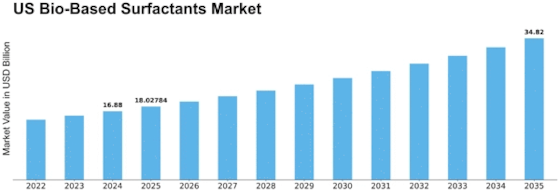
US Bio-based surfactants Market Size Graph
Author
Chitranshi Jaiswal
Research Analyst Level I

In her 3 years of experience in the market research field, she has handled critical cross-domain projects. She has an in-depth knowledge of market estimation & analysis, problem-solving, primary as well as secondary research, and team management.She holds an engineering degree and is an MBA professional from a well-known university, capable of evaluating the market and competitive conditions. An exceptional strategist with excellent communication skills and a passion for delivering cutting-edge & practical insights for the market. Proficient in multi-tasking, and can successfully deal with competing demands, while maintaining complete confidentiality. Generated business through active client and project development, networking, and high-quality responses. Her knowledge and skills have helped in making solid business decisions, securing funding from investors, and avoiding business failures.

Leave a Comment

FAQs

What is the current valuation of the US Bio-Based Surfactants Market?

The market valuation reached 16.88 USD Billion in 2024.

What is the projected market size for the US Bio-Based Surfactants Market by 2035?

The market is expected to grow to 34.82 USD Billion by 2035.

What is the expected CAGR for the US Bio-Based Surfactants Market during the forecast period?

The market is projected to experience a CAGR of 6.8% from 2025 to 2035.

Which product types are leading in the US Bio-Based Surfactants Market?

Leading product types include Alkyl Polyglucosides (APG) valued at 3.2 to 6.8 USD Billion and Rhamnolipids valued at 2.54 to 5.2 USD Billion.

What are the key segments of the US Bio-Based Surfactants Market?

Key segments include Foam Type, Product Type, and Industry, with varying valuations across each.

Market Summary

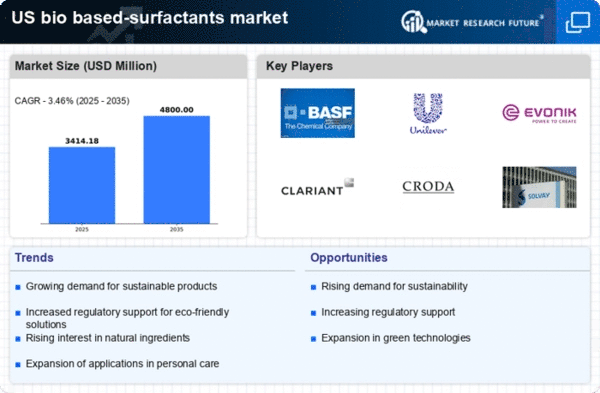
As per Market Research Future analysis, the US bio based-surfactants market size was estimated at 3300.0 $ Million in 2024. The US bio based-surfactants market is projected to grow from 3414.18 $ Million in 2025 to 4800.0 $ Million by 2035, exhibiting a compound annual growth rate (CAGR) of 3.4% during the forecast period 2025 - 2035

Key Market Trends & Highlights

The US bio based-surfactants market is experiencing a robust shift towards sustainability and innovation.

  • The market is increasingly driven by a focus on sustainability, with consumers prioritizing eco-friendly products.
  • Diverse applications across industries such as personal care and household cleaning are expanding the market's reach.
  • Innovation and collaboration among manufacturers are fostering the development of advanced bio based-surfactants.
  • Regulatory support for sustainable products and rising consumer demand for eco-friendly options are key drivers of market growth.

Market Size & Forecast

2024 Market Size 3300.0 (USD Million)
2035 Market Size 4800.0 (USD Million)
CAGR (2025 - 2035) 3.46%

Major Players

<p>BASF SE (DE), Unilever PLC (GB), Evonik Industries AG (DE), Clariant AG (CH), Croda International PLC (GB), Solvay SA (BE), Huntsman Corporation (US), Kraton Corporation (US), Stepan Company (US)</p>

Market Trends

The bio based-surfactants market is currently experiencing a notable shift towards sustainability and eco-friendliness. This transition is largely driven by increasing consumer awareness regarding environmental issues and the harmful effects of synthetic chemicals. As a result, manufacturers are increasingly focusing on developing products derived from renewable resources. This trend not only aligns with consumer preferences but also complies with regulatory frameworks that promote the use of biodegradable and non-toxic substances. The market appears to be evolving, with companies investing in research and development to innovate and enhance the performance of bio based-surfactants. Moreover, the bio based-surfactants market is witnessing a rise in applications across various sectors, including personal care, household cleaning, and industrial processes. The versatility of these surfactants makes them suitable for a wide range of formulations, which is likely to drive their adoption further. Additionally, collaborations between industry players and research institutions are fostering advancements in technology and product offerings. This collaborative approach may lead to the introduction of novel bio based-surfactants that meet the diverse needs of consumers and industries alike, thereby enhancing market growth.

Sustainability Focus

There is a growing emphasis on sustainability within the bio based-surfactants market. Companies are increasingly prioritizing the development of products that are environmentally friendly and derived from renewable resources. This trend reflects a broader societal shift towards eco-consciousness, influencing consumer purchasing decisions.

Diverse Applications

The versatility of bio based-surfactants is leading to their adoption across various industries. From personal care to household cleaning and industrial applications, these surfactants are being integrated into a wide range of products, enhancing their market presence.

Innovation and Collaboration

Innovation is a key driver in the bio based-surfactants market, with companies investing in research and development. Collaborations between industry players and research institutions are fostering advancements, potentially leading to the introduction of new products that cater to evolving consumer demands.

US Bio-based surfactants Market Market Drivers

Consumer Awareness and Education

The growing awareness and education regarding the benefits of bio-based products are crucial drivers for the US Bio-Based Surfactants Market. As consumers become more informed about the environmental and health advantages of bio-based surfactants, their purchasing decisions are increasingly influenced by these factors. Educational campaigns and marketing strategies that highlight the advantages of bio-based surfactants are likely to enhance consumer trust and drive demand. Market Research Future indicates that consumers are willing to pay a premium for products that are perceived as environmentally friendly, which could lead to a substantial increase in market share for bio-based surfactants in various sectors, including personal care and household cleaning.

Innovations in Production Technologies

Technological advancements in the production of bio-based surfactants are significantly influencing the US Bio-Based Surfactants Market. Innovations such as enzymatic processes and fermentation technology are enhancing the efficiency and cost-effectiveness of bio-surfactant production. For instance, recent developments have led to the creation of surfactants that are not only effective but also produced with lower energy inputs. This is crucial as the market is expected to reach a valuation of over USD 1 billion by 2026, driven by these innovations. Furthermore, the ability to produce bio-based surfactants at scale is likely to attract more manufacturers, thereby expanding the market and increasing competition.

Rising Demand for Eco-Friendly Products

The increasing consumer preference for eco-friendly products is a pivotal driver for the US Bio-Based Surfactants Market. As awareness of environmental issues grows, consumers are gravitating towards products that are biodegradable and derived from renewable resources. This shift is reflected in market data, indicating that the demand for bio-based surfactants is projected to grow at a compound annual growth rate (CAGR) of approximately 5% over the next five years. Companies are responding by reformulating their products to include bio-based ingredients, thereby enhancing their market appeal. This trend not only aligns with consumer values but also positions companies favorably in a competitive landscape where sustainability is becoming a key differentiator.

Regulatory Incentives for Bio-Based Products

Regulatory frameworks supporting the use of bio-based products are emerging as a significant driver for the US Bio-Based Surfactants Market. Government initiatives aimed at promoting sustainable practices are encouraging manufacturers to adopt bio-based alternatives. For example, the Environmental Protection Agency (EPA) has established guidelines that favor the use of bio-based materials in various applications. This regulatory support not only facilitates market entry for new players but also incentivizes existing companies to transition towards bio-based surfactants. As a result, the market is likely to witness an influx of innovative products that comply with these regulations, further propelling growth.

Shift Towards Sustainable Manufacturing Practices

The transition towards sustainable manufacturing practices is a notable driver for the US Bio-Based Surfactants Market. Manufacturers are increasingly adopting practices that minimize environmental impact, such as reducing waste and utilizing renewable resources. This shift is not only driven by consumer demand but also by corporate responsibility initiatives aimed at enhancing brand reputation. As companies strive to meet sustainability goals, the incorporation of bio-based surfactants into their product lines is becoming more prevalent. This trend is expected to contribute to a robust growth trajectory for the market, as businesses recognize the long-term benefits of sustainable practices in terms of cost savings and consumer loyalty.

Market Segment Insights

By Product Type: Rhamnolipids (Largest) vs. Methyl Glucoside Esters (Fastest-Growing)

<p>In the US bio based-surfactants market, Rhamnolipids hold a significant market share due to their versatile applications in various industries, notably in personal care and agriculture. This segment's popularity stems from its eco-friendliness and effectiveness, allowing for widespread adoption among manufacturers looking to enhance sustainability. Meanwhile, Methyl Glucoside Esters are rapidly gaining traction, appealing to a growing segment of consumers seeking natural and biodegradable surfactants, thus contributing to their increased market presence. The growth trends within these segments are driven by rising consumer awareness around environmental issues and a shift towards sustainable products. Rhamnolipids continue to dominate due to their established reputation and wide-ranging functionality, while Methyl Glucoside Esters are emerging swiftly, facilitated by innovation in formulation technology and an expanding application range, particularly in cosmetics and cleaning products. The overall drive towards sustainability is bolstering the performance of both these product types in the market.</p>

<p>Rhamnolipids (Dominant) vs. Methyl Glucoside Esters (Emerging)</p>

<p>Rhamnolipids are characterized by their high surface activity and versatility, making them a go-to choice in industries ranging from personal care to agriculture. Their ability to enhance product formulation while being environmentally friendly has solidified their dominant position in the market. In contrast, Methyl Glucoside Esters are emerging as an innovative and sustainable solution, favored for their mildness and biodegradability. These esters offer formulators the advantage of creating high-performance products with lower environmental impact, aligning well with current consumer trends towards natural ingredients. Both product types serve diverse applications, ensuring their relevancy in the evolving landscape of the US bio based-surfactants market.</p>

By Industry: Household Detergents (Largest) vs. Industrial & Institutional Cleaners (Fastest-Growing)

<p>The US bio based-surfactants market exhibits a diverse distribution among its industry segments, with Household Detergents holding the largest share. This segment's stability and consumer preference for eco-friendly cleaning products bolster its market dominance. Following closely, Industrial & Institutional Cleaners, known for their significant procurement by businesses, contribute appreciably to the market, showcasing an increasing share as sustainability considerations continue to rise within commercial settings. Growth trends in this market reflect a robust push towards sustainable and renewable products. The demand for bio-based surfactants is primarily driven by increasing consumer awareness about environmental impacts, along with regulatory support favoring bio-based materials. Furthermore, innovations in formulation and the biodegradability of these surfactants position them favorably against conventional options, fueling exponential growth in segments like Industrial & Institutional Cleaners, while Household Detergents remain a consistent performance leader.</p>

<p>Household Detergents (Dominant) vs. Industrial & Institutional Cleaners (Emerging)</p>

<p>Household Detergents represent a dominant force in the US bio based-surfactants market, characterized by consistent consumer demand for eco-friendly products. This segment thrives on the evolving habits of households prioritizing sustainability, with bio-based surfactants effectively addressing the requirement for effective cleaning while minimizing environmental impact. On the other hand, Industrial & Institutional Cleaners emerge as a rapidly growing segment driven by businesses' increasing adoption of sustainable practices and environmentally friendly products. This segment is gaining traction due to the need for hazardous chemical alternatives and the growing trend of green certifications in industries. The competition between these segments showcases a diverse market landscape, with both values playing crucial roles in shaping the future of cleaning solutions in the US.</p>

By Foam: Anionic (Largest) vs. Non-Ionic (Fastest-Growing)

<p>In the US bio based-surfactants market, the market share distribution shows that Anionic surfactants dominate the segment, accounting for the largest share. Cationic, Non-Ionic, and Amphoteric surfactants follow, each holding significant portions of the market. Anionic surfactants benefit from their widespread application in household and personal care products, which contributes to their strong market presence. The growth trends in this segment indicate a rising demand for Non-Ionic surfactants, which are recognized for their mildness and versatility. This growth is driven by increasing consumer preference for eco-friendly products and the expansion of the personal care industry. Innovations and advancements in formulations are also propelling the development of these surfactants, particularly in the Non-Ionic category.</p>

<p>Anionic (Dominant) vs. Cationic (Emerging)</p>

<p>Anionic surfactants are established as the dominant player in the US bio based-surfactants market, primarily due to their effectiveness and ability to generate foaming properties. They are widely utilized in various applications, such as cleaning agents and personal care products. Meanwhile, Cationic surfactants, while emerging, are gaining traction owing to their beneficial properties in hair and skin care formulations. They provide conditioning effects and are often used in products designed to enhance user experience. As demand for sustainable and biodegradable products increases, Cationic surfactants are positioned to grow, complementing the established presence of Anionic surfactants.</p>

Get more detailed insights about US Bio-based surfactants Market Research Report—Forecast till 2035

Regional Insights

North America : Innovation and Sustainability Leader

The North American bio-based surfactants market is primarily driven by increasing consumer demand for sustainable products and stringent environmental regulations. The U.S. holds the largest market share at approximately 60%, followed by Canada at around 20%. Regulatory catalysts, such as the EPA's focus on reducing hazardous substances, further bolster market growth. The shift towards eco-friendly formulations is reshaping the industry landscape, leading to increased investments in R&D. The competitive landscape in North America is characterized by the presence of major players like Dow Inc., BASF SE, and Huntsman Corporation. These companies are actively innovating to develop bio-based alternatives that meet consumer preferences. The U.S. market is witnessing a surge in collaborations and partnerships aimed at enhancing product offerings. As sustainability becomes a priority, companies are focusing on integrating bio-based surfactants into various applications, including personal care and household products.

Europe : Regulatory Framework and Innovation

Europe is a significant player in the bio-based surfactants market, driven by stringent regulations and a strong commitment to sustainability. The region holds approximately 25% of the global market share, with Germany and France being the largest contributors. The European Union's Green Deal and REACH regulations are pivotal in promoting the use of bio-based products, encouraging manufacturers to innovate and adopt sustainable practices. This regulatory framework is expected to propel market growth in the coming years. Leading countries like Germany, France, and the Netherlands are at the forefront of bio-based surfactant production. The competitive landscape features key players such as Clariant AG and Evonik Industries AG, who are investing heavily in R&D to develop innovative solutions. The presence of numerous startups focusing on sustainable chemistry is also enhancing the market dynamics. As consumer awareness grows, the demand for eco-friendly surfactants is expected to rise, further solidifying Europe's position in the market.

Asia-Pacific : Emerging Market with Growth Potential

The Asia-Pacific region is emerging as a significant market for bio-based surfactants, driven by rapid industrialization and increasing consumer awareness regarding sustainability. Countries like China and India are leading the market, collectively holding around 15% of the global share. The growing demand for eco-friendly products in personal care and household applications is a key driver. Additionally, supportive government policies aimed at promoting green chemistry are expected to further enhance market growth in this region. China is the largest market in Asia-Pacific, with a robust manufacturing base and increasing investments in bio-based technologies. The competitive landscape includes key players like Croda International Plc and Stepan Company, who are expanding their presence in the region. As the market matures, collaborations between local and international companies are becoming more common, fostering innovation and enhancing product offerings. The region's focus on sustainability is likely to drive the adoption of bio-based surfactants in various applications.

Middle East and Africa : Resource-Rich with Emerging Opportunities

The Middle East and Africa (MEA) region is gradually recognizing the potential of bio-based surfactants, driven by increasing environmental awareness and the need for sustainable solutions. The market share in this region is currently around 5%, with countries like South Africa and the UAE leading the way. The growing demand for eco-friendly products in personal care and industrial applications is a significant growth driver. Additionally, government initiatives aimed at promoting sustainable practices are expected to catalyze market expansion. South Africa is emerging as a key player in the MEA market, with several local companies investing in bio-based surfactant production. The competitive landscape is characterized by a mix of local and international players, including Kraton Corporation. As the region's economy diversifies, the focus on sustainability is likely to increase, leading to greater adoption of bio-based surfactants across various sectors. The potential for growth in this region is substantial, given the increasing emphasis on environmental responsibility.

Key Players and Competitive Insights

The bio based-surfactants market is currently characterized by a dynamic competitive landscape, driven by increasing consumer demand for sustainable and eco-friendly products. Key players are actively engaging in innovation and strategic partnerships to enhance their market positioning. For instance, BASF SE (DE) has been focusing on expanding its portfolio of bio-based products, emphasizing sustainability in its operations. Similarly, Unilever PLC (GB) is leveraging its strong brand equity to promote bio-based surfactants, aligning with its broader sustainability goals. These strategies collectively contribute to a competitive environment that prioritizes innovation and environmental responsibility.

In terms of business tactics, companies are increasingly localizing manufacturing to reduce carbon footprints and optimize supply chains. The market structure appears moderately fragmented, with several key players exerting influence while also allowing for niche entrants. This fragmentation fosters competition, as companies strive to differentiate themselves through unique product offerings and sustainable practices.

In October 2025, Evonik Industries AG (DE) announced a strategic partnership with a leading biotechnology firm to develop new bio-based surfactants derived from renewable resources. This collaboration is expected to enhance Evonik's product portfolio and strengthen its position in the market, reflecting a broader trend towards innovation in sustainable materials. The strategic importance of this partnership lies in its potential to accelerate product development cycles and meet the growing demand for environmentally friendly solutions.

In September 2025, Clariant AG (CH) launched a new line of bio-based surfactants aimed at the personal care sector, highlighting its commitment to sustainability. This product line not only caters to consumer preferences for natural ingredients but also positions Clariant as a leader in the bio-based segment. The launch underscores the company's strategy to capitalize on the increasing trend towards clean beauty and personal care products, which is gaining traction among consumers.

In August 2025, Stepan Company (US) expanded its production capacity for bio-based surfactants in response to rising demand from the household and industrial cleaning sectors. This expansion is indicative of Stepan's proactive approach to scaling operations and meeting market needs. The strategic importance of this move lies in its potential to enhance supply chain reliability and ensure that the company can effectively respond to fluctuations in demand.

As of November 2025, current competitive trends in the bio based-surfactants market are heavily influenced by digitalization, sustainability, and the integration of advanced technologies such as AI. Strategic alliances are increasingly shaping the landscape, enabling companies to pool resources and expertise to drive innovation. Looking ahead, competitive differentiation is likely to evolve from traditional price-based competition towards a focus on innovation, technological advancements, and supply chain resilience. This shift suggests that companies prioritizing sustainable practices and cutting-edge solutions will be better positioned to thrive in the future.

Key Companies in the US Bio-based surfactants Market market include

Industry Developments

The US Bio-Based Surfactants Market has experienced notable developments recently. In October 2023, Innospec announced the expansion of its bio-based portfolio, underscoring a growing trend towards sustainability in surfactant production. Furthermore, BASF is advancing its research capabilities focusing on innovative bio-based solutions, reflecting increasing consumer demand for eco-friendly products. In terms of mergers and acquisitions, Elevance Renewable Sciences completed its acquisition of a key bio-refinery facility in September 2023, enhancing its production capacity and sustainability efforts.

The market valuation of companies within this sector, including Kraton Corporation and EcoSynthetix, reflects a steady growth trajectory, driven by heightened awareness of environmental impacts and regulatory support for renewable materials. Unilever's sustainable initiatives and Cargill's partnerships towards bio-based surfactants further contribute to the sector's progress, emphasizing the industry's transition towards greener alternatives. Major happenings over the last few years, including Evonik's strategic collaborations and Genomatica's advancements in bio-manufacturing, have positioned these companies as leaders in the industry.

Market dynamics indicate that consumer preferences are significantly shifting towards sustainable products, reinforcing the necessity for ongoing innovation within the US Bio-Based Surfactants Market.

Future Outlook

US Bio-based surfactants Market Future Outlook

<p>The bio based-surfactants market is projected to grow at a 3.46% CAGR from 2024 to 2035, driven by increasing demand for sustainable products and regulatory support.</p>

New opportunities lie in:

  • <p>Development of biodegradable packaging solutions incorporating bio based-surfactants.</p>
  • <p>Investment in R&D for innovative formulations targeting personal care applications.</p>
  • <p>Expansion into emerging markets with tailored bio based-surfactant products.</p>

<p>By 2035, the market is expected to achieve robust growth, driven by sustainability trends and innovation.</p>

Market Segmentation

US Bio-based surfactants Market Foam Outlook

  • Anionic
  • Cationic
  • Non-Ionic
  • Amphoteric

US Bio-based surfactants Market Industry Outlook

  • Household Detergents
  • Industrial & Institutional Cleaners
  • Cosmetic & Personal Care
  • Textile
  • Oilfield Chemicals
  • Agriculture Chemicals
  • Others

US Bio-based surfactants Market Product Type Outlook

  • Rhamnolipids
  • Methyl Glucoside Esters
  • Alkyl Polyglucosides (APG)
  • Sucrose Esters
  • Anionic APG Derivatives
  • Methyl Ester Sulfonates (MES)
  • Others

Report Scope

MARKET SIZE 20243300.0(USD Million)
MARKET SIZE 20253414.18(USD Million)
MARKET SIZE 20354800.0(USD Million)
COMPOUND ANNUAL GROWTH RATE (CAGR)3.46% (2024 - 2035)
REPORT COVERAGERevenue Forecast, Competitive Landscape, Growth Factors, and Trends
BASE YEAR2024
Market Forecast Period2025 - 2035
Historical Data2019 - 2024
Market Forecast UnitsUSD Million
Key Companies Profiled["BASF SE (DE)", "Unilever PLC (GB)", "Evonik Industries AG (DE)", "Clariant AG (CH)", "Croda International PLC (GB)", "Solvay SA (BE)", "Huntsman Corporation (US)", "Kraton Corporation (US)", "Stepan Company (US)"]
Segments CoveredProduct Type, Industry, Foam
Key Market OpportunitiesGrowing demand for sustainable products drives innovation in the bio based-surfactants market.
Key Market DynamicsRising consumer demand for sustainable products drives innovation and competition in the bio based-surfactants market.
Countries CoveredUS

FAQs

What is the current valuation of the US Bio-Based Surfactants Market?

The market valuation reached 16.88 USD Billion in 2024.

What is the projected market size for the US Bio-Based Surfactants Market by 2035?

The market is expected to grow to 34.82 USD Billion by 2035.

What is the expected CAGR for the US Bio-Based Surfactants Market during the forecast period?

The market is projected to experience a CAGR of 6.8% from 2025 to 2035.

Which product types are leading in the US Bio-Based Surfactants Market?

Leading product types include Alkyl Polyglucosides (APG) valued at 3.2 to 6.8 USD Billion and Rhamnolipids valued at 2.54 to 5.2 USD Billion.

What are the key segments of the US Bio-Based Surfactants Market?

Key segments include Foam Type, Product Type, and Industry, with varying valuations across each.

  1. SECTION I: EXECUTIVE SUMMARY AND KEY HIGHLIGHTS
    1. EXECUTIVE SUMMARY
      1. Market Overview
      2. Key Findings
      3. Market Segmentation
      4. Competitive Landscape
      5. Challenges and Opportunities
      6. Future Outlook
  2. SECTION II: SCOPING, METHODOLOGY AND MARKET STRUCTURE
    1. MARKET INTRODUCTION
      1. Definition
      2. Scope of the study
    2. RESEARCH METHODOLOGY
      1. Overview
      2. Data Mining
      3. Secondary Research
      4. Primary Research
      5. Forecasting Model
      6. Market Size Estimation
      7. Data Triangulation
      8. Validation
  3. SECTION III: QUALITATIVE ANALYSIS
    1. MARKET DYNAMICS
      1. Overview
      2. Drivers
      3. Restraints
      4. Opportunities
    2. MARKET FACTOR ANALYSIS
      1. Value chain Analysis
      2. Porter's Five Forces Analysis
      3. COVID-19 Impact Analysis
  4. SECTION IV: QUANTITATIVE ANALYSIS
    1. Chemicals and Materials, BY Foam Type (USD Billion)
      1. Anionic
      2. Cationic
      3. Non-Ionic
      4. Amphoteric
    2. Chemicals and Materials, BY Product Type (USD Billion)
      1. Rhamnolipids
      2. Methyl Glucoside Esters
      3. Alkyl Polyglucosides (APG)
      4. Sucrose Esters
      5. Anionic APG Derivatives
      6. Methyl Ester Sulfonates (MES)
      7. Others
    3. Chemicals and Materials, BY Industry (USD Billion)
      1. Household Detergents
      2. Industrial & Institutional Cleaners
      3. Cosmetic & Personal Care
      4. Textile
      5. Oilfield Chemicals
      6. Agriculture Chemicals
    4. Chemicals and Materials, BY Region (USD Billion)
      1. North America
      2. Europe
      3. APAC
      4. South America
      5. MEA
  5. SECTION V: COMPETITIVE ANALYSIS
    1. Competitive Landscape
      1. Overview
      2. Competitive Analysis
      3. Market share Analysis
      4. Major Growth Strategy in the Chemicals and Materials
      5. Competitive Benchmarking
      6. Leading Players in Terms of Number of Developments in the Chemicals and Materials
      7. Key developments and growth strategies
      8. Major Players Financial Matrix
    2. Company Profiles
      1. BASF SE (DE)
      2. Dow Inc. (US)
      3. Clariant AG (CH)
      4. Evonik Industries AG (DE)
      5. Solvay SA (BE)
      6. Huntsman Corporation (US)
      7. Stepan Company (US)
      8. Kraton Corporation (US)
      9. Croda International Plc (GB)
    3. Appendix
      1. References
      2. Related Reports
  6. LIST OF FIGURES
    1. MARKET SYNOPSIS
    2. NORTH AMERICA MARKET ANALYSIS
    3. US MARKET ANALYSIS BY FOAM TYPE
    4. US MARKET ANALYSIS BY PRODUCT TYPE
    5. US MARKET ANALYSIS BY INDUSTRY
    6. CANADA MARKET ANALYSIS BY FOAM TYPE
    7. CANADA MARKET ANALYSIS BY PRODUCT TYPE
    8. CANADA MARKET ANALYSIS BY INDUSTRY
    9. EUROPE MARKET ANALYSIS
    10. GERMANY MARKET ANALYSIS BY FOAM TYPE
    11. GERMANY MARKET ANALYSIS BY PRODUCT TYPE
    12. GERMANY MARKET ANALYSIS BY INDUSTRY
    13. UK MARKET ANALYSIS BY FOAM TYPE
    14. UK MARKET ANALYSIS BY PRODUCT TYPE
    15. UK MARKET ANALYSIS BY INDUSTRY
    16. FRANCE MARKET ANALYSIS BY FOAM TYPE
    17. FRANCE MARKET ANALYSIS BY PRODUCT TYPE
    18. FRANCE MARKET ANALYSIS BY INDUSTRY
    19. RUSSIA MARKET ANALYSIS BY FOAM TYPE
    20. RUSSIA MARKET ANALYSIS BY PRODUCT TYPE
    21. RUSSIA MARKET ANALYSIS BY INDUSTRY
    22. ITALY MARKET ANALYSIS BY FOAM TYPE
    23. ITALY MARKET ANALYSIS BY PRODUCT TYPE
    24. ITALY MARKET ANALYSIS BY INDUSTRY
    25. SPAIN MARKET ANALYSIS BY FOAM TYPE
    26. SPAIN MARKET ANALYSIS BY PRODUCT TYPE
    27. SPAIN MARKET ANALYSIS BY INDUSTRY
    28. REST OF EUROPE MARKET ANALYSIS BY FOAM TYPE
    29. REST OF EUROPE MARKET ANALYSIS BY PRODUCT TYPE
    30. REST OF EUROPE MARKET ANALYSIS BY INDUSTRY
    31. APAC MARKET ANALYSIS
    32. CHINA MARKET ANALYSIS BY FOAM TYPE
    33. CHINA MARKET ANALYSIS BY PRODUCT TYPE
    34. CHINA MARKET ANALYSIS BY INDUSTRY
    35. INDIA MARKET ANALYSIS BY FOAM TYPE
    36. INDIA MARKET ANALYSIS BY PRODUCT TYPE
    37. INDIA MARKET ANALYSIS BY INDUSTRY
    38. JAPAN MARKET ANALYSIS BY FOAM TYPE
    39. JAPAN MARKET ANALYSIS BY PRODUCT TYPE
    40. JAPAN MARKET ANALYSIS BY INDUSTRY
    41. SOUTH KOREA MARKET ANALYSIS BY FOAM TYPE
    42. SOUTH KOREA MARKET ANALYSIS BY PRODUCT TYPE
    43. SOUTH KOREA MARKET ANALYSIS BY INDUSTRY
    44. MALAYSIA MARKET ANALYSIS BY FOAM TYPE
    45. MALAYSIA MARKET ANALYSIS BY PRODUCT TYPE
    46. MALAYSIA MARKET ANALYSIS BY INDUSTRY
    47. THAILAND MARKET ANALYSIS BY FOAM TYPE
    48. THAILAND MARKET ANALYSIS BY PRODUCT TYPE
    49. THAILAND MARKET ANALYSIS BY INDUSTRY
    50. INDONESIA MARKET ANALYSIS BY FOAM TYPE
    51. INDONESIA MARKET ANALYSIS BY PRODUCT TYPE
    52. INDONESIA MARKET ANALYSIS BY INDUSTRY
    53. REST OF APAC MARKET ANALYSIS BY FOAM TYPE
    54. REST OF APAC MARKET ANALYSIS BY PRODUCT TYPE
    55. REST OF APAC MARKET ANALYSIS BY INDUSTRY
    56. SOUTH AMERICA MARKET ANALYSIS
    57. BRAZIL MARKET ANALYSIS BY FOAM TYPE
    58. BRAZIL MARKET ANALYSIS BY PRODUCT TYPE
    59. BRAZIL MARKET ANALYSIS BY INDUSTRY
    60. MEXICO MARKET ANALYSIS BY FOAM TYPE
    61. MEXICO MARKET ANALYSIS BY PRODUCT TYPE
    62. MEXICO MARKET ANALYSIS BY INDUSTRY
    63. ARGENTINA MARKET ANALYSIS BY FOAM TYPE
    64. ARGENTINA MARKET ANALYSIS BY PRODUCT TYPE
    65. ARGENTINA MARKET ANALYSIS BY INDUSTRY
    66. REST OF SOUTH AMERICA MARKET ANALYSIS BY FOAM TYPE
    67. REST OF SOUTH AMERICA MARKET ANALYSIS BY PRODUCT TYPE
    68. REST OF SOUTH AMERICA MARKET ANALYSIS BY INDUSTRY
    69. MEA MARKET ANALYSIS
    70. GCC COUNTRIES MARKET ANALYSIS BY FOAM TYPE
    71. GCC COUNTRIES MARKET ANALYSIS BY PRODUCT TYPE
    72. GCC COUNTRIES MARKET ANALYSIS BY INDUSTRY
    73. SOUTH AFRICA MARKET ANALYSIS BY FOAM TYPE
    74. SOUTH AFRICA MARKET ANALYSIS BY PRODUCT TYPE
    75. SOUTH AFRICA MARKET ANALYSIS BY INDUSTRY
    76. REST OF MEA MARKET ANALYSIS BY FOAM TYPE
    77. REST OF MEA MARKET ANALYSIS BY PRODUCT TYPE
    78. REST OF MEA MARKET ANALYSIS BY INDUSTRY
    79. KEY BUYING CRITERIA OF CHEMICALS AND MATERIALS
    80. RESEARCH PROCESS OF MRFR
    81. DRO ANALYSIS OF CHEMICALS AND MATERIALS
    82. DRIVERS IMPACT ANALYSIS: CHEMICALS AND MATERIALS
    83. RESTRAINTS IMPACT ANALYSIS: CHEMICALS AND MATERIALS
    84. SUPPLY / VALUE CHAIN: CHEMICALS AND MATERIALS
    85. CHEMICALS AND MATERIALS, BY FOAM TYPE, 2024 (% SHARE)
    86. CHEMICALS AND MATERIALS, BY FOAM TYPE, 2024 TO 2035 (USD Billion)
    87. CHEMICALS AND MATERIALS, BY PRODUCT TYPE, 2024 (% SHARE)
    88. CHEMICALS AND MATERIALS, BY PRODUCT TYPE, 2024 TO 2035 (USD Billion)
    89. CHEMICALS AND MATERIALS, BY INDUSTRY, 2024 (% SHARE)
    90. CHEMICALS AND MATERIALS, BY INDUSTRY, 2024 TO 2035 (USD Billion)
    91. BENCHMARKING OF MAJOR COMPETITORS
  7. LIST OF TABLES
    1. LIST OF ASSUMPTIONS
    2. North America MARKET SIZE ESTIMATES; FORECAST
      1. BY FOAM TYPE, 2025-2035 (USD Billion)
      2. BY PRODUCT TYPE, 2025-2035 (USD Billion)
      3. BY INDUSTRY, 2025-2035 (USD Billion)
    3. US MARKET SIZE ESTIMATES; FORECAST
      1. BY FOAM TYPE, 2025-2035 (USD Billion)
      2. BY PRODUCT TYPE, 2025-2035 (USD Billion)
      3. BY INDUSTRY, 2025-2035 (USD Billion)
    4. Canada MARKET SIZE ESTIMATES; FORECAST
      1. BY FOAM TYPE, 2025-2035 (USD Billion)
      2. BY PRODUCT TYPE, 2025-2035 (USD Billion)
      3. BY INDUSTRY, 2025-2035 (USD Billion)
    5. Europe MARKET SIZE ESTIMATES; FORECAST
      1. BY FOAM TYPE, 2025-2035 (USD Billion)
      2. BY PRODUCT TYPE, 2025-2035 (USD Billion)
      3. BY INDUSTRY, 2025-2035 (USD Billion)
    6. Germany MARKET SIZE ESTIMATES; FORECAST
      1. BY FOAM TYPE, 2025-2035 (USD Billion)
      2. BY PRODUCT TYPE, 2025-2035 (USD Billion)
      3. BY INDUSTRY, 2025-2035 (USD Billion)
    7. UK MARKET SIZE ESTIMATES; FORECAST
      1. BY FOAM TYPE, 2025-2035 (USD Billion)
      2. BY PRODUCT TYPE, 2025-2035 (USD Billion)
      3. BY INDUSTRY, 2025-2035 (USD Billion)
    8. France MARKET SIZE ESTIMATES; FORECAST
      1. BY FOAM TYPE, 2025-2035 (USD Billion)
      2. BY PRODUCT TYPE, 2025-2035 (USD Billion)
      3. BY INDUSTRY, 2025-2035 (USD Billion)
    9. Russia MARKET SIZE ESTIMATES; FORECAST
      1. BY FOAM TYPE, 2025-2035 (USD Billion)
      2. BY PRODUCT TYPE, 2025-2035 (USD Billion)
      3. BY INDUSTRY, 2025-2035 (USD Billion)
    10. Italy MARKET SIZE ESTIMATES; FORECAST
      1. BY FOAM TYPE, 2025-2035 (USD Billion)
      2. BY PRODUCT TYPE, 2025-2035 (USD Billion)
      3. BY INDUSTRY, 2025-2035 (USD Billion)
    11. Spain MARKET SIZE ESTIMATES; FORECAST
      1. BY FOAM TYPE, 2025-2035 (USD Billion)
      2. BY PRODUCT TYPE, 2025-2035 (USD Billion)
      3. BY INDUSTRY, 2025-2035 (USD Billion)
    12. Rest of Europe MARKET SIZE ESTIMATES; FORECAST
      1. BY FOAM TYPE, 2025-2035 (USD Billion)
      2. BY PRODUCT TYPE, 2025-2035 (USD Billion)
      3. BY INDUSTRY, 2025-2035 (USD Billion)
    13. APAC MARKET SIZE ESTIMATES; FORECAST
      1. BY FOAM TYPE, 2025-2035 (USD Billion)
      2. BY PRODUCT TYPE, 2025-2035 (USD Billion)
      3. BY INDUSTRY, 2025-2035 (USD Billion)
    14. China MARKET SIZE ESTIMATES; FORECAST
      1. BY FOAM TYPE, 2025-2035 (USD Billion)
      2. BY PRODUCT TYPE, 2025-2035 (USD Billion)
      3. BY INDUSTRY, 2025-2035 (USD Billion)
    15. India MARKET SIZE ESTIMATES; FORECAST
      1. BY FOAM TYPE, 2025-2035 (USD Billion)
      2. BY PRODUCT TYPE, 2025-2035 (USD Billion)
      3. BY INDUSTRY, 2025-2035 (USD Billion)
    16. Japan MARKET SIZE ESTIMATES; FORECAST
      1. BY FOAM TYPE, 2025-2035 (USD Billion)
      2. BY PRODUCT TYPE, 2025-2035 (USD Billion)
      3. BY INDUSTRY, 2025-2035 (USD Billion)
    17. South Korea MARKET SIZE ESTIMATES; FORECAST
      1. BY FOAM TYPE, 2025-2035 (USD Billion)
      2. BY PRODUCT TYPE, 2025-2035 (USD Billion)
      3. BY INDUSTRY, 2025-2035 (USD Billion)
    18. Malaysia MARKET SIZE ESTIMATES; FORECAST
      1. BY FOAM TYPE, 2025-2035 (USD Billion)
      2. BY PRODUCT TYPE, 2025-2035 (USD Billion)
      3. BY INDUSTRY, 2025-2035 (USD Billion)
    19. Thailand MARKET SIZE ESTIMATES; FORECAST
      1. BY FOAM TYPE, 2025-2035 (USD Billion)
      2. BY PRODUCT TYPE, 2025-2035 (USD Billion)
      3. BY INDUSTRY, 2025-2035 (USD Billion)
    20. Indonesia MARKET SIZE ESTIMATES; FORECAST
      1. BY FOAM TYPE, 2025-2035 (USD Billion)
      2. BY PRODUCT TYPE, 2025-2035 (USD Billion)
      3. BY INDUSTRY, 2025-2035 (USD Billion)
    21. Rest of APAC MARKET SIZE ESTIMATES; FORECAST
      1. BY FOAM TYPE, 2025-2035 (USD Billion)
      2. BY PRODUCT TYPE, 2025-2035 (USD Billion)
      3. BY INDUSTRY, 2025-2035 (USD Billion)
    22. South America MARKET SIZE ESTIMATES; FORECAST
      1. BY FOAM TYPE, 2025-2035 (USD Billion)
      2. BY PRODUCT TYPE, 2025-2035 (USD Billion)
      3. BY INDUSTRY, 2025-2035 (USD Billion)
    23. Brazil MARKET SIZE ESTIMATES; FORECAST
      1. BY FOAM TYPE, 2025-2035 (USD Billion)
      2. BY PRODUCT TYPE, 2025-2035 (USD Billion)
      3. BY INDUSTRY, 2025-2035 (USD Billion)
    24. Mexico MARKET SIZE ESTIMATES; FORECAST
      1. BY FOAM TYPE, 2025-2035 (USD Billion)
      2. BY PRODUCT TYPE, 2025-2035 (USD Billion)
      3. BY INDUSTRY, 2025-2035 (USD Billion)
    25. Argentina MARKET SIZE ESTIMATES; FORECAST
      1. BY FOAM TYPE, 2025-2035 (USD Billion)
      2. BY PRODUCT TYPE, 2025-2035 (USD Billion)
      3. BY INDUSTRY, 2025-2035 (USD Billion)
    26. Rest of South America MARKET SIZE ESTIMATES; FORECAST
      1. BY FOAM TYPE, 2025-2035 (USD Billion)
      2. BY PRODUCT TYPE, 2025-2035 (USD Billion)
      3. BY INDUSTRY, 2025-2035 (USD Billion)
    27. MEA MARKET SIZE ESTIMATES; FORECAST
      1. BY FOAM TYPE, 2025-2035 (USD Billion)
      2. BY PRODUCT TYPE, 2025-2035 (USD Billion)
      3. BY INDUSTRY, 2025-2035 (USD Billion)
    28. GCC Countries MARKET SIZE ESTIMATES; FORECAST
      1. BY FOAM TYPE, 2025-2035 (USD Billion)
      2. BY PRODUCT TYPE, 2025-2035 (USD Billion)
      3. BY INDUSTRY, 2025-2035 (USD Billion)
    29. South Africa MARKET SIZE ESTIMATES; FORECAST
      1. BY FOAM TYPE, 2025-2035 (USD Billion)
      2. BY PRODUCT TYPE, 2025-2035 (USD Billion)
      3. BY INDUSTRY, 2025-2035 (USD Billion)
    30. Rest of MEA MARKET SIZE ESTIMATES; FORECAST
      1. BY FOAM TYPE, 2025-2035 (USD Billion)
      2. BY PRODUCT TYPE, 2025-2035 (USD Billion)
      3. BY INDUSTRY, 2025-2035 (USD Billion)
    31. PRODUCT LAUNCH/PRODUCT DEVELOPMENT/APPROVAL
    32. ACQUISITION/PARTNERSHIP

US Bio-Based Surfactants Market Segmentation


  • Bio-Based Surfactants Market By Foam (USD Billion, 2019-2035)
    • Anionic
    • Cationic
    • Non-Iconic
    • Amphoteric


  • Bio-Based Surfactants Market By Product Type (USD Billion, 2019-2035)
    • Rhamnolipids
    • Methyl Glucoside Esters
    • Alkyl Polyglucosides (APG)
    • Sucrose Esters
    • Anionic APG Derivatives
    • Methyl Ester Sulfonates (MES)
    • Others


  • Bio-Based Surfactants Market By Industry (USD Billion, 2019-2035)
    • Household Detergents
    • Industrial & Institutional Cleaners
    • Cosmetic & Personal Care
    • Textile
    • Oilfield Chemicals
    • Agriculture Chemicals


Infographic

Free Sample Request

Kindly complete the form below to receive a free sample of this Report

Get Free Sample

Customer Strories

Compare Licence

×
Features License Type
Single User Multiuser License Enterprise User
Price $4,950 $5,950 $7,250
Maximum User Access Limit 1 User Upto 10 Users Unrestricted Access Throughout the Organization
Free Customization
Direct Access to Analyst
Deliverable Format
Platform Access
Discount on Next Purchase 10% 15% 15%
Printable Versions