×
Request Free Sample ×

Kindly complete the form below to receive a free sample of this Report

* Please use a valid business email

Leading companies partner with us for data-driven Insights

clients tt-cursor
Hero Background

Bio-Based Chemicals Market

ID: MRFR/CnM/4251-CR
449 Pages
Anshula Mandaokar
December 2021

Bio-based Chemicals Market Research Report Information By Type (Bio-alcohols, Bio-plastics, Bio-lubricants, Bio-solvents, Bio-surfactants, Bio-based acids), By Application (Food & beverages, Agriculture, Automotive, Personal Care, Packaging, Detergents & cleaner, Paints & coating, Adhesives and sealants, Pharmaceutical, Paint dispersion), And By Region (North America, Europe, Asia-Pacific, And Rest Of The World) – Market Forecast Till 2035

Share:
Download PDF ×

We do not share your information with anyone. However, we may send you emails based on your report interest from time to time. You may contact us at any time to opt-out.

Bio-Based Chemicals Market Infographic
Purchase Options

Bio-Based Chemicals Market Summary

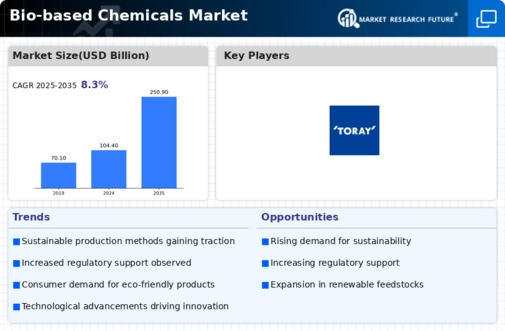
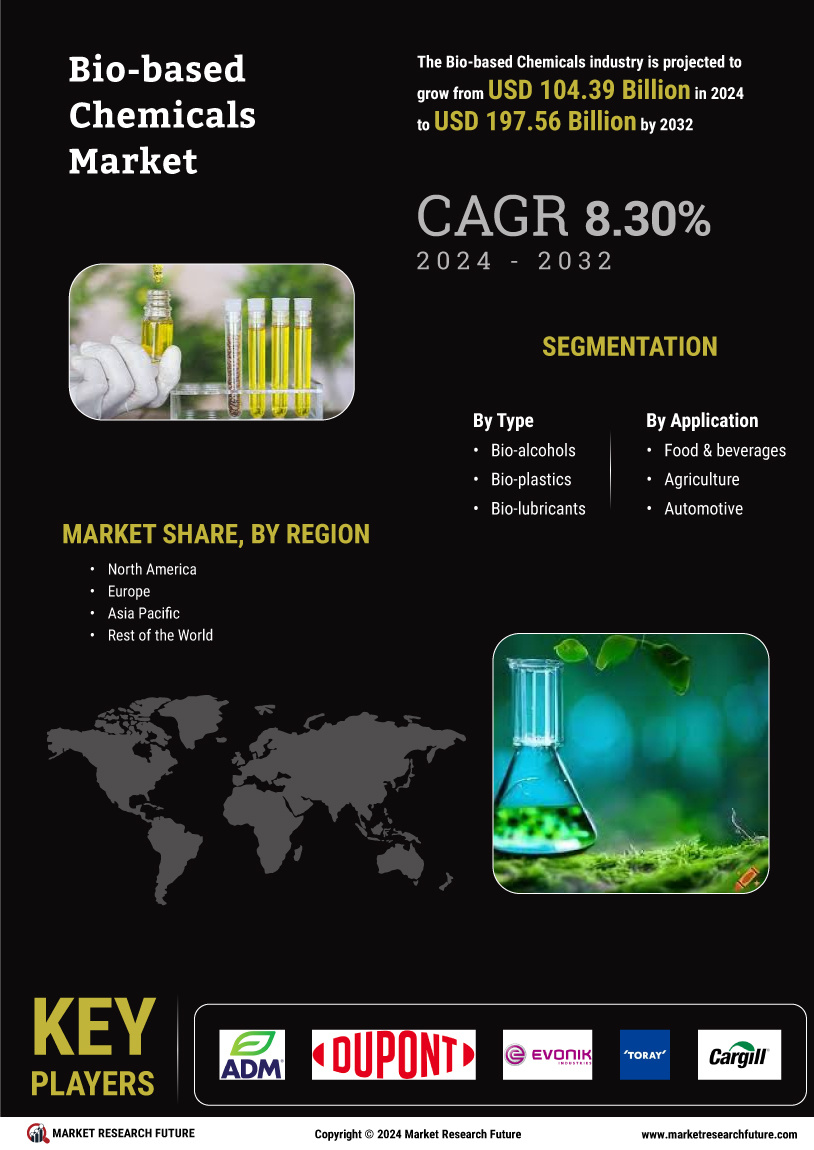
As per MRFR analysis, the Bio-Based Chemicals Market Size was estimated at 104.39 USD Billion in 2024. The Bio-Based Chemicals industry is projected to grow from 113.06 USD Billion in 2025 to 250.99 USD Billion by 2035, exhibiting a compound annual growth rate (CAGR) of 8.3 during the forecast period 2025 - 2035.

Key Market Trends & Highlights

The Bio-Based Chemicals Market is experiencing robust growth driven by sustainability and innovation.

  • North America remains the largest market for bio-based chemicals, reflecting a strong commitment to sustainability initiatives.
  • Asia-Pacific is identified as the fastest-growing region, propelled by increasing investments in renewable resources.
  • The industrial segment leads in market share, while the consumer segment is rapidly expanding due to rising eco-consciousness.
  • Key market drivers include the rising demand for sustainable products and innovations in production technologies.

Market Size & Forecast

2024 Market Size 104.39 (USD Billion)
2035 Market Size 250.99 (USD Billion)
CAGR (2025 - 2035) 8.3%

Major Players

BASF (DE), DuPont (US), Cargill (US), Novozymes (DK), Braskem (BR), NatureWorks (US), Mitsubishi Chemical (JP), Corbion (NL), LyondellBasell (US), Evonik Industries (DE)

Our Impact
Enabled $4.3B Revenue Impact for Fortune 500 and Leading Multinationals
Partnering with 2000+ Global Organizations Each Year
30K+ Citations by Top-Tier Firms in the Industry

Bio-Based Chemicals Market Trends

The Bio-Based Chemicals Market is currently experiencing a notable transformation, driven by increasing environmental awareness and the demand for sustainable alternatives to traditional petrochemical products. This shift is largely influenced by regulatory frameworks that promote the use of renewable resources, as well as consumer preferences that lean towards eco-friendly products. Companies are actively investing in research and development to innovate and expand their portfolios, which is likely to enhance their competitive edge in this evolving landscape. Furthermore, the integration of advanced technologies in production processes appears to be streamlining operations, thereby reducing costs and improving efficiency. In addition, the Bio-Based Chemicals Market is witnessing a growing collaboration between various stakeholders, including manufacturers, suppliers, and research institutions. This collaborative approach seems to foster knowledge sharing and accelerate the commercialization of bio-based products. As the market continues to mature, it may also see an increase in the availability of bio-based chemicals across diverse applications, ranging from packaging to pharmaceuticals. Overall, the trajectory of this market suggests a promising future, characterized by innovation and sustainability.

Sustainability Initiatives

The emphasis on sustainability is reshaping the Bio-Based Chemicals Market. Companies are increasingly adopting practices that minimize environmental impact, aligning their operations with global sustainability goals. This trend is likely to drive the development of new bio-based products that cater to eco-conscious consumers.

Technological Advancements

Innovations in technology are playing a crucial role in the Bio-Based Chemicals Market. Enhanced production methods and bioprocessing techniques are emerging, which may lead to more efficient and cost-effective manufacturing of bio-based chemicals. This evolution could significantly alter market dynamics.

Regulatory Support

Government policies and regulations are increasingly favoring bio-based solutions. Supportive frameworks are being established to encourage the adoption of renewable resources, which may bolster the growth of the Bio-Based Chemicals Market. This regulatory environment appears to create opportunities for new entrants and established players alike.

Bio-Based Chemicals Market Drivers

Supportive Regulatory Frameworks

The establishment of supportive regulatory frameworks is a significant driver for the Bio-Based Chemicals Market. Governments across various regions are implementing policies that promote the use of bio-based chemicals, often through incentives and subsidies. For example, regulations that mandate the reduction of greenhouse gas emissions are encouraging industries to transition towards bio-based alternatives. Market data suggests that regions with stringent environmental regulations are witnessing a faster adoption of bio-based chemicals, as companies seek compliance while enhancing their sustainability profiles. This regulatory support not only facilitates market entry for bio-based products but also encourages research and development, thereby bolstering the Bio-Based Chemicals Market.

Innovations in Production Technologies

Technological advancements in production processes are playing a crucial role in shaping the Bio-Based Chemicals Market. Innovations such as fermentation technology and enzymatic processes are enhancing the efficiency and cost-effectiveness of bio-based chemical production. For instance, recent developments in biocatalysis have shown potential to reduce production costs by up to 30%, making bio-based chemicals more competitive with their fossil fuel counterparts. Furthermore, the integration of digital technologies, such as artificial intelligence and machine learning, is streamlining operations and optimizing resource utilization. These innovations not only improve the economic viability of bio-based chemicals but also contribute to a more sustainable production framework, thereby fostering growth in the Bio-Based Chemicals Market.

Rising Demand for Sustainable Products

The increasing consumer awareness regarding environmental issues appears to drive the demand for sustainable products, thereby influencing the Bio-Based Chemicals Market. As consumers become more conscious of their purchasing decisions, they tend to favor products derived from renewable resources over traditional petrochemical-based alternatives. This shift is reflected in market data, which indicates that the bio-based chemicals segment is projected to grow at a compound annual growth rate of approximately 10% over the next five years. Companies are responding to this trend by investing in bio-based alternatives, which not only meet consumer preferences but also align with corporate sustainability goals. Consequently, the rising demand for sustainable products is likely to propel the Bio-Based Chemicals Market forward.

Growing Investment in Renewable Resources

The increasing investment in renewable resources is significantly impacting the Bio-Based Chemicals Market. Investors are recognizing the long-term potential of bio-based chemicals as a sustainable alternative to traditional petrochemicals. Recent reports indicate that venture capital funding for bio-based startups has surged, with investments reaching over 1 billion dollars in the past year alone. This influx of capital is enabling companies to scale their operations and innovate new products, thereby expanding the market. Additionally, partnerships between established chemical companies and startups are fostering knowledge transfer and accelerating the commercialization of bio-based technologies. As a result, the growing investment in renewable resources is likely to enhance the competitiveness of the Bio-Based Chemicals Market.

Consumer Preference for Eco-Friendly Solutions

The shift in consumer preference towards eco-friendly solutions is a pivotal driver for the Bio-Based Chemicals Market. As environmental concerns become more pronounced, consumers are actively seeking products that minimize ecological impact. This trend is evident in various sectors, including personal care, packaging, and automotive, where bio-based chemicals are increasingly favored. Market analysis indicates that products containing bio-based ingredients are experiencing higher sales growth compared to conventional products. Companies are responding to this demand by reformulating their offerings to include bio-based alternatives, thereby enhancing their market appeal. Consequently, the consumer preference for eco-friendly solutions is expected to continue driving growth in the Bio-Based Chemicals Market.

Market Segment Insights

By Application: Solvents (Largest) vs. Surfactants (Fastest-Growing)

In the Bio-Based Chemicals Market, solvents hold the largest share, reflecting their widespread utility across diverse industries. This sector capitalizes on natural feedstocks which are gradually replacing conventional petroleum-based solvents. Surfactants, on the other hand, are emerging aggressively in the market, driven by increased consumer demand for eco-friendly and sustainable products. Their share is expected to surge due to innovations in formulation and heightened regulations restricting synthetic alternatives.

Solvents (Dominant) vs. Surfactants (Emerging)

Solvents are a dominant presence in the bio-based chemicals landscape due to their essential roles in formulations across various applications such as paints, coatings, and cleaning agents. These organic solvents, derived from renewable resources, are gaining traction as businesses pivot to more sustainable practices. On the other hand, surfactants, considered an emerging category, are rapidly growing in popularity, especially in industries like personal care and cleaning. They offer biodegradable alternatives to traditional chemicals, aligning with consumer preferences for sustainability. This shift is further propelled by regulatory pressures and societal trends emphasizing environmental responsibility, marking a transformative period in the bio-based segment.

By End Use Industry: Agriculture (Largest) vs. Pharmaceuticals (Fastest-Growing)

The Bio-Based Chemicals Market showcases a diverse array of end-use industries, with Agriculture leading the charge. This segment is heavily dominated by sustainable practices, driving demand for bio-based fertilizers and pesticides. Following closely is the Food and Beverage industry, which relies on bio-based chemicals for packaging and preservation, while Personal Care and Automotive industries also contribute significantly to overall market share. Pharmaceuticals, while currently smaller, show great potential for growth, particularly due to the increasing demand for greener alternatives in drug synthesis. The growth trends across these segments reveal a clear shift towards sustainability. Agriculture is witnessing robust growth propelled by developments in organic farming and eco-friendly agricultural solutions. Conversely, the Pharmaceuticals sector is rapidly evolving, fueled by regulatory support for sustainable practices and heightened consumer awareness of environmental impacts. Emerging innovations in bio-based chemical applications continue to spur growth, making it an attractive area for investment.

Agriculture (Dominant) vs. Pharmaceuticals (Emerging)

The Agriculture segment of the Bio-Based Chemicals Market stands as the dominant force, characterized by its extensive use of bio-based fertilizers, pesticides, and herbicides. Stakeholders in this industry emphasize sustainability, leading to a reduction in chemical residues in farming practices. This segment is further strengthened by a growing consumer demand for organic produce and environmentally-friendly practices. Conversely, the Pharmaceuticals segment, while emerging, is rapidly gaining prominence. It is defined by a progressive shift towards biomanufacturing processes, driven by innovation in drug formulation and increased regulatory support for sustainable practices. As the world leans towards green solutions, pharmaceuticals are expected to expand their footprint in the market, tapping into the benefits of bio-based chemical alternatives in drug production.

By Type: Bio-Based Ethanol (Largest) vs. Bio-Based Polypropylene (Fastest-Growing)

In the Bio-Based Chemicals Market, Bio-Based Ethanol stands out as the largest segment, attributable to its extensive applications in fuels, chemicals, and food industries. Meanwhile, Bio-Based Polypropylene is rapidly gaining traction, emerging as the fastest-growing segment driven by its versatility in diverse applications ranging from packaging to automotive. Other segments such as Bio-Based Acids and Bio-Based Polyethylene also contribute to market dynamics, albeit at a slower pace compared to the top two.

Bio-Based Ethanol (Dominant) vs. Bio-Based Polypropylene (Emerging)

Bio-Based Ethanol leads the Bio-Based Chemicals Market due to its established production techniques and widespread use in biofuels and various industrial applications. Characterized by its renewable source and lower carbon footprint, it appeals to environmentally conscious consumers and industries alike. On the other hand, Bio-Based Polypropylene is rapidly defining its niche in the market, appealing particularly to sectors focused on sustainability. With ongoing advancements in production technologies and growing demand for eco-friendly alternatives in packaging and textiles, Bio-Based Polypropylene is set to carve out a significant market presence.

By Source: Plant-Based (Largest) vs. Waste-Based (Fastest-Growing)

In the Bio-Based Chemicals Market, the 'Source' segment is predominantly led by Plant-Based chemicals, which command the largest share due to their sustainable sourcing and versatility in applications. The market is increasingly drawn to the benefits of renewable resources, giving Plant-Based a competitive edge, such as lower carbon footprints and compliance with stringent regulations. Waste-Based sources are emerging as a significant contributor, leveraging the increasing focus on waste management and circular economy principles to foster innovative solutions.

Plant-Based (Dominant) vs. Waste-Based (Emerging)

Plant-Based chemicals represent the dominant source in the Bio-Based Chemicals Market, characterized by their versatility in end-uses spanning multiple industries such as pharmaceuticals, cosmetics, and food. This dominance is fueled by consumer preference for eco-friendly products and government incentives supporting bio-based initiatives. Conversely, Waste-Based chemicals are an emerging segment driven by innovation and sustainability efforts, converting waste materials into valuable chemical products. This approach not only mitigates waste disposal challenges but also aligns with global sustainability targets, attracting investments and technological advancements that bolster its market growth.

By Form: Liquid (Largest) vs. Solid (Fastest-Growing)

In the Bio-Based Chemicals Market, the form segment is characterized by three primary categories: liquid, solid, and gas. Among these, liquid bio-based chemicals hold the largest market share due to their extensive application in various industries, including pharmaceuticals, cosmetics, and food. Solid bio-based chemicals are making significant inroads, reflecting robust market demand and evolving preferences in product formulation, thus positively impacting their share in the overall segment.

Liquid (Dominant) vs. Solid (Emerging)

Liquid bio-based chemicals dominate the market due to their adaptability and broad range of applications across multiple sectors. They are favored for their ease of handling, transportation, and integration into existing production processes. This segment includes biofuels, biolubricants, and solvents, which are becoming increasingly popular as sustainability concerns rise. On the other hand, solid bio-based chemicals are emerging rapidly, driven by their potential for better stability, storage, and delivery. These include biodegradable plastics and bio-based polymers, which are gaining traction as industries seek eco-friendly alternatives to traditional materials.

Get more detailed insights about Bio-Based Chemicals Market

Regional Insights

North America : Innovation and Leadership Hub

North America leads the bio-based chemicals market with a commanding 50.0% share as of 2024. The region's growth is driven by increasing consumer demand for sustainable products, stringent environmental regulations, and significant investments in R&D. Government initiatives promoting bio-based alternatives are further catalyzing market expansion, making it a focal point for innovation in the sector. The U.S. is the primary player, hosting major companies like DuPont and Cargill, which are at the forefront of bio-based chemical production. Canada is also emerging as a key player, leveraging its vast natural resources. The competitive landscape is characterized by collaborations among industry leaders and academic institutions, enhancing technological advancements and market penetration.

Europe : Sustainability and Regulation Focus

Europe holds a significant 30.0% share in the bio-based chemicals market, driven by robust regulatory frameworks and a strong consumer preference for sustainable products. The European Union's Green Deal and various national policies are pushing industries towards greener alternatives, fostering innovation and investment in bio-based technologies. This regulatory support is crucial for market growth, as companies adapt to meet stringent environmental standards. Leading countries like Germany, France, and the Netherlands are at the forefront, with key players such as BASF and Novozymes driving advancements in bio-based solutions. The competitive landscape is marked by a mix of established firms and innovative startups, all vying to capture the growing demand for eco-friendly chemicals. The region's commitment to sustainability positions it as a leader in the global bio-based chemicals market.

Asia-Pacific : Emerging Market Potential

Asia-Pacific accounts for a 20.0% share of the bio-based chemicals market, showcasing rapid growth driven by increasing industrialization and urbanization. Countries like China and India are witnessing a surge in demand for bio-based products, supported by government initiatives aimed at reducing carbon footprints and promoting sustainable practices. The region's diverse agricultural base also provides a strong feedstock supply for bio-based chemicals. China is the leading country in this region, with significant investments from companies like Mitsubishi Chemical and NatureWorks. The competitive landscape is evolving, with both local and international players striving to enhance their market presence. As awareness of environmental issues grows, the demand for bio-based chemicals is expected to rise, further solidifying the region's position in the global market.

Middle East and Africa : Resource-Rich Opportunities

The Middle East and Africa represent a nascent but promising segment of the bio-based chemicals market, with a share of 4.39%. The region's growth is primarily driven by its rich natural resources and increasing investments in sustainable technologies. Governments are beginning to recognize the potential of bio-based chemicals in diversifying their economies and reducing reliance on fossil fuels, leading to supportive policies and initiatives. Countries like South Africa and the UAE are emerging as key players, with local firms exploring bio-based alternatives to traditional chemicals. The competitive landscape is still developing, but there is a growing interest from international companies looking to invest in the region. As awareness of sustainability increases, the bio-based chemicals market in the Middle East and Africa is poised for significant growth.

Key Players and Competitive Insights

The Bio-Based Chemicals Market is currently characterized by a dynamic competitive landscape, driven by increasing consumer demand for sustainable products and regulatory pressures aimed at reducing carbon footprints. Key players such as BASF (Germany), DuPont (US), and Cargill (US) are strategically positioning themselves through innovation and partnerships to enhance their market presence. BASF (Germany) focuses on developing advanced biopolymers, while DuPont (US) emphasizes its commitment to sustainable solutions through its bio-based materials portfolio. Cargill (US) is leveraging its extensive agricultural supply chain to produce bio-based chemicals, indicating a trend towards vertical integration among major players, which collectively shapes a moderately fragmented market structure.

In terms of business tactics, companies are increasingly localizing manufacturing to reduce transportation emissions and optimize supply chains. This approach not only enhances operational efficiency but also aligns with the growing consumer preference for locally sourced products. The competitive structure of the market remains moderately fragmented, with several key players exerting influence through strategic collaborations and technological advancements.

In January 2026, BASF (Germany) announced a partnership with a leading biotechnology firm to develop a new line of bio-based surfactants aimed at the personal care industry. This collaboration is expected to enhance BASF's product offerings and strengthen its position in the sustainable chemicals segment, reflecting a broader trend of innovation-driven growth in the market. The strategic importance of this partnership lies in its potential to meet the rising demand for eco-friendly personal care products, thereby aligning with consumer preferences.

In December 2025, DuPont (US) launched a new bio-based polymer that is designed to replace conventional plastics in packaging applications. This product introduction is significant as it not only showcases DuPont's commitment to sustainability but also positions the company as a leader in the transition towards circular economy practices. The launch is likely to attract attention from major packaging companies seeking to enhance their sustainability profiles, further solidifying DuPont's competitive edge.

In November 2025, Cargill (US) expanded its bio-based chemical production facility in Brazil, aiming to increase its output of bio-based glycerin. This expansion is crucial as it allows Cargill to meet the growing demand for bio-based products in South America, a region that is increasingly prioritizing sustainable solutions. The strategic move underscores Cargill's focus on regional expansion and its commitment to leveraging local resources for bio-based chemical production.

As of February 2026, the competitive trends in the Bio-Based Chemicals Market are increasingly defined by digitalization, sustainability, and the integration of artificial intelligence in production processes. Strategic alliances are becoming more prevalent, as companies recognize the need to collaborate to enhance innovation and efficiency. Looking ahead, competitive differentiation is likely to evolve from traditional price-based competition to a focus on technological advancements, sustainability, and supply chain reliability, reflecting the changing priorities of consumers and regulatory bodies alike.

Key Companies in the Bio-Based Chemicals Market include

Industry Developments

July 2021: Archer Daniels Midland Corporation (ADM) has agreed to buy Sojaprotein, the largest manufacturer of plant-based proteins in southern Europe. The acquisition of Sojaprotein is anticipated to boost the company's manufacturing capacity and meet the nutritional demands of consumers.

June 2021: TotalEnergies, MPG Manifattura Plastica, and Froneri announced the commercial release of bio-based ice cream plastic cups produced from Certified Renewable Polypropylene. Its bio-based naphtha-based renewable polypropylene delivers virgin-like performance with a lower carbon footprint and is totally recyclable.

Future Outlook

Bio-Based Chemicals Market Future Outlook

The Bio-Based Chemicals Market is projected to grow at an 8.3% CAGR from 2024 to 2035, driven by sustainability initiatives, regulatory support, and technological advancements.

New opportunities lie in:

  • Development of bioplastics for packaging solutions
  • Investment in bio-refinery technologies for cost efficiency
  • Expansion into emerging markets with tailored bio-based products

By 2035, the market is expected to achieve substantial growth, positioning itself as a leader in sustainable chemical solutions.

Market Segmentation

Bio-Based Chemicals Market Form Outlook

  • Liquid
  • Solid
  • Gas

Bio-Based Chemicals Market Type Outlook

  • Bio-Based Ethanol
  • Bio-Based Acids
  • Bio-Based Polyethylene
  • Bio-Based Polypropylene
  • Bio-Based Surfactants

Bio-Based Chemicals Market Source Outlook

  • Plant-Based
  • Animal-Based
  • Microbial-Based
  • Waste-Based

Bio-Based Chemicals Market Application Outlook

  • Solvents
  • Surfactants
  • Adhesives
  • Plastics
  • Coatings

Bio-Based Chemicals Market End Use Industry Outlook

  • Agriculture
  • Food and Beverage
  • Personal Care
  • Pharmaceuticals
  • Automotive

Report Scope

MARKET SIZE 2024104.39(USD Billion)
MARKET SIZE 2025113.06(USD Billion)
MARKET SIZE 2035250.99(USD Billion)
COMPOUND ANNUAL GROWTH RATE (CAGR)8.3% (2024 - 2035)
REPORT COVERAGERevenue Forecast, Competitive Landscape, Growth Factors, and Trends
BASE YEAR2024
Market Forecast Period2025 - 2035
Historical Data2019 - 2024
Market Forecast UnitsUSD Billion
Key Companies ProfiledBASF (DE), DuPont (US), Cargill (US), Novozymes (DK), Braskem (BR), NatureWorks (US), Mitsubishi Chemical (JP), Corbion (NL), LyondellBasell (US), Evonik Industries (DE)
Segments CoveredApplication, End Use Industry, Type, Source, Form
Key Market OpportunitiesGrowing demand for sustainable alternatives drives innovation in the Bio-Based Chemicals Market.

Key Market DynamicsRising consumer demand for sustainable products drives innovation and competition in the bio-based chemicals sector.
Countries CoveredNorth America, Europe, APAC, South America, MEA

Market Highlights

Author
Anshula Mandaokar
Team Lead - Research

Anshula Mandaokar holds an academic degree in Chemical Engineering and has been contributing to the field for more than 5 years. She has expertise in Market Research and Business Consulting and serves as a Team Lead for a reputed Market Research firm under the Chemicals and Materials domain spectrum. She has worked on multiple projects, generating explicit results in a quick turnaround time. Her understanding of data interpretation justifies her role as a leader.

Leave a Comment

FAQs

What is the current valuation of the US bio-based chemicals market?

As of 2024, the US bio-based chemicals market was valued at 16.96 USD Billion.

What is the projected market size for the US bio-based chemicals market by 2035?

The market is projected to reach 37.65 USD Billion by 2035.

What is the expected CAGR for the US bio-based chemicals market during the forecast period 2025 - 2035?

The expected CAGR for the US bio-based chemicals market during 2025 - 2035 is 7.52%.

Which companies are considered key players in the US bio-based chemicals market?

Key players in the market include DuPont, Cargill, BASF, Genomatica, Novozymes, NatureWorks, LyondellBasell, Amyris, and Green Biologics.

What are the main application segments of the US bio-based chemicals market?

The main application segments include solvents, surfactants, adhesives, plastics, and coatings.

How much is the plastics segment expected to grow by 2035?

The plastics segment is projected to grow from 4.08 USD Billion in 2024 to 9.12 USD Billion by 2035.

Download Free Sample

Kindly complete the form below to receive a free sample of this Report

Compare Licence

×
Features License Type
Single User Multiuser License Enterprise User
Price $4,950 $5,950 $7,250
Maximum User Access Limit 1 User Upto 10 Users Unrestricted Access Throughout the Organization
Free Customization
Direct Access to Analyst
Deliverable Format
Platform Access
Discount on Next Purchase 10% 15% 15%
Printable Versions