×
Request Free Sample ×

Kindly complete the form below to receive a free sample of this Report

* Please use a valid business email

Leading companies partner with us for data-driven Insights

clients tt-cursor
Hero Background
English
Chinese
French
Japanese
Korean
German
Spanish

Washdown Sensor Market Analysis

ID: MRFR/SEM/12362-HCR
128 Pages
Shubham Munde
October 2025

Washdown Sensor Market Size, Share and Research Report By Type (Stainless Steel Sensor, Plastic Sensor, and Others), By Application (Food and Beverage, Packaging, Pharmaceutics, and Others) And By Region (North America, Europe, Asia-Pacific, And Rest Of The World)– Industry Forecast Till 2035

Share:
Download PDF ×

We do not share your information with anyone. However, we may send you emails based on your report interest from time to time. You may contact us at any time to opt-out.

Washdown Sensor Market Infographic
×
Washdown Sensor Market Infographic Full View
Purchase Options

Market Analysis

In-depth Analysis of Washdown Sensor Market Industry Landscape

The global washdown sensor market is set to reach US$ 743.2 BN by 2032, at a 10.20% CAGR between years 2023-2032. The Washdown Sensor Market is a segment operating in dynamic circle where their activities are influenced by stringent hygienic limitations required in industries for example, food and beverages, pharmaceuticals, and health. As the market drivers, one can name an increasing focus on cleanliness’ and sanitation standard in the manufacturing processes. Washdown sensors, which can endure scrubbing techniques that use water and in cleansers have turned into necessary in regions were keeping up the sterilization and cross contamination free condition is immeasurable. First and foremost, the food and beverage industry are notable in greatly influencing washdown sensor market dynamics.

Food production is regulated, and there are quality standards associated with it that force the manufacturer to adopt effective hygienic measures. Washdown sensors are all over the place in these situations because as they use high water pressure and flushing to wash down both interiors of product lines, warehouses, and pipelines ensure that the washdown sensors themselves remain clean from contamination and bacteria; hence with regards to contributing towards safety and quality production. The technology development in washdown sensors cannot be complete without technological advancements in sensor design and materials, which is also a crucial part of washdown due to its dynamics.

Going to challenging conditions, the manufacturers progressively innovate in order to improve the durability reliability and performance of these sensors. Advanced washdown sensor technology is proved by the emerging of water-resistance sensors that are rated IP67 or more, which means I5POX protection against dust and solid particles out there. In this way, innovation always remains a core driver even if other factors such as the search for viable sensor alternatives could also come from outside the market. Additionally, also global attention to pharmaceutical and health care standards acts as a key driving force on the market dynamics of washdown sensors. In these fields of manufacturing, where a sterile environment is of utmost importance for product standard and patient safety, the wash generation sensors are mandatory. Apart from wash down, the sensor systems are vital in pharmaceutical production manufacturing as well as medical device manufacture to ensure all is proper and that they are compliant with strict regulations.

Washdown sensors emanate from a much competitive landscape, which performs a key role underlying their market dynamics. When several firms enter the market for a share, innovation and cost cutting grow phenomenon. The sensors produced by the manufacturers are evolving in such a way that consumers enjoy sensor range with higher chemical tolerance, larger temperature spans and compatibility to different cleaning routines. This stimulates an atmosphere of continuous improvement, providing many washdown sensor options for end users, ranging from a variety of reliable and advanced sensors with their specified capabilities.
Author
Shubham Munde
Research Analyst Level II

With a technical background in information technology & semiconductors, Shubham has 4.5+ years of experience in market research and analytics with the tasks of data mining, analysis, and project execution. He is the POC for our clients, for their consulting projects running under the ICT/Semiconductor domain. Shubham holds a Bachelor’s in Information and Technology and a Master of Business Administration (MBA). Shubham has executed over 150 research projects for our clients under the brand name Market Research Future in the last 2 years. His core skill is building the research respondent relation for gathering the primary information from industry and market estimation for niche markets. He is having expertise in conducting secondary & primary research, market estimations, market projections, competitive analysis, analysing current market trends and market dynamics, deep-dive analysis on market scenarios, consumer behaviour, technological impact analysis, consulting, analytics, etc. He has worked on fortune 500 companies' syndicate and consulting projects along with several government projects. He has worked on the projects of top tech brands such as IBM, Google, Microsoft, AWS, Meta, Oracle, Cisco Systems, Samsung, Accenture, VMware, Schneider Electric, Dell, HP, Ericsson, and so many others. He has worked on Metaverse, Web 3.0, Zero-Trust security, cyber-security, blockchain, quantum computing, robotics, 5G technology, High-Performance computing, data centers, AI, automation, IT equipment, sensors, semiconductors, consumer electronics and so many tech domain projects.

Leave a Comment

FAQs

What is the size of the Washdown Sensor market?

In 2024, the size of the worldwide washdown sensor market was estimated to be USD 293.37 billion.

What is the market growth rate for washdown sensors?

During the forecast period, 2025 to 2035, It is expected that the global market would grow at a CAGR of 10.20%.

Which geographical area accounted for the biggest market share for washdown sensors?

North America held the majority of the global market.

Who are the major companies in the market for washdown sensors?

Wenglor, Turck Banner, Balluff, SICK, Baumer, OMRON, Delta, Pepperl+Fuchs, and Keyence are the major participants in the market.

What category dominated the washdown sensor market?

In 2022, the Plastic Sensor segment dominated the market.

Which Application dominated the washdown sensor market in terms of market share?

The largest market share in the world was held by food and beverages.

Market Summary

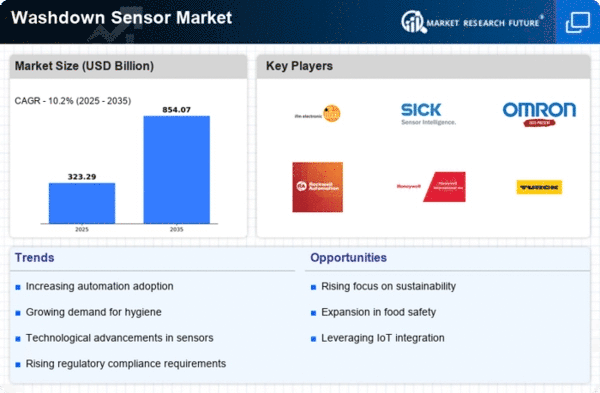
As per MRFR analysis, the Washdown Sensor Market Size was estimated at 293.37 USD Billion in 2024. The Washdown Sensor industry is projected to grow from 323.29 USD Billion in 2025 to 854.07 USD Billion by 2035, exhibiting a compound annual growth rate (CAGR) of 10.2 during the forecast period 2025 - 2035.

Key Market Trends & Highlights

The Washdown Sensor Market is experiencing robust growth driven by technological advancements and increasing hygiene awareness.

  • North America remains the largest market for washdown sensors, driven by stringent regulatory compliance and advanced manufacturing practices. The Asia-Pacific region is emerging as the fastest-growing market, fueled by rapid industrialization and heightened hygiene standards. The food processing segment dominates the market, while the pharmaceuticals segment is witnessing the fastest growth due to rising health and safety regulations. Technological advancements and regulatory compliance are key drivers propelling demand in both the food and beverage and manufacturing sectors.

Market Size & Forecast

2024 Market Size 293.37 (USD Billion)
2035 Market Size 854.07 (USD Billion)
CAGR (2025 - 2035) 10.2%
Largest Regional Market Share in 2024 North America

Major Players

Pepperl+Fuchs (DE), IFM Electronic (DE), Sick AG (DE), Omron Corporation (JP), Rockwell Automation (US), Honeywell International Inc. (US), Turck GmbH & Co. KG (DE), Banner Engineering Corp. (US), Schneider Electric (FR)

Market Trends

The Washdown Sensor Market is currently experiencing a notable evolution, driven by the increasing demand for automation and enhanced hygiene standards across various industries. This market encompasses sensors designed to withstand rigorous cleaning processes, particularly in sectors such as food and beverage, pharmaceuticals, and chemical processing. As industries prioritize safety and cleanliness, the adoption of washdown sensors appears to be gaining momentum. Furthermore, advancements in sensor technology, including improved durability and accuracy, are likely to bolster market growth. The integration of smart technologies, such as IoT capabilities, may also play a pivotal role in shaping the future landscape of this market. In addition to technological advancements, regulatory frameworks emphasizing hygiene and safety standards are influencing the Washdown Sensor Market. Companies are increasingly compelled to comply with stringent regulations, which may drive the demand for specialized sensors that can endure harsh cleaning environments. Moreover, the growing awareness of the importance of maintaining sanitary conditions in production facilities suggests a sustained interest in washdown sensors. As the market continues to evolve, it is essential to monitor these trends closely, as they may significantly impact the competitive dynamics and innovation strategies within the sector.

Technological Advancements

The Washdown Sensor Market is witnessing a surge in technological innovations, particularly in sensor design and functionality. Enhanced durability and precision are becoming critical attributes, as industries seek solutions that can withstand rigorous cleaning processes while maintaining high performance. The integration of smart technologies, such as IoT connectivity, is also emerging, allowing for real-time monitoring and data analysis.

Regulatory Compliance

Increasing regulatory requirements regarding hygiene and safety are shaping the Washdown Sensor Market. Industries are compelled to adhere to stringent standards, which drives the demand for specialized sensors capable of withstanding harsh cleaning environments. This trend indicates a growing emphasis on compliance, potentially influencing purchasing decisions and product development.

Rising Awareness of Hygiene

There is a notable rise in awareness surrounding hygiene and cleanliness in various sectors, particularly food and beverage and pharmaceuticals. This heightened focus on sanitary conditions is likely to propel the demand for washdown sensors, as companies strive to ensure safe production environments. The trend suggests a long-term commitment to maintaining high hygiene standards.

Washdown Sensor Market Market Drivers

Market Growth Projections

The Global Washdown Sensor Market Industry is poised for substantial growth, with projections indicating a market size of 293.4 USD Billion in 2024 and an anticipated increase to 854.1 USD Billion by 2035. This growth represents a remarkable CAGR of 10.2% from 2025 to 2035, reflecting the increasing adoption of washdown sensors across various industries. Factors such as rising hygiene standards, technological advancements, and the growth of the food and beverage sector are expected to drive this expansion. The market's trajectory suggests a robust future for washdown sensors as industries prioritize cleanliness and efficiency.

Growth of the Food and Beverage Sector

The food and beverage sector is a primary driver of the Global Washdown Sensor Market Industry, as the need for cleanliness and hygiene is paramount in this field. With the increasing production of packaged foods and beverages, manufacturers are investing in advanced cleaning technologies, including washdown sensors. These sensors ensure that production lines remain compliant with health regulations, thereby safeguarding consumer safety. The growth of this sector is expected to contribute significantly to the market, with projections indicating a substantial increase in demand for washdown sensors in the coming years.

Increasing Demand for Hygiene Standards

The Global Washdown Sensor Market Industry is experiencing heightened demand due to stringent hygiene standards across various sectors, particularly in food and beverage processing. As industries strive to comply with regulations, the adoption of washdown sensors is becoming essential. These sensors facilitate effective cleaning processes, ensuring that equipment remains free from contaminants. The market is projected to reach 293.4 USD Billion in 2024, reflecting the growing emphasis on maintaining sanitary conditions. This trend is likely to continue, as companies increasingly recognize the importance of hygiene in safeguarding public health and enhancing product quality.

Rising Automation in Industrial Processes

The Global Washdown Sensor Market Industry is significantly influenced by the increasing automation of industrial processes. As manufacturers seek to enhance productivity and reduce labor costs, the implementation of automated systems becomes more prevalent. Washdown sensors play a crucial role in these automated environments, ensuring that equipment is cleaned effectively without human intervention. This trend is likely to drive market growth, as industries recognize the benefits of integrating washdown sensors into their automated systems. The expected CAGR of 10.2% from 2025 to 2035 further underscores the potential for expansion in this sector.

Technological Advancements in Sensor Technology

Technological innovations are driving the Global Washdown Sensor Market Industry forward, with advancements in sensor technology enhancing performance and reliability. The integration of IoT capabilities allows for real-time monitoring and data collection, enabling industries to optimize their cleaning processes. These innovations not only improve efficiency but also reduce operational costs. As the market evolves, the demand for smart washdown sensors is expected to rise, contributing to the projected growth of the industry. By 2035, the market is anticipated to reach 854.1 USD Billion, indicating a robust trajectory fueled by ongoing technological developments.

Environmental Regulations and Sustainability Initiatives

Environmental regulations and sustainability initiatives are shaping the Global Washdown Sensor Market Industry. As companies strive to minimize their environmental impact, the adoption of efficient cleaning technologies becomes critical. Washdown sensors contribute to sustainable practices by optimizing water and energy usage during cleaning processes. This alignment with environmental goals not only enhances operational efficiency but also meets regulatory requirements. As sustainability continues to gain traction, the demand for washdown sensors is likely to rise, further propelling the market's growth trajectory.

Market Segment Insights

By Application: Food Processing (Largest) vs. Pharmaceuticals (Fastest-Growing)

The washdown sensor market is significantly influenced by its diverse applications across various sectors. Among these, the food processing sector holds the largest market share due to stringent hygiene regulations and the growing need for automated systems. This segment utilizes washdown sensors extensively to maintain cleanliness and safety in food handling, processing, and packaging environments, which contributes to its leading position. Meanwhile, the pharmaceuticals segment, while smaller in market share, is identified as the fastest-growing area. This growth is attributed to increasing investments in advanced manufacturing processes and the necessity for stringent compliance with health regulations.

Food Processing (Dominant) vs. Pharmaceuticals (Emerging)

The food processing sector remains the dominant application for washdown sensors, driven by the industry's focus on sanitation and compliance with food safety standards. These sensors are vital in monitoring and ensuring that equipment remains uncontaminated during and after production processes. In contrast, the pharmaceuticals industry is emerging rapidly, characterized by high demand for precise and reliable sensors that meet rigorous sterility requirements. Both sectors emphasize the importance of durability and resistance to harsh cleaning agents in washdown sensors, which enhances their operational efficiency and reliability.

By End Use Industry: Manufacturing (Largest) vs. Food and Beverage (Fastest-Growing)

In the Washdown Sensor Market, the End Use Industry segment is pivotal, with Manufacturing holding the largest share. This segment is characterized by a robust demand for sensors that can withstand the rigorous cleaning processes typical in manufacturing environments. Food and Beverage follows closely, driven by stringent hygiene regulations that enhance the need for reliable washdown sensors. Both sectors are integral to the market, showcasing distinct yet overlapping needs for durability and performance under harsh conditions. The growth trends within this segment are distinctly influenced by technological advancements and evolving industry standards. Manufacturing continues to expand due to ongoing automation and the need for efficiency, while the Food and Beverage sector experiences rapid growth fueled by health-conscious consumers and an emphasis on food safety. Such trends are compelling manufacturers to innovate and tailor their washdown sensors to meet specific industry requirements, thereby driving market momentum.

Food and Beverage: Dominant vs. Pharmaceutical: Emerging

The Food and Beverage segment in the Washdown Sensor Market stands as a dominant force, thanks to its necessity for sensors that allow efficient cleaning without compromising safety and hygiene. This sector demands high-performance washdown sensors that can endure corrosive conditions and frequent washdowns, leading manufacturers to prioritize durability and reliability in product design. In contrast, the Pharmaceutical segment is emerging, characterized by a growing need for precision and adherence to stringent regulations. Washdown sensors in pharmaceuticals must not only meet rigorous cleaning standards but also ensure accuracy in dosing and monitoring conditions. While Food and Beverage is currently the leader, the increasing focus on pharmaceutical sanitation and compliance suggests that this emerging segment may soon gain significant traction as industry players invest more in specialized sensor technologies.

By Technology: Capacitive Sensors (Largest) vs. Inductive Sensors (Fastest-Growing)

In the Washdown Sensor Market, the distribution of market share among various technologies reveals that capacitive sensors dominate the landscape, capturing a significant portion due to their versatility and reliability in wet environments. Inductive sensors follow, holding a robust position but are witnessing rapid growth as industries seek more robust and water-resistant solutions. Ultrasonic and optical sensors also contribute to the segment but currently represent smaller shares, primarily catering to niche applications.

Technology: Capacitive Sensors (Dominant) vs. Inductive Sensors (Emerging)

Capacitive sensors are recognized as the dominant force in the Washdown Sensor Market, known for their ability to detect proximity without physical contact, which is essential in sanitary environments. They excel in various applications, from food and beverage processing to pharmaceutical manufacturing. On the other hand, inductive sensors are emerging quickly, driven by their unique features such as higher operational reliability in harsh conditions, lower maintenance requirements, and improved performance in washdown settings. This comparative advantage fuels their rapid adoption across manufacturing sectors, indicating a strong potential for growth as industries increasingly prioritize efficiency and safety.

By Sensor Type: Pressure Sensors (Largest) vs. Temperature Sensors (Fastest-Growing)

In the Washdown Sensor Market, pressure sensors hold the largest share among various sensor types due to their extensive applications across industries such as food and beverage, pharmaceuticals, and manufacturing. Their robustness and reliability in harsh environments make them indispensable for monitoring pressure in washdown processes. On the other hand, temperature sensors are rapidly gaining traction, evolving as the fastest-growing segment owing to rising demands for precise thermal measurements in washdown systems. This is particularly critical in industries where hygienic conditions are paramount. Growth trends indicate a notable shift towards digital and smart sensor technology, driving innovation in pressure and temperature sensors. Enhanced functionalities, like real-time data monitoring and connectivity features, are influencing the adoption of these sensors. The increasing focus on automation, IoT integration, and efficiency in washdown processes is propelling the expansion of these segments. With stricter hygiene standards and the need for efficient operational management, both pressure and temperature sensors are set to experience significant growth in the coming years.

Pressure Sensors (Dominant) vs. Flow Sensors (Emerging)

Pressure sensors are the dominant player in the Washdown Sensor Market, characterized by their versatility and reliability in critical applications. They provide accurate and consistent measurements crucial for maintaining optimum pressure levels in washdown processes across various industries. In contrast, flow sensors are emerging as an exciting segment, with increasing adoption driven by the need for accurate flow measurement in cleaning processes. Flow sensors support water and chemical management efficiency, which is essential for sustainability and cost-effectiveness in washdown operations. As automation and real-time monitoring become increasingly prioritized, flow sensors are positioned to carve out a significant niche, complementing the established market presence of pressure sensors with their innovative capabilities.

Get more detailed insights about Washdown Sensor Market Research Report—Global Forecast till 2035

Regional Insights

By region, the study provides the market insights into North America, Europe, Asia-Pacific and Rest of the World. The North American Washdown Sensor Market area will dominate this market; this is linked to rising actions by important market participants in regional nations. The global development of the photoelectric sensor industry will be aided by these low-cost, high-performance product advancements.

Further, the major countries studied in the market report are The US, German, France, the UK, Canada, Italy, Spain, India, Australia, South Korea, China, Japan, and Brazil.

Figure 2: WASHDOWN SENSOR MARKET SHARE BY REGION 2022 (USD Billion)

Europe Washdown Sensor Market represents the second-largest market share this is attributable to an increase in activities by important market participants in the region's nations. Further, the German Washdown Sensor Market held a dominant market share, and the UK Washdown Sensor Market was the European region's fastest-growing market.

The Asia-Pacific Washdown Sensor Market is expected to see the highest CAGR 10.20% between 2024 and 2032. This is attributable to an increase in activities by important market participants in the region's nations. Moreover, China’s Washdown Sensor Market held a dominant market share, and the Indian Washdown Sensor Market was the Asia-Pacific region's fastest-growing market.

Key Players and Competitive Insights

The Washdown Sensor Market is currently characterized by a dynamic competitive landscape, driven by increasing demand for automation and stringent hygiene standards across various industries, particularly food and beverage, pharmaceuticals, and chemicals. Key players such as Pepperl+Fuchs (Germany), IFM Electronic (Germany), and Sick AG (Germany) are strategically positioned to leverage their technological expertise and innovative product offerings. These companies focus on enhancing their product lines through continuous research and development, thereby fostering a culture of innovation that is essential for maintaining competitive advantage. Moreover, partnerships and collaborations with other technology firms are becoming increasingly prevalent, as they allow for the integration of advanced technologies such as IoT and AI into sensor solutions, thereby enhancing operational efficiency and customer satisfaction. In terms of business tactics, companies are increasingly localizing manufacturing to reduce lead times and optimize supply chains. This approach not only mitigates risks associated with The Washdown Sensor demands. The competitive structure of the market appears moderately fragmented, with several players vying for market share. However, the collective influence of major companies is significant, as they set industry standards and drive technological advancements that smaller firms often follow. In November 2025, Sick AG (Germany) announced the launch of its new line of washdown sensors designed specifically for high-pressure cleaning environments. This strategic move is indicative of Sick AG's commitment to innovation and its understanding of the unique challenges faced by industries requiring stringent hygiene protocols. By introducing products that cater to these specific needs, Sick AG not only enhances its product portfolio but also strengthens its market position against competitors. In October 2025, Pepperl+Fuchs (Germany) expanded its global footprint by establishing a new manufacturing facility in Southeast Asia. This strategic decision is likely to enhance the company's production capabilities and reduce operational costs, thereby allowing for more competitive pricing. The facility is expected to focus on the production of advanced washdown sensors, which could significantly bolster Pepperl+Fuchs's market share in the Asia-Pacific region, a rapidly growing market for automation solutions. In September 2025, IFM Electronic (Germany) entered into a strategic partnership with a leading software company to integrate AI capabilities into its washdown sensor technology. This collaboration aims to enhance predictive maintenance features, thereby providing customers with greater operational insights and reducing downtime. The integration of AI into sensor technology is a forward-thinking approach that positions IFM Electronic as a leader in innovation within the market. As of December 2025, the competitive trends shaping the Washdown Sensor Market include a pronounced focus on digitalization, sustainability, and the integration of AI technologies. Strategic alliances are increasingly pivotal, as they enable companies to pool resources and expertise, thereby accelerating innovation. The market appears to be shifting from traditional price-based competition towards a landscape where differentiation is driven by technological advancements, reliability, and supply chain efficiency. This evolution suggests that companies that prioritize innovation and customer-centric solutions will likely emerge as leaders in the future.

Key Companies in the Washdown Sensor Market include

Industry Developments

June 2021: SICK's most recent generation of tiny photoelectric sensors, the W4F, was made available. A new ASIC platform enhances the performance of this product line in different ways. For example, these sensors are incredibly accurate in detecting flat, clear, pitch-black, or highly reflective objects. The W4F can also provide distance information, such as object height, in order to identify process flaws.

July 2022: AutomationDirect now offers the M30 tough-duty Eaton E58 photoelectric sensor family. The company's PVDF, steel, aluminum, and glass that was tempered component pieces were mechanically assembled using the Vitron seals to give resistance to moisture infiltration and chemicals.

September 2022: IRC40 Inductive Proximity Sensors, created by Carlo Gavazzi, are intended for use in everyday indoor and outdoor applications. Additionally, it guarantees precise detection of actuating components, such as step detection on escalators, skid conveyor positioning, and material positioning on conveyor systems.

Future Outlook

Washdown Sensor Market Future Outlook

The Washdown Sensor Market is projected to grow at a 10.2% CAGR from 2024 to 2035, driven by increasing automation, stringent hygiene regulations, and technological advancements.

New opportunities lie in:

  • Integration of IoT-enabled washdown sensors for real-time monitoring
  • Development of customizable washdown sensor solutions for diverse industries
  • Expansion into emerging markets with tailored product offerings

By 2035, the Washdown Sensor Market is expected to achieve substantial growth and innovation.

Market Segmentation

Washdown Sensor Market Technology Outlook

  • Capacitive Sensors
  • Inductive Sensors
  • Ultrasonic Sensors
  • Optical Sensors

Washdown Sensor Market Application Outlook

  • Food Processing
  • Pharmaceuticals
  • Beverage Production
  • Chemical Processing

Washdown Sensor Market Sensor Type Outlook

  • Pressure Sensors
  • Temperature Sensors
  • Level Sensors
  • Flow Sensors

Washdown Sensor Market End Use Industry Outlook

  • Manufacturing
  • Food and Beverage
  • Pharmaceutical
  • Chemical

Report Scope

MARKET SIZE 2024 293.37(USD Billion)
MARKET SIZE 2025 323.29(USD Billion)
MARKET SIZE 2035 854.07(USD Billion)
COMPOUND ANNUAL GROWTH RATE (CAGR) 10.2% (2025 - 2035)
REPORT COVERAGE Revenue Forecast, Competitive Landscape, Growth Factors, and Trends
BASE YEAR 2024
Market Forecast Period 2025 - 2035
Historical Data 2019 - 2024
Market Forecast Units USD Billion
Key Companies Profiled Pepperl+Fuchs (DE), IFM Electronic (DE), Sick AG (DE), Omron Corporation (JP), Rockwell Automation (US), Honeywell International Inc. (US), Turck GmbH & Co. KG (DE), Banner Engineering Corp. (US), Schneider Electric (FR)
Segments Covered Application, End Use Industry, Technology, Sensor Type
Key Market Opportunities Integration of advanced hygiene standards drives demand for Washdown Sensors in food and beverage industries.
Key Market Dynamics Rising demand for hygienic solutions drives innovation and competition in the washdown sensor market.
Countries Covered North America, Europe, APAC, South America, MEA

FAQs

What is the size of the Washdown Sensor market?

In 2024, the size of the worldwide washdown sensor market was estimated to be USD 293.37 billion.

What is the market growth rate for washdown sensors?

During the forecast period, 2025 to 2035, It is expected that the global market would grow at a CAGR of 10.20%.

Which geographical area accounted for the biggest market share for washdown sensors?

North America held the majority of the global market.

Who are the major companies in the market for washdown sensors?

Wenglor, Turck Banner, Balluff, SICK, Baumer, OMRON, Delta, Pepperl+Fuchs, and Keyence are the major participants in the market.

What category dominated the washdown sensor market?

In 2022, the Plastic Sensor segment dominated the market.

Which Application dominated the washdown sensor market in terms of market share?

The largest market share in the world was held by food and beverages.

  1. SECTION I: EXECUTIVE SUMMARY AND KEY HIGHLIGHTS |
    1. EXECUTIVE SUMMARY 2
  2. SECTION II: SCOPING, METHODOLOGY AND MARKET STRUCTURE |
    1. MARKET INTRODUCTION |
    2. RESEARCH METHODOLOGY 3
  3. SECTION III: QUALITATIVE ANALYSIS |
    1. MARKET DYNAMICS |
    2. MARKET FACTOR ANALYSIS 4
  4. SECTION IV: QUANTITATIVE ANALYSIS |
    1. Semiconductor & Electronics, BY Application (USD Billion) |
    2. Semiconductor & Electronics, BY End Use Industry (USD Billion) |
    3. Semiconductor & Electronics, BY Technology (USD Billion) |
    4. Semiconductor & Electronics, BY Sensor Type (USD Billion) |
    5. Semiconductor & Electronics, BY Region (USD Billion) 5
  5. SECTION V: COMPETITIVE ANALYSIS |
    1. Competitive Landscape |
    2. Company Profiles |
    3. Appendix

Washdown Sensor Market Segmentation

Market Segmentation Overview

  • Detailed segmentation data will be available in the full report
  • Comprehensive analysis by multiple parameters
  • Regional and country-level breakdowns
  • Market size forecasts by segment
Infographic

Free Sample Request

Kindly complete the form below to receive a free sample of this Report

Get Free Sample

Customer Strories

Compare Licence

×
Features License Type
Single User Multiuser License Enterprise User
Price $4,950 $5,950 $7,250
Maximum User Access Limit 1 User Upto 10 Users Unrestricted Access Throughout the Organization
Free Customization
Direct Access to Analyst
Deliverable Format
Platform Access
Discount on Next Purchase 10% 15% 15%
Printable Versions