×
Request Free Sample ×

Kindly complete the form below to receive a free sample of this Report

* Please use a valid business email

Leading companies partner with us for data-driven Insights

clients tt-cursor
Hero Background

UK Multichannel Order Management Market

ID: MRFR/ICT/62419-HCR
200 Pages
Aarti Dhapte
February 2026

UK Multichannel Order Management Market Size, Share and Trends Analysis Report By Solution (Software, Services, Consulting, Integration), By Deployment Type (Cloud-Based, On-Premises), By End User (Retail, Wholesale, E-commerce, Manufacturing) and By Functionality (Order Processing, Inventory Management, Shipping Management, Payment Processing)-Forecast to 2035

Share:
Download PDF ×

We do not share your information with anyone. However, we may send you emails based on your report interest from time to time. You may contact us at any time to opt-out.

UK Multichannel Order Management Market Infographic
Purchase Options

UK Multichannel Order Management Market Summary

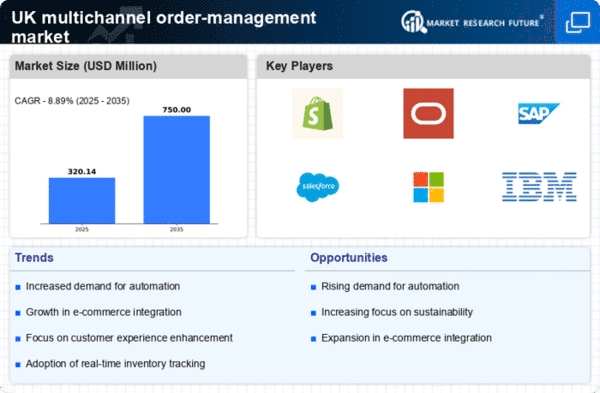
As per Market Research Future analysis, the UK Multichannel Order Management Market size was estimated at 294.0 USD Million in 2024. The Multichannel Order-management market is projected to grow from 320.14 USD Million in 2025 to 750.0 USD Million by 2035, exhibiting a compound annual growth rate (CAGR) of 8.8% during the forecast period 2025 - 2035

Key Market Trends & Highlights

The UK multichannel order-management market is evolving towards greater integration of technology and sustainability.

  • The integration of Artificial Intelligence is transforming operational efficiencies across the market.
  • A notable focus on sustainability is shaping consumer preferences and business practices.
  • The rise of omnichannel strategies is becoming essential for retailers to meet diverse customer needs.
  • E-commerce growth surge and consumer demand for personalization are key drivers propelling market expansion.

Market Size & Forecast

2024 Market Size 294.0 (USD Million)
2035 Market Size 750.0 (USD Million)
CAGR (2025 - 2035) 8.89%

Major Players

Shopify (CA), Oracle (US), SAP (DE), Salesforce (US), Microsoft (US), IBM (US), ChannelAdvisor (US), Brightpearl (GB), Zoho (IN)

Our Impact
Enabled $4.3B Revenue Impact for Fortune 500 and Leading Multinationals
Partnering with 2000+ Global Organizations Each Year
30K+ Citations by Top-Tier Firms in the Industry

UK Multichannel Order Management Market Trends

The UK Multichannel Order Management Market is currently experiencing a transformative phase, driven by the increasing demand for seamless integration across various sales channels. Retailers are recognizing the necessity of providing a unified customer experience, which has led to the adoption of advanced technologies that facilitate real-time inventory management and order processing. This shift appears to be influenced by changing consumer behaviors, as shoppers increasingly expect flexibility in how they interact with brands. Consequently, businesses are investing in sophisticated software solutions that enable them to manage orders efficiently across multiple platforms, thereby enhancing operational efficiency and customer satisfaction. Moreover, the competitive landscape within the multichannel order-management market is evolving, with companies striving to differentiate themselves through innovative service offerings. The emphasis on data analytics is becoming more pronounced, as organizations seek to leverage insights for better decision-making and personalized marketing strategies. This trend suggests a growing recognition of the importance of data-driven approaches in optimizing supply chain operations and improving customer engagement. As the market continues to mature, it is likely that collaboration between technology providers and retailers will intensify, fostering an environment conducive to further advancements in order management solutions.

Integration of Artificial Intelligence

The integration of artificial intelligence (AI) technologies is becoming increasingly prevalent in the multichannel order-management market. AI-driven solutions are enhancing predictive analytics, enabling businesses to forecast demand more accurately and optimize inventory levels. This trend suggests that companies are leveraging AI to streamline operations and improve customer experiences.

Focus on Sustainability

Sustainability is emerging as a key consideration within the multichannel order-management market. Retailers are increasingly prioritizing eco-friendly practices, such as reducing packaging waste and optimizing delivery routes to minimize carbon footprints. This shift indicates a growing awareness of environmental impact among consumers and businesses alike.

Rise of Omnichannel Strategies

The rise of omnichannel strategies is reshaping the multichannel order-management market. Businesses are focusing on creating cohesive shopping experiences across online and offline channels. This trend highlights the importance of ensuring that customers receive consistent service, regardless of the platform they choose to engage with.

UK Multichannel Order Management Market Drivers

E-commerce Growth Surge

The rapid expansion of e-commerce in the UK is a primary driver for the multichannel order-management market. With online retail sales reaching approximately £200 billion in 2025, businesses are increasingly adopting multichannel strategies to cater to diverse consumer preferences. This shift necessitates robust order-management systems that can seamlessly integrate various sales channels, ensuring efficient inventory management and order fulfillment. As consumers demand faster delivery and more flexible shopping options, companies are compelled to enhance their operational capabilities. The multichannel order-management market is thus positioned to benefit from this e-commerce growth, as businesses seek solutions that can streamline processes and improve customer satisfaction.

Shift Towards Subscription Models

The rise of subscription-based business models is emerging as a significant driver for the multichannel order-management market. In the UK, subscription services are gaining traction, with an estimated market value of £1.5 billion in 2025. This shift requires businesses to adopt flexible order-management systems capable of handling recurring orders and managing customer subscriptions across various channels. As consumers increasingly prefer the convenience of subscription services, companies must ensure their order-management solutions can accommodate this trend. The multichannel order-management market is thus likely to see increased demand for systems that support subscription management, enhancing customer retention and satisfaction.

Consumer Demand for Personalisation

In the UK, consumers are increasingly seeking personalised shopping experiences, which significantly impacts the multichannel order-management market. Research indicates that 80% of consumers are more likely to make a purchase when brands offer personalised experiences. This trend compels retailers to implement sophisticated order-management systems that can track customer preferences across multiple channels. By leveraging data analytics, businesses can tailor their offerings and communications, enhancing customer engagement and loyalty. Consequently, the demand for advanced multichannel order-management solutions is likely to rise, as companies strive to meet the expectations of a more discerning consumer base.

Regulatory Compliance and Standards

The multichannel order-management market in the UK is also influenced by the need for compliance with various regulations and standards. Businesses must navigate complex legal frameworks, including data protection laws and consumer rights regulations. Compliance not only ensures legal adherence but also builds consumer trust. As companies expand their operations across multiple channels, the complexity of maintaining compliance increases. This scenario drives the demand for multichannel order-management systems that incorporate compliance features, enabling businesses to manage their operations effectively while adhering to regulatory requirements. The focus on compliance is likely to shape the development of solutions within the market.

Technological Advancements in Logistics

Technological innovations in logistics are transforming the landscape of the multichannel order-management market. The integration of automation, artificial intelligence, and real-time tracking systems is enhancing supply chain efficiency. In the UK, logistics technology investments are projected to exceed £10 billion by 2026, indicating a strong commitment to improving operational capabilities. These advancements enable businesses to optimise inventory levels, reduce lead times, and enhance order accuracy. As a result, companies are increasingly adopting multichannel order-management solutions that can leverage these technologies, ensuring they remain competitive in a rapidly evolving market.


Market Segment Insights

By Solution: Software (Largest) vs. Services (Fastest-Growing)

In the UK multichannel order-management market, Software takes the lead with a predominant market share, reflecting a strong demand for efficient and technology-driven solutions. Conversely, Services are rapidly gaining traction, appealing to businesses looking for tailored support and integration with existing workflows. This distribution underscores the critical role that software plays in operational efficiency while also highlighting the emerging importance of services in this competitive landscape. Growth trends in this segment are influenced by an increasing shift towards e-commerce and digital transformation initiatives within organizations. The demand for Software is propelled by the need for better inventory management and streamlined processes, while Services are becoming essential as companies seek expertise to enhance their operational capabilities. This evolving dynamic points towards a promising future for both segments, with Services likely to continue their upward trajectory.

Software (Dominant) vs. Services (Emerging)

Software in the UK multichannel order-management market is characterized by robust functionalities that facilitate seamless order processing, real-time inventory tracking, and enhanced customer experiences. Its dominance is driven by technological advancements that offer scalability and integration capabilities. On the other hand, Services are emerging as a critical component, providing essential support ranging from implementation to ongoing operational enhancements. This segment caters to businesses that require strategic guidance and personalized solutions, thus filling a vital gap in operational efficiency. As digital transformation accelerates, both Software and Services are poised to play key roles, but with Software leading in market presence and Services rising quickly in responsiveness to market needs.

By Deployment Type: Cloud-Based (Largest) vs. On-Premises (Fastest-Growing)

In the UK multichannel order-management market, cloud-based solutions dominate the deployment type segment, holding a significant share due to their flexibility and scalability. Businesses increasingly prefer cloud solutions for their ease of integration and cost-effectiveness, enabling them to streamline operations and enhance customer service. Conversely, the on-premises deployment is witnessing rapid growth as companies seek to maintain control over their systems and data. This trend is driven by the increasing demand for robust data security measures and customized configurations, allowing businesses to tailor the systems to their unique needs. As digital transformation continues to shape the marketplace, both deployment types are set to play crucial roles in the evolving landscape.

Cloud-Based (Dominant) vs. On-Premises (Emerging)

Cloud-based solutions are at the forefront of the deployment landscape, offering unparalleled scalability and accessibility for businesses in the UK multichannel order-management market. They facilitate seamless integration with existing systems and enhance collaborative efforts across different departments. On the other hand, on-premises solutions are becoming increasingly popular among organizations that prioritize control over their data and system infrastructure. This deployment type allows for customized solutions that align closely with specific operational requirements. The contrasting characteristics of these segments reflect the diverse needs of businesses as they navigate the complexities of order management.

By End User: E-commerce (Largest) vs. Retail (Fastest-Growing)

The UK multichannel order-management market exhibits a diverse distribution among its end-user segments, with E-commerce holding the largest share, primarily driven by shifting consumer preferences towards online shopping and the growing reliance on digital platforms. Retail stands out as a robust segment, benefiting from the increasing integration of online and offline experiences, which enhances customer engagement and satisfaction. Meanwhile, Wholesale and Manufacturing segments also contribute to the marketplace, but to a lesser extent, reflecting varied adoption rates of order-management systems across sectors. Growth trends showcase significant potential for E-commerce as it capitalizes on technological advancements and evolving consumer habits. Factors such as improved logistics, user-friendly interfaces, and personalized shopping experiences are driving this segment's expansion. Retail, recognized as the fastest-growing segment, is adapting rapidly to the omnichannel approach, focusing on seamless integration of physical and digital channels. This growth is bolstered by retail companies investing in advanced order-management solutions to enhance operational efficiency and response to market demands.

Retail (Dominant) vs. Manufacturing (Emerging)

In the context of the UK multichannel order-management market, Retail is a dominant segment characterized by its adaptability and responsiveness to changing consumer preferences. Retail companies are increasingly leveraging advanced technologies to streamline operations, enhance customer experiences, and optimize inventory management. The focus on omnichannel strategies allows retailers to bridge the gap between online and offline sales, creating a cohesive shopping experience for consumers. On the other hand, Manufacturing is emerging as a vital segment, gradually adopting order-management systems to improve production efficiency and supply chain management. The shift towards Just-in-Time (JIT) manufacturing processes and demand-driven production models highlights the growing recognition of the importance of integrated order-management solutions in driving competitiveness in this sector.

By Functionality: Order Processing (Largest) vs. Inventory Management (Fastest-Growing)

In the UK multichannel order-management market, Order Processing leads the functionality segment, capturing the largest market share among its peers. This segment is crucial for businesses, allowing them to handle customer orders efficiently and meet service expectations. Inventory Management, while currently holding a smaller share, is recognized as the fastest-growing functionality, driven by increased demand for real-time stock tracking and improved operational efficiency. Growth trends in the UK multichannel order-management market highlight a strong inclination towards automation and integration of systems to streamline operations. Factors such as the rise of e-commerce, heightened consumer expectations, and advancements in technology significantly contribute to the rapid development of functionalities like Inventory Management. Businesses are increasingly prioritizing these enhancements to remain competitive and responsive in a dynamic market environment.

Order Processing: Dominant vs. Payment Processing: Emerging

Order Processing stands out as the dominant functionality within the UK multichannel order-management market, characterized by its critical role in fulfilling customer orders promptly and accurately. This segment drives efficiency and customer satisfaction, ensuring that businesses can handle high volumes of transactions effortlessly. In contrast, Payment Processing emerges as a vital and rapidly developing area, focused on enhancing security and speed in transactions. With consumers increasingly seeking seamless payment experiences, this functionality is evolving to incorporate innovative solutions such as mobile payments and digital wallets. Together, these functionalities reflect the market's adaptability and responsiveness to changing consumer needs, with Order Processing leading in stability while Payment Processing is positioned for remarkable growth.

Get more detailed insights about UK Multichannel Order Management Market

Key Players and Competitive Insights

The multichannel order-management market is currently characterized by a dynamic competitive landscape, driven by the increasing demand for seamless integration across various sales channels. Key players are actively pursuing strategies that emphasize innovation, digital transformation, and strategic partnerships to enhance their market positioning. For instance, Shopify (CA) has focused on expanding its ecosystem through partnerships with logistics providers, thereby streamlining order fulfillment processes. Similarly, Oracle (US) has been enhancing its cloud-based solutions to facilitate better data analytics and customer insights, which are crucial for optimizing order management across multiple channels. These strategies collectively contribute to a competitive environment that is increasingly reliant on technological advancements and customer-centric solutions.In terms of business tactics, companies are increasingly localizing their operations and optimizing supply chains to respond swiftly to market demands. The competitive structure of the market appears moderately fragmented, with several players vying for market share. However, the influence of major companies like SAP (DE) and Salesforce (US) is substantial, as they leverage their extensive resources and technological capabilities to shape market trends and consumer expectations.

In October SAP (DE) announced the launch of its new AI-driven order management system, which aims to enhance predictive analytics capabilities for retailers. This strategic move is significant as it positions SAP to better serve clients looking to leverage data for improved decision-making in their order fulfillment processes. The integration of AI into order management systems is likely to set a new standard in the industry, emphasizing the importance of data-driven strategies.

In September Salesforce (US) expanded its partnership with a leading logistics firm to enhance its order management capabilities. This collaboration is expected to streamline the order-to-delivery process, thereby improving customer satisfaction. The strategic importance of this partnership lies in its potential to provide Salesforce's clients with a more integrated solution, which is increasingly vital in a market where customer expectations are continuously evolving.

In November Brightpearl (GB) launched a new feature that allows retailers to automate inventory management across multiple channels. This development is crucial as it addresses the growing need for efficiency in inventory control, which is a key component of effective order management. By automating these processes, Brightpearl positions itself as a leader in providing solutions that enhance operational efficiency for retailers.

As of November the competitive trends in the multichannel order-management market are heavily influenced by digitalization, sustainability, and the integration of AI technologies. Strategic alliances are becoming increasingly important, as companies recognize the need to collaborate to enhance their service offerings. Looking ahead, it appears that competitive differentiation will increasingly hinge on innovation and technological advancements rather than solely on price. Companies that can effectively integrate cutting-edge technologies and maintain reliable supply chains are likely to emerge as leaders in this evolving landscape.

Key Companies in the UK Multichannel Order Management Market include

Industry Developments

The UK Multichannel Order Management Market has witnessed significant developments recently, particularly with companies like Skubana, Shopify, and Linnworks focusing on enhancing their software capabilities to streamline order processing across multiple platforms. In March 2023, Orderhive announced strategic partnerships designed to enhance inventory management features, reflecting the growing inclination towards integrated solutions.

Meanwhile, in June 2022, trade platform DEAR Inventory enhanced its offering by integrating with various e-commerce platforms, thereby catering to the complex needs of retailers. Recent acquisitions have also shaped the landscape; in October 2023, Finale Inventory acquired a smaller competitor to expand its market reach, demonstrating the competitive nature of the sector. The market’s valuation has been on an upward trajectory, with a reported growth rate of approximately 12 percent from 2021 to 2023, attributed to increasing demand for efficient order management solutions amid the rise in online retailing.

Notably, companies like Brightpearl and ChannelAdvisor have been at the forefront of responding to changing consumer behaviors, ensuring their platforms remain robust in the dynamic e-commerce environment. This landscape shows no signs of slowing as digital transformation continues to accelerate in the UK.

Future Outlook

UK Multichannel Order Management Market Future Outlook

The Multichannel Order Management Market is projected to grow at an 8.89% CAGR from 2025 to 2035, driven by technological advancements and increasing consumer demand for seamless shopping experiences.

New opportunities lie in:

  • Integration of AI-driven analytics for inventory optimization.
  • Development of mobile applications for real-time order tracking.
  • Expansion of automated fulfillment centers to enhance delivery efficiency.

By 2035, the market is expected to achieve robust growth, driven by innovation and evolving consumer preferences.

Market Segmentation

UK Multichannel Order Management Market End User Outlook

  • Retail
  • Wholesale
  • E-commerce
  • Manufacturing

UK Multichannel Order Management Market Solution Outlook

  • Software
  • Services
  • Consulting
  • Integration

UK Multichannel Order Management Market Functionality Outlook

  • Order Processing
  • Inventory Management
  • Shipping Management
  • Payment Processing

UK Multichannel Order Management Market Deployment Type Outlook

  • Cloud-Based
  • On-Premises

Report Scope

MARKET SIZE 2024 294.0(USD Million)
MARKET SIZE 2025 320.14(USD Million)
MARKET SIZE 2035 750.0(USD Million)
COMPOUND ANNUAL GROWTH RATE (CAGR) 8.89% (2025 - 2035)
REPORT COVERAGE Revenue Forecast, Competitive Landscape, Growth Factors, and Trends
BASE YEAR 2024
Market Forecast Period 2025 - 2035
Historical Data 2019 - 2024
Market Forecast Units USD Million
Key Companies Profiled Shopify (CA), Oracle (US), SAP (DE), Salesforce (US), Microsoft (US), IBM (US), ChannelAdvisor (US), Brightpearl (GB), Zoho (IN)
Segments Covered Solution, Deployment Type, End User, Functionality
Key Market Opportunities Integration of artificial intelligence for enhanced inventory management in the multichannel order-management market.
Key Market Dynamics Rising consumer demand for seamless integration across platforms drives innovation in multichannel order-management solutions.
Countries Covered UK
Leave a Comment

FAQs

What is the expected market size of the UK Multichannel Order Management Market in 2024?

The UK Multichannel Order Management Market is expected to be valued at approximately 299.62 million USD in 2024.

How much is the UK Multichannel Order Management Market projected to grow by 2035?

By 2035, the market is projected to reach a valuation of about 942.98 million USD.

What is the expected compound annual growth rate (CAGR) for the UK Multichannel Order Management Market during the forecast period?

The expected CAGR for the UK Multichannel Order Management Market from 2025 to 2035 is approximately 10.985%.

Which segment is anticipated to dominate the UK Multichannel Order Management Market?

The software segment is anticipated to be a dominant player, with an expected valuation of 120.0 million USD in 2024.

What are the projected values for the services segment by 2035 in the UK Multichannel Order Management Market?

The services segment is projected to reach a valuation of around 290.0 million USD by 2035.

Who are some of the key players in the UK Multichannel Order Management Market?

Key players include Skubana, Shopify, and ChannelAdvisor among others.

What is the expected market size for the consulting segment of the UK Multichannel Order Management Market in 2024?

The consulting segment is expected to be valued at approximately 45.0 million USD in 2024.

What is the value of the integration sub-segment in the UK Multichannel Order Management Market for 2024?

The integration segment is valued at about 44.62 million USD in 2024.

What trends are driving growth in the UK Multichannel Order Management Market?

Key trends include increasing demand for integrated solutions and the rise of e-commerce marketplaces.

What challenges might impact the UK Multichannel Order Management Market's growth?

Challenges may include competition from emerging technologies and fluctuating consumer preferences.

Download Free Sample

Kindly complete the form below to receive a free sample of this Report

Compare Licence

×
Features License Type
Single User Multiuser License Enterprise User
Price $4,950 $5,950 $7,250
Maximum User Access Limit 1 User Upto 10 Users Unrestricted Access Throughout the Organization
Free Customization
Direct Access to Analyst
Deliverable Format
Platform Access
Discount on Next Purchase 10% 15% 15%
Printable Versions