×
Request Free Sample ×

Kindly complete the form below to receive a free sample of this Report

* Please use a valid business email

Leading companies partner with us for data-driven Insights

clients tt-cursor
Hero Background

Japan Multichannel Order Management Market

ID: MRFR/ICT/62422-HCR
200 Pages
Aarti Dhapte
February 2026

Japan Multichannel Order Management Market Size, Share and Trends Analysis Report By Solution (Software, Services, Consulting, Integration), By Deployment Type (Cloud-Based, On-Premises), By End User (Retail, Wholesale, E-commerce, Manufacturing) and By Functionality (Order Processing, Inventory Management, Shipping Management, Payment Processing)-Forecast to 2035

Share:
Download PDF ×

We do not share your information with anyone. However, we may send you emails based on your report interest from time to time. You may contact us at any time to opt-out.

Japan Multichannel Order Management Market Infographic
Purchase Options

Japan Multichannel Order Management Market Summary

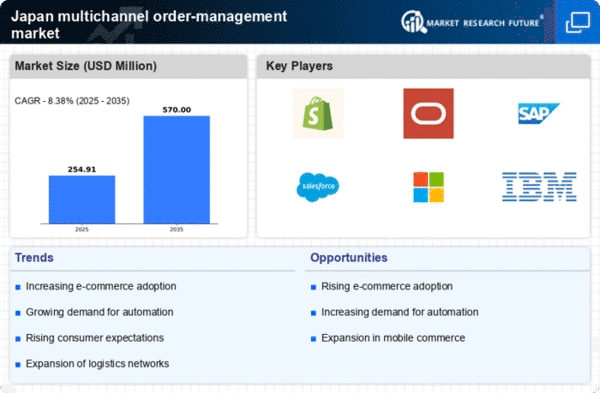
As per Market Research Future analysis, the Japan Multichannel Order Management Market size was estimated at 235.2 USD Million in 2024. The Multichannel Order-management market is projected to grow from 254.91 USD Million in 2025 to 570.0 USD Million by 2035, exhibiting a compound annual growth rate (CAGR) of 8.3% during the forecast period 2025 - 2035

Key Market Trends & Highlights

The Japan multichannel order-management market is experiencing robust growth driven by technological advancements and evolving consumer preferences.

  • The integration of e-commerce platforms is becoming increasingly prevalent, enhancing operational efficiency.
  • A strong focus on customer experience is evident, as businesses strive to meet rising consumer expectations.
  • Automation technologies are being adopted widely, streamlining order management processes and reducing costs.
  • Rising e-commerce adoption and consumer demand for personalization are key drivers propelling market growth.

Market Size & Forecast

2024 Market Size 235.2 (USD Million)
2035 Market Size 570.0 (USD Million)
CAGR (2025 - 2035) 8.38%

Major Players

Shopify (CA), Oracle (US), SAP (DE), Salesforce (US), Microsoft (US), IBM (US), ChannelAdvisor (US), Brightpearl (GB), Zoho (IN)

Our Impact
Enabled $4.3B Revenue Impact for Fortune 500 and Leading Multinationals
Partnering with 2000+ Global Organizations Each Year
30K+ Citations by Top-Tier Firms in the Industry

Japan Multichannel Order Management Market Trends

The Japan Multichannel Order Management Market is currently experiencing a transformative phase. This transformation is driven by the increasing complexity of consumer purchasing behaviors and the rapid evolution of technology. In Japan, businesses are adapting to a landscape where customers expect seamless integration across various sales channels. This shift necessitates sophisticated systems that can manage orders efficiently, ensuring that inventory levels are accurately reflected in real-time across platforms. As a result, companies are investing in advanced software solutions that facilitate better visibility and control over their supply chains. Furthermore, the emphasis on customer experience is prompting organizations to refine their order fulfillment processes, thereby enhancing satisfaction and loyalty. In addition, the multichannel order-management market is witnessing a growing trend towards automation and artificial intelligence. These technologies are being leveraged to streamline operations, reduce human error, and optimize inventory management. Japanese firms are increasingly recognizing the potential of data analytics to inform decision-making and improve operational efficiency. As the market continues to evolve, it appears that the integration of innovative technologies will play a crucial role in shaping the future of order management, enabling businesses to respond swiftly to market demands and consumer preferences.

Integration of E-commerce Platforms

The integration of various e-commerce platforms is becoming a focal point for businesses in the multichannel order-management market. Companies are increasingly seeking solutions that allow for seamless connectivity between online and offline sales channels. This trend is driven by the need to provide customers with a unified shopping experience, where inventory and order information is consistent across all platforms.

Focus on Customer Experience

Enhancing customer experience is a primary objective for many organizations within the multichannel order-management market. Businesses are prioritizing strategies that improve order accuracy and delivery speed. This focus on customer satisfaction is leading to the adoption of technologies that facilitate real-time tracking and communication, ensuring that customers remain informed throughout the order process.

Adoption of Automation Technologies

The adoption of automation technologies is reshaping operations in the multichannel order-management market. Companies are increasingly implementing automated systems to manage inventory and streamline order processing. This shift not only reduces operational costs but also enhances efficiency, allowing businesses to respond more effectively to fluctuating consumer demands.

Japan Multichannel Order Management Market Drivers

Rising E-commerce Adoption

The increasing adoption of e-commerce in Japan is a pivotal driver for the multichannel order-management market. As consumers increasingly prefer online shopping, businesses are compelled to enhance their order management systems to accommodate this shift. In 2025, e-commerce sales in Japan are projected to reach approximately $200 billion, reflecting a growth rate of around 10% annually. This surge necessitates robust multichannel order-management solutions that can seamlessly integrate various sales channels, ensuring efficient order processing and fulfillment. Companies that invest in advanced order management systems are likely to gain a competitive edge, as they can respond more effectively to consumer demands and preferences. Thus, the multichannel order-management market is positioned for significant expansion, driven by the need for businesses to adapt to the evolving retail landscape.

Consumer Demand for Personalization

Consumer demand for personalization is a crucial driver of the multichannel order-management market. Japanese consumers are increasingly seeking tailored shopping experiences, which compels retailers to adopt more flexible and responsive order management systems. In 2025, it is projected that 70% of consumers in Japan will expect personalized services, influencing how businesses approach their order fulfillment strategies. This trend necessitates the integration of customer data into order management processes, allowing for customized promotions and product recommendations. As a result, companies that leverage multichannel order-management solutions to deliver personalized experiences are likely to enhance customer loyalty and drive sales growth. The market is thus expected to expand as businesses strive to meet these evolving consumer expectations.

Regulatory Compliance and Standards

Regulatory compliance and standards are increasingly shaping the multichannel order-management market in Japan. As the government implements stricter regulations regarding data protection and consumer rights, businesses must adapt their order management practices accordingly. In 2025, compliance-related costs for Japanese retailers are anticipated to rise by 15%, prompting a reevaluation of existing systems. Companies that fail to comply with these regulations risk facing significant penalties and reputational damage. Consequently, there is a growing demand for multichannel order-management solutions that incorporate compliance features, ensuring that businesses can navigate the complex regulatory landscape effectively. This driver indicates that investment in compliant systems is not only necessary for legal adherence but also for maintaining consumer trust.

Shift Towards Omnichannel Retailing

The shift towards omnichannel retailing is a significant driver for the multichannel order-management market. Japanese retailers are increasingly recognizing the importance of providing a seamless shopping experience across various channels, including online, mobile, and brick-and-mortar stores. In 2025, it is estimated that omnichannel sales will account for over 50% of total retail sales in Japan, highlighting the need for integrated order management solutions. This trend compels businesses to adopt systems that can synchronize inventory, orders, and customer interactions across all platforms. As a result, the multichannel order-management market is likely to experience substantial growth, driven by the necessity for retailers to create cohesive and efficient shopping experiences for consumers.

Technological Advancements in Logistics

Technological advancements in logistics are significantly influencing the multichannel order-management market in Japan. Innovations such as artificial intelligence, machine learning, and real-time data analytics are transforming how businesses manage their supply chains. In 2025, it is estimated that logistics technology spending in Japan will exceed $30 billion, indicating a strong focus on enhancing operational efficiency. These technologies enable companies to optimize inventory management, reduce delivery times, and improve customer satisfaction. As logistics becomes increasingly complex, the demand for sophisticated multichannel order-management solutions that can integrate with these technologies is likely to rise. This trend suggests that businesses must invest in advanced systems to remain competitive in the rapidly evolving market.


Market Segment Insights

By Solution: Software (Largest) vs. Services (Fastest-Growing)

In the Japan multichannel order-management market, the market share distribution is significantly tilted towards the software segment, which serves as the backbone of operational efficiencies across various industries. Meanwhile, the services sector is witnessing a notable increase in its share as businesses prioritize end-to-end solutions, leading to a more integrated approach towards order management. Growth trends in the solution segment indicate a robust demand for comprehensive software solutions that facilitate omnichannel capabilities. Additionally, the rapid expansion of e-commerce and changing consumer behaviors are driving the services sector, with companies increasingly looking for specialized services that enhance their order fulfillment processes and customer engagement strategies.

Software: Software (Dominant) vs. Services (Emerging)

The software segment stands out as the dominant force in the Japan multichannel order-management market, boasting advanced features that streamline inventory management, order processing, and customer relationship management. As businesses seek more efficient and automated systems, software solutions are rapidly evolving, incorporating AI and analytics for predictive insights. Conversely, the services segment is emerging as a crucial player, providing tailored consulting and integration services that complement software offerings. This burgeoning segment focuses on delivering value through customized strategies and operational support, ensuring businesses can harness the full potential of their order management systems.

By Deployment Type: Cloud-Based (Largest) vs. On-Premises (Fastest-Growing)

In the Japan multichannel order-management market, the deployment type segment is predominantly led by cloud-based solutions, which hold a significant market share due to their scalability and lower operational costs. Cloud-based deployments allow businesses to manage orders from multiple channels efficiently, enabling them to adapt swiftly to changing market demands. Conversely, on-premises solutions are emerging rapidly as businesses look for greater control over their data and operations. This segment's growth is driven by increasing concerns over data security and the need for customization, which on-premise systems inherently provide. As companies weigh the trade-offs between flexibility and control, on-premises solutions are gaining traction among specific sectors seeking tailored solutions.

Cloud-Based (Dominant) vs. On-Premises (Emerging)

Cloud-based deployments in the Japan multichannel order-management market are characterized by their flexibility, allowing businesses to scale operations quickly without significant upfront investments. These solutions typically offer seamless integration across various sales channels, enhancing the overall efficiency of order management. On the other hand, on-premises solutions are gaining popularity as they provide businesses with enhanced security and customization options. Companies in industries that prioritize data privacy, such as finance and healthcare, are increasingly considering on-premises deployments to maintain strict control over their data environments. Both deployment types cater to distinct business needs, shaping the competitive landscape of the order management market in Japan.

By End User: E-commerce (Largest) vs. Retail (Fastest-Growing)

The Japan multichannel order-management market showcases distinct segment values, with E-commerce commanding the largest share. This segment has benefited from the rapid digital transformation and the growing trend of online shopping among consumers. Retail, while smaller in comparison, is experiencing a surge in market adoption due to the rise of omnichannel strategies that integrate online and offline shopping experiences. As businesses adapt to changing consumer preferences, the fragmentation in retail will likely continue to provide opportunities for growth in this channel. Growth trends in the Japan multichannel order-management market are primarily driven by the increasing demand for seamless and efficient order processing across various segments. E-commerce is thriving as consumers increasingly prefer online shopping for its convenience and broad product range. Concurrently, retail is emerging robustly, fueled by innovations in logistics and inventory management solutions that streamline operations. The manufacturing sector remains stable, but it plays a critical role in providing products that feed into these growing channels, thus creating a symbiotic relationship among all segments.

E-commerce: E-commerce (Dominant) vs. Retail (Emerging)

In the Japan multichannel order-management market, E-commerce stands out as the dominant force, leveraging advancements in technology to enhance customer experience and operational efficiency. Its superiority derives from the ability to provide personalized shopping journeys and robust logistics management, which are essential in meeting consumer expectations. Retail, on the other hand, is rapidly emerging, driven by the integration of online capabilities into traditional brick-and-mortar stores. This fusion supports greater flexibility and responsiveness to market demands. Both segments are characterized by their need for sophisticated order management solutions that cater to diverse consumer behaviors and preferences, leading to innovations that bridge the gap between online and offline retailing.

By Functionality: Order Processing (Largest) vs. Inventory Management (Fastest-Growing)

In the Japan multichannel order-management market, the order processing segment commands a significant share, representing the largest functional area. This dominance can be attributed to the increasing demand for efficient customer service and timely order fulfillment. Following closely is the inventory management segment, which is gaining traction due to evolving consumer expectations for real-time data and better stock visibility, making it an essential function in multichannel operations. The growth trends in this market are primarily driven by advancements in technology and the increasing need for integration across various sales channels. Businesses are increasingly investing in sophisticated systems that enhance order processing efficiency while ensuring accurate inventory tracking. As e-commerce continues to expand in Japan, effective shipping management and seamless payment processing are also critical, with these areas being enhanced through technological innovations that cater to consumer needs.

Order Processing: Dominant vs. Inventory Management: Emerging

Order processing is the dominant functionality in the Japan multichannel order-management market, characterized by its critical role in ensuring customer satisfaction through streamlined and quick service. This segment stands out for its robust ability to handle large volumes of transactions effortlessly, integrating various sales channels into a cohesive operation. In contrast, inventory management is quickly emerging due to the demand for real-time insights and the shift towards automated solutions. It focuses on optimizing stock levels and reducing overhead costs, making it indispensable for modern retailers who wish to adapt to rapid market changes. The combination of both functionalities creates a synergetic effect, enabling businesses to enhance their operational efficiency.

Get more detailed insights about Japan Multichannel Order Management Market

Key Players and Competitive Insights

The multichannel order-management market in Japan is characterized by a dynamic competitive landscape, driven by the increasing demand for seamless customer experiences and efficient supply chain operations. Key players such as Shopify (CA), Oracle (US), and SAP (DE) are strategically positioned to leverage their technological capabilities and extensive service offerings. Shopify (CA) focuses on empowering small to medium-sized enterprises (SMEs) through user-friendly platforms that facilitate multichannel selling, while Oracle (US) emphasizes its robust cloud solutions to enhance operational efficiency for larger enterprises. SAP (DE) continues to innovate with its integrated solutions that cater to diverse industries, thereby shaping a competitive environment that prioritizes technological advancement and customer-centric strategies.In terms of business tactics, companies are increasingly localizing their operations to better serve the Japanese market, optimizing supply chains to enhance responsiveness and reduce costs. The competitive structure of the market appears moderately fragmented, with a mix of established players and emerging startups. This fragmentation allows for a variety of innovative solutions, although the influence of key players remains substantial, as they set benchmarks for service quality and technological integration.

In October Shopify (CA) announced a partnership with a leading Japanese logistics provider to enhance its fulfillment capabilities within the region. This strategic move is likely to bolster Shopify's position by improving delivery times and customer satisfaction, which are critical in the competitive landscape of e-commerce. The partnership underscores the importance of logistics in multichannel order management, particularly in a market where consumer expectations for speed and reliability are high.

In September Oracle (US) launched a new AI-driven analytics tool designed to optimize inventory management for retailers operating across multiple channels. This tool is expected to provide businesses with real-time insights, enabling them to make informed decisions regarding stock levels and distribution strategies. The introduction of such technology indicates Oracle's commitment to enhancing operational efficiency and supporting retailers in navigating the complexities of multichannel environments.

In August SAP (DE) expanded its cloud-based solutions tailored for the Japanese market, focusing on integrating advanced data analytics and machine learning capabilities. This expansion is significant as it allows SAP to cater to the growing demand for data-driven decision-making among Japanese retailers. By enhancing its offerings, SAP positions itself as a leader in providing comprehensive solutions that address the unique challenges faced by businesses in the region.

As of November the competitive trends in the multichannel order-management market are increasingly defined by digitalization, sustainability, and the integration of AI technologies. Strategic alliances among key players are shaping the landscape, fostering innovation and enhancing service delivery. The shift from price-based competition to a focus on technological differentiation and supply chain reliability is evident, suggesting that companies must continuously innovate to maintain a competitive edge. Looking ahead, the evolution of competitive differentiation will likely hinge on the ability to leverage technology and respond to changing consumer preferences.

Key Companies in the Japan Multichannel Order Management Market include

Industry Developments

Recent developments in the Japan Multichannel Order Management Market have highlighted significant growth and technological advancements. Major companies like Oracle, Shopify, and SAP have been investing in enhancing their software solutions to better serve e-commerce retailers and streamline their order management processes.

In recent months, Skubana and BigCommerce have also expanded their functionalities to cater to local requirements, aiding businesses in managing multiple sales channels more efficiently. Notably, in August 2023, Salesforce announced a collaboration with local Japanese retailers to integrate advanced inventory management features, which reflects the rising demand for seamless operations in this market. Additionally, the market has seen an increasing adoption of cloud-based solutions, allowing businesses to scale their operations effectively.

In terms of mergers and acquisitions, there have been no significant announcements involving the specified companies in the last three months, indicating a stable period for corporate restructuring. Furthermore, the government's focus on digital transformation is pushing companies in the Japan Multichannel Order Management Market to innovate, enhancing competition and service offerings to meet the evolving needs of consumers and businesses alike. These trends show that the sector is well-positioned for growth in the coming years.

Future Outlook

Japan Multichannel Order Management Market Future Outlook

The Multichannel Order Management Market in Japan is projected to grow at an 8.38% CAGR from 2025 to 2035, driven by technological advancements and increasing consumer demand.

New opportunities lie in:

  • Integration of AI-driven analytics for inventory optimization.
  • Expansion of mobile order management solutions for enhanced customer engagement.
  • Development of automated fulfillment centers to reduce operational costs.

By 2035, the market is expected to achieve substantial growth, positioning itself as a leader in efficiency and innovation.

Market Segmentation

Japan Multichannel Order Management Market End User Outlook

  • Retail
  • Wholesale
  • E-commerce
  • Manufacturing

Japan Multichannel Order Management Market Solution Outlook

  • Software
  • Services
  • Consulting
  • Integration

Japan Multichannel Order Management Market Functionality Outlook

  • Order Processing
  • Inventory Management
  • Shipping Management
  • Payment Processing

Japan Multichannel Order Management Market Deployment Type Outlook

  • Cloud-Based
  • On-Premises

Report Scope

MARKET SIZE 2024 235.2(USD Million)
MARKET SIZE 2025 254.91(USD Million)
MARKET SIZE 2035 570.0(USD Million)
COMPOUND ANNUAL GROWTH RATE (CAGR) 8.38% (2025 - 2035)
REPORT COVERAGE Revenue Forecast, Competitive Landscape, Growth Factors, and Trends
BASE YEAR 2024
Market Forecast Period 2025 - 2035
Historical Data 2019 - 2024
Market Forecast Units USD Million
Key Companies Profiled Shopify (CA), Oracle (US), SAP (DE), Salesforce (US), Microsoft (US), IBM (US), ChannelAdvisor (US), Brightpearl (GB), Zoho (IN)
Segments Covered Solution, Deployment Type, End User, Functionality
Key Market Opportunities Integration of advanced analytics and automation enhances efficiency in the multichannel order-management market.
Key Market Dynamics Rising demand for seamless integration across platforms drives innovation in multichannel order-management solutions.
Countries Covered Japan
Leave a Comment

FAQs

What is the projected market size of the Japan Multichannel Order Management Market in 2024?

The Japan Multichannel Order Management Market is expected to be valued at 299.62 million USD in 2024.

What is the expected market size for the Japan Multichannel Order Management Market by 2035?

By 2035, the market is projected to reach 792.19 million USD.

What is the anticipated compound annual growth rate (CAGR) for the Japan Multichannel Order Management Market from 2025 to 2035?

The market is expected to grow at a CAGR of 9.241% during the forecast period from 2025 to 2035.

What is the expected market size for the software segment of the Japan Multichannel Order Management Market in 2024?

The software segment is expected to be valued at 120.0 million USD in 2024.

What is the projected market value of consulting services in the Japan Multichannel Order Management Market by 2035?

The consulting services segment is expected to reach 130.0 million USD by 2035.

Who are the key players in the Japan Multichannel Order Management Market?

Major players in the market include Oracle, Shopify, SAP, Salesforce, and Microsoft.

What is the projected value of the services segment in the Japan Multichannel Order Management Market in 2035?

The services segment is expected to grow to 220.0 million USD by 2035.

What is the expected market size of the integration segment in the Japan Multichannel Order Management Market in 2024?

The integration segment is projected to be valued at 49.62 million USD in 2024.

What is the value of the entire Japan Multichannel Order Management Market expected to be in 2025?

The market is expected to have a value in line with the growth trend towards the overall figure projected for 2035.

What are the emerging trends influencing the Japan Multichannel Order Management Market?

Trends such as increased automation, integration of AI technologies, and growing consumer demand for seamless shopping experiences are influencing the market.

Download Free Sample

Kindly complete the form below to receive a free sample of this Report

Compare Licence

×
Features License Type
Single User Multiuser License Enterprise User
Price $4,950 $5,950 $7,250
Maximum User Access Limit 1 User Upto 10 Users Unrestricted Access Throughout the Organization
Free Customization
Direct Access to Analyst
Deliverable Format
Platform Access
Discount on Next Purchase 10% 15% 15%
Printable Versions