×
Request Free Sample ×

Kindly complete the form below to receive a free sample of this Report

* Please use a valid business email

Leading companies partner with us for data-driven Insights

clients tt-cursor
Hero Background

Germany Multichannel Order Management Market

ID: MRFR/ICT/62421-HCR
200 Pages
Aarti Dhapte
February 2026

Germany Multichannel Order Management Market Size, Share and Trends Analysis Report By Solution (Software, Services, Consulting, Integration), By Deployment Type (Cloud-Based, On-Premises), By End User (Retail, Wholesale, E-commerce, Manufacturing) and By Functionality (Order Processing, Inventory Management, Shipping Management, Payment Processing)-Forecast to 2035

Share:
Download PDF ×

We do not share your information with anyone. However, we may send you emails based on your report interest from time to time. You may contact us at any time to opt-out.

Germany Multichannel Order Management Market Infographic
Purchase Options

Germany Multichannel Order Management Market Summary

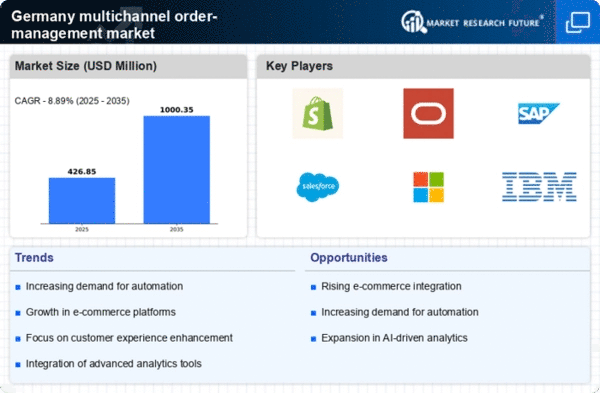
As per Market Research Future analysis, the Germany Multichannel Order Management Market size was estimated at 392.0 USD Million in 2024. The Multichannel Order-management market is projected to grow from 426.85 USD Million in 2025 to 1000.35 USD Million by 2035, exhibiting a compound annual growth rate (CAGR) of 8.8% during the forecast period 2025 - 2035

Key Market Trends & Highlights

The Germany multichannel order-management market is poised for substantial growth driven by technological advancements and evolving consumer preferences.

  • The integration of advanced technologies is transforming operational processes in the multichannel order-management market.
  • A strong focus on customer experience is becoming essential for businesses to remain competitive in the market.
  • Regulatory compliance and data security are increasingly prioritized as businesses navigate complex legal landscapes.
  • Rising e-commerce adoption and demand for operational efficiency are key drivers propelling market growth.

Market Size & Forecast

2024 Market Size 392.0 (USD Million)
2035 Market Size 1000.35 (USD Million)
CAGR (2025 - 2035) 8.89%

Major Players

Shopify (CA), Oracle (US), SAP (DE), Salesforce (US), Microsoft (US), IBM (US), ChannelAdvisor (US), Brightpearl (GB), Linnworks (GB)

Our Impact
Enabled $4.3B Revenue Impact for Fortune 500 and Leading Multinationals
Partnering with 2000+ Global Organizations Each Year
30K+ Citations by Top-Tier Firms in the Industry

Germany Multichannel Order Management Market Trends

The Germany Multichannel Order Management Market is currently experiencing a transformative phase, driven by the increasing demand for seamless integration across various sales channels. Businesses are recognizing the necessity of providing a unified customer experience, which has led to the adoption of advanced technologies and platforms. This shift is not merely a trend but appears to be a fundamental change in how companies operate. The emphasis on efficiency and customer satisfaction is prompting organizations to invest in sophisticated order-management systems that can handle complex logistics and inventory management. Furthermore, the rise of e-commerce has intensified competition, compelling businesses to refine their operations to meet consumer expectations. In addition, the regulatory landscape in Germany is evolving, with new policies aimed at enhancing consumer protection and data security. This regulatory environment is influencing how companies approach their order-management strategies. As businesses adapt to these changes, they are likely to explore innovative solutions that not only comply with regulations but also enhance operational efficiency. The multichannel order-management market is thus positioned for growth, with companies seeking to leverage technology to streamline processes and improve customer engagement. The future appears promising, as organizations continue to navigate the complexities of a rapidly changing marketplace.

Integration of Advanced Technologies

The multichannel order-management market is witnessing a significant integration of advanced technologies such as artificial intelligence and machine learning. These innovations are enhancing predictive analytics, enabling businesses to forecast demand more accurately and optimize inventory levels. As a result, companies can respond swiftly to market changes, improving overall efficiency.

Focus on Customer Experience

There is a growing emphasis on enhancing customer experience within the multichannel order-management market. Businesses are increasingly prioritizing personalized services and streamlined processes to meet consumer expectations. This trend indicates a shift towards customer-centric strategies, where satisfaction and engagement are paramount.

Regulatory Compliance and Data Security

The evolving regulatory landscape in Germany is shaping the multichannel order-management market. Companies are focusing on compliance with new data protection laws and consumer rights regulations. This trend suggests that businesses are not only adapting to legal requirements but are also leveraging compliance as a competitive advantage.

Germany Multichannel Order Management Market Drivers

Rising E-commerce Adoption

The increasing adoption of e-commerce in Germany is a pivotal driver for the multichannel order-management market. As consumers increasingly prefer online shopping, businesses are compelled to enhance their order management systems to accommodate this shift. In 2025, e-commerce sales in Germany are projected to reach approximately €100 billion, reflecting a growth rate of around 10% annually. This surge necessitates robust multichannel order-management solutions that can seamlessly integrate various sales channels, ensuring efficient order processing and fulfillment. Companies that invest in advanced order management systems are likely to gain a competitive edge, as they can respond more effectively to consumer demands and preferences. The multichannel order-management market is thus positioned to expand significantly, driven by the need for businesses to adapt to the evolving retail landscape.

Demand for Operational Efficiency

Operational efficiency remains a critical driver for the multichannel order-management market in Germany. Businesses are increasingly seeking ways to streamline their operations, reduce costs, and improve service delivery. The implementation of sophisticated order management systems can lead to enhanced inventory management, reduced order processing times, and improved customer satisfaction. In 2025, it is estimated that companies that adopt efficient order management practices could see a reduction in operational costs by up to 15%. This focus on efficiency not only helps businesses remain competitive but also allows them to allocate resources more effectively. As a result, the multichannel order-management market is likely to witness substantial growth, as organizations prioritize systems that facilitate operational excellence.

Shift Towards Omnichannel Retailing

The shift towards omnichannel retailing is significantly influencing the multichannel order-management market in Germany. Retailers are increasingly recognizing the importance of providing a seamless shopping experience across various channels, including online, mobile, and physical stores. This trend is driven by consumer expectations for flexibility and convenience. In 2025, it is anticipated that over 60% of retailers in Germany will adopt omnichannel strategies, necessitating advanced order management solutions that can integrate and synchronize inventory across all platforms. The ability to manage orders efficiently across multiple channels is crucial for meeting customer demands and enhancing brand loyalty. Consequently, the multichannel order-management market is expected to expand as businesses invest in technologies that support omnichannel retailing.

Consumer Preference for Personalization

Consumer preference for personalization is emerging as a significant driver for the multichannel order-management market in Germany. Shoppers are increasingly seeking tailored experiences, which necessitates that businesses implement systems capable of managing personalized orders effectively. In 2025, it is estimated that 70% of consumers in Germany will expect personalized shopping experiences, prompting retailers to invest in advanced order management solutions that can accommodate these preferences. This trend not only enhances customer satisfaction but also fosters brand loyalty, as personalized experiences are often linked to higher customer retention rates. As a result, the multichannel order-management market is likely to experience growth as businesses strive to meet the evolving expectations of their customers.

Technological Advancements in Logistics

Technological advancements in logistics are playing a vital role in shaping the multichannel order-management market in Germany. Innovations such as automation, artificial intelligence, and real-time tracking are enhancing the efficiency of supply chain operations. These technologies enable businesses to optimize their order fulfillment processes, reduce delivery times, and improve overall customer satisfaction. In 2025, it is projected that logistics technology investments in Germany will exceed €5 billion, reflecting a growing recognition of the importance of efficient logistics in the retail sector. As companies increasingly adopt these technologies, the demand for sophisticated order management systems that can integrate with logistics solutions is likely to rise, further propelling the growth of the multichannel order-management market.


Market Segment Insights

By Solution: Software (Largest) vs. Services (Fastest-Growing)

In the Germany multichannel order-management market, the distribution of market share among key solutions is prominent, with Software holding the largest segment. Its robust capabilities in automating processes and integrating with various sales channels make it indispensable for businesses looking to streamline operations. Services, while smaller in comparison, are on the rise as companies increasingly seek professional assistance to optimize their systems, driving demand for specialized services. Looking ahead, the growth trends reveal that Services are expected to experience the fastest expansion, fueled by the increasing complexity of order management systems and the need for tailored support. The rapid advancement of technology and integration capabilities is compelling organizations to invest in consulting and integration services, further driving this segment's upward trajectory. Software solutions will continue to dominate, complemented by supporting services that enhance overall effectiveness and customer experience.

Software (Dominant) vs. Services (Emerging)

Software in the Germany multichannel order-management market is characterized by its comprehensive features that facilitate the management of orders across various channels. It includes tools for inventory management, customer engagement, and analytics, making it a critical component in driving operational efficiency. On the other hand, Services are emerging as a significant value, providing consultancy and support necessary for businesses to effectively implement and adapt their order-management solutions. With increasing customization needs, these services play a vital role in ensuring that the software's capabilities are maximized to meet specific business requirements.

By Deployment Type: Cloud-Based (Largest) vs. On-Premises (Fastest-Growing)

In the Germany multichannel order-management market, the deployment type segment is primarily split between Cloud-Based and On-Premises solutions. Cloud-Based solutions maintain the largest share, driven by the increasing demand for flexibility and scalability in order management systems. On-Premises, while smaller in market share, is experiencing a surge in interest due to organizations' desire for enhanced security and control over their data. Growth trends indicate that while Cloud-Based options dominate due to their cost-effectiveness and accessibility, On-Premises solutions are on the rise as businesses prioritize data privacy and regulatory compliance. The adaptability of Cloud-Based services is prompting numerous small and medium enterprises to shift towards this model, yet larger corporations are increasingly investing in On-Premises systems to support their unique operational needs and regulatory requirements.

Cloud-Based (Dominant) vs. On-Premises (Emerging)

Cloud-Based deployment in the Germany multichannel order-management market is characterized by its flexibility, lower upfront costs, and ability to support remote access, making it particularly attractive to businesses looking to streamline operations and enhance customer experience. This deployment type allows for easy integration with existing systems and scalability as business operations expand. Conversely, On-Premises solutions, though currently smaller in market share, are emerging rapidly as organizations seek robust security measures and greater control over their IT infrastructures. These systems cater to industries with strict data regulations, offering customization tailored to specific business requirements. As a result, both deployment types are essential in shaping the future landscape of order management.

By End User: E-commerce (Largest) vs. Retail (Fastest-Growing)

In the Germany multichannel order-management market, the distribution of market share among end users reveals that E-commerce holds the largest segment, driven by a surge in online shopping preferences. Retail follows closely, showcasing significant interest, particularly in omni-channel strategies that integrate physical and digital experiences. Wholesale and manufacturing play smaller roles, yet they maintain a steady presence as they adapt to evolving consumer demands and technological advancements. The growth trends for these segments highlight the shifting landscape within consumer behaviors. E-commerce is propelled by increasing digital penetration and the evolution of logistics solutions. Conversely, Retail is rapidly emerging as businesses leverage technology to enhance customer interactions. The need for efficient order management is critical across all segments, reflecting a broader trend towards seamless integration of services across channels.

E-commerce: E-commerce (Dominant) vs. Retail (Emerging)

E-commerce continues to dominate the landscape of the Germany multichannel order-management market, characterized by its rapid adaptation to consumer needs and technological innovations. It excels in providing a vast selection of products, convenience, and personalized shopping experiences. Retail, while currently an emerging segment, is adapting swiftly, focusing on merging in-store and online activities to enhance customer experience. This includes implementing advanced order management systems to streamline fulfillment processes. Both segments exhibit distinct characteristics; E-commerce prioritizes speed and user experience, while Retail emphasizes customer service and brand loyalty. The interplay between these segments is shaping the future of commerce in Germany, as businesses strive to optimize their operations.

By Functionality: Order Processing (Largest) vs. Inventory Management (Fastest-Growing)

In the Germany multichannel order-management market, Order Processing dominates the functionality segment with significant market share, reflecting its critical role in ensuring timely and efficient transaction handling. Following this is the Inventory Management function, which, while not the largest, shows impressive growth rates indicative of increasing demand for improved stock control and visibility across sales channels. The growth trends within the functionality segment reveal that as businesses shift more towards e-commerce, the need for sophisticated Order Processing systems continues to rise. Meanwhile, Inventory Management is emerging as a fast-growing area, driven by technological advancements and the necessity for real-time inventory tracking, allowing organizations to enhance customer satisfaction by reducing stockouts and overstocks.

Order Processing: Dominant vs. Inventory Management: Emerging

Order Processing is the cornerstone of the functionality segment, characterized by its comprehensive features that streamline the order lifecycle from initiation to fulfillment. It is recognized for its ability to integrate with various sales channels, ensuring that consumers have a seamless purchasing experience. Its dominant position in the market is bolstered by the increasing complexity of order handling in retail environments. On the other hand, Inventory Management serves as an emerging segment vital for optimizing stock levels and aligning supply with demand. This function is gaining traction as businesses leverage data analytics to forecast demand better, thus minimizing waste and ensuring product availability. Together, these functionalities enhance operational efficiency and customer satisfaction in the Germany multichannel order-management market.
Get more detailed insights about Germany Multichannel Order Management Market

Key Players and Competitive Insights

The multichannel order-management market in Germany is characterized by a dynamic competitive landscape, driven by the increasing demand for seamless integration across various sales channels. Key players are focusing on enhancing their technological capabilities and operational efficiencies to capture market share. Companies such as Shopify (CA), Oracle (US), and SAP (DE) are at the forefront, leveraging innovation and strategic partnerships to strengthen their positions. Shopify (CA) emphasizes user-friendly solutions for small to medium-sized enterprises, while Oracle (US) and SAP (DE) target larger organizations with comprehensive enterprise resource planning (ERP) systems that facilitate complex order management processes. Collectively, these strategies contribute to a competitive environment that is increasingly reliant on technological advancements and customer-centric solutions.In terms of business tactics, companies are adopting localized approaches to manufacturing and optimizing their supply chains to enhance responsiveness to market demands. The market structure appears moderately fragmented, with a mix of established players and emerging startups. This fragmentation allows for diverse offerings, yet the influence of key players remains substantial, as they set benchmarks for service quality and technological integration.

In October Shopify (CA) announced the launch of its new AI-driven analytics tool designed to provide merchants with real-time insights into customer behavior and inventory management. This strategic move is likely to enhance Shopify's value proposition, enabling merchants to make data-driven decisions that could lead to increased sales and improved customer satisfaction. The integration of AI into their platform signifies a commitment to innovation and responsiveness to market trends.

In September SAP (DE) expanded its partnership with Microsoft (US) to enhance cloud-based order management solutions. This collaboration aims to integrate SAP's ERP capabilities with Microsoft Azure, potentially streamlining operations for businesses seeking to optimize their order fulfillment processes. Such partnerships indicate a trend towards collaborative ecosystems that leverage the strengths of multiple technology providers to deliver comprehensive solutions.

In August Oracle (US) unveiled its latest cloud-based order management system, which incorporates advanced machine learning algorithms to predict demand fluctuations. This development is indicative of a broader trend towards automation and predictive analytics in the market, allowing businesses to proactively manage their inventory and reduce operational costs. Oracle's focus on cutting-edge technology positions it well to meet the evolving needs of its clients.

As of November the competitive trends in the multichannel order-management market are increasingly defined by digitalization, sustainability, and the integration of AI technologies. Strategic alliances among key players are shaping the landscape, fostering innovation and enhancing service offerings. The shift from price-based competition to a focus on technological differentiation and supply chain reliability is evident, suggesting that future competitive advantages will hinge on the ability to innovate and adapt to changing consumer expectations.

Key Companies in the Germany Multichannel Order Management Market include

Industry Developments

Recent developments in the Germany Multichannel Order Management Market have been significant, underscored by companies like Mediacommerce, Skubana, and Nutshell striving to enhance their technological offerings. The market is observing increased traction as businesses seek efficient order fulfillment across multiple sales channels, which is essential for adapting to changing consumer behaviors.

Notably, in March 2023, Unicommerce announced strategic partnerships aimed at integrating its solutions further into the European market. HCL Technologies has also been active, leveraging its IT services to improve Multichannel Order Management systems for German retailers. Additionally, significant acquisitions are shaping the landscape, such as Magento's continued enhancement under Adobe since 2021 to support multichannel functionalities, and TradeGecko (now QuickBooks Commerce), catering to small and medium-sized enterprises.

The German market is demonstrating robust growth with estimates indicating substantial valuation increases, primarily driven by e-commerce expansion. Over the last two years, major shifts occurred, especially due to the pandemic, prompting businesses to invest heavily in digital transformation, thus fueling the demand for advanced Multichannel Order Management solutions that ensure seamless operations and customer satisfaction.

Future Outlook

Germany Multichannel Order Management Market Future Outlook

The Multichannel Order Management Market in Germany is projected to grow at an 8.89% CAGR from 2025 to 2035, driven by technological advancements and increasing consumer demand.

New opportunities lie in:

  • Integration of AI-driven analytics for inventory optimization.
  • Development of mobile order management applications for enhanced customer engagement.
  • Expansion of automated fulfillment centers to reduce operational costs.

By 2035, the market is expected to achieve substantial growth, positioning itself as a leader in efficiency and customer satisfaction.

Market Segmentation

Germany Multichannel Order Management Market End User Outlook

  • Retail
  • Wholesale
  • E-commerce
  • Manufacturing

Germany Multichannel Order Management Market Solution Outlook

  • Software
  • Services
  • Consulting
  • Integration

Germany Multichannel Order Management Market Functionality Outlook

  • Order Processing
  • Inventory Management
  • Shipping Management
  • Payment Processing

Germany Multichannel Order Management Market Deployment Type Outlook

  • Cloud-Based
  • On-Premises

Report Scope

MARKET SIZE 2024 392.0(USD Million)
MARKET SIZE 2025 426.85(USD Million)
MARKET SIZE 2035 1000.35(USD Million)
COMPOUND ANNUAL GROWTH RATE (CAGR) 8.89% (2025 - 2035)
REPORT COVERAGE Revenue Forecast, Competitive Landscape, Growth Factors, and Trends
BASE YEAR 2024
Market Forecast Period 2025 - 2035
Historical Data 2019 - 2024
Market Forecast Units USD Million
Key Companies Profiled Shopify (CA), Oracle (US), SAP (DE), Salesforce (US), Microsoft (US), IBM (US), ChannelAdvisor (US), Brightpearl (GB), Linnworks (GB)
Segments Covered Solution, Deployment Type, End User, Functionality
Key Market Opportunities Integration of advanced analytics and automation enhances efficiency in the multichannel order-management market.
Key Market Dynamics Rising demand for seamless integration across platforms drives innovation in multichannel order-management solutions.
Countries Covered Germany
Leave a Comment

FAQs

What is the projected market size of the Germany Multichannel Order Management Market by 2035?

By 2035, the Germany Multichannel Order Management Market is projected to reach a value of 1200.0 million USD.

What was the market size of the Germany Multichannel Order Management Market in 2024?

The market was valued at 399.5 million USD in 2024.

What is the expected CAGR for the Germany Multichannel Order Management Market from 2025 to 2035?

The expected CAGR for the market from 2025 to 2035 is 10.516%.

Which segment of the Germany Multichannel Order Management Market software is expected to show significant growth?

The Software segment is expected to grow from 159.8 million USD in 2024 to 480.0 million USD in 2035.

What are the major competitors in the Germany Multichannel Order Management Market?

Key players in the market include Mediacommerce, Skubana, Nutshell, Unicommerce, HCL Technologies, and Magento.

How much is the Services segment anticipated to grow by 2035 in the Germany Multichannel Order Management Market?

The Services segment is expected to grow from 119.9 million USD in 2024 to 360.0 million USD in 2035.

What is the expected market size for the Consulting segment in 2035?

The Consulting segment is projected to reach 240.0 million USD by 2035.

What growth opportunities exist within the Germany Multichannel Order Management Market?

The market is experiencing growth driven by increased digitalization and demand for efficient order processing systems.

What is the expected market value for the Integration sub-segment by 2025?

The Integration sub-segment is valued at 39.9 million USD in 2024 and expected to grow to 120.0 million USD by 2035.

What challenges might the Germany Multichannel Order Management Market face in the coming years?

The market may face challenges such as intense competition and the need for continuous technological advancements.

Download Free Sample

Kindly complete the form below to receive a free sample of this Report

Compare Licence

×
Features License Type
Single User Multiuser License Enterprise User
Price $4,950 $5,950 $7,250
Maximum User Access Limit 1 User Upto 10 Users Unrestricted Access Throughout the Organization
Free Customization
Direct Access to Analyst
Deliverable Format
Platform Access
Discount on Next Purchase 10% 15% 15%
Printable Versions