×
Request Free Sample ×

Kindly complete the form below to receive a free sample of this Report

* Please use a valid business email

Leading companies partner with us for data-driven Insights

clients tt-cursor
Hero Background

UK Electric Truck Market

ID: MRFR/AT/52457-HCR
200 Pages
Sejal Akre
February 2026

UK Electric Truck Market Research Report By Propulsion Type (BEV, PHEV, FCEV), By Type (Light Duty Trucks, Medium Duty Trucks, Heavy Duty Trucks), By End User (Last-Mile Delivery, Long Haul Transportation, Refuse Services, Field Services, Distribution Services), By Range (Up to 200 Miles, Above 200 Miles) and By Battery Capacity (Less Than 50kwh, 50-250 Kwh, Above 250 Kwh) - Growth & Industry Forecast 2025 To 2035

Share:
Download PDF ×

We do not share your information with anyone. However, we may send you emails based on your report interest from time to time. You may contact us at any time to opt-out.

UK Electric Truck Market Infographic
Purchase Options

UK Electric Truck Market Summary

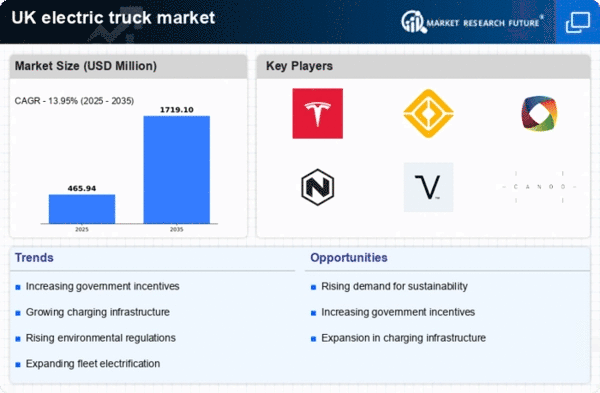
As per Market Research Future analysis, the UK electric truck market Size was estimated at 408.9 USD Million in 2024. The UK electric truck market is projected to grow from 465.94 USD Million in 2025 to 1719.1 USD Million by 2035, exhibiting a compound annual growth rate (CAGR) of 13.9% during the forecast period 2025 - 2035

Key Market Trends & Highlights

The UK electric truck market is experiencing robust growth driven by regulatory support and technological advancements.

  • The largest segment in the UK electric truck market is the heavy-duty truck segment, while the fastest-growing segment is the medium-duty truck segment.
  • Regulatory support and incentives are fostering a favorable environment for electric truck adoption across the UK.
  • Technological advancements in battery systems are enhancing the performance and range of electric trucks, making them more appealing to fleet operators.
  • Increasing environmental regulations and rising fuel prices are key drivers propelling the shift towards electric trucks in the UK.

Market Size & Forecast

2024 Market Size 408.9 (USD Million)
2035 Market Size 1719.1 (USD Million)
CAGR (2025 - 2035) 13.95%

Major Players

Tesla (US), Rivian (US), BYD (CN), Nikola (US), Volta Trucks (GB), Canoo (US), Workhorse Group (US), Lordstown Motors (US)

Our Impact
Enabled $4.3B Revenue Impact for Fortune 500 and Leading Multinationals
Partnering with 2000+ Global Organizations Each Year
30K+ Citations by Top-Tier Firms in the Industry

UK Electric Truck Market Trends

The electric truck market is currently experiencing a transformative phase, driven by a combination of regulatory support, technological advancements, and shifting consumer preferences. The UK government has implemented various initiatives aimed at reducing carbon emissions, which has led to increased investments in electric vehicle infrastructure. This includes the expansion of charging networks and incentives for businesses to transition to electric fleets. As a result, manufacturers are responding by developing a wider range of electric truck models, catering to diverse operational needs. The growing awareness of environmental issues among consumers and businesses alike is further propelling the demand for electric trucks, as companies seek to enhance their sustainability profiles. In addition to regulatory influences, advancements in battery technology are playing a crucial role in shaping the electric truck market. Enhanced battery efficiency and reduced charging times are making electric trucks more viable for long-haul operations. Furthermore, the integration of smart technologies, such as telematics and fleet management systems, is enabling operators to optimize routes and monitor vehicle performance effectively. This convergence of technology and sustainability is likely to redefine logistics and transportation in the UK, as electric trucks become an integral part of the supply chain. Overall, the electric truck market is poised for significant growth, driven by a combination of policy support, technological innovation, and evolving market dynamics.

Regulatory Support and Incentives

The UK government is actively promoting the adoption of electric trucks through various policies and financial incentives. These measures aim to reduce greenhouse gas emissions and encourage businesses to transition to cleaner transportation options. As a result, many companies are exploring electric trucks as a viable alternative to traditional diesel vehicles.

Technological Advancements in Battery Systems

Recent developments in battery technology are enhancing the performance and efficiency of electric trucks. Improved energy density and faster charging capabilities are making these vehicles more suitable for a wider range of applications. This trend is likely to attract more operators to consider electric trucks for their fleets.

Growing Demand for Sustainable Logistics Solutions

There is an increasing emphasis on sustainability within the logistics sector, prompting companies to seek environmentally friendly transportation options. The electric truck market is benefiting from this shift, as businesses recognize the potential for electric trucks to reduce their carbon footprint and improve their overall sustainability.

UK Electric Truck Market Drivers

Corporate Sustainability Initiatives

The electric truck market is being propelled by the increasing emphasis on corporate sustainability initiatives among UK businesses. Many companies are adopting sustainability as a core component of their operational strategies, driven by consumer demand for environmentally friendly practices. This shift is leading to a greater investment in electric trucks, as businesses seek to reduce their carbon footprints and enhance their brand image. In 2025, it is estimated that over 60% of UK companies have integrated sustainability goals into their logistics operations, which includes transitioning to electric fleets. This trend not only supports the electric truck market but also encourages innovation in sustainable logistics solutions. As corporations strive to meet their sustainability targets, the demand for electric trucks is expected to rise, further solidifying their role in the transportation sector.

Increasing Environmental Regulations

The electric truck market is experiencing a surge in demand due to increasing environmental regulations in the UK. The government has set ambitious targets to reduce carbon emissions, aiming for a net-zero economy by 2050. This regulatory framework encourages businesses to transition to electric vehicles, including trucks, to comply with stringent emissions standards. As a result, companies are investing in electric trucks to avoid penalties and enhance their sustainability profiles. The UK government has also introduced various incentives to support this transition, which further stimulates the electric truck market. In 2023, it was reported that the UK aims to have at least 300,000 electric vehicles on the road by 2030, indicating a robust growth trajectory for the electric truck market. This regulatory environment is likely to continue driving innovation and investment in electric truck technologies.

Advancements in Charging Infrastructure

The electric truck market is significantly influenced by advancements in charging infrastructure across the UK. The government and private sector are investing heavily in expanding the network of charging stations, which is crucial for the widespread adoption of electric trucks. As of 2025, there are over 30,000 public charging points available, with plans to increase this number substantially in the coming years. This expansion not only alleviates range anxiety among fleet operators but also enhances the operational efficiency of electric trucks. Furthermore, the development of ultra-fast charging technology is expected to reduce downtime, making electric trucks more appealing for logistics companies. The improved infrastructure is likely to facilitate a smoother transition to electric vehicles, thereby propelling the growth of the electric truck market in the UK.

Rising Fuel Prices and Economic Viability

The electric truck market is increasingly attractive due to rising fuel prices, which have made traditional diesel trucks less economically viable. As fuel costs continue to fluctuate, businesses are seeking alternatives that offer more predictable operating expenses. Electric trucks present a compelling solution, as they typically have lower energy costs compared to diesel vehicles. In 2025, the average cost of electricity for charging electric trucks is projected to be significantly lower than the equivalent cost of diesel fuel, enhancing the economic appeal of electric trucks. This shift in cost dynamics is prompting logistics companies to reevaluate their fleets and consider electric options. Consequently, the electric truck market is likely to see accelerated growth as businesses aim to mitigate the impact of rising fuel prices on their bottom lines.

Economic Incentives for Fleet Electrification

The electric truck market is benefiting from various economic incentives aimed at encouraging fleet electrification in the UK. The government has introduced grants and subsidies to offset the initial costs associated with purchasing electric trucks, making them more financially viable for businesses. For instance, the Plug-in Grant Scheme offers substantial financial support for electric vehicle purchases, which has been instrumental in driving sales in the electric truck market. Additionally, businesses can benefit from lower operating costs associated with electric trucks, such as reduced fuel expenses and maintenance costs. As of 2025, it is projected that the total cost of ownership for electric trucks will become competitive with traditional diesel trucks, further incentivizing fleet operators to make the switch. These economic factors are likely to play a crucial role in the continued growth of the electric truck market.


Market Segment Insights

By Vehicle Type: Heavy Duty Trucks (Largest) vs. Light Duty Trucks (Fastest-Growing)

In the UK electric truck market, Heavy Duty Trucks currently hold the largest market share, showcasing their pivotal role in commercial transportation. Meanwhile, Light Duty Trucks, despite having a smaller overall share, are gaining traction rapidly. This is indicative of changing preferences among consumers and businesses alike, as companies increasingly seek eco-friendly solutions in their logistics operations. The growth trends within the vehicle type segment are driven by heightened environmental awareness and regulatory support for electric vehicles. Medium Duty Trucks are also witnessing growth as businesses aim for efficiency without necessarily committing to heavy-duty solutions. Factors such as advancements in battery technology, improved range, and infrastructure development are supporting these growth trajectories, making electric trucks a viable choice across various sectors.

Heavy Duty Trucks (Dominant) vs. Light Duty Trucks (Emerging)

Heavy Duty Trucks dominate the UK electric truck market, known for their robust capacity and efficiency in freight transport. They cater primarily to long-haul applications, where performance and range are critical. Their established infrastructure and investment from logistics giants contribute to their market stronghold. On the other hand, Light Duty Trucks are emerging as a significant contender, driven by urbanization and the need for smaller, more agile transport solutions. Businesses are increasingly adopting these trucks for last-mile deliveries, benefitting from lower operational costs and increased sustainability. The shift towards electric models in this segment reflects growing consumer demand for greener alternatives, making Light Duty Trucks a promising future growth area alongside the dominance of Heavy Duty Trucks.

By Power Source: Battery Electric Trucks (Largest) vs. Hydrogen Fuel Cell Trucks (Fastest-Growing)

In the UK electric truck market, battery electric trucks dominate the power source segment with the largest market share. Their established infrastructure and widespread adoption have contributed to their leading position. In contrast, hydrogen fuel cell trucks, while currently holding a smaller share, are rapidly gaining traction due to advancements in technology and increasing investments. The growth trends indicate a substantial shift towards sustainable transportation solutions. The adoption of battery electric trucks is driven by stringent emissions regulations and the need for eco-friendly logistics. On the other hand, hydrogen fuel cell trucks are emerging as a viable alternative for longer-range operations, supported by growing government initiatives and the establishment of hydrogen refueling stations, making it the fastest-growing segment in the market.

Battery Electric Trucks (Dominant) vs. Hydrogen Fuel Cell Trucks (Emerging)

Battery electric trucks have cemented their position as the dominant power source in the UK electric truck market due to their efficiency and established charging infrastructure. They are preferred for urban deliveries and short-haul applications, providing lower operating costs and minimizing emissions. Meanwhile, hydrogen fuel cell trucks present an emerging alternative, offering longer range and quicker refueling times, making them suitable for long-haul transportation. Their growth is backed by increasing investment in fuel cell technology and strategic government policies aimed at reducing carbon footprints. The competition between these two segments will shape the future landscape of the market as companies seek optimal solutions for diverse logistics operations.

By Application: Freight Transportation (Largest) vs. Urban Delivery (Fastest-Growing)

In the UK electric truck market, the application segment is characterized by distinct values such as Freight Transportation, Construction, Waste Management, and Urban Delivery. Freight Transportation holds the largest market share, benefiting from the ongoing shift towards electric logistics solutions. Urban Delivery is quickly gaining traction due to rising e-commerce demands, showcasing its significant growth potential within the segment. The growth trends within the application segment are driven by technological advancements, regulatory support, and an increasing focus on sustainability. Freight Transportation is seeing steady adoption as businesses aim to reduce carbon footprints, while Urban Delivery is being propelled by a surge in last-mile delivery services. Construction and Waste Management are also contributing to sector growth, driven by urbanization and environmental policies.

Freight Transportation (Dominant) vs. Urban Delivery (Emerging)

Freight Transportation is the dominant application in the UK electric truck market, primarily due to its heavy reliance on logistics and distribution networks. The sector benefits from substantial investment in electric infrastructure, resulting in efficient and eco-friendly delivery methods. Conversely, Urban Delivery is emerging as a key player, fueled by the rapid growth of e-commerce and urbanization. This segment emphasizes smaller, more agile vehicles designed for short-distance travel, leading to enhanced flexibility in urban settings. Both segments are aligned with sustainability goals, with Freight Transportation focusing on long-haul efficiency and Urban Delivery aiming at reducing urban traffic congestion and emissions.

By Weight Class: Below 3.5 Tons (Largest) vs. Above 7.5 Tons (Fastest-Growing)

In the UK electric truck market, the weight class distribution is notable, with the Below 3.5 Tons segment commanding the largest market share. This segment appeals to urban logistics and short-haul distribution due to its compliance with various regulatory frameworks and lower operational costs. Conversely, the Above 7.5 Tons segment is emerging rapidly, primarily driven by demand for heavy-duty transportation solutions that meet increasing environmental standards. Growth trends within the weight class segment highlight a shift towards electrification influenced by both regulatory incentives and rising fuel prices. The Below 3.5 Tons category is likely to remain robust, benefitting from ongoing advancements in battery technology. Meanwhile, the Above 7.5 Tons category experiences exponential growth due to broader acceptance and investment in infrastructure, positioning it as a key area of focus for manufacturers and fleet operators alike.

Below 3.5 Tons (Dominant) vs. Above 7.5 Tons (Emerging)

The Below 3.5 Tons segment is characterized by compact and maneuverable electric trucks that are ideal for urban environments, which play a crucial role in last-mile delivery. This segment appeals to a wide range of businesses seeking to reduce their carbon footprint while maintaining efficiency. In contrast, the Above 7.5 Tons segment includes larger electric trucks designed for long-distance and heavy-load transport, representing an emerging force in the UK market. These vehicles are gaining traction due to their ability to meet stringent emissions regulations, thus supporting companies in their sustainability goals. The rapid expansion of charging infrastructure is further facilitating the growth of this segment, making it more attractive for logistics providers.

Get more detailed insights about UK Electric Truck Market

Key Players and Competitive Insights

The electric truck market is currently characterized by a dynamic competitive landscape, driven by increasing demand for sustainable transportation solutions and stringent emissions regulations. Key players such as Tesla (US), Rivian (US), and Volta Trucks (GB) are actively shaping the market through innovative strategies and operational focuses. Tesla (US) continues to lead with its advanced battery technology and extensive charging infrastructure, while Rivian (US) emphasizes its commitment to sustainability and outdoor adventure, appealing to a niche market segment. Volta Trucks (GB), on the other hand, is focusing on urban logistics, aiming to provide zero-emission solutions tailored for city environments. Collectively, these strategies contribute to a competitive environment that prioritizes innovation and sustainability.In terms of business tactics, companies are increasingly localizing manufacturing to mitigate supply chain disruptions and enhance responsiveness to market demands. This trend is particularly evident in the UK, where firms are establishing production facilities to cater to regional needs. The market structure appears moderately fragmented, with several players vying for market share, yet the influence of major companies remains substantial. Their collective actions are likely to shape the trajectory of the market, as they compete not only on product offerings but also on operational efficiencies.
In October Tesla (US) announced the opening of a new Gigafactory in the UK, aimed at ramping up production of its electric trucks. This strategic move is expected to significantly enhance Tesla's manufacturing capabilities and reduce lead times for customers in the region. The establishment of this facility underscores Tesla's commitment to expanding its footprint in the UK and meeting the growing demand for electric vehicles.
In September Rivian (US) secured a partnership with a major logistics company to develop a fleet of electric delivery trucks. This collaboration is poised to enhance Rivian's market presence and validate its technology in real-world applications. By aligning with established logistics providers, Rivian is likely to accelerate its growth trajectory and solidify its position in the competitive landscape.
In August Volta Trucks (GB) launched its first fully electric truck designed specifically for urban environments. This product introduction is strategically significant as it addresses the increasing demand for sustainable urban logistics solutions. By focusing on the unique challenges of city driving, Volta Trucks is positioning itself as a leader in the niche market of urban electric trucks, potentially capturing a substantial share of this growing segment.
As of November current trends in the electric truck market indicate a strong emphasis on digitalization, sustainability, and the integration of AI technologies. Strategic alliances are becoming increasingly important, as companies seek to leverage complementary strengths to enhance their competitive positions. The shift from price-based competition to a focus on innovation, technology, and supply chain reliability is evident, suggesting that future differentiation will hinge on these factors. As the market evolves, companies that prioritize these elements are likely to emerge as leaders in the electric truck sector.

Key Companies in the UK Electric Truck Market include

Industry Developments

The UK Electric Truck Industry has been witnessing significant developments, particularly with several key players enhancing their positions. In October 2023, Oxbotica announced advanced partnerships with UK logistics firms to boost autonomous electric truck technology while MAN SE unveiled its strategic goals to electrify its fleet, aiming for a competitive edge in the marketplace. In September 2023, Tesla Inc confirmed that it expects to begin deliveries of its electric trucks in the UK by early 2024. Meanwhile, Einride has been making strides towards expanding operations in the UK, focusing on sustainable transport solutions.

Scania AB reported growth in its electric vehicle production, resulting in increased market presence. Notable valuations have been rising for companies like Volvo Group and Daimler AG as demand for electric trucks surges, driven by governmental support towards a net-zero economy by 2050. Over the past two to three years, major events like BYD Company's entry into the UK market were marked in January 2022, indicating a robust interest in sustainable vehicle alternatives. Current affairs reflect a dynamic shift as major players invest heavily in Research and Development to meet the evolving environmental standards in the UK.


Future Outlook

UK Electric Truck Market Future Outlook

The Electric Truck Market is projected to grow at 13.95% CAGR from 2025 to 2035, driven by advancements in battery technology, regulatory support, and increasing demand for sustainable logistics.

New opportunities lie in:

  • Development of integrated charging infrastructure for fleet operators. Partnerships with logistics companies for electric truck trials. Investment in battery recycling facilities to enhance sustainability.

By 2035, the electric truck market is expected to be robust, driven by innovation and strategic partnerships.

Market Segmentation

UK Electric Truck Market Application Outlook

  • Freight Transportation
  • Construction
  • Waste Management
  • Urban Delivery

UK Electric Truck Market Power Source Outlook

  • Battery Electric Trucks
  • Hydrogen Fuel Cell Trucks
  • Hybrid Electric Trucks

UK Electric Truck Market Vehicle Type Outlook

  • Light Duty Trucks
  • Medium Duty Trucks
  • Heavy Duty Trucks

UK Electric Truck Market Weight Class Outlook

  • Below 3.5 Tons
  • 3.5 to 7.5 Tons
  • Above 7.5 Tons

Report Scope

MARKET SIZE 2024 408.9(USD Million)
MARKET SIZE 2025 465.94(USD Million)
MARKET SIZE 2035 1719.1(USD Million)
COMPOUND ANNUAL GROWTH RATE (CAGR) 13.95% (2025 - 2035)
REPORT COVERAGE Revenue Forecast, Competitive Landscape, Growth Factors, and Trends
BASE YEAR 2024
Market Forecast Period 2025 - 2035
Historical Data 2019 - 2024
Market Forecast Units USD Million
Key Companies Profiled Tesla (US), Rivian (US), BYD (CN), Nikola (US), Volta Trucks (GB), Canoo (US), Workhorse Group (US), Lordstown Motors (US)
Segments Covered Vehicle Type, Power Source, Application, Weight Class
Key Market Opportunities Growing demand for sustainable logistics solutions drives innovation in the electric truck market.
Key Market Dynamics Regulatory shifts and technological advancements drive rapid growth in the electric truck market.

Countries Covered UK
Leave a Comment

FAQs

What is the projected market size of the UK Electric Truck Market in 2024?

The UK Electric Truck Market is expected to be valued at approximately 408.9 million USD in 2024.

What will the market value of the UK Electric Truck Market be by 2035?

By 2035, the UK Electric Truck Market is anticipated to reach around 1,224.7 million USD.

What is the expected compound annual growth rate (CAGR) for the UK Electric Truck Market from 2025 to 2035?

The UK Electric Truck Market is projected to have a CAGR of approximately 10.487% during the forecast period from 2025 to 2035.

Which propulsion type is expected to dominate the UK Electric Truck Market in terms of value?

Battery Electric Vehicles (BEV) are expected to dominate, valued at 600.0 million USD by 2035.

What will be the market size of Plug-in Hybrid Electric Vehicles (PHEV) in 2035?

The market size for Plug-in Hybrid Electric Vehicles (PHEV) is projected to be 360.0 million USD in 2035.

How much is the market for Fuel Cell Electric Vehicles (FCEV) expected to grow by 2035?

The market for Fuel Cell Electric Vehicles (FCEV) is anticipated to grow to about 264.7 million USD by 2035.

Who are the key players in the UK Electric Truck Market?

Major players in the UK Electric Truck Market include Tesla Inc, Volvo Group, and BYD Company among others.

What is driving the growth of the UK Electric Truck Market?

The growth is driven by increasing demand for eco-friendly transportation solutions and regulatory support for electric vehicles.

What challenges does the UK Electric Truck Market face?

Challenges include the high initial costs of electric trucks and the need for extensive charging infrastructure.

What impact does the global trend towards sustainability have on the UK Electric Truck Market?

The global shift towards sustainability significantly boosts the demand and innovation in the UK Electric Truck Market.

Download Free Sample

Kindly complete the form below to receive a free sample of this Report

Compare Licence

×
Features License Type
Single User Multiuser License Enterprise User
Price $4,950 $5,950 $7,250
Maximum User Access Limit 1 User Upto 10 Users Unrestricted Access Throughout the Organization
Free Customization
Direct Access to Analyst
Deliverable Format
Platform Access
Discount on Next Purchase 10% 15% 15%
Printable Versions