×
Request Free Sample ×

Kindly complete the form below to receive a free sample of this Report

* Please use a valid business email

Leading companies partner with us for data-driven Insights

clients tt-cursor
Hero Background

UK Drones Market

ID: MRFR/AD/43162-HCR
128 Pages
Sejal Akre
February 2026

UK Drones Market Size, Share, Industry Trend & Analysis Research Report By Application (Inspection and Leak and Spillage Response and Security, Surveillance), By Type (Fixed-Wing Drone, Rotary Blade Drone, Hybrid Drone), By Industry Type (Oil Gas, Renewable, Power), and By Technology (Hardware, Software)-Forecast to 2035

Share:
Download PDF ×

We do not share your information with anyone. However, we may send you emails based on your report interest from time to time. You may contact us at any time to opt-out.

UK Drones Market Infographic
Purchase Options

UK Drones Market Summary

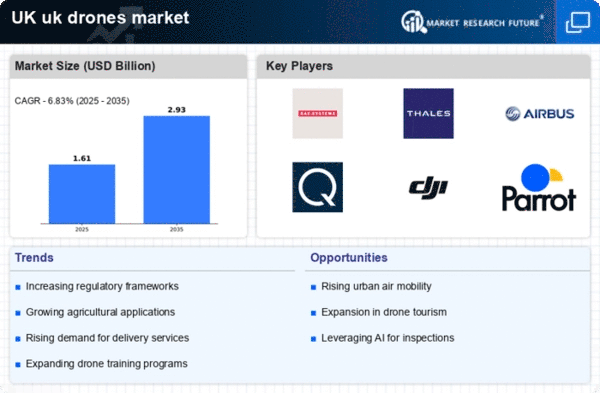
As per analysis, the UK Drones Market is projected to grow from USD 1.60 Billion in 2025 to USD 2.93 Billion by 2035, exhibiting a compound annual growth rate (CAGR) of 6.19% during the forecast period (2025 - 2035).

Key Market Trends & Highlights

The UK Drones Market is poised for substantial growth driven by regulatory support and technological advancements.

  • The Aerial Photography segment remains the largest contributor to the UK Drones Market, reflecting a robust demand for high-quality imaging.
  • Agricultural applications are emerging as the fastest-growing segment, driven by the need for precision farming and crop monitoring.
  • Commercial drone usage continues to dominate the market, while government applications are rapidly expanding due to increased investment.
  • Technological advancements in drone capabilities and growing demand for aerial surveillance and security are key drivers propelling market growth.

Market Size & Forecast

2024 Market Size 1.51 (USD Billion)
2035 Market Size 2.93 (USD Billion)
CAGR (2025 - 2035) 6.19%

Major Players

BAE Systems (GB), Thales Group (FR), QinetiQ (GB), Leonardo (IT), Northrop Grumman (US), DJI (CN), Parrot (FR), Aerialtronics (NL), Sky-Futures (GB)

Our Impact
Enabled $4.3B Revenue Impact for Fortune 500 and Leading Multinationals
Partnering with 2000+ Global Organizations Each Year
30K+ Citations by Top-Tier Firms in the Industry

UK Drones Market Trends

The UK Drones Market is currently experiencing a transformative phase, characterized by rapid advancements in technology and increasing applications across various sectors. The integration of drones into industries such as agriculture, logistics, and surveillance is becoming more prevalent, driven by the need for efficiency and cost-effectiveness. Regulatory frameworks are evolving to accommodate these innovations, with the UK Civil Aviation Authority actively working to establish guidelines that ensure safety while promoting growth. This dynamic environment suggests a promising future for drone adoption, as businesses recognize the potential benefits of utilizing unmanned aerial vehicles. Moreover, the public's perception of drones is shifting, with increasing acceptance of their use in everyday life. This change is likely influenced by successful implementations in emergency services and environmental monitoring, which demonstrate the technology's capabilities. As the UK Drones Market continues to expand, it appears that collaboration between government bodies, industry stakeholders, and technology developers will be crucial in addressing challenges and maximizing opportunities. The future landscape may see enhanced drone functionalities, improved battery life, and advanced AI integration, further solidifying the role of drones in the UK economy.

Increased Regulatory Support

The UK Drones Market is witnessing enhanced regulatory support, which is crucial for fostering innovation and ensuring safety. The UK Civil Aviation Authority is actively developing frameworks that facilitate the integration of drones into national airspace. This regulatory clarity is likely to encourage investment and adoption across various sectors, as businesses feel more secure in deploying drone technology.

Expansion in Agricultural Applications

Agriculture is emerging as a key sector for drone utilization within the UK Drones Market. Farmers are increasingly adopting drones for crop monitoring, precision agriculture, and livestock management. This trend suggests a growing recognition of drones as valuable tools for enhancing productivity and sustainability in farming practices.

Rise of Delivery Services

The UK Drones Market is experiencing a notable rise in drone delivery services, particularly in urban areas. Companies are exploring the potential of drones to expedite logistics and improve last-mile delivery efficiency. This trend indicates a shift towards innovative solutions that could reshape the future of transportation and consumer services.

UK Drones Market Drivers

Expansion of Drone Delivery Services

The UK Drones Market is poised for growth due to the expansion of drone delivery services. Major retailers and logistics companies are exploring drone technology to streamline their delivery processes. For example, companies like Amazon and Deliveroo are piloting drone delivery programs in select UK cities, aiming to reduce delivery times and costs. Recent market analysis indicates that the drone delivery segment could account for approximately 10% of the total logistics market in the UK by 2028. This shift towards drone-based delivery solutions is likely to reshape the logistics landscape, creating new opportunities for businesses and enhancing customer satisfaction.

Regulatory Framework Supporting Drone Operations

The UK Drones Market is supported by a robust regulatory framework that facilitates safe and efficient drone operations. The Civil Aviation Authority (CAA) has established clear guidelines for drone usage, which helps to ensure safety while promoting innovation. Recent updates to regulations have streamlined the process for obtaining permits and licenses, making it easier for businesses to integrate drones into their operations. This regulatory support is crucial, as it fosters public trust and encourages investment in the drone sector. As the regulatory landscape continues to evolve, it is likely to further enhance the growth prospects of the UK Drones Market, attracting new entrants and expanding existing operations.

Technological Advancements in Drone Capabilities

The UK Drones Market is experiencing a surge in technological advancements, particularly in drone capabilities. Innovations in battery life, payload capacity, and autonomous navigation systems are enhancing operational efficiency. For instance, the integration of AI and machine learning is enabling drones to perform complex tasks such as real-time data analysis and obstacle avoidance. According to recent data, the UK drone sector is projected to grow at a compound annual growth rate of 15% over the next five years, driven by these technological improvements. This growth is likely to attract investments and foster the development of new applications across various sectors, including logistics, surveillance, and environmental monitoring.

Growing Demand for Aerial Surveillance and Security

The UK Drones Market is witnessing an increasing demand for aerial surveillance and security solutions. With rising concerns over public safety and crime, law enforcement agencies are increasingly adopting drones for monitoring and reconnaissance purposes. The UK government has allocated significant funding to enhance public safety measures, which includes the deployment of drones in urban areas. Recent statistics indicate that the use of drones in policing has increased by over 30% in the last year alone. This trend suggests that the market for surveillance drones is likely to expand, as both public and private sectors recognize the value of aerial capabilities in enhancing security.

Increased Investment in Drone Research and Development

The UK Drones Market is benefiting from increased investment in research and development. Government initiatives and private sector funding are driving innovation in drone technology, leading to the development of more sophisticated and versatile drones. The UK government has committed to investing over £100 million in drone-related research over the next five years, focusing on areas such as safety, efficiency, and environmental impact. This influx of capital is expected to accelerate advancements in drone technology, making it more accessible for various industries, including agriculture, construction, and emergency services. As a result, the market is likely to see a proliferation of new applications and use cases.


Market Segment Insights

By Application: Aerial Photography (Largest) vs. Agriculture (Fastest-Growing)

In the UK Drones Market, the application segment is increasingly diverse, with aerial photography commanding the largest market share due to its widespread deployment across various industries, including real estate and media. Aerial photography services are sought after for their efficiency and high-quality results, providing a competitive edge in visual storytelling. Conversely, agriculture is emerging as the fastest-growing segment as farmers integrate drone technology into their operations for enhanced crop monitoring and precision farming practices. This transition indicates not only the efficiency of drones in traditional farming but also their potential in smart agriculture practices.

Aerial Photography (Dominant) vs. Agriculture (Emerging)

Aerial photography represents the dominant application within the UK Drones Market, leveraging cutting-edge technology to deliver stunning imagery for commercial and creative endeavors. This segment thrives on its ability to offer unique perspectives that traditional photography cannot achieve, making it indispensable for marketing and promotional strategies. On the other hand, agriculture is witnessing a surge in adoption, positioning itself as an emerging segment. With the need for more efficient farming methods, drones equipped with advanced sensors facilitate real-time data collection on crop health and soil conditions. This paradigm shift reflects a broader agricultural trend towards sustainability and innovation, ultimately driving growth in the sector.

By End Use: Commercial (Largest) vs. Government (Fastest-Growing)

In the UK Drones Market, the distribution of end-use segments demonstrates a clear dominance by the commercial sector, which utilizes drones for applications such as aerial photography, agriculture, and logistics. This segment caters to various industries, reflecting a steady increase in demand driven by technological advancements and the rising acceptance of drones in everyday business operations. Meanwhile, the government segment holds significant market potential and is on the trajectory of rapid growth, focusing on surveillance, infrastructure inspection, and emergency management. The growth trends within the UK’s drone market are largely influenced by advancements in drone technology and regulatory support that encourages innovation. Government initiatives such as promoting the use of unmanned aerial vehicles (UAVs) for public services are propelling the growth of the government segment as it seeks efficient solutions for challenging tasks. The increasing investments in drone capabilities for delivery services also indicate a promising future for these segments, aligning with the broader shift towards automation and efficiency in various sectors.

Commercial (Dominant) vs. Recreational (Emerging)

The commercial segment remains the dominant force in the UK Drones Market, characterized by its diverse application across various industries, including real estate, agriculture, and logistics. Businesses leveraging drone technology realize significant operational efficiencies, making it an integral part of modern workflows. In contrast, the recreational segment, though smaller, represents an emerging market fueled by hobbyists and tech enthusiasts who utilize drones for personal use, aerial photography, and racing. The growing availability of affordable drones and increased interest in UAVs is propelling this segment forward. As society increasingly embraces innovations, the recreational segment is expected to expand, potentially evolving into a more significant player as technology continues to improve and regulations become more accommodating.

By Type: Fixed Wing (Largest) vs. Rotary Wing (Fastest-Growing)

In the UK drones market, Fixed Wing drones hold the largest share, favored for their efficiency over long distances and ability to cover vast areas quickly. Rotary Wing drones, meanwhile, are experiencing significant growth, capturing the attention of both commercial and recreational users due to their versatility and ease of use in complex environments. Both types cater to different needs in industries like agriculture and surveillance, contributing to a diverse market landscape.

Fixed Wing (Dominant) vs. Rotary Wing (Emerging)

Fixed Wing drones are characterized by their ability to maintain prolonged flight times and navigate large areas due to their fixed wings, making them ideal for applications like mapping, surveying, and agricultural monitoring. Conversely, Rotary Wing drones exhibit remarkable maneuverability and vertical takeoff and landing capabilities, making them suitable for tasks that require agility and precision, such as real-time surveillance and photography. Both segments exhibit complementary strengths, catering to a broad range of consumer needs and reinforcing the dynamic nature of the UK drones market.

By Payload Capacity: Less than 2 kg (Largest) vs. 5 kg to 10 kg (Fastest-Growing)

In the UK Drones Market, the payload capacity segment showcases diverse distribution patterns. The 'Less than 2 kg' category holds a significant market share, primarily catering to recreational and light commercial uses. This segment's popularity stems from the growing demand for lightweight drones among hobbyists and small businesses, driving its dominance. Meanwhile, the '5 kg to 10 kg' segment is emerging as the fastest-growing category, propelled by increasing applications in commercial sectors such as agriculture, surveying, and emergency services. The trend towards heavier payloads is supported by technological advancements that enhance drone capabilities and efficiency, making this segment attractive for various high-demand applications.



Payload Capacity: Less than 2 kg (Dominant) vs. 5 kg to 10 kg (Emerging)

The 'Less than 2 kg' payload capacity segment is characterized by its versatility and affordability, ideal for casual users and small enterprises. It includes drones suitable for aerial photography, monitoring, and light deliveries, making it a dominant player in the UK market. On the other hand, the '5 kg to 10 kg' segment is rapidly gaining traction due to its capacity to carry specialized equipment for professional use. This category appeals to businesses requiring robust drone solutions for tasks like crop monitoring or infrastructure inspections, driving its growth. As industries seek drones with higher payload capacities for more complex applications, this emerging segment is expected to play a pivotal role in shaping the future of the UK Drones Market.

By Technology: GPS Navigation (Largest) vs. Autonomous Flight (Fastest-Growing)

In the UK Drones Market, the technology segment showcases a diverse distribution of capabilities, with GPS Navigation leading the pack. This segment is integral, offering enhanced accuracy and reliability in drone operations. Following closely, Autonomous Flight is emerging rapidly, attracting consumers due to its advanced capabilities and reduction in human error. Other notable technologies, such as Real-Time Data Processing and Obstacle Avoidance, contribute to this dynamic landscape, further diversifying the applications of drones across industries.

Technology: GPS Navigation (Dominant) vs. Autonomous Flight (Emerging)

GPS Navigation stands as the dominant technology in the UK Drones Market, providing essential location tracking and navigational services critical for various operational needs. Its reliability and established integration in commercial drones allow it to maintain a stronghold. In contrast, Autonomous Flight is rapidly emerging as an innovative force, enabling drones to operate with minimal human intervention. This technology not only enhances operational efficiency but also opens new avenues in sectors such as agriculture, surveillance, and logistics. As consumers prioritize automation, Autonomous Flight is likely to witness substantial adoption, making it a key player in future market developments.

Get more detailed insights about UK Drones Market

Key Players and Competitive Insights

The Drones Market in the UK is characterized by a dynamic competitive landscape, driven by technological advancements and increasing applications across various sectors, including defense, agriculture, and logistics. Key players such as BAE Systems (GB), Thales Group (FR), and DJI (CN) are at the forefront, each adopting distinct strategies to enhance their market positioning. BAE Systems (GB) focuses on innovation and defense applications, leveraging its expertise in military technology to develop advanced drone systems. Thales Group (FR) emphasizes partnerships and collaborations, particularly in the realm of security and surveillance, to expand its operational capabilities. Meanwhile, DJI (CN) continues to dominate the consumer drone segment, investing heavily in R&D to maintain its competitive edge through cutting-edge technology and user-friendly designs.

The business tactics employed by these companies reflect a trend towards localizing manufacturing and optimizing supply chains to enhance efficiency and responsiveness. The market structure appears moderately fragmented, with a mix of established players and emerging startups. This fragmentation allows for diverse offerings, yet the collective influence of major companies shapes the competitive dynamics, as they set benchmarks for innovation and service delivery.

In December 2025, BAE Systems (GB) announced a strategic partnership with a leading tech firm to develop AI-driven drone systems aimed at enhancing operational efficiency in military applications. This collaboration is likely to bolster BAE's capabilities in autonomous systems, positioning it favorably in a market increasingly focused on AI integration. The strategic importance of this move lies in its potential to streamline operations and reduce costs, thereby enhancing BAE's competitive advantage.

In November 2025, Thales Group (FR) launched a new drone surveillance system designed for urban environments, showcasing its commitment to addressing the growing demand for security solutions. This initiative not only reinforces Thales's position in the security sector but also highlights its adaptability to emerging market needs. The introduction of this system is indicative of a broader trend towards urban surveillance, which is expected to gain traction in the coming years.

In October 2025, DJI (CN) unveiled a new line of agricultural drones equipped with advanced imaging technology, aimed at optimizing crop monitoring and management. This strategic move underscores DJI's focus on diversifying its product offerings beyond consumer markets, tapping into the lucrative agricultural sector. The significance of this development lies in its potential to enhance agricultural productivity, aligning with global trends towards sustainable farming practices.

As of January 2026, the competitive trends in the Drones Market are increasingly defined by digitalization, sustainability, and the integration of AI technologies. Strategic alliances are becoming pivotal, as companies seek to leverage complementary strengths to innovate and expand their market reach. The competitive landscape is shifting from traditional price-based competition to a focus on technological differentiation and supply chain reliability. This evolution suggests that future competitive advantages will hinge on the ability to innovate and adapt to rapidly changing market demands.

Key Companies in the UK Drones Market include

Industry Developments

Recent developments in the UK drone market indicate a growing focus on regulatory advancements and technological integration. The UK Civil Aviation Authority (CAA) has been actively updating drone regulations to facilitate the safe use of drones in commercial airspace, enhancing the market's growth potential.

Companies like DJI have introduced innovative drone technologies catering to various sectors, including agriculture and surveillance. Notably, the UK government has allocated funds for drone research and development projects, aiming to foster innovation.

In terms of mergers and acquisitions, Boeing announced its acquisition of a small drone manufacturer in January 2023 to bolster its defense capabilities, while Yuneec is reportedly collaborating with local firms to enhance its service offerings in the UK.

Additionally, market valuation for companies such as Teledyne FLIR and Northrop Grumman has seen a rise due to increased demand for surveillance drones amidst growing security concerns. Over the last few years, events like the unveiling of the UK's National Drone Strategy in March 2021 have shaped industry expectations, signaling a significant commitment to establishing the UK as a leader in drone technology.

Future Outlook

UK Drones Market Future Outlook

The UK Drones Market is projected to grow at a 6.19% CAGR from 2025 to 2035, driven by technological advancements, regulatory support, and increasing applications across various sectors.

New opportunities lie in:

  • Development of drone delivery networks for e-commerce logistics.
  • Integration of AI for enhanced autonomous navigation systems.
  • Expansion into agricultural monitoring and precision farming solutions.

By 2035, the UK Drones Market is expected to be robust, driven by innovation and diverse applications.

Market Segmentation

UK Drones Market Type Outlook

  • Fixed Wing
  • Rotary Wing
  • Hybrid
  • Nano
  • Micro

UK Drones Market End Use Outlook

  • Commercial
  • Government
  • Military
  • Recreational

UK Drones Market Technology Outlook

  • GPS Navigation
  • Autonomous Flight
  • Real-Time Data Processing
  • Obstacle Avoidance

UK Drones Market Application Outlook

  • Aerial Photography
  • Agriculture
  • Surveillance
  • Delivery Services
  • Infrastructure Inspection

UK Drones Market Payload Capacity Outlook

  • Less than 2 kg
  • 2 kg to 5 kg
  • 5 kg to 10 kg
  • More than 10 kg

Report Scope

MARKET SIZE 20241.51(USD Billion)
MARKET SIZE 20251.6(USD Billion)
MARKET SIZE 20352.93(USD Billion)
COMPOUND ANNUAL GROWTH RATE (CAGR)6.19% (2024 - 2035)
REPORT COVERAGERevenue Forecast, Competitive Landscape, Growth Factors, and Trends
BASE YEAR2024
Market Forecast Period2025 - 2035
Historical Data2019 - 2024
Market Forecast UnitsUSD Billion
Key Companies ProfiledBAE Systems (GB), Thales Group (FR), QinetiQ (GB), Leonardo (IT), Northrop Grumman (US), DJI (CN), Parrot (FR), Aerialtronics (NL), Sky-Futures (GB)
Segments CoveredApplication, End Use, Type, Payload Capacity, Technology
Key Market OpportunitiesExpansion of drone delivery services driven by evolving regulations and consumer demand in urban areas.
Key Market DynamicsRegulatory advancements and technological innovations drive growth in the UK Drones Market, enhancing operational capabilities.
Countries CoveredUK
Leave a Comment

FAQs

What is the current valuation of the UK Drones Market?

The UK Drones Market was valued at 1.51 USD Billion in 2024.

What is the projected market valuation for the UK Drones Market by 2035?

The market is projected to reach 2.93 USD Billion by 2035.

What is the expected CAGR for the UK Drones Market during the forecast period 2025 - 2035?

The expected CAGR for the UK Drones Market during 2025 - 2035 is 6.19%.

Which companies are considered key players in the UK Drones Market?

Key players include BAE Systems, Thales Group, QinetiQ, Leonardo, Northrop Grumman, DJI, Parrot, Aerialtronics, and Sky-Futures.

What are the main applications driving the UK Drones Market?

Main applications include Aerial Photography, Agriculture, Surveillance, Delivery Services, and Infrastructure Inspection.

How does the market segment by end use in the UK Drones Market?

The market segments by end use into Commercial, Government, Military, and Recreational categories.

What types of drones are prevalent in the UK Drones Market?

The prevalent types include Fixed Wing, Rotary Wing, Hybrid, Nano, and Micro drones.

What is the payload capacity segmentation in the UK Drones Market?

Payload capacity segments include Less than 2 kg, 2 kg to 5 kg, 5 kg to 10 kg, and More than 10 kg.

What technological advancements are influencing the UK Drones Market?

Technological advancements include GPS Navigation, Autonomous Flight, Real-Time Data Processing, and Obstacle Avoidance.

How did the UK Drones Market perform in terms of surveillance applications?

Surveillance applications were valued at 0.4 USD Billion in 2024 and are expected to grow to 0.8 USD Billion by 2035.

Download Free Sample

Kindly complete the form below to receive a free sample of this Report

Compare Licence

×
Features License Type
Single User Multiuser License Enterprise User
Price $4,950 $5,950 $7,250
Maximum User Access Limit 1 User Upto 10 Users Unrestricted Access Throughout the Organization
Free Customization
Direct Access to Analyst
Deliverable Format
Platform Access
Discount on Next Purchase 10% 15% 15%
Printable Versions