×
Request Free Sample ×

Kindly complete the form below to receive a free sample of this Report

* Please use a valid business email

Leading companies partner with us for data-driven Insights

clients tt-cursor
Hero Background

Drones Energy Industry Market

ID: MRFR/AD/2559-CR
103 Pages
Swapnil Palwe
July 2019

Drones Market Size, Share, Industry Trend & Analysis for Energy Industry Information by Drone Type (Fixed-Wing Drone, Rotary Blade Drone and Hybrid Drone), By Industry Type (Oil & Gas, and Power and Renewable), by Application (Inspection and Leak and Spillage Response and Security and Surveillance), By Technology (Hardware and Software) and by Region (North America, Europe, Asia-Pacific, Middle East and Africa and Latin America) - Forecast till 2030

Share:
Download PDF ×

We do not share your information with anyone. However, we may send you emails based on your report interest from time to time. You may contact us at any time to opt-out.

Drones Energy Industry Market Infographic
Purchase Options

Drones Energy Industry Market Summary

As per MRFR analysis, the Drones Energy Market was estimated at 56.3 USD Billion in 2024. The drones energy industry is projected to grow from 60.5 USD Billion in 2025 to 125.9 USD Billion by 2035, exhibiting a compound annual growth rate (CAGR) of 7.6 during the forecast period 2025 - 2035.

Key Market Trends & Highlights

The Drones Energy Market is poised for substantial growth driven by technological advancements and increasing demand for renewable energy solutions.

  • The market experiences increased adoption of renewable energy sources, particularly in North America, which remains the largest market.
  • Technological advancements in drone capabilities are enhancing operational efficiency and expanding applications across various sectors.
  • Regulatory support for drone integration is fostering a conducive environment for market growth, especially in the Asia-Pacific region.
  • Key market drivers include the growing demand for efficient energy solutions and the expansion of infrastructure development, which are propelling the industry's evolution.

Market Size & Forecast

2024 Market Size 56.3 (USD Billion)
2035 Market Size 125.9 (USD Billion)
CAGR (2025 - 2035) 7.6%

Major Players

DJI (CN), Parrot (FR), Skydio (US), AeroVironment (US), Northrop Grumman (US), General Atomics (US), senseFly (CH), Insitu (US), Quantum Systems (DE)

Our Impact
Enabled $4.3B Revenue Impact for Fortune 500 and Leading Multinationals
Partnering with 2000+ Global Organizations Each Year
30K+ Citations by Top-Tier Firms in the Industry

Drones Energy Industry Market Trends

The Drones Energy Market is currently experiencing a transformative phase characterized by rapid technological advancements and increasing applications across various sectors. The integration of drones into energy operations is reshaping traditional methodologies, enhancing efficiency, and reducing operational costs. This market appears to be driven by the growing demand for renewable energy sources, as drones facilitate the monitoring and maintenance of solar panels and wind turbines. Furthermore, regulatory frameworks are evolving to accommodate the use of unmanned aerial vehicles, which may further stimulate market growth. As organizations seek innovative solutions to optimize energy production and distribution, the role of drones is likely to expand significantly. In addition to operational efficiency, the Drones Energy Industry Market is witnessing a surge in investment and research aimed at developing advanced drone technologies. These innovations include improved battery life, enhanced payload capacities, and sophisticated navigation systems. The potential for drones to conduct aerial surveys, inspect infrastructure, and deliver energy resources suggests a promising future for this sector. Stakeholders are increasingly recognizing the value of integrating drones into their energy strategies, which could lead to a more sustainable and resilient energy landscape. Overall, the Drones Energy Industry Market is poised for substantial growth as it adapts to the evolving needs of the energy sector.

Increased Adoption of Renewable Energy

The Drones Energy Industry Market is witnessing a notable shift towards renewable energy sources. Drones are being utilized for tasks such as inspecting solar farms and wind turbines, which enhances operational efficiency and reduces downtime. This trend indicates a growing recognition of the importance of sustainable energy solutions.

Technological Advancements in Drone Capabilities

Recent developments in drone technology are significantly impacting the Drones Energy Industry Market. Innovations such as improved battery life, enhanced sensors, and autonomous navigation systems are enabling drones to perform complex tasks more effectively. This trend suggests that drones will play an increasingly vital role in energy operations.

Regulatory Support for Drone Integration

The evolving regulatory landscape is facilitating the integration of drones into the energy sector. Governments are establishing guidelines that promote the safe and efficient use of unmanned aerial vehicles. This trend indicates a supportive environment for the Drones Energy Industry Market, potentially accelerating its growth.

Drones Energy Industry Market Drivers

Advancements in Drone Technology

Technological advancements are a pivotal driver of the Drones Energy Industry Market. Innovations in drone capabilities, such as enhanced battery life, improved sensors, and autonomous flight systems, are expanding the range of applications within the energy sector. For example, drones equipped with thermal imaging can detect energy losses in solar panels, leading to more efficient energy management. The market for drone technology is expected to grow at a compound annual growth rate of 15 percent over the next five years. These advancements are likely to enhance the operational efficiency of energy companies, thereby propelling the Drones Energy Industry Market.

Expansion of Infrastructure Development

Infrastructure development is a critical driver for the Drones Energy Industry Market. As countries invest in renewable energy infrastructure, the need for advanced monitoring and maintenance solutions becomes paramount. Drones are employed to conduct aerial inspections of power lines, pipelines, and renewable energy installations, ensuring safety and compliance. The market for drone services in infrastructure is projected to reach USD 1.5 billion by 2027, indicating a robust growth trajectory. This expansion in infrastructure development is expected to propel the Drones Energy Industry Market forward, as stakeholders increasingly recognize the value of drone technology in enhancing operational capabilities.

Growing Demand for Efficient Energy Solutions

The Drones Energy Industry Market is experiencing a notable surge in demand for efficient energy solutions. As energy consumption continues to rise, industries are seeking innovative methods to optimize energy production and distribution. Drones are increasingly utilized for tasks such as surveying solar farms and inspecting wind turbines, which enhances operational efficiency. According to recent data, the integration of drones in energy sectors has the potential to reduce operational costs by up to 30 percent. This growing demand for efficiency is likely to drive investments in drone technology, thereby expanding the Drones Energy Industry Market.

Increased Focus on Environmental Sustainability

The Drones Energy Industry Market is significantly influenced by the heightened focus on environmental sustainability. As organizations strive to minimize their carbon footprints, drones offer a viable solution for monitoring and managing energy resources. For instance, drones can efficiently assess vegetation growth around power lines, reducing the risk of outages and promoting sustainable land use. Furthermore, the use of drones in environmental assessments is projected to grow by 25 percent annually, reflecting a shift towards greener practices. This emphasis on sustainability is likely to catalyze further adoption of drones within the energy sector, thereby bolstering the Drones Energy Industry Market.

Regulatory Frameworks Supporting Drone Operations

The establishment of regulatory frameworks is a crucial driver for the Drones Energy Industry Market. Governments are increasingly recognizing the potential of drones in various sectors, including energy. Regulatory bodies are developing guidelines that facilitate the safe integration of drones into energy operations. For instance, streamlined regulations for drone inspections of energy infrastructure are being implemented, which could lead to a 20 percent increase in drone utilization within the industry. This supportive regulatory environment is expected to foster growth in the Drones Energy Industry Market, as companies seek to leverage drone technology for enhanced operational efficiency.

Market Segment Insights

By Application: Energy Infrastructure Inspection (Largest) vs. Renewable Energy Monitoring (Fastest-Growing)

The Drones Energy Industry Market showcases a significant distribution across various application segments, with Energy Infrastructure Inspection commanding the largest share due to its essential role in maintaining and ensuring the safety of critical energy assets. Following closely, Renewable Energy Monitoring is rapidly gaining traction, reflecting a growing emphasis on sustainable energy solutions and regulatory obligations for monitoring renewable energy infrastructure.

Power Line Maintenance (Dominant) vs. Wind Turbine Inspection (Emerging)

Power Line Maintenance remains a dominant application in the Drones Energy Industry Market, as utilities increasingly adopt drone technology for efficient inspections to enhance reliability and safety. In contrast, Wind Turbine Inspection is emerging as a critical segment due to the rise in renewable energy installations; drones provide fast and cost-effective means to assess operational efficiency and maintenance needs. Both segments leverage advanced drone capabilities, but Power Line Maintenance currently leads the market in adoption, while Wind Turbine Inspection is set to experience significant growth as global investment in wind energy increases.

By End Use: Utility Companies (Largest) vs. Renewable Energy Providers (Fastest-Growing)

The Drones Energy Industry Market has seen significant distribution in end use among various sectors. Utility companies represent the largest share, leveraging drone technology for infrastructure maintenance, surveillance, and data collection. In contrast, renewable energy providers are experiencing rapid growth, increasingly adopting drones for site assessments, monitoring, and inspection of solar panels and wind turbines. This shift is indicative of the changing landscape as energy companies seek efficiency and innovation in their operations. As the market evolves, several growth drivers are influencing these trends. The increasing emphasis on renewable energy and sustainability has propelled renewable energy providers to adopt drones for enhanced operational efficiency and cost reduction. Meanwhile, utility companies continue to expand their use of drone technology to improve reliability and service quality. The regulatory environment is also adapting to accommodate these advancements, thereby fueling the growth of both segments.

Utility Companies (Dominant) vs. Telecommunication Companies (Emerging)

Utility companies are currently the dominant players in the Drones Energy Industry Market, using drone technology for a range of applications, including inspecting power lines and conducting vegetation management. Their established infrastructure and commitment to innovation position them favorably within this market. On the other hand, telecommunication companies are emerging players, recognizing the potential of drones to assist in tower inspections, maintenance, and deployment of wireless infrastructure. The growth of 5G networks has prompted a surge in interest from this segment, as drones can effectively enhance coverage and operational efficiency. Overall, while utility companies hold a strong market position, telecommunication companies are rapidly adapting to leverage drone capabilities, indicating a shift in end-use dynamics.

By Drone Type: Multirotor Drones (Largest) vs. Hybrid Drones (Fastest-Growing)

In the Drones Energy Industry Market, Multirotor Drones hold the largest market share due to their versatility and ease of use in various applications ranging from aerial photography to agricultural monitoring. They cater to diverse industries, which enhances their appeal to both commercial and recreational users. Fixed Wing Drones are also significant, known for their long endurance capabilities, but do not match the broad usage scenarios of multirotors. Hybrid Drones, while currently a smaller segment, are gaining traction due to their ability to combine the benefits of both fixed-wing and multirotor aircraft, offering potential for enhanced operational efficiencies.

Drone Type: Multirotor Drones (Dominant) vs. Hybrid Drones (Emerging)

Multirotor Drones are at the forefront of the Drones Energy Industry as they dominate the market with their multifunctional capabilities and user-friendly nature. They excel in applications that require hovering, such as surveying and surveillance, making them a favorite across various sectors. On the other hand, Hybrid Drones represent an emerging segment that blends the features of fixed-wing and multirotor designs, offering longer flight times and the ability to carry heavier payloads. Their innovative design helps optimize energy consumption, positioning them as a promising option for future energy efficiency advancements in drone technologies.

By Energy Source: Battery Powered (Largest) vs. Fuel Cell Powered (Fastest-Growing)

The Energy Source segment in the Drones Energy Industry Market displays a diverse landscape with Battery Powered systems leading in market share. This dominance is largely attributed to the robust infrastructure supporting battery technologies, coupled with their established performance in various drone applications. Conversely, Fuel Cell Powered systems are emerging rapidly, appealing to sectors seeking longer operational times and sustainability. Their increasing efficiency and declining costs position them favorably among alternative energy options. As the global emphasis on eco-friendly practices elevates, Solar Powered and Hybrid Energy Systems are also experiencing significant interest. Innovations in solar panel efficiency and hybrid integration technologies are enabling these energy sources to carve a niche within the market. The collective shift towards renewable energy sources, alongside regulatory incentives for sustainability, are prime drivers of growth for these emerging segments.

Battery Powered (Dominant) vs. Hybrid Energy Systems (Emerging)

Battery Powered drones continue to dominate the Drones Energy Industry due to their reliability, ease of use, and expanding charging infrastructure. These systems provide consistent power output while benefiting from ongoing advancements in battery technology, leading to improved flight times and operational efficiency. In contrast, Hybrid Energy Systems represent an emerging segment, capable of utilizing both batteries and traditional engines. This adaptable approach allows them to extend operational ranges and optimize energy consumption. As industries increasingly demand longer flight durations for complex applications, Hybrid Energy Systems are set to gain traction, appealing to commercial and industrial sectors that require versatility and robustness in drone operations.

Get more detailed insights about Drones Energy Industry Market

Regional Insights

North America : Market Leader in Drones Energy

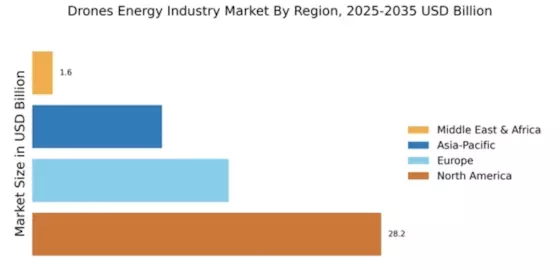
North America is poised to maintain its leadership in the Drones Energy Industry, holding a market share of 30.0% as of 2024. The region's growth is driven by technological advancements, increasing demand for energy-efficient solutions, and supportive regulatory frameworks. Government initiatives promoting drone usage in energy sectors, such as inspections and monitoring, are significant catalysts for this growth. The integration of AI and machine learning in drone technology further enhances operational efficiency, attracting investments and fostering innovation. The competitive landscape in North America is robust, featuring key players like DJI, Skydio, and AeroVironment. The U.S. stands out as a leader, with substantial investments in drone technology and infrastructure. The presence of major companies and startups alike fosters a dynamic environment for innovation. Additionally, partnerships between tech firms and energy companies are becoming increasingly common, further solidifying North America's position as a hub for drone energy solutions.

Europe : Emerging Market with Potential

Europe's Drones Energy Industry is on the rise, with a market size of 12.0% as of 2024. The region is experiencing growth driven by increasing investments in renewable energy and the adoption of drones for energy management and monitoring. Regulatory support from the European Union, including initiatives to enhance drone operations, is a key factor in this growth. The focus on sustainability and efficiency in energy sectors is pushing demand for innovative drone solutions, making Europe a promising market for future developments. Leading countries in this region include Germany, France, and the UK, where companies like Parrot and Quantum Systems are making significant strides. The competitive landscape is characterized by a mix of established firms and emerging startups, fostering innovation. Collaborative efforts between governments and private sectors are enhancing the market's potential, positioning Europe as a significant player in the global Drones Energy Industry.

Asia-Pacific : Rapidly Growing Drone Market

The Asia-Pacific region is witnessing rapid growth in the Drones Energy Industry, with a market size of 10.0% as of 2024. This growth is fueled by increasing urbanization, advancements in drone technology, and a rising focus on renewable energy solutions. Countries in this region are adopting drones for various applications, including energy monitoring and infrastructure inspections, driven by regulatory support and investment in smart technologies. The demand for efficient energy management solutions is propelling the market forward, making it a key area for future developments. China and Australia are leading the charge in this market, with companies like DJI and Insitu playing pivotal roles. The competitive landscape is diverse, featuring both local and international players. The presence of significant investments in drone technology and infrastructure development is enhancing the region's capabilities. As governments continue to support drone initiatives, the Asia-Pacific market is set for substantial growth in the coming years.

Middle East and Africa : Emerging Market with Challenges

The Middle East and Africa region is gradually emerging in the Drones Energy Industry, with a market size of 4.3% as of 2024. The growth is driven by increasing investments in energy infrastructure and the adoption of drones for monitoring and maintenance. However, challenges such as regulatory hurdles and limited technological adoption hinder rapid expansion. Governments are beginning to recognize the potential of drones in enhancing energy efficiency, leading to gradual regulatory improvements that could stimulate market growth in the future. Countries like South Africa and the UAE are at the forefront of this emerging market, with local companies exploring drone applications in energy sectors. The competitive landscape is still developing, with a mix of international firms and local startups. As awareness of drone technology's benefits grows, the region is likely to see increased investment and innovation, paving the way for future advancements in the Drones Energy Industry.

Drones Energy Industry Market Regional Image

Key Players and Competitive Insights

The Drones Energy Industry Market is currently characterized by a dynamic competitive landscape, driven by technological advancements and increasing demand for energy efficiency. Major players such as DJI (CN), Skydio (US), and AeroVironment (US) are at the forefront, each adopting distinct strategies to enhance their market positioning. DJI (CN) continues to lead in innovation, focusing on developing advanced drone technologies that cater to energy sector applications, while Skydio (US) emphasizes autonomous flight capabilities, which are particularly appealing for energy infrastructure inspections. AeroVironment (US) is strategically expanding its portfolio through partnerships aimed at integrating drone technology with renewable energy solutions, thereby enhancing operational efficiency in energy management.

The business tactics employed by these companies reflect a trend towards localizing manufacturing and optimizing supply chains to mitigate risks and enhance responsiveness to market demands. The market structure appears moderately fragmented, with a mix of established players and emerging startups, each contributing to a competitive environment that fosters innovation and collaboration. The collective influence of these key players is shaping a landscape where agility and technological prowess are paramount.

In January 2026, DJI (CN) announced a partnership with a leading energy provider to develop drone-based solutions for solar panel inspections. This collaboration is expected to streamline maintenance processes and reduce operational costs, highlighting DJI's commitment to leveraging its technological expertise in the energy sector. The strategic importance of this partnership lies in its potential to enhance service delivery and operational efficiency, positioning DJI as a pivotal player in the energy market.

In December 2025, Skydio (US) launched a new autonomous drone specifically designed for wind turbine inspections. This innovation not only underscores Skydio's focus on automation but also addresses the growing need for efficient maintenance solutions in the renewable energy sector. The introduction of this drone is likely to enhance safety and reduce downtime, thereby providing a competitive edge in a rapidly evolving market.

In November 2025, AeroVironment (US) secured a contract with a government agency to deploy drones for energy infrastructure monitoring. This strategic move is indicative of AeroVironment's efforts to expand its footprint in the public sector, leveraging its technology to enhance energy security and operational oversight. The implications of this contract extend beyond immediate revenue, as it positions AeroVironment as a trusted partner in energy management initiatives.

As of February 2026, current competitive trends in the Drones Energy Industry Market are increasingly defined by digitalization, sustainability, and the integration of artificial intelligence (AI). Strategic alliances are becoming more prevalent, as companies recognize the value of collaboration in driving innovation and enhancing service offerings. Looking ahead, competitive differentiation is likely to evolve from traditional price-based competition towards a focus on technological innovation, reliability in supply chains, and the ability to deliver sustainable solutions. This shift suggests that companies that prioritize R&D and strategic partnerships will be better positioned to thrive in this rapidly changing landscape.

Key Companies in the Drones Energy Industry Market include

Industry Developments

On March 15, 2024, DJI released the Inspire 3, an advanced drone specifically designed for filmmakers and content creators. The drone comes with advanced stabilization feature powered by AI processor which augurs well for aerial shoot videography.

In February 2024, Amazon Prime Air added new cities in Europe and the US to its drone delivery program. This initiative is aimed at minimizing the time frame between the customer order placement and delivery through new multipurpose drones that can transport heavy goods.

In January 2024, Zipline forged an alliance with the United Nations on a particular venture the goal of which is to transport medical products and vaccines to hinterlands of Africa using drones. Extended range and durability have been incorporated in the drone models used in this program to make them reliable in difficult settings.

In December 2023, Parrot launched its latest series of agricultural drones equipped with multispectral cameras and AI analytical systems, everything geared towards the trend in agriculture today which requires drones that can enhance the services of pest control, crop monitoring and yield estimation.

In November 2023, Skydio won a contract with the US Department of defense worth 200 million dollars for the provision of autonomous drones which will be used in reconnaissance and surveillance tasks. Such contract reflects the trend that more high-tech arms and ammunitions that rely on artificial intelligence will be sought by the military.

In October 2023, Wing – a subsidiary of Alphabet, Inc – disclosed the successful trials of its voice-controlled drone lockers. This development enables clients to have their parcels packed in safe lockers with drone systems which makes their delivery process both easy and safe.

In September 2023, Indian Authorities announced the new incentives intended for indigenous drone builders under the Make In India initiative. This is geared towards boosting local innovation and production in the drone sector as demand in agriculture, logistics and defence expands.

Future Outlook

Drones Energy Industry Market Future Outlook

The Drones Energy Industry Market is projected to grow at a 7.6% CAGR from 2024 to 2035, driven by technological advancements, regulatory support, and increasing demand for renewable energy solutions.

New opportunities lie in:

  • Development of autonomous drone charging stations for remote locations.
  • Integration of drones in energy infrastructure inspections and maintenance.
  • Partnerships with renewable energy firms for drone-based energy delivery services.

By 2035, the Drones Energy Industry Market is expected to be robust, driven by innovation and strategic partnerships.

Market Segmentation

Drones Energy Industry Market End Use Outlook

  • Utility Companies
  • Renewable Energy Providers
  • Telecommunication Companies
  • Government Agencies

Drones Energy Industry Market Drone Type Outlook

  • Fixed Wing Drones
  • Multirotor Drones
  • Hybrid Drones
  • Solar Powered Drones

Drones Energy Industry Market Application Outlook

  • Energy Infrastructure Inspection
  • Renewable Energy Monitoring
  • Power Line Maintenance
  • Wind Turbine Inspection

Drones Energy Industry Market Energy Source Outlook

  • Battery Powered
  • Solar Powered
  • Hybrid Energy Systems
  • Fuel Cell Powered

Report Scope

MARKET SIZE 202456.3(USD Billion)
MARKET SIZE 202560.5(USD Billion)
MARKET SIZE 2035125.9(USD Billion)
COMPOUND ANNUAL GROWTH RATE (CAGR)7.6% (2024 - 2035)
REPORT COVERAGERevenue Forecast, Competitive Landscape, Growth Factors, and Trends
BASE YEAR2024
Market Forecast Period2025 - 2035
Historical Data2019 - 2024
Market Forecast UnitsUSD Billion
Key Companies ProfiledDJI (CN), Parrot (FR), Skydio (US), AeroVironment (US), Northrop Grumman (US), General Atomics (US), senseFly (CH), Insitu (US), Quantum Systems (DE)
Segments CoveredApplication, End Use, Drone Type, Energy Source
Key Market OpportunitiesIntegration of advanced battery technologies enhances operational efficiency in the Drones Energy Industry Market.
Key Market DynamicsTechnological advancements in battery efficiency drive competitive dynamics in the Drones Energy Industry market.
Countries CoveredNorth America, Europe, APAC, South America, MEA

Market Highlights

Author
Swapnil Palwe
Team Lead - Research

With a technical background as Bachelor's in Mechanical Engineering, with MBA in Operations Management , Swapnil has 6+ years of experience in market research, consulting and analytics with the tasks of data mining, analysis, and project execution. He is the POC for our clients, for their consulting projects running under the Automotive/A&D domain. Swapnil has worked on major projects in verticals such as Aerospace & Defense, Automotive and many other domain projects. He has worked on projects for fortune 500 companies' syndicate and consulting projects along with several government projects.

Leave a Comment

FAQs

What is the current valuation of the US drones energy industry market?

The market valuation was 15.76 USD Billion in 2024.

What is the projected market size for the US drones energy industry by 2035?

The projected valuation for 2035 is 32.79 USD Billion.

What is the expected CAGR for the US drones energy industry from 2025 to 2035?

The expected CAGR during the forecast period 2025 - 2035 is 6.89%.

Which companies are considered key players in the US drones energy industry?

Key players include General Atomics, Northrop Grumman, Lockheed Martin, Boeing, DJI Technology, AeroVironment, Parrot Drones, Skydio, and senseFly.

Download Free Sample

Kindly complete the form below to receive a free sample of this Report

Compare Licence

×
Features License Type
Single User Multiuser License Enterprise User
Price $4,950 $5,950 $7,250
Maximum User Access Limit 1 User Upto 10 Users Unrestricted Access Throughout the Organization
Free Customization
Direct Access to Analyst
Deliverable Format
Platform Access
Discount on Next Purchase 10% 15% 15%
Printable Versions