×
Request Free Sample ×

Kindly complete the form below to receive a free sample of this Report

* Please use a valid business email

Leading companies partner with us for data-driven Insights

clients tt-cursor
Hero Background

UK 3D Rendering Software Market

ID: MRFR/ICT/62764-HCR
200 Pages
Aarti Dhapte
February 2026

UK 3D Rendering Software Market Size, Share and Research Report: By Application (Architectural Visualization, Product Visualization, Animation and Visual Effects, Gaming, Virtual Reality), By Deployment Type (On-Premise, Cloud-Based, Hybrid), By End User (Architects, Animators, Game Developers, Industrial Designers, Educational Institutions) and By Rendering Type (Real-Time Rendering, Pre-Rendered, Distributed Rendering)- Industry Forecast to 2035

Share:
Download PDF ×

We do not share your information with anyone. However, we may send you emails based on your report interest from time to time. You may contact us at any time to opt-out.

UK 3D Rendering Software Market Infographic
Purchase Options

UK 3D Rendering Software Market Summary

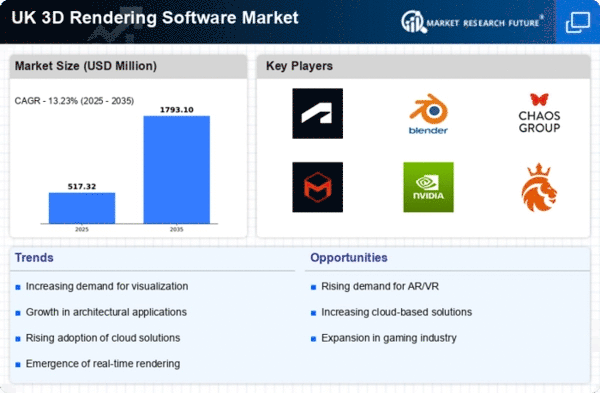
As per Market Research Future analysis, the UK 3D Rendering Software Market size was estimated at 456.88 USD Million in 2024. The 3D Rendering-software market is projected to grow from 517.32 USD Million in 2025 to 1793.1 USD Million by 2035, exhibiting a compound annual growth rate (CAGR) of 13.2% during the forecast period 2025 - 2035

Key Market Trends & Highlights

The UK 3D rendering-software market is experiencing robust growth driven by technological advancements and increasing demand for visual content.

  • The integration of AI and Machine Learning is transforming the capabilities of 3D rendering software.
  • The rise of Virtual and Augmented Reality is significantly influencing user engagement and application areas.
  • The architectural visualization segment remains the largest, while the gaming industry is the fastest-growing segment in the market.
  • Increased demand for visual content and technological advancements in software are key drivers propelling market expansion.

Market Size & Forecast

2024 Market Size 456.88 (USD Million)
2035 Market Size 1793.1 (USD Million)
CAGR (2025 - 2035) 13.23%

Major Players

Autodesk (US), Blender Foundation (NL), Chaos Group (BG), Maxon (DE), NVIDIA (US), Solid Angle (ES), Trimble (US), Unity Technologies (US)

Our Impact
Enabled $4.3B Revenue Impact for Fortune 500 and Leading Multinationals
Partnering with 2000+ Global Organizations Each Year
30K+ Citations by Top-Tier Firms in the Industry

UK 3D Rendering Software Market Trends

The UK 3D Rendering Software Market is currently experiencing a notable evolution, driven by advancements in technology and increasing demand across various sectors. The integration of artificial intelligence and machine learning into rendering processes appears to enhance efficiency and output quality. This trend is particularly evident in industries such as architecture, gaming, and film, where high-quality visualizations are essential. Furthermore, the rise of virtual and augmented reality applications is likely to propel the need for sophisticated rendering solutions, as these technologies require detailed and immersive graphics. As a result, software developers are focusing on creating tools that cater to these emerging needs, potentially leading to a more competitive landscape. In addition, the growing emphasis on sustainability and eco-friendly practices may influence the development of rendering software. Companies are increasingly seeking solutions that minimize energy consumption and reduce carbon footprints. This shift could lead to innovations in rendering techniques that prioritize efficiency and sustainability. Overall, the 3d rendering-software market is poised for growth, with technological advancements and changing consumer preferences shaping its future trajectory.

Integration of AI and Machine Learning

The incorporation of artificial intelligence and machine learning into rendering software is transforming workflows. These technologies streamline processes, enhance rendering speeds, and improve the quality of visual outputs. As industries demand more efficient solutions, software developers are likely to prioritize these innovations.

Rise of Virtual and Augmented Reality

The increasing adoption of virtual and augmented reality technologies is driving demand for advanced rendering solutions. These applications require high-quality graphics and immersive experiences, prompting developers to create software that meets these specific needs.

Focus on Sustainability

There is a growing trend towards sustainability within the 3d rendering-software market. Companies are seeking solutions that reduce energy consumption and environmental impact. This focus on eco-friendly practices may lead to the development of more efficient rendering techniques.

UK 3D Rendering Software Market Drivers

Growth of the Gaming Industry

The gaming industry serves as a significant driver for the 3d rendering-software market, particularly in the UK, where the sector is valued at approximately £7.16 billion. As gaming technology advances, the demand for realistic graphics and immersive experiences intensifies. Developers are increasingly turning to sophisticated rendering software to create lifelike environments and characters, which enhances player engagement. The rise of eSports and mobile gaming further contributes to this growth, as developers seek to differentiate their products in a competitive landscape. Additionally, the increasing popularity of virtual reality (VR) gaming necessitates high-quality rendering solutions to deliver seamless experiences. This trend suggests that the 3d rendering-software market will continue to thrive as gaming companies invest in advanced tools to meet consumer expectations and elevate their offerings.

Increased Demand for Visual Content

The 3d rendering-software market experiences heightened demand for visual content across various sectors, including advertising, gaming, and architecture. As businesses increasingly rely on high-quality visuals to engage consumers, the need for advanced rendering solutions becomes apparent. In the UK, the advertising industry alone is projected to grow by 5.5% annually, driving the adoption of 3d rendering software. This trend indicates that companies are investing in sophisticated tools to create compelling visual narratives, thereby enhancing their market presence. Furthermore, the rise of social media platforms necessitates visually appealing content, further propelling the demand for 3d rendering solutions. As a result, software developers are likely to innovate and enhance their offerings to meet the evolving needs of businesses, solidifying the importance of the 3d rendering-software market in the UK economy.

Technological Advancements in Software

Technological advancements play a crucial role in shaping the 3d rendering-software market. Innovations in graphics processing units (GPUs) and rendering algorithms have significantly improved rendering speeds and quality. In the UK, the introduction of real-time rendering technologies has transformed how designers and artists create visual content. This shift allows for immediate feedback and adjustments, streamlining workflows and enhancing productivity. Moreover, the integration of cloud computing facilitates collaborative projects, enabling teams to work seamlessly across different locations. As these technologies continue to evolve, the 3d rendering-software market is likely to witness increased competition among software providers, each striving to offer cutting-edge solutions that cater to the diverse needs of users. Consequently, the market is expected to expand as more professionals adopt these advanced tools to enhance their creative processes.

Expansion of Architectural Visualization

Architectural visualization is a pivotal driver for the 3d rendering-software market, particularly in the UK, where the construction sector is experiencing a resurgence. As architects and developers seek to present their designs more effectively, the demand for high-quality 3d renderings has surged. This trend is evidenced by the increasing number of architectural firms adopting advanced rendering software to create realistic visualizations for clients. The ability to showcase projects in a visually compelling manner not only aids in securing approvals but also enhances marketing efforts. Furthermore, the integration of augmented reality (AR) into architectural presentations allows clients to experience designs in immersive ways, further driving the need for sophisticated rendering solutions. As the construction industry continues to grow, the 3d rendering-software market is likely to benefit from this expansion, with firms investing in cutting-edge tools to enhance their competitive edge.

Rising Interest in Education and Training

The rising interest in education and training within the creative industries significantly impacts the 3d rendering-software market. Educational institutions in the UK are increasingly incorporating advanced rendering software into their curricula, preparing students for careers in design, animation, and architecture. This trend indicates a growing recognition of the importance of 3d rendering skills in the job market. As students become proficient in these tools, they are likely to influence industry standards and practices upon entering the workforce. Additionally, online training platforms are emerging, offering courses on 3d rendering techniques, further expanding access to these essential skills. This educational focus suggests that the 3d rendering-software market will continue to grow as a new generation of professionals enters the field, equipped with the knowledge and expertise to leverage advanced rendering technologies.


Market Segment Insights

By Application: Architectural Visualization (Largest) vs. Gaming (Fastest-Growing)

The UK 3d rendering-software market demonstrates a diverse distribution of market shares among its application segments. Architectural Visualization holds the largest share, driven by persistent demand in real estate and construction. Product Visualization and Animation and Visual Effects also play crucial roles, catering to industries such as marketing and entertainment. Meanwhile, segments like Gaming and Virtual Reality are emerging with robust growth due to innovations in technology and increased consumer interest. Growth trends in the UK 3d rendering-software market are heavily influenced by technological advancements, such as real-time rendering and cloud computing, which enhance the capabilities of various applications. Gaming has gained momentum as one of the fastest-growing segments, fueled by the rise of online gaming and eSports. Additionally, the increasing utilization of virtual reality applications across multiple sectors indicates a shift toward immersive experiences that require sophisticated rendering solutions.

Architectural Visualization (Dominant) vs. Gaming (Emerging)

Architectural Visualization is the dominant segment in the UK 3d rendering-software market, characterized by extensive use in professional architecture, real estate, and construction projects. This segment benefits from advanced visualization techniques that allow users to create realistic 3D models and walkthroughs, contributing to informed decision-making and marketing strategies. In contrast, Gaming represents an emerging segment, driven by innovations in graphic rendering technologies and a growing player base. The demand for high-quality graphics and realistic environments in video games propels the gaming segment forward, establishing it as a crucial area of growth within the market.

By Deployment Type: Cloud-Based (Largest) vs. On-Premise (Fastest-Growing)

In the UK 3d rendering-software market, the deployment type segment is characterized by distinct preferences among users. Cloud-Based solutions currently hold the largest market share, driven by their accessibility and scalability, making them a favored choice for many organizations. On the other hand, On-Premise solutions are witnessing a surge in demand, positioning them as the fastest-growing segment due to increasing security concerns and the need for customized rendering solutions. The growth trends within this segment indicate a shift towards more hybrid solutions that combine the benefits of both Cloud-Based and On-Premise deployments. The rise in remote working and digital transformation initiatives are significant drivers propelling this trend. As organizations continue to seek flexible rendering options that enhance productivity while ensuring security, the Hybrid deployment type is expected to gain considerable traction, appealing to a diverse user base.

Deployment: Cloud-Based (Dominant) vs. On-Premise (Emerging)

Cloud-Based deployment is becoming the dominant choice in the UK 3d rendering-software market, favored for its ease of access, cost-effectiveness, and collaboration capabilities. This segment allows users to render projects remotely, facilitating real-time updates and teamwork across geographical boundaries. In contrast, On-Premise solutions, while traditionally seen as a secure option, are now emerging due to a growing demand for enhanced control over data and rendering processes. Organizations looking for robust security, compliance, and customized configurations are increasingly considering On-Premise options. As the market evolves, the combination of both deployment types is likely to create a competitive landscape that caters to varying user needs.

By End User: Architects (Largest) vs. Animators (Fastest-Growing)

In the UK 3d rendering-software market, the distribution of market share highlights architects as the largest end user segment, leveraging their need for detailed visualizations in building design. This significant share emphasizes the critical role that 3D rendering plays in architectural projects, ranging from residential to large-scale commercial developments. Conversely, animators are emerging as the fastest-growing segment, driven by the increasing demand for animated content across various media platforms, including film, gaming, and online content creation. Growth trends indicate that the UK 3d rendering-software market is benefitting from advancements in rendering technology, including real-time rendering and enhanced visualization capabilities that appeal to various end users. The rise of virtual reality (VR) and augmented reality (AR) applications is particularly influencing animators' adoption of these tools, as they seek to create immersive experiences. Furthermore, educational institutions are also beginning to integrate 3D rendering training in their curricula, further propelling demand across segments.

Architects: Dominant vs. Animators: Emerging

Architects dominate the UK 3d rendering-software market due to their extensive need for high-quality visual representations to communicate design intentions effectively. Their projects necessitate precise models that can articulate complex architectural concepts. This demand is characterized by tailored features that enable designers to visualize materials, lighting, and spatial relationships. On the other hand, animators are characterized by a fast-paced growth trajectory driven by creative innovation and the expansion of digital media platforms. Their requirements often focus on dynamic rendering capabilities and compatibility with animation software, making them adept at producing engaging visual narratives. The competition between these segments showcases how traditional practices are evolving alongside emerging technological trends.

By Rendering Type: Real-Time Rendering (Largest) vs. Pre-Rendered (Fastest-Growing)

In the UK 3d rendering-software market, Real-Time Rendering commands a significant share, owing to its rapid feedback loop and ability to facilitate interactive experiences. Pre-Rendered solutions, while historically prominent, are increasingly being challenged by advancements in real-time technologies. This shift indicates that user preferences are tilting towards more immediate visual outputs that can enhance productivity across various sectors. Furthermore, the growth of real-time rendering is driven by innovations in GPU technology and cloud computing. As organizations seek more efficiency in their visual production processes, the demand for real-time solutions is expected to rise. Meanwhile, Pre-Rendered systems are adapting by incorporating aspects of real-time capabilities, though they may struggle to keep pace with the burgeoning interest in faster, more versatile rendering options.

Rendering: Real-Time (Dominant) vs. Pre-Rendered (Emerging)

Real-Time Rendering has established itself as the dominant force in the UK 3d rendering-software market, primarily due to its ability to deliver instant results that support various applications, from gaming to architectural visualization. This segment benefits from ongoing technological advancements, particularly in graphics processing units and real-time engines that allow for high-quality output at unprecedented speeds. Meanwhile, Pre-Rendered solutions, while still essential for certain applications that require detailed visuals, are being recognized as an emerging alternative struggling to maintain dominance. These solutions often involve extensive computation, resulting in longer rendering times, which can limit their appeal in an increasingly fast-paced digital landscape. However, their quality and aesthetic appeal remain valued in specific markets.

Get more detailed insights about UK 3D Rendering Software Market

Key Players and Competitive Insights

The 3D rendering-software market exhibits a dynamic competitive landscape, characterized by rapid technological advancements and a growing demand for high-quality visual content across various sectors. Key players such as Autodesk (US), Chaos Group (BG), and NVIDIA (US) are at the forefront, leveraging innovation and strategic partnerships to enhance their market positions. Autodesk (US) focuses on integrating AI capabilities into its software, aiming to streamline workflows and improve user experience. Meanwhile, Chaos Group (BG) emphasizes real-time rendering solutions, catering to the increasing need for speed and efficiency in design processes. NVIDIA (US) continues to push the boundaries of graphics processing, investing heavily in GPU technology to support complex rendering tasks, thereby solidifying its leadership in the market.The business tactics employed by these companies reflect a concerted effort to optimize operations and adapt to market demands. Localizing software solutions and enhancing customer support are pivotal strategies that allow these firms to cater to regional preferences and requirements. The market structure appears moderately fragmented, with a mix of established players and emerging startups, each contributing to a competitive environment that fosters innovation and growth. The collective influence of these key players shapes the market dynamics, driving advancements in rendering technology and expanding application areas.

In October Autodesk (US) announced a strategic partnership with a leading AI firm to develop next-generation rendering tools that utilize machine learning algorithms. This collaboration is poised to enhance the efficiency of rendering processes, potentially reducing rendering times by up to 30%. Such advancements not only improve productivity for users but also position Autodesk (US) as a pioneer in integrating AI into 3D rendering workflows, thereby reinforcing its competitive edge.

In September Chaos Group (BG) launched a new version of its V-Ray rendering software, which includes enhanced features for virtual reality (VR) applications. This release is significant as it aligns with the growing trend of immersive experiences in design and architecture. By focusing on VR capabilities, Chaos Group (BG) is likely to attract a broader customer base, particularly in industries where visualization plays a critical role in decision-making.

In August NVIDIA (US) unveiled its latest GPU architecture, designed specifically for real-time ray tracing. This technological leap is expected to revolutionize the rendering process, allowing for unprecedented levels of detail and realism in 3D graphics. The introduction of this architecture not only strengthens NVIDIA's position in the market but also sets a new standard for rendering quality, compelling competitors to innovate further.

As of November the competitive trends in the 3D rendering-software market are increasingly defined by digitalization, sustainability, and the integration of AI technologies. Strategic alliances are becoming more prevalent, as companies recognize the value of collaboration in driving innovation and expanding market reach. Looking ahead, competitive differentiation is likely to evolve, shifting from price-based competition to a focus on technological innovation, enhanced user experiences, and supply chain reliability. This transition underscores the importance of adaptability and forward-thinking strategies in maintaining a competitive advantage.

Key Companies in the UK 3D Rendering Software Market include

Industry Developments

Recent developments in the UK 3D Rendering Software Market reflect a dynamic and evolving landscape, with significant growth observed in companies like Autodesk, Unity Technologies, and Epic Games. Autodesk, for instance, has announced new features in itsrendering solutions that enhance collaboration and efficiency, catering to sectors such as architecture and gaming.

Unity Technologies continues to gain traction with its real-time rendering capabilities, appealing to the growing demand for high-quality visual content across various industries. Notable mergers include Epic Games acquiring ArtStation in April 2021, substantially enhancing their portfolio in the creative community. Furthermore, with the rising adoption of remote working, the demand for cloud-based rendering solutions has surged, galvanizing companies like Adobe and Blender Foundation to innovate their offerings to meet new user needs.

The UK market's valuation has been positively impacted, forecasted to grow as digital transformation initiatives accelerate across sectors, reflecting a robust appetite for advanced 3D rendering solutions. In the past few years, critical developments, including SolidWorks' partnership with Siemens Digital Industries Software in December 2022, have further solidified the UK’s position as a leading hub for 3D rendering technology and innovation.

Future Outlook

UK 3D Rendering Software Market Future Outlook

The 3D Rendering Software Market is projected to grow at a 13.23% CAGR from 2025 to 2035, driven by advancements in technology, increasing demand for visual content, and expanding applications across industries.

New opportunities lie in:

  • Develop subscription-based models for small businesses to enhance accessibility.
  • Integrate AI-driven features for real-time rendering to attract tech-savvy users.
  • Expand partnerships with educational institutions for training programs in 3D rendering.

By 2035, the market is expected to achieve substantial growth, positioning itself as a leader in digital visualization.

Market Segmentation

UK 3D Rendering Software Market End User Outlook

  • Architects
  • Animators
  • Game Developers
  • Industrial Designers
  • Educational Institutions

UK 3D Rendering Software Market Application Outlook

  • Architectural Visualization
  • Product Visualization
  • Animation and Visual Effects
  • Gaming
  • Virtual Reality

UK 3D Rendering Software Market Rendering Type Outlook

  • Real-Time Rendering
  • Pre-Rendered
  • Distributed Rendering

UK 3D Rendering Software Market Deployment Type Outlook

  • On-Premise
  • Cloud-Based
  • Hybrid

Report Scope

MARKET SIZE 2024 456.88(USD Million)
MARKET SIZE 2025 517.32(USD Million)
MARKET SIZE 2035 1793.1(USD Million)
COMPOUND ANNUAL GROWTH RATE (CAGR) 13.23% (2025 - 2035)
REPORT COVERAGE Revenue Forecast, Competitive Landscape, Growth Factors, and Trends
BASE YEAR 2024
Market Forecast Period 2025 - 2035
Historical Data 2019 - 2024
Market Forecast Units USD Million
Key Companies Profiled Autodesk (US), Blender Foundation (NL), Chaos Group (BG), Maxon (DE), NVIDIA (US), Solid Angle (ES), Trimble (US), Unity Technologies (US)
Segments Covered Application, Deployment Type, End User, Rendering Type
Key Market Opportunities Integration of artificial intelligence in 3d rendering-software enhances efficiency and creativity in design processes.
Key Market Dynamics Technological advancements drive innovation in 3D rendering software, enhancing user experience and competitive differentiation.
Countries Covered UK
Leave a Comment

FAQs

What is the expected market size of the UK 3D Rendering Software Market in 2024?

The UK 3D Rendering Software Market is expected to be valued at 216.88 million USD in 2024.

What is the projected market size for the UK 3D Rendering Software Market by 2035?

By 2035, the UK 3D Rendering Software Market is projected to reach a valuation of 450.0 million USD.

What is the expected CAGR for the UK 3D Rendering Software Market from 2025 to 2035?

The expected compound annual growth rate (CAGR) for the market from 2025 to 2035 is 6.861%.

Which application segment is expected to hold the largest market share in 2024?

Architectural Visualization is expected to lead the market with a valuation of 85.0 million USD in 2024.

What will be the market size of the Gaming application segment by 2035?

The Gaming application segment is projected to reach a market size of 110.0 million USD by 2035.

Which major players dominate the UK 3D Rendering Software Market?

Key players in the market include Autodesk, Unity Technologies, SolidWorks, and Epic Games, among others.

What market value is estimated for Product Visualization in 2024?

Product Visualization is estimated to have a market value of 40.0 million USD in 2024.

How much growth is expected for the Virtual Reality segment from 2024 to 2035?

The Virtual Reality segment is expected to grow from 16.88 million USD in 2024 to 25.0 million USD in 2035.

What challenges are influencing the growth of the UK 3D Rendering Software Market?

Key challenges include rapid technological advancements and the need for constant updates in software capabilities.

What is the projected market size for Animation and Visual Effects by 2035?

The Animation and Visual Effects segment is projected to reach a market size of 60.0 million USD by 2035.

Download Free Sample

Kindly complete the form below to receive a free sample of this Report

Compare Licence

×
Features License Type
Single User Multiuser License Enterprise User
Price $4,950 $5,950 $7,250
Maximum User Access Limit 1 User Upto 10 Users Unrestricted Access Throughout the Organization
Free Customization
Direct Access to Analyst
Deliverable Format
Platform Access
Discount on Next Purchase 10% 15% 15%
Printable Versions