×
Request Free Sample ×

Kindly complete the form below to receive a free sample of this Report

* Please use a valid business email

Leading companies partner with us for data-driven Insights

clients tt-cursor
Hero Background

France 3D Rendering Software Market

ID: MRFR/ICT/62767-HCR
200 Pages
Aarti Dhapte
February 2026

France 3D Rendering Software Market Size, Share and Research Report: By Application (Architectural Visualization, Product Visualization, Animation and Visual Effects, Gaming, Virtual Reality), By Deployment Type (On-Premise, Cloud-Based, Hybrid), By End User (Architects, Animators, Game Developers, Industrial Designers, Educational Institutions) and By Rendering Type (Real-Time Rendering, Pre-Rendered, Distributed Rendering)- Industry Forecast to 2035

Share:
Download PDF ×

We do not share your information with anyone. However, we may send you emails based on your report interest from time to time. You may contact us at any time to opt-out.

France 3D Rendering Software Market Infographic
Purchase Options

France 3D Rendering Software Market Summary

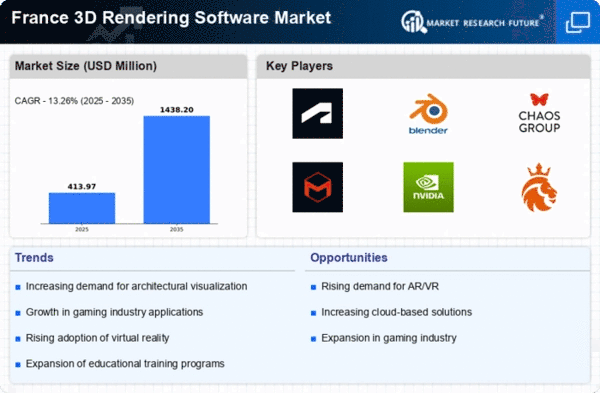
As per Market Research Future analysis, the France 3D Rendering Software Market size was estimated at 365.5 USD Million in 2024. The 3D Rendering-software market is projected to grow from 413.97 USD Million in 2025 to 1438.2 USD Million by 2035, exhibiting a compound annual growth rate (CAGR) of 13.2% during the forecast period 2025 - 2035

Key Market Trends & Highlights

The France 3D rendering-software market is experiencing a transformative shift driven by technological advancements and evolving consumer demands.

  • The market is witnessing a rise in cloud-based solutions, enhancing accessibility and collaboration.
  • Integration of AI technologies is becoming increasingly prevalent, streamlining rendering processes and improving efficiency.
  • The architecture and design segment remains the largest, while the entertainment industry is the fastest-growing segment in the market.
  • Key drivers include the increasing demand in architecture and design, alongside the expansion of the entertainment industry.

Market Size & Forecast

2024 Market Size 365.5 (USD Million)
2035 Market Size 1438.2 (USD Million)
CAGR (2025 - 2035) 13.26%

Major Players

Autodesk (US), Blender Foundation (NL), Chaos Group (BG), Maxon (DE), NVIDIA (US), Solid Angle (ES), SketchUp (US), Unity Technologies (US)

Our Impact
Enabled $4.3B Revenue Impact for Fortune 500 and Leading Multinationals
Partnering with 2000+ Global Organizations Each Year
30K+ Citations by Top-Tier Firms in the Industry

France 3D Rendering Software Market Trends

The France 3D Rendering Software Market in France is currently experiencing a notable evolution, driven by advancements in technology and increasing demand across various sectors. Industries such as architecture, gaming, and film are leveraging these tools to create visually stunning representations of their projects. The integration of artificial intelligence and machine learning into rendering processes appears to enhance efficiency and output quality, suggesting a shift towards more automated solutions. Furthermore, the growing trend of remote work has led to an increased reliance on cloud-based rendering solutions, allowing for greater collaboration and flexibility among teams. In addition, the emphasis on sustainability and eco-friendly practices is influencing the development of rendering software. Companies are increasingly seeking solutions that minimize energy consumption and reduce carbon footprints. This trend indicates a broader awareness of environmental issues within the industry, which may shape future innovations. As the market continues to mature, it is likely that user experience and accessibility will remain focal points, ensuring that a wider range of professionals can utilize these powerful tools effectively.

Rise of Cloud-Based Solutions

The shift towards cloud-based rendering solutions is becoming increasingly prominent. This trend allows users to access powerful rendering capabilities without the need for high-end hardware. It promotes collaboration among teams, enabling real-time updates and sharing of projects, which is particularly beneficial in industries like architecture and design.

Integration of AI Technologies

The incorporation of artificial intelligence into rendering software is transforming workflows. AI algorithms can optimize rendering times and enhance image quality, making it easier for users to achieve desired results. This trend suggests a move towards more intelligent software that can learn from user preferences and improve over time.

Focus on Sustainability

Sustainability is emerging as a key consideration in the development of rendering software. Companies are increasingly prioritizing energy-efficient solutions that reduce environmental impact. This trend reflects a growing awareness of ecological issues and may drive innovation towards greener technologies in the future.

France 3D Rendering Software Market Drivers

Expansion of the Entertainment Industry

The entertainment industry in France significantly influences the 3d rendering-software market, particularly in film, gaming, and animation. As the demand for high-quality visual effects and immersive experiences escalates, production companies increasingly invest in sophisticated rendering software. In 2025, the gaming sector alone is expected to contribute around 25% to the overall market revenue, driven by the rise of virtual reality (VR) and augmented reality (AR) applications. This expansion necessitates advanced rendering capabilities to create lifelike environments and characters, thereby enhancing user engagement. Consequently, the growth of the entertainment industry serves as a vital driver for the 3d rendering-software market, as companies seek to leverage cutting-edge technologies to remain competitive.

Growing Focus on Training and Education

The emphasis on training and education within various sectors in France contributes to the expansion of the 3d rendering-software market. Educational institutions and training centers increasingly incorporate 3D visualization tools into their curricula to enhance learning experiences. This trend is particularly evident in fields such as engineering, architecture, and design, where students benefit from hands-on experience with advanced rendering software. In 2025, the education sector is projected to account for approximately 15% of the market share, reflecting a growing recognition of the importance of 3D visualization in professional training. As educational institutions continue to adopt these technologies, the demand for 3d rendering software is likely to increase, driving market growth.

Increasing Demand in Architecture and Design

The 3d rendering-software market experiences a notable surge in demand from the architecture and design sectors. As architectural firms in France increasingly adopt advanced visualization techniques, the need for high-quality rendering software becomes paramount. This trend is driven by the necessity for architects to present their designs in a visually compelling manner, facilitating client approvals and enhancing project presentations. In 2025, the architectural segment is projected to account for approximately 35% of the total market share, reflecting a growing reliance on 3D rendering tools to create realistic representations of architectural concepts. The integration of these technologies not only streamlines the design process but also fosters collaboration among stakeholders, thereby propelling the growth of the 3d rendering-software market.

Technological Advancements in Rendering Techniques

Technological advancements play a crucial role in shaping the 3d rendering-software market. Innovations such as real-time rendering, ray tracing, and improved rendering algorithms enhance the quality and efficiency of visual outputs. In France, software developers are increasingly focusing on integrating these advanced techniques to meet the evolving demands of users across various sectors, including architecture, gaming, and product design. The introduction of real-time rendering capabilities allows for immediate feedback during the design process, which is particularly beneficial in collaborative environments. As a result, the market is likely to witness a compound annual growth rate (CAGR) of approximately 15% over the next five years, driven by the continuous evolution of rendering technologies.

Rising Adoption of Virtual Reality and Augmented Reality

The growing adoption of virtual reality (VR) and augmented reality (AR) technologies significantly impacts the 3d rendering-software market. In France, industries such as real estate, education, and healthcare are increasingly utilizing VR and AR to create immersive experiences for users. This trend necessitates advanced rendering software capable of producing high-quality, interactive 3D models. By 2025, the VR and AR segment is anticipated to represent about 20% of the overall market, as businesses recognize the potential of these technologies to enhance customer engagement and improve training processes. Consequently, the demand for sophisticated rendering solutions is likely to rise, further propelling the growth of the 3d rendering-software market.


Market Segment Insights

By Application: Architectural Visualization (Largest) vs. Gaming (Fastest-Growing)

The France 3d rendering-software market showcases diverse application segments, with Architectural Visualization leading in market share. This segment benefits from the continual demand in construction and real estate, providing key insights and immersive experiences for architects and clients. Following closely behind, Product Visualization and Animation and Visual Effects also command significant shares, driven by the robust advertising and media industries. In terms of growth trends, the Gaming segment stands out as the fastest-growing component within the application category. Factors propelling this growth include advancements in technology, increased investment in game development, and a growing gamer population. Virtual Reality is emerging as a significant player, enhancing user engagement and experience, signaling a vibrant future for the France 3d rendering-software market.

Architectural Visualization (Dominant) vs. Gaming (Emerging)

Architectural Visualization remains the dominant application in the France 3d rendering-software market, leveraging high fidelity and detailed rendering capabilities to attract architects and developers. This segment plays a crucial role in presenting architectural projects through realistic visualizations, enabling stakeholders to better understand designs. On the other hand, Gaming is identified as an emerging segment, rapidly gaining traction with its interactive and engaging content. The shift towards high-performance graphics and immersive experiences is reshaping the landscape, encouraging software providers to innovate and provide tools that cater to the gaming industry. As technology continues to advance, both segments are expected to evolve, with architectural tools integrating more gaming-like features.

By Deployment Type: Cloud-Based (Largest) vs. On-Premise (Fastest-Growing)

In the deployment type segment of the France 3d rendering-software market, the distribution of market share is led by cloud-based solutions, which have become the preferred choice for many businesses due to their scalability and flexibility. In contrast, on-premise solutions, while currently holding a smaller share, are rapidly gaining traction among companies that prioritize data security and control over their digital assets. The growth trends within this segment are influenced by several factors, including an increasing adoption of remote workflows and the demand for real-time collaboration tools. Hybrid solutions are emerging as a bridge, allowing organizations to leverage both on-premise and cloud-based deployments. The push towards digital transformation and the need for enhanced remote capabilities continue to drive the evolution of deployment types in this market.

Cloud-Based (Dominant) vs. On-Premise (Emerging)

Cloud-based deployment has established itself as the dominant choice in the France 3d rendering-software market, offering significant advantages such as cost-effectiveness and ease of access from anywhere with an internet connection. This model supports a wide array of users from small studios to large enterprises, facilitating collaboration and reducing the overhead of maintaining physical servers. On the other hand, on-premise deployment is emerging as a viable option for organizations that require stringent data governance and customization capabilities. These solutions appeal particularly to industries where compliance and data integrity are critical, allowing businesses to maintain tighter control over their rendering processes.

By End User: Architects (Largest) vs. Animators (Fastest-Growing)

In the France 3d rendering-software market, the segment distribution is heavily influenced by the varying needs of end users. Architects hold a significant share as they utilize 3D rendering for visualizations and project presentations, while animators are also notable in the space, contributing actively to the overall market through creative projects and animations. Game developers and industrial designers also play their part, but the dominance of architects and the rising trend among animators showcases a competitive landscape. The growth trends within this segment indicate a robust demand driven by advancements in technology and the increasing need for high-quality visual content. While architects remain the largest users, animators are experiencing faster growth due to the booming entertainment industry and prior investments in digital content creation. Educational institutions are also leveraging these tools to enhance learning experiences, indicating a broader acceptance of 3D rendering software across various sectors.

Architects: Dominant vs. Animators: Emerging

Architects represent the dominant force in the France 3d rendering-software market, leveraging sophisticated software to create realistic visualizations and elevate their project proposals. Their need for precision, detail, and engaging presentations leads to consistent demand for advanced rendering tools. Meanwhile, animators, though considered an emerging segment, are rapidly gaining traction due to the flourishing animation and gaming industries. This shift is fueled by trends in digital storytelling and multimedia content creation, positioning animators as a significant driver of innovation within the market. Both segments showcase unique requirements, with architects focusing more on structural fidelity and animators emphasizing creative expression and dynamic content.

By Rendering Type: Real-Time Rendering (Largest) vs. Pre-Rendered (Fastest-Growing)

In the France 3d rendering-software market, Real-Time Rendering holds the largest market share, thanks to its capabilities that cater to a wide range of applications, including gaming and simulations. Meanwhile, Pre-Rendered solutions are gaining traction, carving out a significant share due to their high-quality visuals, especially in architectural visualizations and film production. Distributed Rendering, while smaller in comparison, supports both Real-Time and Pre-Rendered methodologies, enhancing overall efficiency. Growth trends highlight the increasing demand for Real-Time Rendering driven by advancements in hardware and software, allowing for more detailed and immersive graphics. The emergence of virtual reality and enhanced gaming experiences further propel this segment forward. On the other hand, Pre-Rendered is growing rapidly, driven by the need for high-resolution content in visual storytelling. Innovations and optimized workflows continue to foster development and interest across all rendering types.

Real-Time Rendering (Dominant) vs. Distributed Rendering (Emerging)

Real-Time Rendering stands out as the dominant segment in the France 3d rendering-software market due to its responsiveness and ability to deliver instant feedback, essential for interactive applications. Its current market position is bolstered by a surge in demand for real-time experiences in gaming, AR, and VR sectors. Conversely, Distributed Rendering is an emerging segment that offers scalability and speed, enabling complex rendering tasks to be executed across multiple machines. This technology is particularly appealing in industries where rendering times can significantly impact production schedules, such as animations and feature films.

Get more detailed insights about France 3D Rendering Software Market

Key Players and Competitive Insights

The 3D rendering-software market in France exhibits a dynamic competitive landscape, characterized by rapid technological advancements and a growing demand for high-quality visual content across various sectors, including architecture, gaming, and film. Key players such as Autodesk (US), Chaos Group (BG), and NVIDIA (US) are at the forefront, leveraging innovation and strategic partnerships to enhance their market positions. Autodesk (US) focuses on integrating cloud-based solutions to streamline workflows, while Chaos Group (BG) emphasizes real-time rendering capabilities, appealing to the gaming and architectural visualization sectors. NVIDIA (US) continues to push the envelope with its GPU technologies, which are essential for rendering high-fidelity graphics, thereby shaping the competitive environment through technological leadership.The market structure appears moderately fragmented, with several players vying for market share. Companies are increasingly adopting tactics such as localizing their offerings to cater to regional preferences and optimizing supply chains to enhance efficiency. This competitive structure allows for a diverse range of solutions, fostering innovation and driving growth. The collective influence of these key players suggests a robust ecosystem where collaboration and competition coexist, ultimately benefiting end-users through improved product offerings.

In October Autodesk (US) announced a strategic partnership with a leading French architectural firm to develop a new suite of tools tailored for sustainable design practices. This collaboration is likely to enhance Autodesk's market presence in France, aligning with the growing emphasis on sustainability in construction and design. By integrating advanced rendering capabilities with sustainable practices, Autodesk positions itself as a leader in eco-friendly solutions, potentially attracting a broader client base.

In September Chaos Group (BG) launched a new version of its V-Ray rendering software, which includes enhanced AI-driven features aimed at automating complex rendering tasks. This update is significant as it not only improves efficiency but also caters to the increasing demand for faster turnaround times in the creative industries. By incorporating AI, Chaos Group (BG) demonstrates its commitment to innovation, which may strengthen its competitive edge in a market that values speed and quality.

In August NVIDIA (US) unveiled its latest GPU architecture, designed specifically for real-time ray tracing applications. This development is crucial as it positions NVIDIA at the cutting edge of rendering technology, appealing to both game developers and visual effects artists. The introduction of this technology could redefine rendering standards, compelling competitors to accelerate their own innovations to keep pace with NVIDIA's advancements.

As of November the competitive trends in the 3D rendering-software market are increasingly defined by digitalization, sustainability, and the integration of AI technologies. Strategic alliances are becoming more prevalent, as companies recognize the value of collaboration in enhancing their technological capabilities. The shift from price-based competition to a focus on innovation and reliability in supply chains is evident, suggesting that future differentiation will hinge on the ability to deliver cutting-edge solutions that meet evolving market demands.

Key Companies in the France 3D Rendering Software Market include

Industry Developments

Recent developments in the France 3D Rendering Software Market showcase significant advancements and competitive positioning among key players. Companies such as Nemetschek, Autodesk, Unity Technologies, and Adobe have been focusing on enhancing their software functionalities to cater to the increasing demands from industries like architecture, gaming, and film.

In September 2023, Nemetschek announced the launch of itsupgraded rendering tool, aimed at optimizing architectural visualization processes, further establishing itspresence in the French market. Meanwhile, Autodesk has been innovating with machine learning tools to improve rendering efficiency. Notably, in March 2023, Epic Games announced a collaboration with French gaming studios to integrate their rendering technologies in local game developments, signaling a flourishing ecosystem for 3D rendering solutions in France.

The recent growth of the market valuation for companies, particularly in the creative sector, reflects an upward trend, fostering innovation and pushing the boundaries of 3D applications. Over the past few years, the sector has seen substantial investments and partnerships, indicating a robust ongoing commitment to develop advanced rendering capabilities that align with the evolving needs of French creatives and businesses alike.

Future Outlook

France 3D Rendering Software Market Future Outlook

The 3D Rendering Software Market in France is poised for growth at 13.26% CAGR from 2025 to 2035, driven by technological advancements and increasing demand for visual content.

New opportunities lie in:

  • Development of subscription-based pricing models for software access.
  • Integration of AI-driven rendering tools to enhance efficiency.
  • Expansion into virtual reality applications for immersive experiences.

By 2035, the market is expected to achieve substantial growth and innovation.

Market Segmentation

France 3D Rendering Software Market End User Outlook

  • Architects
  • Animators
  • Game Developers
  • Industrial Designers
  • Educational Institutions

France 3D Rendering Software Market Application Outlook

  • Architectural Visualization
  • Product Visualization
  • Animation and Visual Effects
  • Gaming
  • Virtual Reality

France 3D Rendering Software Market Rendering Type Outlook

  • Real-Time Rendering
  • Pre-Rendered
  • Distributed Rendering

France 3D Rendering Software Market Deployment Type Outlook

  • On-Premise
  • Cloud-Based
  • Hybrid

Report Scope

MARKET SIZE 2024 365.5(USD Million)
MARKET SIZE 2025 413.97(USD Million)
MARKET SIZE 2035 1438.2(USD Million)
COMPOUND ANNUAL GROWTH RATE (CAGR) 13.26% (2025 - 2035)
REPORT COVERAGE Revenue Forecast, Competitive Landscape, Growth Factors, and Trends
BASE YEAR 2024
Market Forecast Period 2025 - 2035
Historical Data 2019 - 2024
Market Forecast Units USD Million
Key Companies Profiled Autodesk (US), Blender Foundation (NL), Chaos Group (BG), Maxon (DE), NVIDIA (US), Solid Angle (ES), SketchUp (US), Unity Technologies (US)
Segments Covered Application, Deployment Type, End User, Rendering Type
Key Market Opportunities Integration of artificial intelligence in 3d rendering-software enhances efficiency and creativity in design processes.
Key Market Dynamics Rising demand for real-time rendering solutions drives innovation and competition in the 3D rendering-software market.
Countries Covered France
Leave a Comment

FAQs

What is the expected market size of the France 3D Rendering Software Market in 2024?

In 2024, the France 3D Rendering Software Market is expected to be valued at 173.5 million USD.

What is the projected market size of the France 3D Rendering Software Market by 2035?

The market is anticipated to grow significantly to 900.0 million USD by 2035.

What is the expected CAGR for the France 3D Rendering Software Market from 2025 to 2035?

The market is forecasted to grow at a compound annual growth rate (CAGR) of 16.143 percent during the period from 2025 to 2035.

Which segment is leading in the France 3D Rendering Software Market for 2024?

The Architectural Visualization segment is leading with a market valuation of 40.0 million USD in 2024.

What is the market value for Product Visualization in 2035?

By 2035, the Product Visualization segment is estimated to reach a market value of 150.0 million USD.

How much is the Gaming segment of the France 3D Rendering Software Market valued at in 2024?

In 2024, the Gaming segment is valued at 25.0 million USD.

What is the expected market size for Virtual Reality applications by 2035?

The Virtual Reality applications segment is projected to grow to 250.0 million USD by 2035.

Which major players are dominant in the France 3D Rendering Software Market?

Key players include Nemetschek, Autodesk, Unity Technologies, VRay, and Epic Games.

What will be the market value for Animation and Visual Effects in 2024?

The Animation and Visual Effects segment is expected to be valued at 35.0 million USD in 2024.

What are the growth drivers for the France 3D Rendering Software Market?

Key growth drivers include increasing demand for architectural visualization, gaming, and virtual reality applications.

Download Free Sample

Kindly complete the form below to receive a free sample of this Report

Compare Licence

×
Features License Type
Single User Multiuser License Enterprise User
Price $4,950 $5,950 $7,250
Maximum User Access Limit 1 User Upto 10 Users Unrestricted Access Throughout the Organization
Free Customization
Direct Access to Analyst
Deliverable Format
Platform Access
Discount on Next Purchase 10% 15% 15%
Printable Versions