×
Request Free Sample ×

Kindly complete the form below to receive a free sample of this Report

* Please use a valid business email

Leading companies partner with us for data-driven Insights

clients tt-cursor
Hero Background

Germany 3D Rendering Software Market

ID: MRFR/ICT/62765-HCR
200 Pages
Aarti Dhapte
February 2026

Germany 3D Rendering Software Market Size, Share and Research Report: By Application (Architectural Visualization, Product Visualization, Animation and Visual Effects, Gaming, Virtual Reality), By Deployment Type (On-Premise, Cloud-Based, Hybrid), By End User (Architects, Animators, Game Developers, Industrial Designers, Educational Institutions) and By Rendering Type (Real-Time Rendering, Pre-Rendered, Distributed Rendering)- Industry Forecast to 2035

Share:
Download PDF ×

We do not share your information with anyone. However, we may send you emails based on your report interest from time to time. You may contact us at any time to opt-out.

Germany 3D Rendering Software Market Infographic
Purchase Options

Germany 3D Rendering Software Market Summary

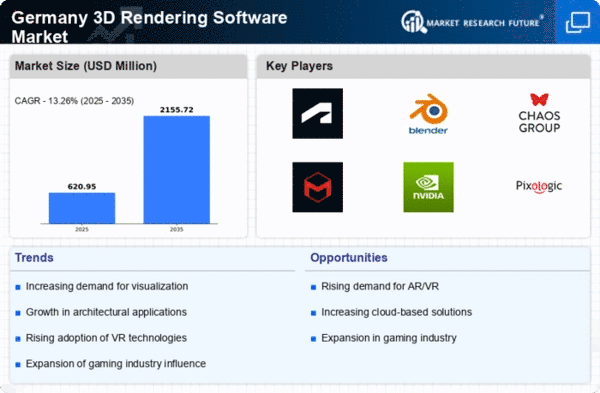
As per Market Research Future analysis, the Germany 3D Rendering Software Market size was estimated at 548.25 USD Million in 2024. The 3D Rendering-software market is projected to grow from 620.95 USD Million in 2025 to 2155.72 USD Million by 2035, exhibiting a compound annual growth rate (CAGR) of 13.2% during the forecast period 2025 - 2035

Key Market Trends & Highlights

The Germany 3D rendering-software market is experiencing a transformative shift driven by technological advancements and evolving consumer demands.

  • The market is witnessing a rise in cloud-based solutions, enhancing accessibility and collaboration.
  • Integration of AI technologies is becoming increasingly prevalent, streamlining workflows and improving rendering quality.
  • Sustainability is gaining traction, with companies focusing on eco-friendly practices in their software development.
  • The increasing demand in architecture and design, along with the expansion of the entertainment industry, are key drivers propelling market growth.

Market Size & Forecast

2024 Market Size 548.25 (USD Million)
2035 Market Size 2155.72 (USD Million)
CAGR (2025 - 2035) 13.26%

Major Players

Autodesk (US), Blender Foundation (NL), Chaos Group (BG), Maxon (DE), NVIDIA (US), Pixologic (US), Solid Angle (ES), Unity Technologies (US)

Our Impact
Enabled $4.3B Revenue Impact for Fortune 500 and Leading Multinationals
Partnering with 2000+ Global Organizations Each Year
30K+ Citations by Top-Tier Firms in the Industry

Germany 3D Rendering Software Market Trends

The Germany 3D Rendering Software Market in Germany is currently experiencing a notable evolution, driven by advancements in technology and increasing demand across various sectors. Industries such as architecture, gaming, and film are leveraging these tools to create visually stunning representations of their projects. The integration of artificial intelligence and machine learning into rendering processes appears to enhance efficiency and output quality, suggesting a shift towards more automated solutions. Furthermore, the growing trend of remote work has led to an increased reliance on cloud-based rendering solutions, allowing for greater collaboration among teams regardless of location. In addition, the emphasis on sustainability and energy efficiency is influencing the development of rendering software. Companies are increasingly focused on creating energy-efficient designs, which necessitates the use of advanced rendering tools to visualize and optimize these projects. This trend indicates a potential shift in consumer preferences towards software that not only meets aesthetic demands but also aligns with environmental considerations. As the market continues to evolve, it is likely that innovations will further shape the landscape, making it essential for stakeholders to stay informed about emerging technologies and consumer needs.

Rise of Cloud-Based Solutions

The shift towards cloud-based rendering solutions is becoming increasingly prominent. This trend allows users to access powerful rendering capabilities without the need for high-end hardware, facilitating collaboration and flexibility in project management.

Integration of AI Technologies

The incorporation of artificial intelligence into rendering software is enhancing the efficiency and quality of outputs. AI-driven tools are streamlining workflows, enabling faster rendering times and improved accuracy in visualizations.

Focus on Sustainability

There is a growing emphasis on sustainability within the 3d rendering-software market. Software developers are responding to the demand for energy-efficient designs, creating tools that help visualize and optimize environmentally friendly projects.

Germany 3D Rendering Software Market Drivers

Growth of E-commerce and Online Retail

The rise of e-commerce and online retail in Germany has a profound impact on the 3d rendering-software market. As businesses increasingly shift to online platforms, the need for high-quality product visualizations becomes paramount. Retailers are leveraging 3d rendering software to create realistic images of products, enhancing customer engagement and driving sales. Recent statistics suggest that e-commerce sales in Germany have grown by approximately 25% in the past year, leading to a heightened demand for rendering solutions that can produce compelling visuals. This trend is particularly evident in sectors such as fashion and home decor, where visual appeal is critical. Consequently, the growth of e-commerce is likely to continue fueling the expansion of the 3d rendering-software market, as businesses seek to improve their online presence through superior visual content.

Expansion of the Entertainment Industry

The entertainment industry in Germany significantly influences the 3d rendering-software market, particularly in film, gaming, and animation. With the increasing production of high-quality visual content, there is a growing need for sophisticated rendering solutions. Recent data indicates that the gaming sector alone has seen a revenue increase of over 20% in the last year, prompting game developers to invest in advanced rendering software to enhance graphics and user experience. Additionally, the rise of streaming platforms has led to a surge in animated content, further driving the demand for 3d rendering tools. As studios seek to produce visually stunning content, the 3d rendering-software market is poised for continued growth, fueled by the entertainment industry's expansion and the need for cutting-edge visual effects.

Rising Interest in Education and Training

The educational sector in Germany is increasingly recognizing the value of 3d rendering software for training and skill development. Institutions are incorporating these tools into their curricula to prepare students for careers in design, architecture, and engineering. The integration of 3d rendering software into educational programs is likely to enhance students' understanding of complex concepts and improve their employability. Recent surveys indicate that over 30% of educational institutions have adopted 3d rendering tools in their programs, reflecting a growing trend towards practical, hands-on learning experiences. As the demand for skilled professionals in these fields rises, the educational sector's investment in 3d rendering software is expected to contribute positively to the overall growth of the market.

Increasing Demand in Architecture and Design

The 3d rendering-software market experiences a notable surge in demand from the architecture and design sectors in Germany. As urbanization accelerates, architects and designers increasingly rely on advanced rendering software to visualize projects before construction. This trend is underscored by a reported growth of approximately 15% in the adoption of 3d rendering tools among architectural firms in the past year. The ability to create photorealistic images and immersive environments enhances client presentations, thereby streamlining the decision-making process. Furthermore, the integration of virtual reality (VR) capabilities into rendering software is likely to further drive this demand, as it allows clients to experience designs in a more interactive manner. Consequently, the architecture and design industries are pivotal in shaping the trajectory of the 3d rendering-software market in Germany.

Technological Advancements in Software Capabilities

Technological advancements play a crucial role in shaping the 3d rendering-software market. Innovations in rendering algorithms, real-time rendering, and cloud computing capabilities have transformed how designers and artists create visual content. In Germany, software developers are increasingly focusing on enhancing the efficiency and speed of rendering processes, which is vital for meeting the demands of fast-paced industries. For instance, the introduction of ray tracing technology has improved the realism of rendered images, making it a sought-after feature among users. As a result, the market is likely to witness a shift towards software that incorporates these advanced technologies, enabling users to produce high-quality visuals more efficiently. This trend indicates a competitive landscape where continuous improvement in software capabilities is essential for success in the 3d rendering-software market.


Market Segment Insights

By Application: Architectural Visualization (Largest) vs. Gaming (Fastest-Growing)

In the Germany 3d rendering-software market, Architectural Visualization commands the largest share, reflecting the robust demand from the real estate and construction sectors. Product Visualization and Animation and Visual Effects follow suit, contributing significantly to the market's overall dynamics. Gaming has emerged as a noteworthy segment, gaining traction with increasing development in interactive entertainment, enhancing its contribution to the market.

Architectural Visualization (Dominant) vs. Gaming (Emerging)

Architectural Visualization stands as the dominant segment within this market, driven by its application in urban planning and design, catering to architects and visualization professionals. Its precision and realism are pivotal in project presentations. In contrast, Gaming represents an emerging segment characterized by its rapid innovation and growing user base. The rise of esports and mobile gaming has fueled extensive investment in compelling 3D environments, making it a vibrant part of the 3D rendering landscape. Both segments exhibit unique requirements and drivers, positioning them strategically as leaders in their respective spheres.

By Deployment Type: Cloud-Based (Largest) vs. On-Premise (Fastest-Growing)

In the Germany 3d rendering-software market, the deployment type segment is witnessing a diverse distribution among its values. Currently, Cloud-Based solutions dominate the market, capturing the largest share due to their scalability, flexibility, and cost-effectiveness. On the other hand, On-Premise deployment is gaining traction as organizations seek security and control over their data, appealing to specific sectors requiring stringent compliance and privacy measures. The growth trends within this segment indicate a shift towards Cloud-Based solutions, driven by the increasing adoption of remote work and the demand for collaborative tools. However, the On-Premise deployment segment is emerging rapidly, as more companies prioritize data security and seamless integration with existing infrastructure. This dual trend reflects a transforming landscape where businesses are weighing the benefits of each deployment type against their operational needs.

Cloud-Based (Dominant) vs. On-Premise (Emerging)

Cloud-Based 3d rendering solutions are currently the dominant force in the Germany 3d rendering-software market, favored for their ease of access, lower upfront costs, and ability to deliver updates and features quickly. These solutions support collaborative work environments, allowing teams to access powerful rendering tools from various locations. In contrast, On-Premise solutions, characterized by their installed software on local servers, are emerging as a strong alternative for businesses prioritizing data control and security. While initially perceived as traditional and less flexible, On-Premise systems are evolving, incorporating cloud integration features, which makes them appealing for industries with specific compliance regulations.

By End User: Architects (Largest) vs. Animators (Fastest-Growing)

In the Germany 3d rendering-software market, the distribution of market share reveals that architects represent the largest segment, leveraging technology to refine their design processes and improve client presentations. This segment benefits from the ongoing architectural projects and an increasing number of firms adopting 3D rendering to visualize concepts effectively, creating a stronghold in the market. On the other hand, animators are experiencing rapid growth, driven by an expanding demand for multimedia content in various sectors such as entertainment, advertising, and education. The rise of online platforms and the need for engaging visual narratives are propelling this segment, making it one of the fastest-growing areas in the market, attracting new talents and investment in advanced rendering technologies.

Architects: Dominant vs. Animators: Emerging

Architects are positioned as the dominant players in the Germany 3d rendering-software market, utilizing sophisticated software to enhance their architectural designs with detailed visualizations and interactive models. This segment thrives on innovation and is often the first to adopt cutting-edge technologies available in 3D rendering solutions. In contrast, animators are the emerging force, increasingly favored for their dynamic storytelling capabilities. They utilize 3D rendering tools to create captivating animations for films, video games, and digital marketing. As demand rises, competition in the animator segment intensifies, driving software developers to enhance their offerings, thus fostering creative advancements and tailored solutions.

By Rendering Type: Real-Time Rendering (Largest) vs. Distributed Rendering (Fastest-Growing)

In the Germany 3d rendering-software market, Real-Time Rendering holds the largest market share, owing to its widespread application across gaming, architectural visualization, and virtual reality. Meanwhile, Pre-Rendered solutions, although significant, are witnessing a gradual decline in preference as industry needs shift towards more interactive and immediate rendering processes. Distributed Rendering, while currently smaller in its overall share, is rapidly gaining traction as more businesses recognize the advantages of efficiency and speed it offers in processing complex rendering tasks. The growth trends in the rendering type segment are being driven by increasing demand for realistic graphics in various sectors, including entertainment and design. Real-Time Rendering is buoyed by advancements in graphics processing technologies, while Distributed Rendering benefits from cloud-based solutions that allow for scalable performance. As industries continue to embrace digital transformation, the accelerated development in rendering technologies is expected to expand the capabilities and applications significantly.

Real-Time Rendering (Dominant) vs. Distributed Rendering (Emerging)

Real-Time Rendering stands out as a dominant force within the Germany 3d rendering-software market, heavily utilized in areas like gaming and interactive applications due to its capability to generate visuals instantly. This segment thrives on the need for immediate feedback and visual quality, making it essential for industries that require rapid prototyping. Meanwhile, Distributed Rendering is emerging as a competitive alternative, especially for tasks requiring extensive resources where multiple computers can share the load. It appeals particularly to larger projects where time efficiency and resource management become critical. Both segments showcase unique strengths; however, the shift towards increased collaboration and resource sharing is positioning Distributed Rendering as a significant player for the future.

Get more detailed insights about Germany 3D Rendering Software Market

Key Players and Competitive Insights

The competitive dynamics within the 3D rendering-software market in Germany exhibit a landscape characterized by rapid technological advancements and a growing demand for high-quality visual content across various sectors, including gaming, architecture, and film. Key players such as Autodesk (US), Maxon (DE), and Chaos Group (BG) are strategically positioned to leverage innovation and partnerships to enhance their market presence. Autodesk (US) focuses on integrating AI capabilities into its software solutions, thereby streamlining workflows and improving user experience. Meanwhile, Maxon (DE) emphasizes its commitment to user-friendly interfaces and robust rendering capabilities, which appeal to both professionals and hobbyists alike. Chaos Group (BG) continues to innovate with its V-Ray rendering engine, which is widely adopted in the architectural visualization sector, indicating a collective strategy among these companies to prioritize technological advancement and customer-centric solutions.The market structure appears moderately fragmented, with several players vying for market share while also collaborating through strategic partnerships. Companies are increasingly localizing their operations to better serve the German market, optimizing supply chains to enhance efficiency and reduce costs. This competitive structure allows for a diverse range of offerings, catering to various customer needs while fostering an environment of innovation and collaboration among key players.

In October Autodesk (US) announced a significant partnership with a leading AI firm to enhance its rendering capabilities, aiming to integrate machine learning algorithms that could potentially reduce rendering times by up to 30%. This strategic move not only positions Autodesk (US) as a frontrunner in the integration of AI within rendering software but also reflects a broader industry trend towards leveraging advanced technologies to improve efficiency and user satisfaction. The implications of this partnership could reshape customer expectations regarding rendering speed and quality.

In September Maxon (DE) launched a new version of its Cinema 4D software, which includes enhanced rendering features and improved compatibility with virtual reality (VR) applications. This development is particularly noteworthy as it aligns with the growing trend of immersive experiences in digital content creation. By focusing on VR integration, Maxon (DE) is likely to attract a new segment of users, thereby expanding its market reach and reinforcing its competitive position.

In August Chaos Group (BG) introduced a cloud-based rendering service that allows users to access powerful rendering capabilities without the need for extensive local hardware. This service is indicative of a shift towards cloud solutions in the rendering space, providing flexibility and scalability for users. The strategic importance of this move lies in its potential to democratize access to high-quality rendering, enabling smaller studios and independent creators to compete more effectively in the market.

As of November the competitive landscape is increasingly defined by trends such as digitalization, sustainability, and the integration of AI technologies. Strategic alliances among companies are shaping the current environment, fostering innovation and enhancing product offerings. Looking ahead, competitive differentiation is likely to evolve from traditional price-based competition towards a focus on technological innovation, reliability in supply chains, and the ability to deliver superior user experiences. This shift underscores the importance of adaptability and forward-thinking strategies in maintaining a competitive edge in the 3D rendering-software market.

Key Companies in the Germany 3D Rendering Software Market include

Industry Developments

The Germany 3D Rendering Software Market has seen significant developments recently, particularly with companies like NVIDIA, Autodesk, and Unity Technologies making strides in advanced rendering technologies. As of September 2023, Autodesk has introduced new features to its rendering software, enhancing the architectural workflow, which has been well-received in the German construction industry.

Meanwhile, Unity Technologies is leveraging its real-time graphics capabilities to cater to automotive and manufacturing sectors in Germany, highlighting the increasing integration of 3D rendering with various industries. In February 2023, Adobe announced the acquisition of Figma, which is expected to augment its 3D rendering capabilities, affecting the market dynamics.

Notably, the growth of the Germany 3D Rendering Software Market is supported by a rise in demand for visualizations in fields such as architecture, gaming, and virtual reality, pushing major firms, including Blender Foundation and Chaos Group, to innovate and expand their offerings. These advancements reflect a robust industry environment, evidenced by a 12% increase in market valuation in the last year, which underscores the sector's resilience and potential for further growth in alignment with Germany's digital strategy.

Future Outlook

Germany 3D Rendering Software Market Future Outlook

The 3D Rendering Software Market is projected to grow at a 13.26% CAGR from 2025 to 2035, driven by advancements in technology and increasing demand for visual content.

New opportunities lie in:

  • Development of AI-driven rendering tools for enhanced efficiency.
  • Expansion into virtual reality applications for immersive experiences.
  • Partnerships with architectural firms for tailored rendering solutions.

By 2035, the market is expected to achieve substantial growth and innovation.

Market Segmentation

Germany 3D Rendering Software Market End User Outlook

  • Architects
  • Animators
  • Game Developers
  • Industrial Designers
  • Educational Institutions

Germany 3D Rendering Software Market Application Outlook

  • Architectural Visualization
  • Product Visualization
  • Animation and Visual Effects
  • Gaming
  • Virtual Reality

Germany 3D Rendering Software Market Rendering Type Outlook

  • Real-Time Rendering
  • Pre-Rendered
  • Distributed Rendering

Germany 3D Rendering Software Market Deployment Type Outlook

  • On-Premise
  • Cloud-Based
  • Hybrid

Report Scope

MARKET SIZE 2024 548.25(USD Million)
MARKET SIZE 2025 620.95(USD Million)
MARKET SIZE 2035 2155.72(USD Million)
COMPOUND ANNUAL GROWTH RATE (CAGR) 13.26% (2025 - 2035)
REPORT COVERAGE Revenue Forecast, Competitive Landscape, Growth Factors, and Trends
BASE YEAR 2024
Market Forecast Period 2025 - 2035
Historical Data 2019 - 2024
Market Forecast Units USD Million
Key Companies Profiled Autodesk (US), Blender Foundation (NL), Chaos Group (BG), Maxon (DE), NVIDIA (US), Pixologic (US), Solid Angle (ES), Unity Technologies (US)
Segments Covered Application, Deployment Type, End User, Rendering Type
Key Market Opportunities Integration of artificial intelligence in 3d rendering-software enhances efficiency and user experience.
Key Market Dynamics Rising demand for real-time rendering solutions drives innovation and competition in the 3D rendering-software market.

Countries Covered Germany
Leave a Comment

FAQs

What is the expected market size of the Germany 3D Rendering Software Market in 2024?

The Germany 3D Rendering Software Market is expected to be valued at 260.25 million USD in 2024.

What will be the projected market size of the Germany 3D Rendering Software Market by 2035?

By 2035, the market is anticipated to reach a valuation of 655.0 million USD.

What is the expected CAGR for the Germany 3D Rendering Software Market from 2025 to 2035?

The market is expected to experience a CAGR of 8.753% during the forecast period from 2025 to 2035.

Which application segment is forecasted to dominate the market by 2035?

Architectural Visualization is projected to dominate the market, growing from 120.0 million USD in 2024 to 305.0 million USD in 2035.

What is the anticipated size of the Product Visualization segment in the Germany 3D Rendering Software Market by 2035?

The Product Visualization segment is expected to grow to 125.0 million USD by 2035 from 50.0 million USD in 2024.

What market share do leading companies hold in the Germany 3D Rendering Software Market?

Key players like NVIDIA, Autodesk, and Unity Technologies are significant contributors to the market's growth and dynamics.

What is the expected market size for the Animation and Visual Effects segment in 2024?

The Animation and Visual Effects segment is anticipated to be valued at 35.0 million USD in 2024.

How much growth is projected for the Gaming application within the market by 2035?

The Gaming application is projected to grow from 30.0 million USD in 2024 to 75.0 million USD by 2035.

What is the expected market size for the Virtual Reality segment in 2035?

The Virtual Reality segment is expected to reach a valuation of 65.0 million USD by 2035, up from 25.25 million USD in 2024.

What key trends are influencing the growth of the Germany 3D Rendering Software Market?

Emerging technologies and the increasing demand for visual content across various sectors are major drivers of market growth.

Download Free Sample

Kindly complete the form below to receive a free sample of this Report

Compare Licence

×
Features License Type
Single User Multiuser License Enterprise User
Price $4,950 $5,950 $7,250
Maximum User Access Limit 1 User Upto 10 Users Unrestricted Access Throughout the Organization
Free Customization
Direct Access to Analyst
Deliverable Format
Platform Access
Discount on Next Purchase 10% 15% 15%
Printable Versions