×
Request Free Sample ×

Kindly complete the form below to receive a free sample of this Report

* Please use a valid business email

Leading companies partner with us for data-driven Insights

clients tt-cursor
Hero Background

Japan 3D Rendering Software Market

ID: MRFR/ICT/62766-HCR
200 Pages
Aarti Dhapte
February 2026

Japan 3D Rendering Software Market Size, Share and Research Report: By Application (Architectural Visualization, Product Visualization, Animation and Visual Effects, Gaming, Virtual Reality), By Deployment Type (On-Premise, Cloud-Based, Hybrid), By End User (Architects, Animators, Game Developers, Industrial Designers, Educational Institutions) and By Rendering Type (Real-Time Rendering, Pre-Rendered, Distributed Rendering)- Industry Forecast to 2035

Share:
Download PDF ×

We do not share your information with anyone. However, we may send you emails based on your report interest from time to time. You may contact us at any time to opt-out.

Japan 3D Rendering Software Market Infographic
Purchase Options

Japan 3D Rendering Software Market Summary

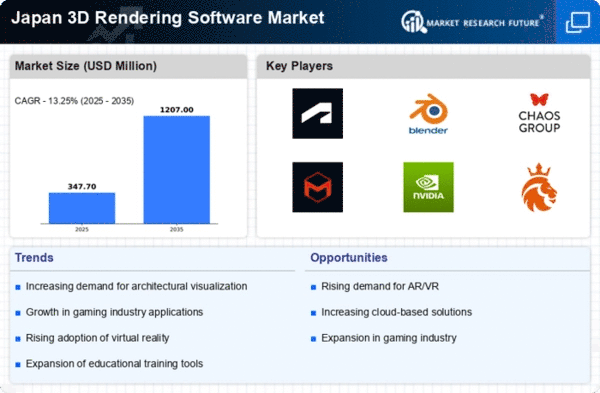
As per Market Research Future analysis, the Japan 3D Rendering Software Market size was estimated at 307.02 USD Million in 2024. The 3D Rendering-software market is projected to grow from 347.7 USD Million in 2025 to 1207.0 USD Million by 2035, exhibiting a compound annual growth rate (CAGR) of 13.2% during the forecast period 2025 - 2035

Key Market Trends & Highlights

The Japan 3D rendering-software market is experiencing robust growth driven by technological advancements and increasing applications across various sectors.

  • The real estate sector emerges as the largest segment, showcasing a notable increase in 3D rendering adoption for architectural visualization.
  • AI technologies are being integrated into rendering software, enhancing efficiency and creativity in design processes.
  • The educational applications segment is rapidly growing, reflecting a rising interest in immersive learning experiences through 3D visualization.
  • Key market drivers include the rising demand in entertainment and media, alongside technological advancements in hardware, fueling the overall market expansion.

Market Size & Forecast

2024 Market Size 307.02 (USD Million)
2035 Market Size 1207.0 (USD Million)
CAGR (2025 - 2035) 13.25%

Major Players

Autodesk (US), Blender Foundation (NL), Chaos Group (BG), Maxon (DE), NVIDIA (US), Solid Angle (ES), SketchUp (US), Unity Technologies (US), Epic Games (US)

Our Impact
Enabled $4.3B Revenue Impact for Fortune 500 and Leading Multinationals
Partnering with 2000+ Global Organizations Each Year
30K+ Citations by Top-Tier Firms in the Industry

Japan 3D Rendering Software Market Trends

The Japan 3D Rendering Software Market is currently experiencing notable growth, driven by advancements in technology and increasing demand across various sectors. In Japan, industries such as architecture, gaming, and film are leveraging these tools to enhance visual presentations and improve design processes. The integration of artificial intelligence and machine learning into rendering software is also becoming more prevalent, allowing for faster and more efficient workflows. As a result, professionals are able to create high-quality visuals that meet the evolving expectations of clients and consumers alike. Moreover, the rise of virtual reality (VR) and augmented reality (AR) applications is further propelling the adoption of 3d rendering software. These technologies require sophisticated rendering capabilities to deliver immersive experiences. Consequently, companies are investing in software solutions that not only provide realistic graphics but also support interactive features. This trend indicates a shift towards more dynamic and engaging content creation, which is likely to shape the future of the market in Japan.

Increased Adoption in Real Estate

The real estate sector is increasingly utilizing 3d rendering software to create virtual tours and realistic property visualizations. This trend enhances marketing efforts and allows potential buyers to experience properties remotely, thereby streamlining the sales process.

Integration of AI Technologies

The incorporation of artificial intelligence into 3d rendering software is transforming how designs are created and rendered. AI-driven tools can automate repetitive tasks, optimize rendering times, and improve overall efficiency, making them attractive to professionals in various fields.

Growth in Educational Applications

Educational institutions are beginning to adopt 3d rendering software for teaching purposes. This trend supports students in visualizing complex concepts and enhances learning experiences, particularly in fields such as engineering and design.

Japan 3D Rendering Software Market Drivers

Technological Advancements in Hardware

The rapid evolution of hardware technology in Japan is a critical driver for the 3d rendering-software market. With the introduction of more powerful GPUs and CPUs, rendering processes have become faster and more efficient, allowing for real-time rendering capabilities. This advancement is particularly relevant in industries such as architecture and product design, where quick iterations and high-quality visualizations are essential. In 2025, the market for graphics processing units in Japan is anticipated to grow by approximately 15%, reflecting the increasing demand for enhanced rendering capabilities. As hardware continues to improve, software developers are likely to innovate further, creating more sophisticated tools that leverage these advancements, thereby expanding the overall market.

Rising Demand in Entertainment and Media

The entertainment and media sectors in Japan are experiencing a notable surge in demand for high-quality visual content, which significantly influences the 3d rendering-software market. As the popularity of animated films, video games, and virtual reality experiences continues to grow, the need for sophisticated rendering solutions becomes increasingly apparent. In 2025, the Japanese video game market alone is projected to reach approximately $20 billion, indicating a robust appetite for advanced graphics. This trend suggests that companies are likely to invest heavily in 3d rendering software to enhance visual storytelling and user engagement. Furthermore, the integration of 3d rendering in live events and streaming services is expected to further propel market growth, as creators seek to deliver immersive experiences that captivate audiences.

Expansion of Virtual and Augmented Reality

The growing interest in virtual reality (VR) and augmented reality (AR) applications in Japan is significantly impacting the 3d rendering-software market. Industries such as gaming, education, and training are increasingly adopting VR and AR technologies to create immersive experiences. In 2025, the AR and VR market in Japan is projected to reach around $10 billion, highlighting the potential for growth in this area. As companies seek to develop engaging content for these platforms, the demand for high-quality 3d rendering software is likely to rise. This trend indicates that software providers may focus on developing tools specifically tailored for VR and AR applications, thus driving innovation and competition within the market.

Growing E-commerce and Product Visualization Needs

The e-commerce sector in Japan is rapidly evolving, leading to an increased demand for high-quality product visualization. As online shopping continues to gain traction, retailers are recognizing the importance of providing customers with realistic 3d representations of products. This trend is particularly relevant in industries such as fashion, furniture, and electronics, where visual appeal plays a crucial role in purchasing decisions. In 2025, the e-commerce market in Japan is projected to reach approximately $100 billion, indicating a substantial opportunity for the 3d rendering-software market. As businesses strive to enhance the online shopping experience, the demand for advanced rendering solutions that can create lifelike product images is likely to grow, driving further market expansion.

Increased Investment in Architectural Visualization

The architectural sector in Japan is witnessing a significant shift towards the use of 3d rendering software for visualization purposes. As architects and designers strive to present their concepts more effectively, the demand for realistic and interactive visualizations is on the rise. In 2025, the architectural visualization market is expected to grow by approximately 12%, driven by the need for enhanced client presentations and marketing materials. This trend suggests that architectural firms are likely to invest in advanced rendering solutions to improve their competitive edge. Consequently, the 3d rendering-software market is poised to benefit from this increased investment, as firms seek tools that can deliver high-quality visual outputs and streamline the design process.


Market Segment Insights

By Application: Architectural Visualization (Largest) vs. Virtual Reality (Fastest-Growing)

The Japan 3d rendering-software market showcases a diverse application landscape, with Architectural Visualization commanding the largest share among the various segments. Product Visualization and Animation and Visual Effects also hold significant portions, catering to industries focused on presenting creative designs and storytelling, while Gaming continues to gain traction as an essential segment. Meanwhile, Virtual Reality is emerging as a transformative force, appealing to sectors interested in immersive experiences and real-time interactions. The growth trends in this segment are primarily driven by technological advancements and increasing consumer demand for high-quality visuals. Architectural Visualization remains dominant due to ongoing investment in infrastructure projects in Japan. Virtual Reality, on the other hand, is witnessing rapid adoption, led by innovations in hardware and software, along with expanded applications in education, training, and entertainment, positioning it as a key area for future growth.

Architectural Visualization (Dominant) vs. Virtual Reality (Emerging)

Architectural Visualization is recognized as the dominant application in the Japan 3d rendering-software market, characterized by its critical role in design and planning for architectural projects. It leverages detailed rendering techniques to create realistic visuals, aiding architects and clients in decision-making processes. This segment thrives on the ongoing construction boom and urban development strategies in Japan. Conversely, Virtual Reality is emerging as a dynamic segment, driven by innovations that facilitate immersive experiences across various fields, including gaming, education, and training simulations. With its ability to deliver interactive environments, Virtual Reality is increasingly becoming vital in the market, appealing to a younger, tech-savvy audience and businesses looking to adopt cutting-edge solutions.

By Deployment Type: Cloud-Based (Largest) vs. Hybrid (Fastest-Growing)

In the Japan 3d rendering-software market, the deployment type segment is characterized by a competitive landscape between On-Premise, Cloud-Based, and Hybrid solutions. Currently, Cloud-Based solutions hold a significant market share, attracting businesses seeking flexibility and scalability. In contrast, On-Premise offerings are preferred by organizations requiring enhanced control over their data and infrastructure. The Hybrid model, which combines both On-Premise and Cloud-Based solutions, is gaining traction but remains behind in overall market share. The growth trends within this segment show a clear shift towards Cloud-Based solutions, driven by the increasing demand for remote work capabilities and efficient resource management. The Hybrid deployment type is emerging rapidly, appealing to businesses looking for a balanced approach that minimizes risks while capitalizing on cloud benefits. This trend indicates a dynamic transformation in adoption preferences as companies prioritize flexibility and resilience in their rendering processes.

On-Premise (Dominant) vs. Cloud-Based (Emerging)

In the Japan 3d rendering-software market, On-Premise solutions are recognized as the dominant force, appealing primarily to industries needing stringent security protocols and customized architectures. These solutions provide organizations with full control over their rendering processes, making them ideal for high-volume and sensitive projects. Conversely, Cloud-Based solutions are quickly emerging due to their cost-effectiveness and ease of access. As businesses embrace digital transformation, Cloud-Based offerings are becoming essential for companies that prioritize agility in project execution and resource allocation. The growing interest in Hybrid solutions further highlights a market trend towards blending these two approaches, allowing firms to leverage the strengths of both On-Premise and Cloud infrastructures.

By End User: Architects (Largest) vs. Game Developers (Fastest-Growing)

In the Japan 3d rendering-software market, Architects hold the largest market share, driven by an increasing demand for innovative design solutions and visualization tools. Their reliance on 3D rendering software enables them to create detailed architectural models and presentations, positioning their segment as crucial for market dominance. On the other hand, Game Developers occupy a significant share as well, but their rapid growth reflects the burgeoning gaming industry, which increasingly prioritizes high-quality graphics and immersive experiences, driving demand for advanced rendering software. The growth trends within the end-user segments are largely influenced by technological advancements and evolving consumer expectations. Architects are increasingly adopting integrated solutions that combine rendering with building information modeling (BIM), enhancing their workflow efficiency. Meanwhile, Game Developers are pushing the boundaries of 3D graphics, propelled by the rise of virtual reality (VR) and augmented reality (AR), making them the fastest-growing segment. This dynamic shift underscores the ongoing revolution in design and entertainment sectors, with significant implications for software providers.

Architects (Dominant) vs. Game Developers (Emerging)

Architects, as the dominant segment in the Japan 3d rendering-software market, leverage advanced visualization tools to enhance their design processes and client presentations. Their established practices involve using 3D rendering software for realistic modeling and architectural visualization, which helps in communicating design concepts effectively to clients. On the other hand, Game Developers represent an emerging segment that is rapidly transforming, driven by innovative gameplay experiences and technological advancements. The sector's increasing focus on high-quality animation and immersive storytelling requires sophisticated rendering software capable of handling complex graphics, which positions Game Developers as pivotal players driving the evolution of the software market.

By Rendering Type: Real-Time Rendering (Largest) vs. Pre-Rendered (Fastest-Growing)

In the Japan 3d rendering-software market, Real-Time Rendering captures the largest market share due to its increasing adoption in gaming, virtual reality, and architecture. This segment thrives on the need for instant feedback and immersive experiences, making it crucial for interactive applications. Pre-Rendered solutions, while smaller in market share, are witnessing rapid growth driven by advancements in rendering technologies that enhance the quality of visuals in films and advertisements. The growth trends in this segment are fueled by evolving consumer expectations and technological improvements. As industries demand more realistic visuals and instantaneous rendering capabilities, Real-Time Rendering is set to dominate the market. Meanwhile, Pre-Rendered solutions are emerging strongly, appealing to creative sectors that favor high-quality, non-interactive content. Distributed Rendering benefits from both trends, supporting complex projects that require collaboration across teams.

Real-Time Rendering (Dominant) vs. Pre-Rendered (Emerging)

Real-Time Rendering stands as the dominant force in the Japan 3d rendering-software market, primarily favored for applications in gaming and VR, where speed and interactivity are critical. This segment's ability to deliver high-quality images at high frame rates caters to an ever-evolving consumer base. In contrast, Pre-Rendered solutions, though emerging, focus on producing visually stunning results for film and advertising, prioritizing quality over speed. As technology advances, Pre-Rendered is carving out a niche that appeals to sectors needing visually rich content. Both segments reflect a growing demand for quality and efficiency, yet they serve distinct purposes within the broader 3d rendering landscape.

Get more detailed insights about Japan 3D Rendering Software Market

Key Players and Competitive Insights

The 3D rendering-software market exhibits a dynamic competitive landscape, characterized by rapid technological advancements and a growing demand for high-quality visual content across various sectors, including gaming, architecture, and film. Key players such as Autodesk (US), Chaos Group (BG), and NVIDIA (US) are strategically positioned to leverage innovation and partnerships to enhance their market presence. Autodesk (US) focuses on integrating cloud-based solutions to streamline workflows, while Chaos Group (BG) emphasizes photorealistic rendering capabilities, appealing to high-end users. NVIDIA (US) continues to push the boundaries of real-time rendering through its GPU technologies, which are increasingly vital in sectors like gaming and virtual reality. Collectively, these strategies foster a competitive environment that prioritizes technological excellence and user-centric solutions.In terms of business tactics, companies are increasingly localizing their operations to better serve regional markets, optimizing supply chains to enhance efficiency. The competitive structure of the market appears moderately fragmented, with several players vying for market share. However, the influence of major companies is substantial, as they set industry standards and drive innovation. This competitive interplay encourages smaller firms to innovate and differentiate their offerings, contributing to a vibrant market ecosystem.

In October Autodesk (US) announced a strategic partnership with a leading cloud service provider to enhance its rendering capabilities, enabling users to access advanced features remotely. This move is likely to bolster Autodesk's position in the market by providing users with greater flexibility and scalability, aligning with the growing trend towards cloud-based solutions. Such partnerships may also facilitate the integration of AI technologies, further enhancing the user experience.

In September Chaos Group (BG) launched a new version of its V-Ray rendering software, which incorporates AI-driven features to optimize rendering times and improve output quality. This development underscores the company's commitment to innovation and positions it favorably against competitors. By harnessing AI, Chaos Group (BG) not only enhances its product offerings but also addresses the increasing demand for efficiency in rendering processes, which is crucial for professionals in the industry.

In August NVIDIA (US) unveiled a new suite of tools aimed at simplifying the rendering process for game developers. This initiative reflects NVIDIA's ongoing strategy to dominate the gaming sector by providing cutting-edge technology that enhances the development experience. By focusing on user-friendly solutions, NVIDIA (US) is likely to attract a broader audience, thereby solidifying its market leadership.

As of November current trends in the 3D rendering-software market indicate a strong emphasis on digitalization, sustainability, and AI integration. Strategic alliances are increasingly shaping the competitive landscape, as companies recognize the value of collaboration in driving innovation. The shift from price-based competition to a focus on technological advancement and supply chain reliability is evident. Moving forward, competitive differentiation will likely hinge on the ability to innovate and adapt to evolving market demands, with companies that prioritize cutting-edge technology and sustainable practices emerging as leaders in the field.

Key Companies in the Japan 3D Rendering Software Market include

Industry Developments

The Japan 3D Rendering Software Market has seen significant developments recently, indicating a robust growth trajectory. In September 2023, Solid Angle announced an enhancement to its Arnold rendering software, tailored to meet the increasing demands of Japanese studios focusing on animation and visual effects. Additionally, NVIDIA's introduction of advanced AI features in their rendering solutions is relevant for industries like architecture and gaming in Japan, fostering more precise and efficient rendering processes.

As for mergers and acquisitions, there have not been any notable publicized transactions related to the specified companies within Japan's market. Over the last few years, notable growth in the valuation of major players like Autodesk and Unity Technologies has also been observed, as they expand their platforms to support the burgeoning virtual and augmented reality environments, highlighting Japan’s strong emphasis on technology and innovation.

Moreover, the government's initiatives towards digitization and support for creative industries are contributing to the market's expansion. Custom offerings from companies such as Blender Foundation and Chaos Group are gaining traction among Japanese developers, showcasing an adaptable ecosystem within this sector.

Future Outlook

Japan 3D Rendering Software Market Future Outlook

The 3D Rendering Software Market in Japan is poised for growth at 13.25% CAGR from 2025 to 2035, driven by advancements in technology and increasing demand for visual content.

New opportunities lie in:

  • Development of AI-driven rendering tools for real-time applications.
  • Expansion into virtual reality environments for immersive experiences.
  • Partnerships with gaming studios to enhance graphics capabilities.

By 2035, the market is expected to achieve substantial growth and innovation.

Market Segmentation

Japan 3D Rendering Software Market End User Outlook

  • Architects
  • Animators
  • Game Developers
  • Industrial Designers
  • Educational Institutions

Japan 3D Rendering Software Market Application Outlook

  • Architectural Visualization
  • Product Visualization
  • Animation and Visual Effects
  • Gaming
  • Virtual Reality

Japan 3D Rendering Software Market Rendering Type Outlook

  • Real-Time Rendering
  • Pre-Rendered
  • Distributed Rendering

Japan 3D Rendering Software Market Deployment Type Outlook

  • On-Premise
  • Cloud-Based
  • Hybrid

Report Scope

MARKET SIZE 2024 307.02(USD Million)
MARKET SIZE 2025 347.7(USD Million)
MARKET SIZE 2035 1207.0(USD Million)
COMPOUND ANNUAL GROWTH RATE (CAGR) 13.25% (2025 - 2035)
REPORT COVERAGE Revenue Forecast, Competitive Landscape, Growth Factors, and Trends
BASE YEAR 2024
Market Forecast Period 2025 - 2035
Historical Data 2019 - 2024
Market Forecast Units USD Million
Key Companies Profiled Autodesk (US), Blender Foundation (NL), Chaos Group (BG), Maxon (DE), NVIDIA (US), Solid Angle (ES), SketchUp (US), Unity Technologies (US), Epic Games (US)
Segments Covered Application, Deployment Type, End User, Rendering Type
Key Market Opportunities Integration of artificial intelligence in 3d rendering-software market enhances efficiency and creativity for users.
Key Market Dynamics Rising demand for real-time rendering solutions drives innovation and competition in the 3D rendering-software market.
Countries Covered Japan
Leave a Comment

FAQs

What is the projected market value of the Japan 3D Rendering Software Market in 2024?

The Japan 3D Rendering Software Market is expected to be valued at 156.15 million USD in 2024.

What is the expected market valuation by 2035 for the Japan 3D Rendering Software Market?

By 2035, the market is projected to reach a valuation of 472.5 million USD.

What is the compound annual growth rate (CAGR) for the Japan 3D Rendering Software Market from 2025 to 2035?

The expected CAGR for the market is 10.59% during the forecast period from 2025 to 2035.

Which application segment holds the largest market share in the Japan 3D Rendering Software Market for 2024?

Architectural Visualization is anticipated to dominate the market with a value of 60.0 million USD in 2024.

How much is the Product Visualization segment expected to be valued at in 2035?

The Product Visualization segment is projected to reach 90.0 million USD by the year 2035.

What is the expected market value for the Gaming application in 2024?

The Gaming application is expected to be valued at 20.0 million USD in 2024.

Who are the key players in the Japan 3D Rendering Software Market?

Major players include Solid Angle, NVIDIA, Autodesk, and Unity Technologies among others.

What revenue is anticipated for the Animation and Visual Effects segment by 2035?

The Animation and Visual Effects segment is expected to generate a revenue of 75.0 million USD by 2035.

How is the Virtual Reality application anticipated to grow by 2035?

The Virtual Reality application is projected to increase to 57.5 million USD by 2035.

What are the key growth drivers for the Japan 3D Rendering Software Market?

Increasing demand for architectural visualization and advancements in rendering technologies are key growth drivers.

Download Free Sample

Kindly complete the form below to receive a free sample of this Report

Compare Licence

×
Features License Type
Single User Multiuser License Enterprise User
Price $4,950 $5,950 $7,250
Maximum User Access Limit 1 User Upto 10 Users Unrestricted Access Throughout the Organization
Free Customization
Direct Access to Analyst
Deliverable Format
Platform Access
Discount on Next Purchase 10% 15% 15%
Printable Versions