×
Request Free Sample ×

Kindly complete the form below to receive a free sample of this Report

* Please use a valid business email

Leading companies partner with us for data-driven Insights

clients tt-cursor
Hero Background

South Korea Security Assertion Markup Language Authentication Market

ID: MRFR/ICT/60240-HCR
200 Pages
Aarti Dhapte
February 2026

South Korea Security Assertion Markup Language Authentication Market Research Report By Application (Single Sign-On, Identity Federation, Web Services Security, Mobile Applications), By Deployment Type (Cloud-based, On-premises), By Organization Size (Small Enterprises, Medium Enterprises, Large Enterprises) and By Service Type (Professional Services, Managed Services) - Forecast to 2035

Share:
Download PDF ×

We do not share your information with anyone. However, we may send you emails based on your report interest from time to time. You may contact us at any time to opt-out.

South Korea Security Assertion Markup Language Authentication Market Infographic
Purchase Options

South Korea Security Assertion Markup Language Authentication Market Summary

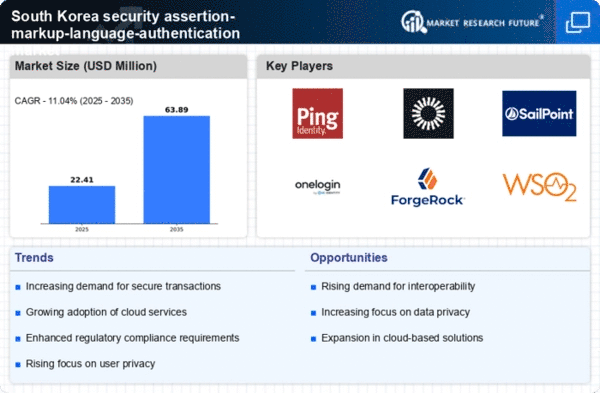
As per Market Research Future analysis, the South Korea Security Assertion Markup Language Authentication Market size was estimated at 20.18 USD Million in 2024. The Security Assertion-markup-language-authentication market is projected to grow from 22.41 USD Million in 2025 to 63.89 USD Million by 2035, exhibiting a compound annual growth rate (CAGR) of 11.0% during the forecast period 2025 - 2035

Key Market Trends & Highlights

The South Korea security assertion-markup-language-authentication market is experiencing robust growth driven by technological advancements and regulatory demands.

  • The market is witnessing increased adoption of cloud services, enhancing accessibility and scalability.
  • Regulatory compliance and data protection are becoming critical factors influencing market dynamics.
  • Integration with emerging technologies is reshaping the landscape, particularly in the financial services segment.
  • Rising cybersecurity threats and government initiatives are key drivers propelling market expansion.

Market Size & Forecast

2024 Market Size 20.18 (USD Million)
2035 Market Size 63.89 (USD Million)
CAGR (2025 - 2035) 11.04%

Major Players

Ping Identity (US), Okta (US), SailPoint Technologies (US), OneLogin (US), ForgeRock (US), WSO2 (LK), Auth0 (US), Microsoft (US)

Our Impact
Enabled $4.3B Revenue Impact for Fortune 500 and Leading Multinationals
Partnering with 2000+ Global Organizations Each Year
30K+ Citations by Top-Tier Firms in the Industry

South Korea Security Assertion Markup Language Authentication Market Trends

The South Korea Security Assertion Markup Language Authentication Market is currently experiencing a notable evolution, driven by the increasing demand for secure online transactions and data protection. As organizations across various sectors recognize the importance of safeguarding sensitive information, the adoption of security assertion markup language (SAML) has gained traction. This technology facilitates seamless single sign-on (SSO) capabilities, enhancing user experience while maintaining robust security protocols. Furthermore, the South Korean government has been proactive in promoting digital transformation initiatives, which further propels the need for advanced authentication solutions. In addition, the rise of cloud computing and mobile applications has created a fertile ground for the security assertion-markup-language-authentication market. Businesses are increasingly migrating to cloud-based platforms, necessitating secure access management solutions that SAML provides. The integration of SAML with identity and access management (IAM) systems is becoming a standard practice, ensuring that organizations can efficiently manage user identities while adhering to compliance requirements. As the market continues to mature, it appears poised for sustained growth, driven by technological advancements and a heightened focus on cybersecurity.

Increased Adoption of Cloud Services

The shift towards cloud computing is significantly influencing the security assertion-markup-language-authentication market. Organizations are increasingly leveraging cloud services, which necessitate robust authentication mechanisms to protect sensitive data. SAML's ability to provide secure access to cloud applications is becoming essential, as businesses seek to enhance their security posture while enabling seamless user experiences.

Regulatory Compliance and Data Protection

With the growing emphasis on data privacy and protection regulations, the security assertion-markup-language-authentication market is witnessing heightened demand. South Korean regulations require organizations to implement stringent security measures, including effective authentication protocols. SAML offers a viable solution for compliance, allowing businesses to meet regulatory requirements while ensuring secure access to their systems.

Integration with Emerging Technologies

The security assertion-markup-language-authentication market is evolving through integration with emerging technologies such as artificial intelligence and machine learning. These technologies enhance the capabilities of SAML by providing advanced threat detection and response mechanisms. As organizations seek to bolster their security frameworks, the synergy between SAML and these technologies is likely to drive innovation and improve overall security effectiveness.

South Korea Security Assertion Markup Language Authentication Market Drivers

Rising Cybersecurity Threats

The security assertion-markup-language-authentication market is experiencing growth. due to the increasing frequency and sophistication of cyber threats in South Korea. Organizations are compelled to adopt robust authentication mechanisms to safeguard sensitive data. In 2025, it is estimated that cybercrime could cost the global economy over $10 trillion annually, prompting South Korean enterprises to invest in advanced security solutions. The need for secure access to applications and data is paramount, as breaches can lead to significant financial losses and reputational damage. Consequently, the demand for security assertion-markup-language-authentication solutions is likely to rise, as they provide a standardized method for secure identity management and access control.

Government Initiatives and Support

The South Korean government is actively promoting cybersecurity initiatives, which significantly impacts the security assertion-markup-language-authentication market. With the implementation of various policies aimed at enhancing national security, there is a growing emphasis on adopting advanced authentication technologies. The government has allocated substantial funding, estimated at $1 billion in 2025, to bolster cybersecurity infrastructure across various sectors. This support encourages organizations to integrate security assertion-markup-language-authentication solutions, ensuring compliance with national standards and enhancing overall security posture. As a result, the market is likely to witness increased adoption driven by government incentives and regulations.

Increased Focus on User Experience

In the competitive landscape of South Korea, organizations are prioritizing user experience alongside security. The security assertion-markup-language-authentication market is influenced by the need for seamless and efficient authentication processes. Companies are recognizing that cumbersome authentication methods can lead to user frustration and abandonment. As a result, there is a growing trend towards implementing solutions that balance security with user convenience. By adopting security assertion-markup-language-authentication, organizations can streamline access while maintaining high security standards, thus enhancing customer satisfaction and loyalty.

Growing Demand for Digital Transformation

As South Korean businesses undergo digital transformation, the need for secure authentication methods becomes increasingly critical. The security assertion-markup-language-authentication market is poised to benefit from this trend, as organizations seek to protect their digital assets while enhancing user experience. In 2025, it is projected that the digital transformation market in South Korea will reach $30 billion, with a significant portion allocated to cybersecurity solutions. This shift towards digital platforms necessitates the implementation of robust authentication frameworks, making security assertion-markup-language-authentication a vital component of the overall security strategy for enterprises.

Expansion of E-commerce and Online Services

The rapid expansion of e-commerce and online services in South Korea is driving the demand for secure authentication solutions. The security assertion-markup-language-authentication market is likely to see increased adoption as businesses seek to protect customer data and transactions. In 2025, the e-commerce market in South Korea is projected to exceed $100 billion, necessitating robust security measures to build consumer trust. As online transactions become more prevalent, organizations are compelled to implement security assertion-markup-language-authentication to ensure secure access and protect sensitive information, thereby fostering a secure online environment.

Market Segment Insights

By Application: Single Sign-On (Largest) vs. Identity Federation (Fastest-Growing)

In the South Korea security assertion-markup-language-authentication market, Single Sign-On (SSO) holds the largest market share, driven by its simplicity and efficiency in managing user identities across multiple platforms. Meanwhile, Identity Federation is emerging rapidly, attracting businesses that prioritize secure collaborations across different organizational boundaries, thereby contributing to its status as the fastest-growing segment. Growth trends in this segment indicate a rising demand for seamless user experiences and the integration of cyber security measures. Mobile Applications and Web Services Security are also gaining traction, fostering a competitive environment where technologies that enhance security and access convenience are in high demand. Factors driving this growth include increased mobile usage, the rise of remote work, and heightened cyber threats that necessitate robust authentication strategies.

Single Sign-On (Dominant) vs. Identity Federation (Emerging)

Single Sign-On (SSO) is currently the dominant force within the South Korea security assertion-markup-language-authentication market, providing users with a streamlined login experience and significantly reducing password fatigue. Its widespread adoption among enterprises reflects the growing need for efficient identity management solutions. On the other hand, Identity Federation is gaining prominence as companies strive for enhanced interoperability across platforms and collaborations. This segment enables organizations to allow users from different domains to access shared resources securely, reflecting the increasing need for cooperative security arrangements. As businesses continue to adopt cloud services and expand partnerships, both SSO and Identity Federation are poised to evolve, with SSO leading in stability and Identity Federation driving innovation.

By Deployment Type: Cloud-based (Largest) vs. On-premises (Fastest-Growing)

In the South Korea security assertion-markup-language-authentication market, the distribution of market share indicates a strong preference for cloud-based solutions, which hold the largest portion of the market. This deployment type appeals to organizations due to factors such as easy accessibility, scalability, and reduced infrastructure costs, making it a favored choice for various enterprises. Conversely, the on-premises deployment type is emerging rapidly, showcasing the fastest growth trend. This is primarily driven by businesses seeking enhanced control over their authentication processes, data security, and regulatory compliance. As organizations focus on safeguarding sensitive information, the demand for on-premises solutions is expected to rise, creating opportunities for vendors in this segment.

Cloud-based (Dominant) vs. On-premises (Emerging)

The cloud-based deployment type maintains a dominant position in the South Korea security assertion-markup-language-authentication market, characterized by its ability to offer flexible and cost-effective solutions for users. Businesses are increasingly adopting cloud services to streamline their authentication processes, leveraging the widespread integration capabilities and advanced features these solutions provide. On the other hand, the on-premises deployment type is recognized as an emerging option, appealing to organizations that prioritize data sovereignty and wish to maintain total control over their authentication systems. This segment's growth reflects a shift towards customized solutions that cater specifically to individual business requirements, enabling them to enhance security while managing their compliance obligations effectively.

By Organization Size: Large Enterprises (Largest) vs. Medium Enterprises (Fastest-Growing)

In the South Korea security assertion-markup-language-authentication market, the distribution of market share among various organization sizes reveals a notable dominance by large enterprises, which command the majority of the market. These enterprises benefit from extensive resources and infrastructure, allowing them to implement robust authentication mechanisms that meet their complex security requirements. Medium enterprises, while smaller in size, are rapidly expanding their adoption of security assertion markup language (SAML) due to their growing need for improved identity management solutions. The growth trends for this segment indicate that medium enterprises are emerging as the fastest-growing group as they seek to bolster their cybersecurity defenses amidst rising threats. This trend is fueled by a growing awareness of security measures, regulatory compliance demands, and the increasing adoption of cloud services. Large enterprises are expected to maintain their lead, but medium enterprises are catching up quickly, indicating a significant shift in the market dynamics.

Large Enterprises: Dominant vs. Medium Enterprises: Emerging

Large enterprises play a dominant role in the South Korea security assertion-markup-language-authentication market due to their substantial investments in technology and dedicated IT teams. These organizations often have established security protocols and frameworks tailored to their expansive operations and compliance needs. On the other hand, medium enterprises, while classified as emerging, are growing swiftly as they recognize the value of robust authentication systems. They tend to adopt SAML solutions to enhance their security posture and protect against potential threats while accommodating growing customer demands. This segment is characterized by a blend of innovation and agility, allowing medium enterprises to adapt quickly to market changes and security challenges.

By Service Type: Professional Services (Largest) vs. Managed Services (Fastest-Growing)

In the South Korea security assertion-markup-language-authentication market, Professional Services currently hold the largest share, reflecting the strong demand for expert consulting and implementation services. This segment is characterized by its focus on custom solutions that enhance the security posture of organizations. On the other hand, Managed Services are gaining traction, appealing to businesses looking for outsourced security solutions that offer scalability and ongoing support. The balance of market share is shifting as companies lean towards professional expertise to navigate complex security needs. Growth in this segment is driven by increasing cybersecurity threats and the need for compliance with stringent regulations. Organizations are investing in Professional Services to ensure robust system implementations, while Managed Services are rapidly evolving, supported by advances in technology that enable remote management and real-time threat detection. The transition towards cloud-based solutions is also propelling the Managed Services segment, making it an attractive option for businesses seeking efficiency and expert management.

Professional Services (Dominant) vs. Managed Services (Emerging)

Professional Services in the South Korea security assertion-markup-language-authentication market are essential for providing tailored solutions that address specific organizational needs. They typically involve in-depth consulting, implementation, and training services that help clients understand and effectively utilize security technologies. This segment thrives on the requirement for personalized expertise in navigating complex security challenges. Meanwhile, Managed Services represent an emerging trend wherein businesses opt for outsourced solutions to efficiently manage their security infrastructure. These services offer a flexible approach, allowing companies to adapt to changing demands swiftly. The blend of expertise and the convenience of outsourcing positions Managed Services as a critical future growth area, appealing especially to smaller enterprises that may lack in-house security resources.

Get more detailed insights about South Korea Security Assertion Markup Language Authentication Market

Key Players and Competitive Insights

The security assertion-markup-language-authentication market in South Korea is characterized by a dynamic competitive landscape, driven by increasing demand for secure digital identities and seamless user experiences. Key players such as Ping Identity (US), Okta (US), and Microsoft (US) are at the forefront, each adopting distinct strategies to enhance their market presence. For instance, Ping Identity (US) focuses on innovation through continuous product development, while Okta (US) emphasizes strategic partnerships to expand its service offerings. Microsoft (US), leveraging its extensive ecosystem, integrates security solutions into its existing platforms, thereby enhancing user engagement and retention. Collectively, these strategies contribute to a competitive environment that is increasingly centered around technological advancement and customer-centric solutions.In terms of business tactics, companies are increasingly localizing their operations to better cater to the South Korean market. This includes optimizing supply chains and enhancing customer support services to meet local demands. The market structure appears moderately fragmented, with several players vying for market share, yet the influence of major companies remains substantial. Their collective actions shape the competitive dynamics, as they strive to differentiate themselves through innovative solutions and tailored services.

In October Okta (US) announced a strategic partnership with a leading South Korean telecommunications provider to enhance its identity management solutions. This collaboration is expected to facilitate the integration of advanced security features into the telecom's existing infrastructure, thereby expanding Okta's footprint in the region. The strategic importance of this partnership lies in its potential to leverage the telecom's extensive customer base, allowing Okta to penetrate deeper into the South Korean market.

In September Microsoft (US) launched a new suite of security features specifically designed for the South Korean market, focusing on compliance with local regulations. This initiative underscores Microsoft's commitment to addressing regional security concerns while enhancing its product offerings. The introduction of these features is likely to strengthen Microsoft's competitive position, as it aligns with the growing emphasis on regulatory compliance among South Korean enterprises.

In November Ping Identity (US) unveiled a new AI-driven authentication solution tailored for the South Korean financial sector. This innovative approach not only enhances security but also streamlines user experiences, which is crucial in a market where digital banking is rapidly evolving. The strategic significance of this launch lies in its potential to address the unique challenges faced by financial institutions in South Korea, thereby positioning Ping Identity as a leader in this niche.

As of November the competitive trends in the market are increasingly defined by digitalization, AI integration, and a focus on sustainability. Strategic alliances are becoming more prevalent, as companies recognize the need to collaborate to enhance their technological capabilities. Looking ahead, competitive differentiation is likely to evolve from traditional price-based strategies to a focus on innovation, technology integration, and supply chain reliability. This shift indicates a broader trend where companies must not only offer competitive pricing but also deliver superior technological solutions to maintain their market positions.

Key Companies in the South Korea Security Assertion Markup Language Authentication Market include

Industry Developments

Recent developments in the South Korea Security Assertion Markup Language (SAML) Authentication Market indicate a rising demand for secure online identity management solutions amidst increasing cyber threats. Companies such as LG Uplus and Samsung Electronics are actively enhancing their cybersecurity offerings, integrating advanced SAML technologies to streamline authentication processes. In September 2023, SK Telecom announced a partnership with Hancom Secure to improve itsservice security leveraging SAML frameworks, reflecting a growing collaboration among tech firms. Current affairs also highlight that Naver Corporation and Kakao Corporation are investing in expanding their SAML authentication capabilities as online services proliferate. 

The market valuation is expected to surge as organizations prioritize security measures in response to data breaches, with industry growth projected at over 15 percent annually through 2025. Additionally, in June 2023, a notable merger between SecuTech Solutions and Cyborg Security was confirmed, aimed at consolidating resources to deliver more comprehensive SAML solutions, further impacting the competitive landscape. This momentum in mergers and innovations illustrates the critical role that SAML authentication plays in securing digital identities in South Korea.

Future Outlook

South Korea Security Assertion Markup Language Authentication Market Future Outlook

The Security Assertion Markup Language Authentication Market is projected to grow at 11.04% CAGR from 2025 to 2035, driven by increasing cybersecurity needs and digital transformation initiatives.

New opportunities lie in:

  • Development of tailored SAML solutions for SMEs
  • Integration of AI-driven analytics for enhanced security
  • Expansion into mobile authentication services for enterprises

By 2035, the market is expected to achieve robust growth, reflecting evolving security demands.

Market Segmentation

South Korea Security Assertion Markup Language Authentication Market Application Outlook

  • Single Sign-On
  • Identity Federation
  • Web Services Security
  • Mobile Applications

South Korea Security Assertion Markup Language Authentication Market Service Type Outlook

  • Professional Services
  • Managed Services

South Korea Security Assertion Markup Language Authentication Market Deployment Type Outlook

  • Cloud-based
  • On-premises

South Korea Security Assertion Markup Language Authentication Market Organization Size Outlook

  • Small Enterprises
  • Medium Enterprises
  • Large Enterprises

Report Scope

MARKET SIZE 2024 20.18(USD Million)
MARKET SIZE 2025 22.41(USD Million)
MARKET SIZE 2035 63.89(USD Million)
COMPOUND ANNUAL GROWTH RATE (CAGR) 11.04% (2025 - 2035)
REPORT COVERAGE Revenue Forecast, Competitive Landscape, Growth Factors, and Trends
BASE YEAR 2024
Market Forecast Period 2025 - 2035
Historical Data 2019 - 2024
Market Forecast Units USD Million
Key Companies Profiled Ping Identity (US), Okta (US), SailPoint Technologies (US), OneLogin (US), ForgeRock (US), WSO2 (LK), Auth0 (US), Microsoft (US)
Segments Covered Application, Deployment Type, Organization Size, Service Type
Key Market Opportunities Growing demand for secure identity management solutions drives innovation in the security assertion-markup-language-authentication market.
Key Market Dynamics Rising demand for secure digital identities drives innovation in security assertion-markup-language authentication solutions in South Korea.
Countries Covered South Korea
Leave a Comment

FAQs

What is the expected market size of the South Korea Security Assertion Markup Language Authentication Market in 2024?

The market is expected to be valued at 20.2 USD Million in 2024.

What is the projected market value for the South Korea Security Assertion Markup Language Authentication Market by 2035?

By 2035, the market is projected to reach a value of 60.6 USD Million.

What is the expected compound annual growth rate (CAGR) for the South Korea Security Assertion Markup Language Authentication Market from 2025 to 2035?

The expected CAGR for the market is 10.503% from 2025 to 2035.

Which application segment has the largest market share in the South Korea Security Assertion Markup Language Authentication Market for 2024?

The Single Sign-On segment is valued at 8.9 USD Million in 2024, making it the largest segment.

What is the expected market value of the Identity Federation application in 2035?

The Identity Federation application is expected to reach a value of 15.5 USD Million by 2035.

Who are the major players in the South Korea Security Assertion Markup Language Authentication Market?

Key players include LG Uplus, Samsung Electronics, SK Telecom, and Naver Corp among others.

What will be the market size for Web Services Security in 2024?

In 2024, the Web Services Security segment is valued at 3.6 USD Million.

What is the forecasted growth of the Mobile Applications segment by 2035?

The Mobile Applications segment is expected to grow to 7.6 USD Million by 2035.

What challenges could impact the growth of the South Korea Security Assertion Markup Language Authentication Market?

Challenges may include evolving security threats and the need for regulatory compliance.

What recent trends are emerging in the South Korea Security Assertion Markup Language Authentication Market?

Emerging trends include an increased demand for identity federation and enhanced security measures.

Download Free Sample

Kindly complete the form below to receive a free sample of this Report

Compare Licence

×
Features License Type
Single User Multiuser License Enterprise User
Price $4,950 $5,950 $7,250
Maximum User Access Limit 1 User Upto 10 Users Unrestricted Access Throughout the Organization
Free Customization
Direct Access to Analyst
Deliverable Format
Platform Access
Discount on Next Purchase 10% 15% 15%
Printable Versions