×
Request Free Sample ×

Kindly complete the form below to receive a free sample of this Report

* Please use a valid business email

Leading companies partner with us for data-driven Insights

clients tt-cursor
Hero Background

Canada Security Assertion Markup Language Authentication Market

ID: MRFR/ICT/60092-HCR
200 Pages
Aarti Dhapte
February 2026

Canada Security Assertion Markup Language Authentication Market Research Report By Application (Single Sign-On, Identity Federation, Web Services Security, Mobile Applications), By Deployment Type (Cloud-based, On-premises), By Organization Size (Small Enterprises, Medium Enterprises, Large Enterprises), and By Service Type (Professional Services, Managed Services)- Forecast to 2035

Share:
Download PDF ×

We do not share your information with anyone. However, we may send you emails based on your report interest from time to time. You may contact us at any time to opt-out.

Canada Security Assertion Markup Language Authentication Market Infographic
Purchase Options

Canada Security Assertion Markup Language Authentication Market Summary

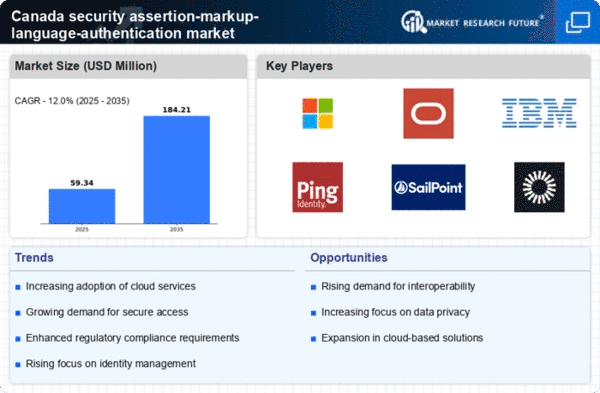
As per Market Research Future analysis, the Canada Security Assertion Markup Language Authentication Market size was estimated at 52.98 USD Million in 2024. The Security Assertion-markup-language-authentication market is projected to grow from 59.34 USD Million in 2025 to 184.21 USD Million by 2035, exhibiting a compound annual growth rate (CAGR) of 12% during the forecast period 2025 - 2035

Key Market Trends & Highlights

The Canada security assertion-markup-language-authentication market is experiencing robust growth driven by technological advancements and increasing security needs.

  • The market is witnessing increased adoption of cloud services, enhancing the demand for SAML authentication solutions.
  • Regulatory compliance is becoming a focal point, compelling organizations to implement SAML for secure data exchange.
  • Integration of advanced technologies, such as AI and machine learning, is transforming SAML authentication processes.
  • Rising cybersecurity threats and government initiatives are key drivers propelling the market forward.

Market Size & Forecast

2024 Market Size 52.98 (USD Million)
2035 Market Size 184.21 (USD Million)
CAGR (2025 - 2035) 12.0%

Major Players

Microsoft (US), Oracle (US), IBM (US), Ping Identity (US), SailPoint Technologies (US), Okta (US), ForgeRock (US), OneLogin (US)

Our Impact
Enabled $4.3B Revenue Impact for Fortune 500 and Leading Multinationals
Partnering with 2000+ Global Organizations Each Year
30K+ Citations by Top-Tier Firms in the Industry

Canada Security Assertion Markup Language Authentication Market Trends

The Canada Security Assertion Markup Language Authentication Market is experiencing notable growth, driven by the increasing demand for secure online transactions and identity verification. Organizations across various sectors are adopting SAML to enhance their security frameworks, as it facilitates single sign-on (SSO) capabilities and improves user experience. This trend is particularly relevant in sectors such as finance, healthcare, and government, where data protection is paramount. Furthermore, the rise of cloud computing and mobile applications has further propelled the need for robust authentication solutions, as businesses seek to safeguard sensitive information from unauthorized access. In addition, regulatory compliance is becoming a critical factor influencing the security assertion-markup-language-authentication market. Organizations are increasingly required to adhere to stringent data protection regulations, which necessitate the implementation of secure authentication methods. As a result, SAML is being recognized as a viable solution to meet these compliance requirements. The market landscape is also evolving with the emergence of new technologies, such as artificial intelligence and machine learning, which are being integrated into authentication processes to enhance security measures. Overall, the security assertion-markup-language-authentication market is poised for continued expansion as organizations prioritize security and compliance in their digital strategies.

Increased Adoption of Cloud Services

The shift towards cloud-based solutions is driving the security assertion-markup-language-authentication market. Organizations are increasingly leveraging SAML to facilitate secure access to cloud applications, ensuring that user identities are verified without compromising sensitive data.

Focus on Regulatory Compliance

As data protection regulations become more stringent, organizations are compelled to adopt secure authentication methods. The security assertion-markup-language-authentication market is responding to this demand by providing solutions that help businesses comply with legal requirements.

Integration of Advanced Technologies

The incorporation of artificial intelligence and machine learning into authentication processes is transforming the security assertion-markup-language-authentication market. These technologies enhance security measures, making it more difficult for unauthorized users to gain access.

Canada Security Assertion Markup Language Authentication Market Drivers

Rising Cybersecurity Threats

The increasing frequency and sophistication of cyber threats in Canada is a primary driver for the security assertion-markup-language-authentication market. Organizations are compelled to adopt robust authentication mechanisms to safeguard sensitive data and maintain user trust. In 2025, it is estimated that cybercrime could cost Canadian businesses over $10 billion annually, highlighting the urgent need for effective security solutions. The security assertion-markup-language-authentication market is positioned to benefit from this trend, as it provides a framework for secure identity management and access control. As companies seek to mitigate risks associated with data breaches, the demand for SAML-based authentication solutions is likely to rise, reinforcing the market's growth trajectory.

Government Initiatives and Support

The Canadian government has been actively promoting cybersecurity initiatives, which significantly impacts the security assertion-markup-language-authentication market. Programs aimed at enhancing digital security infrastructure and providing funding for cybersecurity projects are becoming more prevalent. For instance, the Canadian Cyber Security Strategy outlines a commitment to improving the nation's cybersecurity posture, which includes the adoption of advanced authentication technologies. This governmental support not only encourages organizations to invest in SAML solutions but also fosters a collaborative environment for developing innovative security measures. As a result, the security assertion-markup-language-authentication market is likely to experience increased growth driven by public sector initiatives.

Growing Demand for Seamless User Experience

In an era where user experience is paramount, organizations in Canada are increasingly seeking authentication solutions that balance security with convenience. The security assertion-markup-language-authentication market is well-positioned to address this demand, as SAML enables single sign-on (SSO) capabilities that streamline user access across multiple applications. This functionality is particularly appealing to enterprises looking to enhance productivity while maintaining robust security protocols. As businesses recognize the importance of user satisfaction in retaining customers, the adoption of SAML-based solutions is expected to rise. Market analysts project that the user experience focus could drive a growth rate of approximately 15% in the security assertion-markup-language-authentication market over the next few years.

Expansion of E-commerce and Digital Services

The rapid expansion of e-commerce and digital services in Canada is a significant driver for the security assertion-markup-language-authentication market. As more businesses transition to online platforms, the need for secure authentication methods becomes increasingly critical. In 2025, e-commerce sales in Canada are projected to reach $50 billion, necessitating robust security measures to protect consumer data. SAML provides a reliable framework for ensuring secure transactions and user authentication, making it an attractive option for e-commerce platforms. Consequently, the security assertion-markup-language-authentication market will see heightened demand as businesses prioritize security to foster consumer confidence in their digital offerings.

Integration of Identity and Access Management Solutions

The integration of identity and access management (IAM) solutions is driving growth in the security assertion-markup-language-authentication market. Organizations in Canada are recognizing the importance of managing user identities and access rights effectively to enhance security. SAML plays a crucial role in IAM by facilitating secure authentication and authorization processes. As companies increasingly adopt IAM solutions to streamline operations and improve security, the demand for SAML-based authentication is expected to rise. This trend is indicative of a broader shift towards comprehensive security frameworks that encompass identity management, further propelling the security assertion-markup-language-authentication market forward.


Market Segment Insights

By Application: Single Sign-On (Largest) vs. Identity Federation (Fastest-Growing)

In the Canada security assertion-markup-language-authentication market, the application segment demonstrates a diverse share distribution. Single Sign-On (SSO) has established itself as the largest segment, greatly favored for its ability to simplify user authentication across multiple platforms. Conversely, Identity Federation is rapidly gaining traction, appealing to organizations looking to streamline cross-domain user management and enhancing security protocols. Growth trends in this segment are being driven by increased adoption of cloud services and mobile applications, which require robust authentication mechanisms. The rising emphasis on cybersecurity, coupled with the necessity for seamless user experiences, fuels the demand for SSO and Identity Federation solutions, leading to sustained innovations and evolving market strategies.

Single Sign-On (Dominant) vs. Identity Federation (Emerging)

Single Sign-On (SSO) serves as a dominant force within the Canada security assertion-markup-language-authentication market, primarily due to its capability to improve user convenience and security. By allowing users to access multiple applications with a single set of credentials, SSO minimizes the risk of password fatigue and enhances compliance with security standards. On the other hand, Identity Federation is emerging as a crucial solution, particularly for organizations looking to manage identities across different domains efficiently. It enables secure sharing of user identities and attributes while maintaining control, thereby supporting the growing trend of collaboration across organizations and the integration of cloud-based services.

By Deployment Type: Cloud-based (Largest) vs. On-premises (Fastest-Growing)

In the Canada security assertion-markup-language-authentication market, the deployment type segment is predominantly influenced by cloud-based solutions, which hold the largest share due to their scalability and lower operational costs. Conversely, on-premises solutions have emerged as a significant contender, offering businesses enhanced control over their data and security protocols, thus capturing an increasing percentage of the market share. The growth trends in this segment are driven by a rising demand for flexible and efficient security solutions amidst evolving cyber threats. Businesses are increasingly adopting cloud-based authentication systems for their user-friendliness and cost-effectiveness, while the on-premises segment gains traction with organizations valuing data sovereignty and regulatory compliance, positioning it as the fastest-growing area in the market.

Cloud-based (Dominant) vs. On-premises (Emerging)

Cloud-based authentication solutions dominate the Canada security assertion-markup-language-authentication market, favored for their accessibility, ease of deployment, and lower upfront costs. They provide robust scalability and are well-suited for organizations looking to streamline operations without the weight of extensive IT infrastructure. In contrast, on-premises solutions are emerging as a viable alternative, particularly among businesses with stringent compliance requirements. These systems offer enhanced data security and customization options, appealing to enterprises that prioritize control over their digital assets. As regulatory landscapes evolve, the balance between these two deployment types will significantly shape the future of the market.

By Organization Size: Large Enterprises (Largest) vs. Small Enterprises (Fastest-Growing)

In the Canada security assertion-markup-language-authentication market, market share distribution is significantly tilted towards large enterprises, which dominate the sector due to their extensive resource allocation and complex authentication requirements. These organizations are leveraging advanced security solutions, thereby solidifying their existing market position. Conversely, small enterprises are experiencing rapid growth driven by a rising demand for secure authentication mechanisms as they increasingly digitize operations. The growth trends for these segments reveal that small enterprises are emerging as the fastest-growing segment, primarily fueled by the need for robust and cost-effective security measures. As cyber threats continue to evolve, these enterprises are adopting security assertion markup language (SAML) authentication to protect sensitive information. Meanwhile, large enterprises continue to invest heavily in enhancing their cybersecurity frameworks, ensuring that they remain competitive in a constantly evolving market landscape.

Large Enterprises: (Dominant) vs. Small Enterprises (Emerging)

Large enterprises in the Canada security assertion-markup-language-authentication market are characterized by their significant investments in security protocols and a deep understanding of regulatory compliance standards. They often implement comprehensive authentication frameworks that cater to their intricate operations, making them a dominant force in the market. On the other hand, small enterprises, categorized as emerging players, are rapidly adapting to the demands of modern cybersecurity challenges. These companies prioritize cost-effective solutions while striving to incorporate advanced authentication technologies. As they evolve, their ability to implement scalable and flexible security measures positions them uniquely in the market, allowing them to compete effectively against larger counterparts.

By Service Type: Professional Services (Largest) vs. Managed Services (Fastest-Growing)

In the Canada security assertion-markup-language-authentication market, Professional Services command the largest share among service types. This segment encompasses various offerings such as consulting, integration, and training services, which are crucial for the effective deployment of security protocols. On the other hand, Managed Services, although smaller in market share, are gaining traction rapidly as organizations seek more efficient security management solutions, creating a competitive landscape between the two. The growth of Managed Services is heavily driven by an increased demand for outsourcing security tasks to specialized providers. Organizations are recognizing the benefits of leveraging advanced security infrastructure without the need for substantial in-house investment. As cyber threats evolve, businesses are shifting their focus towards comprehensive, managed security solutions that offer scalability and flexibility, thus boosting the Managed Services segment significantly. Meanwhile, Professional Services continue to thrive, largely due to their essential role in enabling businesses to establish and maintain robust security frameworks.

Professional Services: Dominant vs. Managed Services: Emerging

Professional Services are characterized by their extensive range of specialized offerings, including consulting, implementation, and comprehensive training aimed at reinforcing security measures within organizations. This segment's dominance is attributed to the essential nature of these services in ensuring effective security posture and compliance. In contrast, Managed Services represent an emerging trend, providing outsourced and continuous security management solutions. These services appeal to businesses looking for cost-effective alternatives to handle their security needs, thereby enhancing organizational resilience against growing cyber threats. The adaptability and innovation within both segments are shaping their market dynamics, with Professional Services solidifying their place as a backbone of security infrastructure, while Managed Services rapidly evolve to meet modern security demands.

Get more detailed insights about Canada Security Assertion Markup Language Authentication Market

Key Players and Competitive Insights

The security assertion-markup-language-authentication market in Canada is characterized by a dynamic competitive landscape, driven by the increasing demand for secure identity management solutions. Key players such as Microsoft (US), Oracle (US), and Okta (US) are at the forefront, leveraging their technological prowess to enhance their offerings. Microsoft (US) focuses on integrating advanced AI capabilities into its authentication solutions, thereby improving user experience and security. Oracle (US) emphasizes its cloud-based identity management systems, which are designed to cater to the growing needs of enterprises seeking scalable solutions. Okta (US) positions itself as a leader in identity management, with a strong emphasis on partnerships and integrations that enhance its platform's capabilities. Collectively, these strategies contribute to a competitive environment that is increasingly centered around innovation and customer-centric solutions.In terms of business tactics, companies are increasingly localizing their operations to better serve the Canadian market. This includes optimizing supply chains and enhancing customer support services. The market structure appears moderately fragmented, with several players vying for market share. However, the influence of major companies is substantial, as they set industry standards and drive technological advancements that smaller firms often follow.

In October Microsoft (US) announced a strategic partnership with a leading Canadian cybersecurity firm to enhance its security offerings. This collaboration aims to integrate advanced threat detection capabilities into Microsoft’s existing authentication solutions, thereby providing a more robust defense against cyber threats. The strategic importance of this partnership lies in its potential to significantly bolster Microsoft’s market position in Canada, particularly in sectors that are highly regulated and require stringent security measures.

In September Oracle (US) launched a new version of its identity management platform, which includes enhanced features for compliance with Canadian privacy regulations. This move is particularly significant as it aligns with the increasing scrutiny on data protection and privacy in Canada. By addressing these regulatory requirements, Oracle (US) not only strengthens its product offering but also positions itself as a trusted partner for Canadian enterprises navigating complex compliance landscapes.

In November Okta (US) expanded its operations in Canada by opening a new regional office in Toronto, aimed at providing localized support and services. This expansion reflects Okta’s commitment to enhancing customer engagement and support in the region. The strategic importance of this move is underscored by the growing demand for identity solutions in Canada, as businesses increasingly prioritize security and user experience.

As of November the competitive trends in the market are heavily influenced by digitalization, AI integration, and a focus on sustainability. Strategic alliances are becoming more prevalent, as companies recognize the value of collaboration in enhancing their technological capabilities. Looking ahead, competitive differentiation is likely to evolve, shifting from price-based competition to a focus on innovation, technology, and supply chain reliability. This transition suggests that companies that prioritize these aspects will be better positioned to thrive in an increasingly competitive landscape.

Key Companies in the Canada Security Assertion Markup Language Authentication Market include

Industry Developments

By moving and growing its Toronto office in May 2023, Okta strengthened its leadership in providing SAML-based single-sign-on and federated access services across Canada and bolstered its local channel-led business development initiatives.Imprivata dominated the delivery of SAML-based authentication for healthcare workflows across the country in late 2022, accounting for about 34% of hospital SSO deployments in Canada. 

In the meantime, Microsoft's Azure Active Directory, which supports SAML SSO and federation, has remained quite popular in 2023–2024, especially with Canadian businesses moving to SaaS and hybrid cloud.With its Vancouver development office and global identity solutions, such as PingFederate, Ping Identity continued to provide federated SAML authentication to Canadian clients in the technology, government, and financial sectors in October 2022.

Future Outlook

Canada Security Assertion Markup Language Authentication Market Future Outlook

The Security Assertion Markup Language Authentication Market is projected to grow at a 12.0% CAGR from 2025 to 2035, driven by increasing cybersecurity demands and digital transformation initiatives.

New opportunities lie in:

  • Development of tailored SAML solutions for small to medium enterprises.
  • Integration of SAML with emerging technologies like AI and IoT.
  • Expansion of SAML-based identity management services in cloud environments.

By 2035, the market is expected to achieve robust growth, reflecting its critical role in digital security.

Market Segmentation

Canada Security Assertion Markup Language Authentication Market Application Outlook

  • Single Sign-On
  • Identity Federation
  • Web Services Security
  • Mobile Applications

Canada Security Assertion Markup Language Authentication Market Service Type Outlook

  • Professional Services
  • Managed Services

Canada Security Assertion Markup Language Authentication Market Deployment Type Outlook

  • Cloud-based
  • On-premises

Canada Security Assertion Markup Language Authentication Market Organization Size Outlook

  • Small Enterprises
  • Medium Enterprises
  • Large Enterprises

Report Scope

MARKET SIZE 2024 52.98(USD Million)
MARKET SIZE 2025 59.34(USD Million)
MARKET SIZE 2035 184.21(USD Million)
COMPOUND ANNUAL GROWTH RATE (CAGR) 12.0% (2025 - 2035)
REPORT COVERAGE Revenue Forecast, Competitive Landscape, Growth Factors, and Trends
BASE YEAR 2024
Market Forecast Period 2025 - 2035
Historical Data 2019 - 2024
Market Forecast Units USD Million
Key Companies Profiled Microsoft (US), Oracle (US), IBM (US), Ping Identity (US), SailPoint Technologies (US), Okta (US), ForgeRock (US), OneLogin (US)
Segments Covered Application, Deployment Type, Organization Size, Service Type
Key Market Opportunities Growing demand for secure identity management solutions drives innovation in the security assertion-markup-language-authentication market.
Key Market Dynamics Growing demand for secure digital identities drives innovation in security assertion-markup-language-authentication solutions.
Countries Covered Canada
Leave a Comment

FAQs

What is the projected market size of the Canada Security Assertion Markup Language Authentication Market in 2024?

The market is expected to be valued at 70.7 million USD in 2024.

What is the expected market valuation of the Canada Security Assertion Markup Language Authentication Market by 2035?

By 2035, the market is projected to reach a valuation of 236.1 million USD.

What is the expected compound annual growth rate (CAGR) for the Canada Security Assertion Markup Language Authentication Market from 2025 to 2035?

The market is anticipated to grow at a CAGR of 11.585 percent during the forecast period.

What are the main applications driving the Canada Security Assertion Markup Language Authentication Market?

The primary applications include Single Sign-On, Identity Federation, Web Services Security, and Mobile Applications.

What was the market value for Single Sign-On in the Canada Security Assertion Markup Language Authentication Market in 2024?

In 2024, the market value for Single Sign-On is anticipated to be 30.0 million USD.

How much is the Identity Federation segment projected to be worth in 2035?

The Identity Federation segment is expected to reach approximately 51.8 million USD by 2035.

What is the projected market size for Web Services Security in 2024?

The Web Services Security segment is expected to be valued at around 12.0 million USD in 2024.

Which key players are leading the Canada Security Assertion Markup Language Authentication Market?

Major players in the market include F5 Networks, Okta, Microsoft, and IBM among others.

What is the projected market value for Mobile Applications within the market by 2035?

The Mobile Applications segment is forecasted to reach approximately 40.8 million USD by 2035.

Are there any emerging trends influencing the Canada Security Assertion Markup Language Authentication Market?

Trends influencing the market include increased demand for secure access solutions and growing adoption of cloud services.

Download Free Sample

Kindly complete the form below to receive a free sample of this Report

Compare Licence

×
Features License Type
Single User Multiuser License Enterprise User
Price $4,950 $5,950 $7,250
Maximum User Access Limit 1 User Upto 10 Users Unrestricted Access Throughout the Organization
Free Customization
Direct Access to Analyst
Deliverable Format
Platform Access
Discount on Next Purchase 10% 15% 15%
Printable Versions