×
Request Free Sample ×

Kindly complete the form below to receive a free sample of this Report

* Please use a valid business email

Leading companies partner with us for data-driven Insights

clients tt-cursor
Hero Background
English
Chinese
French
Japanese
Korean
German
Spanish

Portable Iron Market Size

ID: MRFR/CnM/10500-HCR
128 Pages
Anshula Mandaokar
October 2025

Portable Iron Market Research Report Information By Iron Type (Dry and Steam), By Soleplate Type (Stainless Steel, Ceramic, and Others (Titanium etc.)), By Distribution Channel (Offline and Online), and By Region (North America, Europe, Asia-Pacific, and Rest Of The World) – Market Forecast Till 2035

Share:
Download PDF ×

We do not share your information with anyone. However, we may send you emails based on your report interest from time to time. You may contact us at any time to opt-out.

Portable Iron Market Infographic
×
Portable Iron Market Infographic Full View
Purchase Options

Portable Iron Size

Portable Iron Market Growth Projections and Opportunities

The size of the market for Portable Iron was valued at $146.9 billion in 2022. The industry for Portable Iron is projected to grow from USD 155.0 Billion in 2023 to USD 237.9 Billion by 2032, with a compound annual growth rate (CAGR) of 5.50%.

The dynamics of the portable iron market are influenced in its entirety by several factors. Households and travel uses have widely adopted portable irons that are small and flexible instruments used for removing creases from clothes. One of the key drivers behind the portable iron market is the need for convenient and effective garment care solutions, particularly where traditional, bulkier irons would not prove useful. This reflects consumer preference towards portability and convenience such as compactness in appliances that can be carried around during travels.

Ironing technology advancements play a crucial role in driving the dynamics of the portable iron market significantly. Efforts are being made to develop more efficient and safer appliances by continuous research and development activities aimed at improving performance, energy efficiency, and safety features of portable irons. User experience through material innovation, heating elements advances, design innovations that appeal to customers who demand reliable compact garment care solution have been pursued.

Consumer lifestyles as well as travel trends influence the Portable Iron market because people prefer lightweight devices which they can carry along when travelling around. When people opt for on-the-go lifestyle with frequent travelling calls for more portable irons hence need for enhance their supply through different options such as cordless ones or those designed small so that users can use them to maintain neat clothing even while away from home.

Competition within this household appliance industry shapes how its dynamics move along an angle that influences trade of portable iron across many states globally resulting into other considerations within its supply chain environment like manufacturing sites, sourcing raw materials transportation costs, global demand for household items among others will affect availability and pricing.

Market growth is also influenced by consumer awareness and education about the benefits of portable irons. With increased knowledge among consumers about compact garment care solutions that are portable, convenient and energy efficient, it is expected that they will be in greater demand for portable irons. For effective and portable garment care, educational efforts including product demonstrations play a vital role in creating awareness and building confidence towards the adoption of these types of iron.
Portable Iron Market Size Graph
Author
Anshula Mandaokar
Team Lead - Research

Anshula Mandaokar holds an academic degree in Chemical Engineering and has been contributing to the field for more than 5 years. She has expertise in Market Research and Business Consulting and serves as a Team Lead for a reputed Market Research firm under the Chemicals and Materials domain spectrum. She has worked on multiple projects, generating explicit results in a quick turnaround time. Her understanding of data interpretation justifies her role as a leader.

Leave a Comment

FAQs

How much is the Portable Iron market?

The Portable Iron Market Soleplate Type was valued at USD 146.9 Billion in 2022.

What is the growth rate of the Portable Iron market?

The global market is projected to grow at a CAGR of 5.50% during the forecast period, 2025-2035.

Which region held the largest market share in the Portable Iron market?

North America had the largest share in the global market

Who are the key players in the Portable Iron market?

The key players in the market are Koninklijke Philips N.V., Panasonic Corporation, Conair Corporation, Sunbeam Products, Inc. ROWENTA S.A.S, Hamilton Beach Brands, Inc., Spectrum Brands, Inc. (RussellHobbs), Bajaj Electricals Ltd., PurSteam USA, and Vornado Air, LLC (Brand Steamfast)

Which Iron Type led the Portable Iron market?

The Dry Iron Type dominated the market in 2022.

Which Soleplate Type had the largest market share in the Portable Iron market?

The Stainless Steel Type had the largest share in the global market.

Market Summary

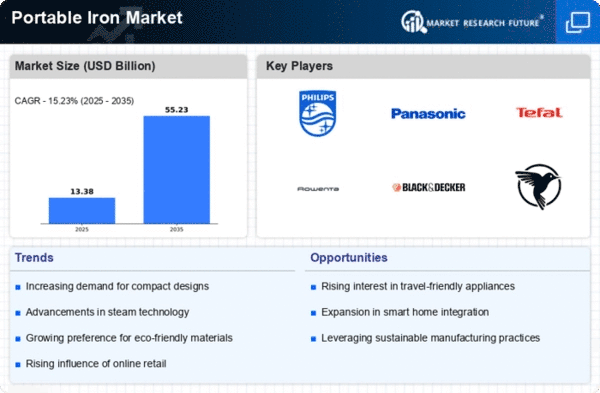
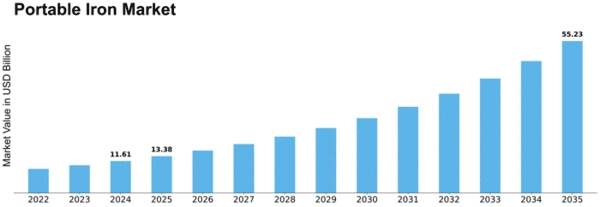
As per MRFR analysis, the Portable Iron Market Size was estimated at 11.61 USD Billion in 2024. The Portable Iron industry is projected to grow from 13.38 USD Billion in 2025 to 55.23 USD Billion by 2035, exhibiting a compound annual growth rate (CAGR) of 15.23 during the forecast period 2025 - 2035.

Key Market Trends & Highlights

The Portable Iron Market is experiencing a dynamic shift towards innovation and sustainability.

  • The rise of smart technology is transforming the functionality and efficiency of portable irons.
  • Sustainability initiatives are increasingly influencing consumer preferences for eco-friendly ironing solutions.
  • The household segment remains the largest market, while the commercial segment is witnessing rapid growth.
  • Key drivers include the increasing demand for compact appliances and the rising awareness of personal grooming.

Market Size & Forecast

2024 Market Size 11.61 (USD Billion)
2035 Market Size 55.23 (USD Billion)
CAGR (2025 - 2035) 15.23%
Largest Regional Market Share in 2024 Asia-Pacific

Major Players

Philips (NL), Panasonic (JP), Tefal (FR), Rowenta (DE), Black+Decker (US), Sunbeam (US), Braun (DE), Conair (US), Electrolux (SE)

Market Trends

The Portable Iron Market is currently experiencing a dynamic evolution, driven by various factors that influence consumer preferences and technological advancements. As individuals increasingly prioritize convenience and efficiency in their daily routines, the demand for portable irons has surged. This market segment appears to be characterized by a growing inclination towards lightweight and compact designs, which facilitate ease of use and storage. Furthermore, the integration of innovative features, such as steam functions and quick heating capabilities, seems to enhance the overall user experience, making these devices more appealing to a broader audience. In addition to design and functionality, sustainability trends are also shaping the Portable Iron Market. Consumers are becoming more environmentally conscious, leading manufacturers to explore eco-friendly materials and energy-efficient technologies. This shift not only aligns with global sustainability goals but also caters to a demographic that values responsible consumption. As the market continues to evolve, it is likely that brands will focus on creating products that not only meet performance expectations but also resonate with the values of modern consumers, thereby ensuring their relevance in an increasingly competitive landscape.

Rise of Smart Technology

The Portable Iron Market is witnessing a notable shift towards the incorporation of smart technology. Devices equipped with sensors and connectivity features are becoming more prevalent, allowing users to control settings via mobile applications. This trend indicates a growing demand for enhanced user interaction and customization, which could redefine the ironing experience.

Sustainability Initiatives

There is a marked emphasis on sustainability within the Portable Iron Market. Manufacturers are increasingly adopting eco-friendly materials and energy-efficient designs, responding to consumer demand for environmentally responsible products. This trend suggests a potential shift in production practices, aligning with broader environmental goals.

Focus on Ergonomic Design

The Portable Iron Market is also seeing a trend towards ergonomic design. As consumers seek comfort and ease of use, manufacturers are prioritizing the development of irons that reduce strain during operation. This focus on user-friendly features may enhance the overall appeal of portable irons, attracting a wider customer base.

Portable Iron Market Market Drivers

E-commerce Growth

The rise of e-commerce platforms significantly impacts the Global Portable Iron Market Industry by providing consumers with convenient access to a wide range of products. Online shopping has transformed the way consumers purchase household appliances, including portable irons. With the increasing penetration of the internet and mobile devices, consumers can easily compare products, read reviews, and make informed decisions. This shift towards online retail is likely to contribute to the market's expansion, as e-commerce platforms offer competitive pricing and promotions. The convenience of online shopping aligns with the modern consumer's preferences, further driving demand for portable irons.

Growing Fashion Industry

The expansion of the fashion industry significantly influences the Global Portable Iron Market Industry. With the rise of fast fashion and an increasing number of clothing brands, consumers are more inclined to maintain their garments in pristine condition. Portable irons are essential tools for ensuring that clothing remains wrinkle-free and presentable. As fashion trends evolve, the demand for portable ironing solutions is likely to increase, supporting the market's growth trajectory. This relationship between fashion and ironing underscores the importance of portable irons in maintaining a polished appearance, further driving market dynamics.

Technological Advancements

Technological innovations play a pivotal role in shaping the Global Portable Iron Market Industry. Manufacturers are increasingly integrating advanced features such as steam technology, lightweight designs, and energy-efficient mechanisms into their products. These enhancements not only improve the ironing experience but also cater to environmentally conscious consumers. As a result, the market is expected to witness a compound annual growth rate (CAGR) of 5.35% from 2025 to 2035. The introduction of smart irons with connectivity features further indicates a shift towards modernizing traditional appliances, appealing to tech-savvy consumers.

Rising Demand for Home Appliances

The Global Portable Iron Market Industry experiences a notable surge in demand for home appliances, driven by an increasing number of households and a growing emphasis on convenience. As urbanization continues to rise, more consumers seek efficient solutions for everyday tasks, including ironing. In 2024, the market is projected to reach 157.5 USD Billion, reflecting a robust consumer preference for portable irons that offer ease of use and storage. This trend is likely to persist, as the industry adapts to consumer needs, potentially leading to a market value of 279.4 USD Billion by 2035.

Increased Focus on Personal Grooming

The Global Portable Iron Market Industry benefits from a heightened focus on personal grooming and presentation among consumers. As professional environments become increasingly competitive, individuals prioritize their appearance, leading to a greater reliance on portable irons for maintaining clothing. This trend is particularly evident among working professionals and students who require efficient solutions for their daily routines. The emphasis on personal grooming is expected to sustain market growth, as consumers seek products that enhance their overall presentation. This growing awareness of personal image reinforces the relevance of portable irons in contemporary lifestyles.

Market Segment Insights

By Application: Household (Largest) vs. Commercial (Fastest-Growing)

In the Portable Iron Market, the Household segment holds the largest share, representing the overwhelming majority of applications. Consumers prioritize convenience and efficiency in their daily ironing tasks, driving demand for lightweight, easy-to-use portable irons. Following closely, the Commercial segment is emerging with significant growth potential, as businesses seek portable solutions to meet their operational needs in various settings such as hotels and laundries. This demand is reflected in the rise of product offerings tailored to business consumers.

Household (Dominant) vs. Travel (Emerging)

The Household segment remains dominant in the Portable Iron Market, characterized by an emphasis on user-friendly designs and features aimed at everyday consumers. Contrasting this, the Travel segment is emerging rapidly, appealing to frequent travelers who prioritize compact and versatile ironing solutions. Travel irons are designed for portability without compromising performance, often featuring dual voltage and lightweight materials. As more individuals prioritize convenience without losing functionality during their travels, the Travel segment is gaining traction, pushing brands to innovate towards these specific needs.

By Type: Steam Iron (Largest) vs. Cordless Iron (Fastest-Growing)

In the Portable Iron Market, the segment distribution is dominated by Steam Irons, which cater to a wide range of consumer needs due to their ability to effortlessly remove wrinkles through steam technology. Following closely are Dry Irons, which have a traditional appeal and provide an economical option for consumers. The market also includes Cordless Irons, Travel Irons, and Multi-Function Irons, each enjoying a niche, reflecting varying consumer preferences and usage contexts. Growth trends in this segment indicate a significant rise in the popularity of Cordless Irons, driven by the increasing demand for convenience and maneuverability in ironing tasks. Consumers are leaning towards innovations that offer seamless usage without the hassle of cords. Additionally, Multi-Function Irons are gaining traction as they combine features, appealing to users seeking versatility and efficiency, especially in compact living situations.

Steam Iron (Dominant) vs. Travel Iron (Emerging)

Steam Irons hold a dominant position in the Portable Iron Market due to their effectiveness in providing professional-quality results at home. Their ability to produce continuous steam helps in quickly tackling tough creases, making them a favorite among consumers who prioritize efficiency and performance. In contrast, Travel Irons are emerging as an essential tool for frequent travelers, offering portability and compact designs. They are lightweight and often designed to work on a variety of fabrics, emphasizing convenience. As travel returns to pre-pandemic levels, the demand for Travel Irons is increasing, indicating a possible growth trajectory amidst the evolving consumer lifestyle.

By Material: Stainless Steel (Largest) vs. Non-Stick (Fastest-Growing)

In the Portable Iron Market, the material segment is represented by various options such as Stainless Steel, Aluminum, Ceramic, Plastic, and Non-Stick. Among these, Stainless Steel holds the largest market share due to its durability and effectiveness in heat distribution. Meanwhile, Non-Stick materials are rapidly gaining traction for their convenience and ease of use. This distribution illustrates a clear preference for resilience combined with user-friendly designs in the market. Growth trends indicate a shifting consumer preference towards Non-Stick materials, which are increasingly considered the fastest-growing segment in the Portable Iron Market. Innovations in non-stick coatings and advancements in manufacturing processes are driving this change. Additionally, the growing demand for lightweight and efficient household appliances is further propelling the success of Non-Stick materials, establishing them as a formidable contender against traditional options.

Stainless Steel (Dominant) vs. Non-Stick (Emerging)

Stainless Steel remains a dominant material in the Portable Iron Market due to its robust nature, providing excellent heat retention and distribution. It appeals to consumers seeking reliability and longevity in their from the product. On the other hand, Non-Stick surfaces are emerging as a favored choice for their grease-reducing features and user-friendliness. As more consumers prioritize convenience and quick cleanup in their household tasks, Non-Stick options are innovating with enhanced technologies that improve durability and performance. This dual presence of Stainless Steel and Non-Stick highlights a market where consumers are balancing traditional durability with modern ease of use.

By Power Source: Electric (Largest) vs. Battery-Powered (Fastest-Growing)

In the Portable Iron Market, the Electric power source remains the largest segment, driven by its widespread adoption due to reliability and ease of use. Electric portable irons dominate the market as consumers favor their efficient heating capabilities and consistent performance. Battery-powered portable irons, on the other hand, are emerging as a strong contender, gaining traction among consumers seeking mobility and convenience. This segment appeals particularly to travelers and individuals in areas with limited access to electricity. Growth trends indicate a notable shift towards battery-powered alternatives, which are appealing to a younger demographic preferring eco-friendly and portable solutions. Technology advancements in battery efficiency and charging time are further propelling this segment's growth. Manufacturers are focusing on integrating innovative features, such as dual heating options and smart functionalities, to capture consumer interest and increase market penetration within this fast-evolving landscape.

Electric (Dominant) vs. Battery-Powered (Emerging)

The Electric portable iron segment is characterized by its dominant market presence, appealing to users who prioritize performance and efficiency. These products offer consistent heating, allowing for effective wrinkle removal, and are ideal for domestic use. Meanwhile, the Battery-Powered segment represents an emerging market focused on convenience, portability, and energy efficiency. These portable irons are designed for users who require mobility, such as travelers or those frequently on the go. Although battery-powered models may not yet match the performance of electric ones, innovations in battery technology are enhancing their effectiveness, enabling them to provide adequate heat and prolonged usage, thus attracting a growing customer base.

By Features: Auto Shut-Off (Largest) vs. Self-Cleaning (Fastest-Growing)

In the Portable Iron Market, features like Auto Shut-Off, Self-Cleaning, Adjustable Temperature, Anti-Drip, and Lightweight are key determinants for consumer preferences. Currently, Auto Shut-Off is the largest segment, captivating users with its safety features that prevent accidents and energy wastage. Self-Cleaning follows closely and is emerging rapidly, as consumers increasingly favor the convenience of maintaining their irons with minimal effort.

Auto Shut-Off (Dominant) vs. Self-Cleaning (Emerging)

The Auto Shut-Off feature is designed for safety, automatically shutting down the iron after a period of inactivity. This innovative characteristic not only prevents potential hazards but also appeals to environmentally-conscious consumers by conserving energy. On the other hand, the Self-Cleaning feature is quickly becoming an essential for busy households: it simplifies maintenance and ensures optimal performance. As lifestyles evolve, the demand for efficient and low-maintenance appliances grows, pushing Self-Cleaning irons to the forefront of consumer choice, indicating a shift in market dynamics favoring convenience.

Get more detailed insights about Portable Iron Market Research Report—Global Forecast till 2035

Regional Insights

North America : Established Market with Innovation

The North American portable iron market, valued at $3.48 billion, is driven by increasing consumer demand for efficient and compact ironing solutions. Factors such as rising disposable incomes and a growing focus on home aesthetics are propelling market growth. Additionally, regulatory support for energy-efficient appliances is enhancing the appeal of portable irons, aligning with sustainability trends in the region. Leading countries like the US and Canada dominate the market, with key players such as Black+Decker, Sunbeam, and Conair actively competing. The competitive landscape is characterized by innovation, with companies focusing on advanced features like steam technology and ergonomic designs. The presence of established brands ensures a robust supply chain and consumer trust, further solidifying North America's position in the portable iron market.

Europe : Diverse Market with Sustainability Focus

Europe's portable iron market, valued at €2.92 billion, is witnessing significant growth driven by a shift towards eco-friendly and energy-efficient products. Regulatory initiatives aimed at reducing carbon footprints are encouraging manufacturers to innovate. The region's commitment to sustainability is reflected in consumer preferences, with a notable increase in demand for portable irons that meet stringent energy standards. Countries like Germany, France, and the UK are leading the market, with key players such as Tefal, Rowenta, and Braun making substantial contributions. The competitive landscape is marked by a focus on product differentiation, with brands investing in technology to enhance user experience. The presence of established manufacturers ensures a diverse range of options for consumers, catering to varying needs and preferences.

Asia-Pacific : Rapid Growth and Market Leadership

Asia-Pacific holds the largest share of the portable iron market, valued at $4.93 billion, driven by urbanization and rising disposable incomes. The region's growing middle class is increasingly investing in home appliances, leading to heightened demand for portable irons. Additionally, government initiatives promoting manufacturing and exports are bolstering market growth, making it a key player in the global landscape. Countries like China, Japan, and India are at the forefront, with major brands such as Philips and Panasonic leading the charge. The competitive landscape is vibrant, with numerous local and international players vying for market share. Innovations in design and technology are prevalent, catering to the diverse needs of consumers, further solidifying Asia-Pacific's dominance in the portable iron market.

Middle East and Africa : Emerging Market with Growth Potential

The Middle East and Africa's portable iron market, valued at $0.28 billion, is in a nascent stage but shows promising growth potential. Factors such as increasing urbanization and a rise in disposable incomes are driving demand for home appliances, including portable irons. Additionally, the region's focus on improving living standards is contributing to the market's expansion, with a growing emphasis on convenience and efficiency in household tasks. Countries like South Africa and the UAE are leading the market, with a mix of local and international brands competing for consumer attention. The competitive landscape is evolving, with companies exploring innovative solutions to cater to the unique needs of the region. As the market matures, the presence of established players will likely enhance consumer trust and drive further growth.

Key Players and Competitive Insights

The Portable Iron Market is currently characterized by a dynamic competitive landscape, driven by innovation, consumer demand for efficiency, and sustainability. Key players such as Philips (NL), Panasonic (JP), and Tefal (FR) are at the forefront, each adopting distinct strategies to enhance their market presence. Philips (NL) emphasizes technological advancements, particularly in steam generation and energy efficiency, while Panasonic (JP) focuses on integrating smart technology into their products, appealing to tech-savvy consumers. Tefal (FR), on the other hand, leverages its strong brand heritage to promote eco-friendly products, thereby aligning with the growing consumer preference for sustainable options. Collectively, these strategies contribute to a competitive environment that is increasingly focused on innovation and consumer-centric solutions.In terms of business tactics, companies are localizing manufacturing to reduce costs and enhance supply chain efficiency. This approach is particularly evident in the Portable Iron Market, which appears to be moderately fragmented, with several players vying for market share. The collective influence of these key players shapes a competitive structure that encourages continuous improvement and adaptation to market demands, fostering a climate of innovation.

In November Philips (NL) launched a new line of portable irons featuring advanced steam technology that reduces ironing time by 30%. This strategic move not only enhances user convenience but also positions Philips as a leader in efficiency within the market. The introduction of this product is likely to attract consumers seeking time-saving solutions, thereby reinforcing Philips' competitive edge.

In October Panasonic (JP) announced a partnership with a leading smart home technology firm to develop a line of smart portable irons that can be controlled via mobile applications. This collaboration signifies Panasonic's commitment to integrating digital solutions into everyday appliances, potentially transforming the ironing experience for consumers. By leveraging smart technology, Panasonic aims to capture a segment of the market that values connectivity and innovation.

In September Tefal (FR) unveiled its new eco-friendly portable iron, which utilizes recycled materials in its construction. This initiative aligns with the increasing consumer demand for sustainable products and reflects Tefal's strategic focus on environmental responsibility. By prioritizing sustainability, Tefal not only enhances its brand image but also appeals to a growing demographic of environmentally conscious consumers.

As of December the Portable Iron Market is witnessing trends such as digitalization, sustainability, and the integration of AI technologies. Strategic alliances among companies are increasingly shaping the competitive landscape, fostering innovation and collaboration. Looking ahead, it is anticipated that competitive differentiation will evolve, with a shift from price-based competition to a focus on innovation, technology, and supply chain reliability. This transition underscores the importance of adapting to consumer preferences and market dynamics in a rapidly changing environment.

Key Companies in the Portable Iron Market include

Industry Developments

July 2017: Rowenta introduced the "Steam 'N Press" portable iron, which has the ability to both steam and iron clothing.

September 2017: For their brand-new portable iron steam generator, Spectrum Brands, Inc. submitted a patent application.

Future Outlook

Portable Iron Market Future Outlook

The Portable Iron Market is projected to grow at a 15.23% CAGR from 2025 to 2035, driven by technological advancements, increasing consumer demand, and eco-friendly innovations.

New opportunities lie in:

  • Expansion into smart portable iron technologies for enhanced user experience.
  • Development of eco-friendly, energy-efficient portable irons to attract environmentally conscious consumers.
  • Strategic partnerships with e-commerce platforms for wider distribution and market penetration.

By 2035, the Portable Iron Market is expected to achieve substantial growth and innovation.

Market Segmentation

Portable Iron Market Type Outlook

  • Steam Iron
  • Dry Iron
  • Cordless Iron
  • Travel Iron
  • Multi-Function Iron

Portable Iron Market Features Outlook

  • Auto Shut-Off
  • Self-Cleaning
  • Adjustable Temperature
  • Anti-Drip
  • Lightweight

Portable Iron Market Material Outlook

  • Stainless Steel
  • Aluminum
  • Ceramic
  • Plastic
  • Non-Stick

Portable Iron Market Application Outlook

  • Household
  • Commercial
  • Industrial
  • Travel
  • Fashion

Portable Iron Market Power Source Outlook

  • Electric
  • Battery-Powered
  • Solar-Powered
  • Hybrid
  • Manual

Report Scope

MARKET SIZE 202411.61(USD Billion)
MARKET SIZE 202513.38(USD Billion)
MARKET SIZE 203555.23(USD Billion)
COMPOUND ANNUAL GROWTH RATE (CAGR)15.23% (2025 - 2035)
REPORT COVERAGERevenue Forecast, Competitive Landscape, Growth Factors, and Trends
BASE YEAR2024
Market Forecast Period2025 - 2035
Historical Data2019 - 2024
Market Forecast UnitsUSD Billion
Key Companies ProfiledPhilips (NL), Panasonic (JP), Tefal (FR), Rowenta (DE), Black+Decker (US), Sunbeam (US), Braun (DE), Conair (US), Electrolux (SE)
Segments CoveredApplication, Type, Material, Power Source, Features
Key Market OpportunitiesIntegration of smart technology in Portable Iron Market enhances user convenience and energy efficiency.
Key Market DynamicsRising consumer preference for compact appliances drives innovation and competition in the portable iron market.
Countries CoveredNorth America, Europe, APAC, South America, MEA

FAQs

How much is the Portable Iron market?

The Portable Iron Market Soleplate Type was valued at USD 146.9 Billion in 2022.

What is the growth rate of the Portable Iron market?

The global market is projected to grow at a CAGR of 5.50% during the forecast period, 2025-2035.

Which region held the largest market share in the Portable Iron market?

North America had the largest share in the global market

Who are the key players in the Portable Iron market?

The key players in the market are Koninklijke Philips N.V., Panasonic Corporation, Conair Corporation, Sunbeam Products, Inc. ROWENTA S.A.S, Hamilton Beach Brands, Inc., Spectrum Brands, Inc. (RussellHobbs), Bajaj Electricals Ltd., PurSteam USA, and Vornado Air, LLC (Brand Steamfast)

Which Iron Type led the Portable Iron market?

The Dry Iron Type dominated the market in 2022.

Which Soleplate Type had the largest market share in the Portable Iron market?

The Stainless Steel Type had the largest share in the global market.

  1. SECTION I: EXECUTIVE SUMMARY AND KEY HIGHLIGHTS
    1. | 1.1 EXECUTIVE SUMMARY
    2. | 1.1.1 Market Overview
    3. | 1.1.2 Key Findings
    4. | 1.1.3 Market Segmentation
    5. | 1.1.4 Competitive Landscape
    6. | 1.1.5 Challenges and Opportunities
    7. | 1.1.6 Future Outlook
  2. SECTION II: SCOPING, METHODOLOGY AND MARKET STRUCTURE
    1. | 2.1 MARKET INTRODUCTION
    2. | 2.1.1 Definition
    3. | 2.1.2 Scope of the study
    4. |-- 2.1.2.1 Research Objective
    5. |-- 2.1.2.2 Assumption
    6. |-- 2.1.2.3 Limitations
    7. | 2.2 RESEARCH METHODOLOGY
    8. | 2.2.1 Overview
    9. | 2.2.2 Data Mining
    10. | 2.2.3 Secondary Research
    11. | 2.2.4 Primary Research
    12. |-- 2.2.4.1 Primary Interviews and Information Gathering Process
    13. |-- 2.2.4.2 Breakdown of Primary Respondents
    14. | 2.2.5 Forecasting Model
    15. | 2.2.6 Market Size Estimation
    16. |-- 2.2.6.1 Bottom-Up Approach
    17. |-- 2.2.6.2 Top-Down Approach
    18. | 2.2.7 Data Triangulation
    19. | 2.2.8 Validation
  3. SECTION III: QUALITATIVE ANALYSIS
    1. | 3.1 MARKET DYNAMICS
    2. | 3.1.1 Overview
    3. | 3.1.2 Drivers
    4. | 3.1.3 Restraints
    5. | 3.1.4 Opportunities
    6. | 3.2 MARKET FACTOR ANALYSIS
    7. | 3.2.1 Value chain Analysis
    8. | 3.2.2 Porter's Five Forces Analysis
    9. |-- 3.2.2.1 Bargaining Power of Suppliers
    10. |-- 3.2.2.2 Bargaining Power of Buyers
    11. |-- 3.2.2.3 Threat of New Entrants
    12. |-- 3.2.2.4 Threat of Substitutes
    13. |-- 3.2.2.5 Intensity of Rivalry
    14. | 3.2.3 COVID-19 Impact Analysis
    15. |-- 3.2.3.1 Market Impact Analysis
    16. |-- 3.2.3.2 Regional Impact
    17. |-- 3.2.3.3 Opportunity and Threat Analysis
  4. SECTION IV: QUANTITATIVE ANALYSIS
    1. | 4.1 Chemicals and Materials, BY Application (USD Billion)
    2. | 4.1.1 Household
    3. | 4.1.2 Commercial
    4. | 4.1.3 Industrial
    5. | 4.1.4 Travel
    6. | 4.1.5 Fashion
    7. | 4.2 Chemicals and Materials, BY Type (USD Billion)
    8. | 4.2.1 Steam Iron
    9. | 4.2.2 Dry Iron
    10. | 4.2.3 Cordless Iron
    11. | 4.2.4 Travel Iron
    12. | 4.2.5 Multi-Function Iron
    13. | 4.3 Chemicals and Materials, BY Material (USD Billion)
    14. | 4.3.1 Stainless Steel
    15. | 4.3.2 Aluminum
    16. | 4.3.3 Ceramic
    17. | 4.3.4 Plastic
    18. | 4.3.5 Non-Stick
    19. | 4.4 Chemicals and Materials, BY Power Source (USD Billion)
    20. | 4.4.1 Electric
    21. | 4.4.2 Battery-Powered
    22. | 4.4.3 Solar-Powered
    23. | 4.4.4 Hybrid
    24. | 4.4.5 Manual
    25. | 4.5 Chemicals and Materials, BY Features (USD Billion)
    26. | 4.5.1 Auto Shut-Off
    27. | 4.5.2 Self-Cleaning
    28. | 4.5.3 Adjustable Temperature
    29. | 4.5.4 Anti-Drip
    30. | 4.5.5 Lightweight
    31. | 4.6 Chemicals and Materials, BY Region (USD Billion)
    32. | 4.6.1 North America
    33. |-- 4.6.1.1 US
    34. |-- 4.6.1.2 Canada
    35. | 4.6.2 Europe
    36. |-- 4.6.2.1 Germany
    37. |-- 4.6.2.2 UK
    38. |-- 4.6.2.3 France
    39. |-- 4.6.2.4 Russia
    40. |-- 4.6.2.5 Italy
    41. |-- 4.6.2.6 Spain
    42. |-- 4.6.2.7 Rest of Europe
    43. | 4.6.3 APAC
    44. |-- 4.6.3.1 China
    45. |-- 4.6.3.2 India
    46. |-- 4.6.3.3 Japan
    47. |-- 4.6.3.4 South Korea
    48. |-- 4.6.3.5 Malaysia
    49. |-- 4.6.3.6 Thailand
    50. |-- 4.6.3.7 Indonesia
    51. |-- 4.6.3.8 Rest of APAC
    52. | 4.6.4 South America
    53. |-- 4.6.4.1 Brazil
    54. |-- 4.6.4.2 Mexico
    55. |-- 4.6.4.3 Argentina
    56. |-- 4.6.4.4 Rest of South America
    57. | 4.6.5 MEA
    58. |-- 4.6.5.1 GCC Countries
    59. |-- 4.6.5.2 South Africa
    60. |-- 4.6.5.3 Rest of MEA
  5. SECTION V: COMPETITIVE ANALYSIS
    1. | 5.1 Competitive Landscape
    2. | 5.1.1 Overview
    3. | 5.1.2 Competitive Analysis
    4. | 5.1.3 Market share Analysis
    5. | 5.1.4 Major Growth Strategy in the Chemicals and Materials
    6. | 5.1.5 Competitive Benchmarking
    7. | 5.1.6 Leading Players in Terms of Number of Developments in the Chemicals and Materials
    8. | 5.1.7 Key developments and growth strategies
    9. |-- 5.1.7.1 New Product Launch/Service Deployment
    10. |-- 5.1.7.2 Merger & Acquisitions
    11. |-- 5.1.7.3 Joint Ventures
    12. | 5.1.8 Major Players Financial Matrix
    13. |-- 5.1.8.1 Sales and Operating Income
    14. |-- 5.1.8.2 Major Players R&D Expenditure. 2023
    15. | 5.2 Company Profiles
    16. | 5.2.1 Philips (NL)
    17. |-- 5.2.1.1 Financial Overview
    18. |-- 5.2.1.2 Products Offered
    19. |-- 5.2.1.3 Key Developments
    20. |-- 5.2.1.4 SWOT Analysis
    21. |-- 5.2.1.5 Key Strategies
    22. | 5.2.2 Panasonic (JP)
    23. |-- 5.2.2.1 Financial Overview
    24. |-- 5.2.2.2 Products Offered
    25. |-- 5.2.2.3 Key Developments
    26. |-- 5.2.2.4 SWOT Analysis
    27. |-- 5.2.2.5 Key Strategies
    28. | 5.2.3 Tefal (FR)
    29. |-- 5.2.3.1 Financial Overview
    30. |-- 5.2.3.2 Products Offered
    31. |-- 5.2.3.3 Key Developments
    32. |-- 5.2.3.4 SWOT Analysis
    33. |-- 5.2.3.5 Key Strategies
    34. | 5.2.4 Rowenta (DE)
    35. |-- 5.2.4.1 Financial Overview
    36. |-- 5.2.4.2 Products Offered
    37. |-- 5.2.4.3 Key Developments
    38. |-- 5.2.4.4 SWOT Analysis
    39. |-- 5.2.4.5 Key Strategies
    40. | 5.2.5 Black+Decker (US)
    41. |-- 5.2.5.1 Financial Overview
    42. |-- 5.2.5.2 Products Offered
    43. |-- 5.2.5.3 Key Developments
    44. |-- 5.2.5.4 SWOT Analysis
    45. |-- 5.2.5.5 Key Strategies
    46. | 5.2.6 Sunbeam (US)
    47. |-- 5.2.6.1 Financial Overview
    48. |-- 5.2.6.2 Products Offered
    49. |-- 5.2.6.3 Key Developments
    50. |-- 5.2.6.4 SWOT Analysis
    51. |-- 5.2.6.5 Key Strategies
    52. | 5.2.7 Braun (DE)
    53. |-- 5.2.7.1 Financial Overview
    54. |-- 5.2.7.2 Products Offered
    55. |-- 5.2.7.3 Key Developments
    56. |-- 5.2.7.4 SWOT Analysis
    57. |-- 5.2.7.5 Key Strategies
    58. | 5.2.8 Conair (US)
    59. |-- 5.2.8.1 Financial Overview
    60. |-- 5.2.8.2 Products Offered
    61. |-- 5.2.8.3 Key Developments
    62. |-- 5.2.8.4 SWOT Analysis
    63. |-- 5.2.8.5 Key Strategies
    64. | 5.2.9 Electrolux (SE)
    65. |-- 5.2.9.1 Financial Overview
    66. |-- 5.2.9.2 Products Offered
    67. |-- 5.2.9.3 Key Developments
    68. |-- 5.2.9.4 SWOT Analysis
    69. |-- 5.2.9.5 Key Strategies
    70. | 5.3 Appendix
    71. | 5.3.1 References
    72. | 5.3.2 Related Reports

Chemicals and Materials Market Segmentation

Chemicals and Materials By Application (USD Billion, 2025-2035)

  • Household
  • Commercial
  • Industrial
  • Travel
  • Fashion

Chemicals and Materials By Type (USD Billion, 2025-2035)

  • Steam Iron
  • Dry Iron
  • Cordless Iron
  • Travel Iron
  • Multi-Function Iron

Chemicals and Materials By Material (USD Billion, 2025-2035)

  • Stainless Steel
  • Aluminum
  • Ceramic
  • Plastic
  • Non-Stick

Chemicals and Materials By Power Source (USD Billion, 2025-2035)

  • Electric
  • Battery-Powered
  • Solar-Powered
  • Hybrid
  • Manual

Chemicals and Materials By Features (USD Billion, 2025-2035)

  • Auto Shut-Off
  • Self-Cleaning
  • Adjustable Temperature
  • Anti-Drip
  • Lightweight
Infographic

Free Sample Request

Kindly complete the form below to receive a free sample of this Report

Get Free Sample

Customer Strories

Compare Licence

×
Features License Type
Single User Multiuser License Enterprise User
Price $4,950 $5,950 $7,250
Maximum User Access Limit 1 User Upto 10 Users Unrestricted Access Throughout the Organization
Free Customization
Direct Access to Analyst
Deliverable Format
Platform Access
Discount on Next Purchase 10% 15% 15%
Printable Versions