×
Request Free Sample ×

Kindly complete the form below to receive a free sample of this Report

* Please use a valid business email

Leading companies partner with us for data-driven Insights

clients tt-cursor
Hero Background
English
Chinese
French
Japanese
Korean
German
Spanish

Military Radio System Market Share

ID: MRFR/AD/2909-CR
111 Pages
Swapnil Palwe
April 2023

Military Radio System Market Size, Share, Industry Trend & Analysis Research Report Information By Type (Manpack Radios, Vehicular Radios), By End User (Naval, Ground Force, Air Force), And By Region (North America, Europe, Asia-Pacific, And Rest Of The World) – Forecast Till 2035

Share:
Download PDF ×

We do not share your information with anyone. However, we may send you emails based on your report interest from time to time. You may contact us at any time to opt-out.

Military Radio System Market Infographic
Purchase Options

Market Share

Military Radio System Market Share Analysis

The Military Radio System market is a vital part of the larger defense industry, which is responsible for enabling efficient communication across national armed forces. This is evidenced by most companies aggressively positioning their operations to capture significant market shares through various strategies. Technological innovation remains one of the key drivers of this industry as indicated by huge sums being invested by firms in development of advanced military radios. Some of these innovations include improved encryption, signal range and interoperability that enable secure and seamless communication among armed forces even in diverse operational environments. Leading technological advancements attracts defence agencies looking out for state-of-the-art communication solutions hence securing a bigger share of the market.

Military radio systems are extensively used in various domains such as inter-vehicle communications, dismounted operations, perimeter security, and maritime communications. This has been driven by factors such as the increased deployment of 3G, 4G and LTE networks and the rising investments in defense sectors by developing countries like India, China, Japan, South Korea among others.

Another important aspect of positioning in the market for military radio systems is that it must meet the needs of modern military operations. Companies that design radios capable of integrating with wider networks of military communication stand out in this regard as more and more armed forces are moving towards digitized and network centric operations. Being interoperable with other equipment or scalable to future ones would not only meet immediate requirements but also lead to long-term partnership deals with potential clients thereby increasing market share.

Within the Military Radio System sector strategic alliances play a major role in market positioning. Collaboration with defence contractors, technology providers and government agencies allows pooling resources and expertise by companies. These collaborations can enable development of full-service communication solutions tailored for defence organizations’ specific needs. Joint ventures improve overall capabilities making companies stronger competitors when bidding for large defense contracts which ultimately adds to their market share.

It is important to consider cost-effectiveness when positioning yourself on the battlefield because defense budgets are often tight. Companies providing affordable yet dependable advanced military radio systems have a higher probability of winning contracts. It is therefore vital to establish competitive advantage by streamlining production processes through supply chain optimization while embracing cost-effective technologies so as to capture bigger market share.

The Military Radio System industry requires firms that have strong global presence. This is because military actions occur worldwide thus firms having international coverage can provide goods needed by armed forces from different countries. In order to gain strong global representation it is necessary for businesses to expand their production output and distribution capacity besides understanding different political frameworks within which they operate their business. By doing so they enter new markets and solidify their position in the existing ones thereby increasing market share.

Author
Swapnil Palwe
Team Lead - Research

With a technical background as Bachelor's in Mechanical Engineering, with MBA in Operations Management , Swapnil has 6+ years of experience in market research, consulting and analytics with the tasks of data mining, analysis, and project execution. He is the POC for our clients, for their consulting projects running under the Automotive/A&D domain. Swapnil has worked on major projects in verticals such as Aerospace & Defense, Automotive and many other domain projects. He has worked on projects for fortune 500 companies' syndicate and consulting projects along with several government projects.

Leave a Comment

FAQs

How much is the Military Radio System market?

The Military Radio System Market size was valued at USD 13.69 billion in 2035.

What is the growth rate of the Military Radio System market?

The global market is projected to grow at a CAGR of 3.93% during the forecast period, 2025-2035.

Which Region held the largest market share in the Military Radio System market?

North America had the largest share of the global market

Who are the key players in the Military Radio System market?

The key players in the market are BARRETT Communications (Australia), Leonardo SpA (Italy), Harris Corporation (US), Radmor SA (Poland), Thales Communications & Security SAS (France), Codan Limited (Australia), Elbit Systems Ltd (Israel), FLIR Systems (US), Safran SA (France), and Selex ES (Italy).

Which Type led the Military Radio System market?

The Vehicular Radios category dominated the market in 2023.

Which End User had the largest market share in the Military Radio System market?

The Ground Force had the largest share of the global market.

Market Summary

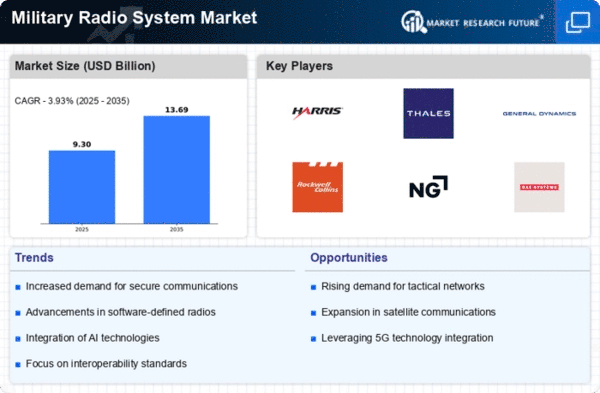
As per MRFR analysis, the Military Radio System Market Size was estimated at 8.95 USD Billion in 2024. The Military Radio System industry is projected to grow from 9.31 USD Billion in 2025 to 13.69 USD Billion by 2035, exhibiting a compound annual growth rate (CAGR) of 3.93 during the forecast period 2025 - 2035.

Key Market Trends & Highlights

The Military Radio System Market is poised for substantial growth driven by technological advancements and increasing defense budgets.

  • Technological advancements are reshaping military radio systems, enhancing communication capabilities.
  • North America remains the largest market, while Asia-Pacific is emerging as the fastest-growing region in military radio systems.
  • The communication segment dominates the market, whereas the data transmission segment is experiencing rapid growth.
  • Increased defense budgets and the need for secure communication are key drivers propelling market expansion.

Market Size & Forecast

2024 Market Size 8.95 (USD Billion)
2035 Market Size 13.69 (USD Billion)
CAGR (2025 - 2035) 3.93%
Largest Regional Market Share in 2024 North America

Major Players

Harris Corporation (US), Thales Group (FR), General Dynamics (US), Rockwell Collins (US), Northrop Grumman (US), BAE Systems (GB), Leonardo S.p.A. (IT), L3 Technologies (US), Elbit Systems (IL)

Market Trends

defense

Military Radio System Market Market Drivers

Increased Defense Budgets

In recent years, many countries have increased their defense budgets, which directly impacts the Global Military Radio System Industry. Nations are recognizing the necessity of modernizing their military capabilities, including communication systems. For example, the United States and NATO countries have allocated substantial funds to enhance their military communication infrastructure. This surge in defense spending is likely to drive demand for advanced radio systems, as military forces require reliable and secure communication channels. Consequently, the market is poised for growth, with projections indicating a rise from 8.95 USD Billion in 2024 to 13.7 USD Billion by 2035.

Market Growth Projections

The Global Military Radio System Industry is projected to experience substantial growth over the next decade. The market is expected to expand from 8.95 USD Billion in 2024 to 13.7 USD Billion by 2035, reflecting a compound annual growth rate (CAGR) of 3.93% from 2025 to 2035. This growth is driven by various factors, including technological advancements, increased defense budgets, and the rising demand for secure communications. As military forces worldwide continue to modernize their communication systems, the market is likely to witness significant developments and innovations.

Technological Advancements

The Global Military Radio System Industry is experiencing rapid technological advancements, particularly in software-defined radio (SDR) systems. These innovations enhance communication capabilities, allowing for greater flexibility and interoperability among different military branches. For instance, the integration of artificial intelligence in radio systems is expected to improve data processing and decision-making. As military forces worldwide seek to modernize their communication infrastructure, the demand for advanced radio systems is projected to increase significantly. This trend is reflected in the market's anticipated growth from 8.95 USD Billion in 2024 to 13.7 USD Billion by 2035, indicating a robust CAGR of 3.93% from 2025 to 2035.

Emerging Markets and Globalization

Emerging markets are becoming increasingly important players in the Global Military Radio System Industry. Countries in regions such as Asia-Pacific and the Middle East are investing heavily in modernizing their military capabilities, including communication systems. This trend is driven by globalization, which encourages collaboration and technology transfer among nations. As these countries seek to enhance their defense capabilities, the demand for advanced military radio systems is likely to rise. This shift is expected to contribute to the overall market growth, with projections indicating an increase from 8.95 USD Billion in 2024 to 13.7 USD Billion by 2035.

Increased Focus on Joint Operations

The Global Military Radio System Industry is witnessing a heightened focus on joint operations among allied forces. As military strategies evolve, the need for seamless communication between different branches of the armed forces becomes paramount. This requirement drives the demand for interoperable radio systems that can facilitate effective communication during joint missions. Countries are investing in advanced military radio technologies to ensure that their forces can operate cohesively. This trend is likely to propel market growth, with expectations of an increase from 8.95 USD Billion in 2024 to 13.7 USD Billion by 2035.

Growing Demand for Secure Communications

The need for secure communication systems is increasingly critical in the Global Military Radio System Industry. As geopolitical tensions rise, military organizations are prioritizing secure communication to protect sensitive information from adversaries. This demand is driving the development of encryption technologies and secure radio systems that can withstand cyber threats. Countries are investing in advanced military radio systems that provide secure and reliable communication channels. The market is expected to grow significantly, with forecasts suggesting an increase from 8.95 USD Billion in 2024 to 13.7 USD Billion by 2035, reflecting the urgent need for secure military communications.

Market Segment Insights

By Application: Communication (Largest) vs. Data Transmission (Fastest-Growing)

<a href="https://www.marketresearchfuture.com/reports/electronic-warfare-market-1552" target="_blank">electronic warfare</a>

Navigation: Communication (Dominant) vs. Electronic Warfare (Emerging)

In the Military Radio System Market, Communication applications remain dominant due to their fundamental role in ensuring effective and secure military operations. These systems enable real-time coordination and information exchange, which are critical in dynamic combat scenarios. In contrast, Electronic Warfare applications are emerging as a crucial component, driven by the increasing need for countermeasure capabilities and protection against electronic threats. The contrasting nature of these applications highlights the evolving landscape of military communication, where secure communication remains a priority, while Electronic Warfare technologies are rapidly developing to address contemporary and future threats.

By End Use: Military (Largest) vs. Homeland Security (Fastest-Growing)

<a href="https://www.marketresearchfuture.com/reports/homeland-security-market-7602" target="_blank">homeland security</a>

Aerospace (Dominant) vs. Defense (Emerging)

The Aerospace segment of the Military Radio System Market is characterized by its dominance in providing reliable communication solutions for air and space operations. These systems are designed to withstand extreme conditions and offer high-performance capabilities essential for military aviation. In contrast, the Defense segment is emerging rapidly as technologies evolve, focusing on both ground forces and naval operations. This segment is notable for the adoption of innovations such as secure communication networks and enhanced radio frequency interference resistance. Both segments are pivotal, yet the Aerospace domain is more established, while Defense is quickly adapting to new challenges and demands, highlighting a shift towards integrated communication systems across all branches of the military.

By Technology: Software Defined Radio (Largest) vs. Frequency Hopping Spread Spectrum (Fastest-Growing)

The Military Radio System Market is segmented into Software Defined Radio (SDR), Analog Radio, Digital Radio, and Frequency Hopping Spread Spectrum (FHSS). Among these, SDR holds the largest share, owing to its versatility and adaptability in various military communication environments. Analog and Digital Radios follow, with FHSS gaining rapid traction due to its inherent security features and resistance to jamming, making it essential for modern warfare applications. The distribution showcases SDR as the leading technology, while FHSS is quickly carving out its niche in the market.

Technology: SDR (Dominant) vs. FHSS (Emerging)

Software Defined Radio (SDR) is characterized by its programmable architecture, allowing military forces to adapt communication protocols as needed. This technology supports multiple frequency bands and standards, making it a dominant player in the Military Radio System Market. Its flexibility facilitates the integration of new capabilities such as advanced encryption and interoperability among different military branches. On the other hand, Frequency Hopping Spread Spectrum (FHSS) is emerging rapidly due to its ability to provide secure, jam-resistant communication across diverse environments. FHSS allows for frequent changes in transmission frequencies, enhancing security in tactical situations. Together, these technologies highlight the shift towards more agile, resilient communication systems essential for modern military operations.

By Frequency Band: Ultra High Frequency (Largest) vs. Very High Frequency (Fastest-Growing)

In the Military Radio System Market, the frequency band segment consists of High Frequency (HF), Very High Frequency (VHF), Ultra High Frequency (UHF), and Super High Frequency (SHF). Among these, UHF holds the largest market share, favored for its capabilities in tactical and secure communications. VHF, while significant, is experiencing rapid growth due to the increasing demand for line-of-sight communication in different military applications.

Very High Frequency (Dominant) vs. Super High Frequency (Emerging)

Very High Frequency (VHF) currently dominates the Military Radio System Market due to its unique advantages in long-range transmission and comprehensive communication needs across various military domains. Its ability to penetrate obstacles and support vehicle-to-vehicle and air-to-ground communication enhances its operational efficacy. On the other hand, Super High Frequency (SHF) is emerging as a vital component, garnering attention for its high capacity and data throughput capabilities. While SHF is primarily utilized for satellite communications and radar, its growing integration into modern military systems is expected to enhance its market relevance, fueled by advancements in communication technology and the expanding need for real-time data exchange.

By Form Factor: Portable (Largest) vs. Manpack (Fastest-Growing)

The Military Radio System Market showcases a diverse distribution across its form factors, including Portable, Vehicular, Base Station, and Manpack systems. Among these, Portable radios hold the largest market share, providing solutions that are typically lighter and easier to deploy in various terrains. Manpack systems, while smaller in overall share, are emerging rapidly as their adaptability and functionality appeal to modern military operations, allowing them to maintain communication in dynamic environments. In terms of growth trends, the Portable segment continues to leverage technological advancements and increased military spending. The demand for versatile communication solutions is propelling the Manpack segment forward, which is designed for rapid deployment and mobility. As military operations evolve, the need for lightweight, durable, and efficient communication systems is driving investments in both segments, ensuring their prominence in future military engagements.

Portable (Dominant) vs. Manpack (Emerging)

The Portable segment of the Military Radio System Market is characterized by its compact design and lightweight features, which make it ideal for individual soldiers and small units operating in the field. These systems are known for their ease of use and flexibility in deployment across various military operations. The evolution of technologies such as software-defined radios (SDR) has enhanced the capabilities of portable units, ensuring reliable communication even in challenging environments. On the other hand, the Manpack segment is rapidly gaining traction as an emerging player within the market. These systems balance portability with enhanced functionality, allowing medium-to-large teams to engage in agile operations without sacrificing communication quality. The Manpack radios often include advanced encryption features and interoperability options, catering to modern military requirements. As militaries seek to enhance situational awareness and operational efficiency, they are increasingly investing in Manpack systems alongside their established Portable counterparts.

Get more detailed insights about Military Radio System Market Research Report - Global Forecast till 2035

Regional Insights

North America : Market Leader in Military Tech

North America continues to lead the Military Radio System market, holding a significant share of 4.48 in 2024. The region's growth is driven by increasing defense budgets, technological advancements, and a focus on secure communication systems. Regulatory support from government agencies further enhances market dynamics, fostering innovation and collaboration among key players. The demand for advanced military communication solutions is expected to rise, driven by geopolitical tensions and modernization efforts. The competitive landscape in North America is robust, featuring major players such as Harris Corporation, General Dynamics, and Northrop Grumman. These companies are at the forefront of developing cutting-edge military radio systems, ensuring interoperability and enhanced operational capabilities. The presence of established defense contractors and a strong emphasis on R&D contribute to the region's dominance. As military operations evolve, the demand for reliable and secure communication systems will continue to grow, solidifying North America's position in the global market.

Europe : Emerging Market with Growth Potential

Europe's Military Radio System market is poised for growth, with a market size of 2.68 in 2024. The region is witnessing increased investments in defense capabilities, driven by rising security concerns and the need for modernized communication systems. Regulatory frameworks are evolving to support innovation and collaboration among member states, enhancing the overall market landscape. The demand for interoperable and secure communication solutions is expected to rise, particularly in response to regional conflicts and NATO commitments. Leading countries in Europe, such as France, Germany, and the UK, are key players in the military radio systems sector. Companies like Thales Group and BAE Systems are actively involved in developing advanced communication technologies. The competitive landscape is characterized by strategic partnerships and collaborations aimed at enhancing technological capabilities. As European nations prioritize defense spending, the market for military radio systems is set to expand significantly, driven by both governmental and private sector initiatives.

Asia-Pacific : Rapidly Growing Defense Sector

The Asia-Pacific Military Radio System market is on an upward trajectory, with a market size of 1.79 in 2024. The region's growth is fueled by increasing defense budgets, modernization of armed forces, and a focus on secure communication technologies. Countries are investing in advanced military capabilities to address regional security challenges, driving demand for sophisticated communication systems. Regulatory support and international collaborations are also playing a crucial role in shaping the market landscape. Key players in the Asia-Pacific region include companies like L3 Technologies and Elbit Systems, which are actively developing innovative military communication solutions. Countries such as India, Japan, and Australia are leading the charge in adopting advanced military radio systems. The competitive environment is characterized by a mix of domestic and international players, all vying for a share of the growing market. As defense priorities shift, the demand for reliable and secure communication systems will continue to rise, positioning Asia-Pacific as a significant player in The Military Radio System.

Middle East and Africa : Untapped Market Potential

The Middle East and Africa region currently shows a nascent Military Radio System market, with a size of 0.0 in 2024. However, the potential for growth is significant, driven by increasing defense expenditures and a focus on enhancing military capabilities. Governments in the region are recognizing the importance of secure communication systems for national security, leading to a gradual shift towards modernization. Regulatory frameworks are beginning to evolve, supporting the development of local defense industries and fostering international partnerships. Countries such as the UAE and South Africa are emerging as key players in the military radio systems sector. The competitive landscape is still developing, with opportunities for both local and international companies to establish a presence. As regional conflicts and security concerns persist, the demand for advanced military communication solutions is expected to grow, paving the way for future investments and collaborations in the Middle East and Africa.

Key Players and Competitive Insights

The Military Radio System Market is characterized by a dynamic competitive landscape, driven by technological advancements and the increasing demand for secure communication systems. Key players such as Harris Corporation (US), Thales Group (FR), and General Dynamics (US) are at the forefront, each adopting distinct strategies to enhance their market positioning. Harris Corporation (US) focuses on innovation in software-defined radios, which allows for greater flexibility and adaptability in military communications. Thales Group (FR) emphasizes partnerships with defense agencies to co-develop next-generation communication solutions, while General Dynamics (US) is investing heavily in digital transformation initiatives to streamline operations and improve product offerings. Collectively, these strategies contribute to a competitive environment that is increasingly centered around technological superiority and strategic collaborations.In terms of business tactics, companies are localizing manufacturing to reduce costs and enhance supply chain resilience. This approach is particularly relevant in a moderately fragmented market where the influence of key players is significant. The competitive structure is shaped by a mix of established firms and emerging players, each vying for market share through innovative solutions and strategic partnerships. The collective influence of these companies fosters a competitive atmosphere that encourages continuous improvement and adaptation to changing market demands.

In November Thales Group (FR) announced a strategic partnership with a leading telecommunications provider to develop advanced secure communication networks for military applications. This collaboration is expected to enhance Thales's capabilities in delivering integrated solutions that meet the evolving needs of defense forces. The strategic importance of this partnership lies in its potential to leverage cutting-edge technology and expand Thales's market reach, thereby solidifying its position as a leader in military communications.

In October General Dynamics (US) unveiled a new line of tactical communication systems designed to operate seamlessly in contested environments. This launch reflects the company's commitment to innovation and addresses the growing need for robust communication solutions in modern warfare. The introduction of these systems is likely to enhance General Dynamics's competitive edge by providing military clients with reliable and secure communication options, crucial for mission success.

In September Harris Corporation (US) completed the acquisition of a cybersecurity firm specializing in secure communications for defense applications. This acquisition is strategically significant as it allows Harris to integrate advanced cybersecurity measures into its radio systems, addressing the increasing concerns over data security in military operations. The move not only strengthens Harris's product portfolio but also positions the company as a comprehensive provider of secure communication solutions.

As of December the Military Radio System Market is witnessing trends such as digitalization, AI integration, and a growing emphasis on sustainability. These trends are reshaping the competitive landscape, with companies increasingly forming strategic alliances to enhance their technological capabilities. The shift from price-based competition to a focus on innovation and supply chain reliability is evident, suggesting that future competitive differentiation will hinge on the ability to deliver cutting-edge solutions that meet the complex demands of modern military operations.

Key Companies in the Military Radio System Market include

Industry Developments

For Instance, January 2020 Cobham signed a contract with Boeing for a Cockpit connectivity solution.

For Instance, June 2018 Northrop Grumman received a 7-year, USD 866 million contract from the US Air Force to sustain and modify a worldwide network.

For Instance, May 2022 General Dynamics Mission Systems announced that it was awarded a contract from the National Security Agency (NSA) to design, develop, test, and deliver a certifiable 400 Gbps high-assurance encryption solution compliant with the Ethernet Data Encryption Cryptographic Interoperability Specification (EDE-CIS).

Future Outlook

Military Radio System Market Future Outlook

The Military Radio System Market is projected to grow at a 3.93% CAGR from 2025 to 2035, driven by technological advancements, increased defense budgets, and the need for secure communications.

New opportunities lie in:

  • Development of advanced encryption technologies for secure communications
  • Integration of AI for enhanced signal processing and operational efficiency
  • Expansion into emerging markets with tailored communication solutions

By 2035, the Military Radio System Market is expected to be robust, driven by innovation and strategic investments.

Market Segmentation

Military Radio System Market End Use Outlook

  • Military
  • Defense
  • Aerospace
  • Homeland Security

Military Radio System Market Technology Outlook

  • Software Defined Radio
  • Analog Radio
  • Digital Radio
  • Frequency Hopping Spread Spectrum

Military Radio System Market Application Outlook

  • Communication
  • Navigation
  • Surveillance
  • Data Transmission
  • Electronic Warfare

Military Radio System Market Form Factor Outlook

  • Portable
  • Vehicular
  • Base Station
  • Manpack

Military Radio System Market Frequency Band Outlook

  • High Frequency
  • Very High Frequency
  • Ultra High Frequency
  • Super High Frequency

Report Scope

MARKET SIZE 20248.95(USD Billion)
MARKET SIZE 20259.31(USD Billion)
MARKET SIZE 203513.69(USD Billion)
COMPOUND ANNUAL GROWTH RATE (CAGR)3.93% (2025 - 2035)
REPORT COVERAGERevenue Forecast, Competitive Landscape, Growth Factors, and Trends
BASE YEAR2024
Market Forecast Period2025 - 2035
Historical Data2019 - 2024
Market Forecast UnitsUSD Billion
Key Companies ProfiledHarris Corporation (US), Thales Group (FR), General Dynamics (US), Rockwell Collins (US), Northrop Grumman (US), BAE Systems (GB), Leonardo S.p.A. (IT), L3 Technologies (US), Elbit Systems (IL)
Segments CoveredApplication, End Use, Technology, Frequency Band, Form Factor
Key Market OpportunitiesIntegration of advanced encryption technologies enhances security in the Military Radio System Market.
Key Market DynamicsTechnological advancements and regulatory changes drive innovation and competition in the Military Radio System Market.
Countries CoveredNorth America, Europe, APAC, South America, MEA

FAQs

How much is the Military Radio System market?

The Military Radio System Market size was valued at USD 13.69 billion in 2035.

What is the growth rate of the Military Radio System market?

The global market is projected to grow at a CAGR of 3.93% during the forecast period, 2025-2035.

Which Region held the largest market share in the Military Radio System market?

North America had the largest share of the global market

Who are the key players in the Military Radio System market?

The key players in the market are BARRETT Communications (Australia), Leonardo SpA (Italy), Harris Corporation (US), Radmor SA (Poland), Thales Communications &amp; Security SAS (France), Codan Limited (Australia), Elbit Systems Ltd (Israel), FLIR Systems (US), Safran SA (France), and Selex ES (Italy).

Which Type led the Military Radio System market?

The Vehicular Radios category dominated the market in 2023.

Which End User had the largest market share in the Military Radio System market?

The Ground Force had the largest share of the global market.

  1. SECTION I: EXECUTIVE SUMMARY AND KEY HIGHLIGHTS
    1. EXECUTIVE SUMMARY
      1. Market Overview
      2. Key Findings
      3. Market Segmentation
      4. Competitive Landscape
      5. Challenges and Opportunities
      6. Future Outlook
  2. SECTION II: SCOPING, METHODOLOGY AND MARKET STRUCTURE
    1. MARKET INTRODUCTION
      1. Definition
      2. Scope of the study
    2. RESEARCH METHODOLOGY
      1. Overview
      2. Data Mining
      3. Secondary Research
      4. Primary Research
      5. Forecasting Model
      6. Market Size Estimation
      7. Data Triangulation
      8. Validation
  3. SECTION III: QUALITATIVE ANALYSIS
    1. MARKET DYNAMICS
      1. Overview
      2. Drivers
      3. Restraints
      4. Opportunities
    2. MARKET FACTOR ANALYSIS
      1. Value chain Analysis
      2. Porter's Five Forces Analysis
      3. COVID-19 Impact Analysis
  4. SECTION IV: QUANTITATIVE ANALYSIS
    1. Military Radio System Market, BY Application (USD Billion)
      1. Communication
      2. Navigation
      3. Surveillance
      4. Data Transmission
      5. Electronic Warfare
    2. Military Radio System Market, BY End Use (USD Billion)
      1. Military
      2. Defense
      3. Aerospace
      4. Homeland Security
    3. Military Radio System Market, BY Technology (USD Billion)
      1. Software Defined Radio
      2. Analog Radio
      3. Digital Radio
      4. Frequency Hopping Spread Spectrum
    4. Military Radio System Market, BY Frequency Band (USD Billion)
      1. High Frequency
      2. Very High Frequency
      3. Ultra High Frequency
      4. Super High Frequency
    5. Military Radio System Market, BY Form Factor (USD Billion)
      1. Portable
      2. Vehicular
      3. Base Station
      4. Manpack
    6. Military Radio System Market, BY Region (USD Billion)
      1. North America
      2. Europe
      3. APAC
      4. South America
      5. MEA
  5. SECTION V: COMPETITIVE ANALYSIS
    1. Competitive Landscape
      1. Overview
      2. Competitive Analysis
      3. Market share Analysis
      4. Major Growth Strategy in the Aerospace & Defense
      5. Competitive Benchmarking
      6. Leading Players in Terms of Number of Developments in the Aerospace & Defense
      7. Key developments and growth strategies
      8. Major Players Financial Matrix
    2. Company Profiles
      1. Harris Corporation (US)
      2. Thales Group (FR)
      3. General Dynamics (US)
      4. Rockwell Collins (US)
      5. Northrop Grumman (US)
      6. BAE Systems (GB)
      7. Leonardo S.p.A. (IT)
      8. L3 Technologies (US)
      9. Elbit Systems (IL)
    3. Appendix
      1. References
      2. Related Reports

Military Radio System Market Segmentation

Military Radio System Market By Application (USD Billion, 2025-2035)

  • Communication
  • Navigation
  • Surveillance
  • Data Transmission
  • Electronic Warfare

Military Radio System Market By End Use (USD Billion, 2025-2035)

  • Military
  • Defense
  • Aerospace
  • Homeland Security

Military Radio System Market By Technology (USD Billion, 2025-2035)

  • Software Defined Radio
  • Analog Radio
  • Digital Radio
  • Frequency Hopping Spread Spectrum

Military Radio System Market By Frequency Band (USD Billion, 2025-2035)

  • High Frequency
  • Very High Frequency
  • Ultra High Frequency
  • Super High Frequency

Military Radio System Market By Form Factor (USD Billion, 2025-2035)

  • Portable
  • Vehicular
  • Base Station
  • Manpack
Infographic

Free Sample Request

Kindly complete the form below to receive a free sample of this Report

Get Free Sample

Customer Strories

Compare Licence

×
Features License Type
Single User Multiuser License Enterprise User
Price $4,950 $5,950 $7,250
Maximum User Access Limit 1 User Upto 10 Users Unrestricted Access Throughout the Organization
Free Customization
Direct Access to Analyst
Deliverable Format
Platform Access
Discount on Next Purchase 10% 15% 15%
Printable Versions