×
Request Free Sample ×

Kindly complete the form below to receive a free sample of this Report

* Please use a valid business email

Leading companies partner with us for data-driven Insights

clients tt-cursor
Hero Background

Japan Streaming Media Device Market

ID: MRFR/ICT/61054-HCR
200 Pages
Aarti Dhapte
February 2026

Japan Streaming Media Device Market Size, Share and Trends Analysis Report By Device Type (Gaming Consoles, Media Streamers), By Resolution (720p, 1080p, 4K), By Application (Gaming, Audio/Video Entertainment, E-learning, Others), and By End-Use (Commercial, Residential)- Forecast to 2035

Share:
Download PDF ×

We do not share your information with anyone. However, we may send you emails based on your report interest from time to time. You may contact us at any time to opt-out.

Japan Streaming Media Device Market Infographic
Purchase Options

Japan Streaming Media Device Market Summary

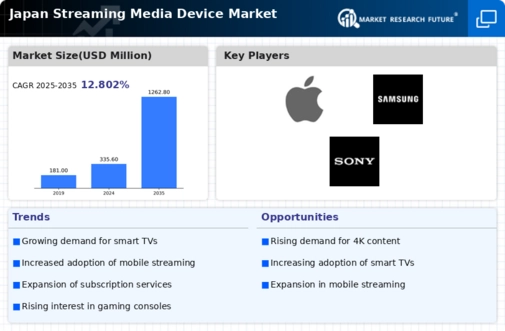
As per analysis, the Japan streaming media device market is projected to grow from USD 0.388 Billion in 2025 to USD 1.33 Billion by 2035, exhibiting a compound annual growth rate (CAGR) of 13.09% during the forecast period (2025 - 2035).

Key Market Trends & Highlights

The Japan streaming media device market is experiencing robust growth driven by technological advancements and evolving consumer preferences.

  • The video streaming segment remains the largest, reflecting a strong consumer preference for on-demand content.
  • Smart TVs dominate the market, while streaming sticks are emerging as the fastest-growing device category.
  • User experience is increasingly prioritized, leading to enhanced interfaces and personalized content recommendations.
  • Increased internet penetration and diverse content offerings are key drivers propelling market expansion.

Market Size & Forecast

2024 Market Size 0.344 (USD Billion)
2035 Market Size 1.33 (USD Billion)
CAGR (2025 - 2035) 13.09%

Major Players

Amazon (JP), Apple (JP), Google (JP), Sony (JP), Roku (US), Microsoft (US), NVIDIA (US), Samsung (KR), LG (KR)

Our Impact
Enabled $4.3B Revenue Impact for Fortune 500 and Leading Multinationals
Partnering with 2000+ Global Organizations Each Year
30K+ Citations by Top-Tier Firms in the Industry

Japan Streaming Media Device Market Trends

The japan streaming media device market is currently experiencing a dynamic evolution, driven by the increasing demand for diverse content and the proliferation of high-speed internet access. Consumers in Japan are increasingly gravitating towards devices that offer seamless streaming experiences, which has led to a surge in the adoption of smart TVs, streaming sticks, and gaming consoles equipped with streaming capabilities. This shift appears to be influenced by a growing preference for on-demand viewing, allowing users to access a wide array of entertainment options at their convenience. Furthermore, the integration of advanced technologies, such as artificial intelligence and machine learning, into these devices enhances user experience by providing personalized content recommendations and improved interface navigation. In addition, the competitive landscape of the japan streaming media device market is marked by the presence of both domestic and international players. Companies are actively innovating to differentiate their offerings, focusing on features such as voice control, compatibility with various streaming services, and enhanced security measures. The rise of subscription-based streaming services has also contributed to the market's expansion, as consumers seek devices that can easily connect to their preferred platforms. As the market continues to evolve, it is likely that trends such as increased integration of smart home technology and the development of more user-friendly interfaces will shape the future of streaming media consumption in Japan.

Rise of Smart Home Integration

The integration of streaming media devices with smart home ecosystems is becoming increasingly prevalent in Japan. Consumers are seeking devices that not only provide entertainment but also seamlessly connect with other smart home technologies. This trend suggests a shift towards a more interconnected lifestyle, where streaming devices serve as central hubs for controlling various home functions.

Emphasis on User Experience

There is a growing focus on enhancing user experience within the japan streaming media device market. Manufacturers are prioritizing intuitive interfaces, voice recognition capabilities, and personalized content recommendations. This emphasis indicates a recognition of the importance of user satisfaction in driving device adoption and retention.

Expansion of Subscription Services

The proliferation of subscription-based streaming services is significantly influencing the japan streaming media device market. As consumers increasingly favor on-demand content, devices that facilitate easy access to multiple platforms are in high demand. This trend highlights the evolving preferences of viewers who seek flexibility and variety in their entertainment options.

Japan Streaming Media Device Market Drivers

Diverse Content Offerings

The Japan streaming media device market benefits from a rich and diverse array of content offerings. Major streaming platforms, such as Netflix, Amazon Prime Video, and local services like AbemaTV, provide a wide range of genres, including anime, dramas, and documentaries. This variety caters to the unique preferences of Japanese consumers, who are known for their discerning tastes in entertainment. As of January 2026, the number of streaming subscriptions in Japan has reached over 30 million, reflecting a growing appetite for on-demand content. The availability of exclusive and localized content further enhances the appeal of streaming media devices, driving their adoption among consumers seeking tailored viewing experiences.

Increased Internet Penetration

The Japan streaming media device market is experiencing growth due to the increasing penetration of high-speed internet across the nation. As of January 2026, approximately 95 percent of households in Japan have access to the internet, with a significant portion utilizing fiber-optic connections. This widespread availability of fast internet facilitates seamless streaming experiences, encouraging consumers to adopt streaming media devices. Moreover, the Japanese government has been actively promoting digital infrastructure development, which further supports the expansion of the streaming media device market. As more households gain access to reliable internet, the demand for streaming services and devices is likely to rise, indicating a robust growth trajectory for the industry.

Shift Towards Mobile Streaming

The Japan streaming media device market is witnessing a notable shift towards mobile streaming, driven by the increasing use of smartphones and tablets. As of January 2026, over 80 percent of the population owns a smartphone, enabling users to access streaming services on-the-go. This trend is particularly pronounced among younger demographics, who prefer consuming content via mobile devices rather than traditional television. Consequently, streaming media device manufacturers are adapting their products to enhance compatibility with mobile platforms, ensuring seamless integration. This shift not only expands the market for streaming devices but also encourages service providers to optimize their offerings for mobile users, potentially leading to increased revenue streams for the industry.

Growing Popularity of Gaming Consoles

The Japan streaming media device market is significantly influenced by the growing popularity of gaming consoles, which increasingly serve as multifunctional streaming devices. As of January 2026, major gaming consoles like PlayStation and Xbox have integrated streaming capabilities, allowing users to access various streaming services directly from their devices. This convergence of gaming and streaming is appealing to a broad audience, particularly among younger consumers who value entertainment versatility. The gaming console market in Japan has seen substantial growth, with sales figures indicating a rise in adoption rates. This trend suggests that gaming consoles will continue to play a pivotal role in the expansion of the streaming media device market, as they offer an all-in-one solution for entertainment.

Government Support for Digital Innovation

The Japan streaming media device market is bolstered by government initiatives aimed at fostering digital innovation. The Japanese government has implemented policies to promote the development of digital content and technology, which includes support for streaming services and devices. As of January 2026, various grants and funding programs are available to encourage startups and established companies to innovate within the digital space. This supportive environment is likely to stimulate competition and drive advancements in streaming technology, ultimately benefiting consumers. Furthermore, the government's focus on enhancing digital literacy among citizens may lead to increased adoption of streaming media devices, as more individuals become aware of the available options and their capabilities.


Market Segment Insights

By Application: Video Streaming (Largest) vs. Music Streaming (Fastest-Growing)

In the Japan streaming media device market, Video Streaming serves as the largest application segment, dominating user preference and device usage. This segment primarily includes services like Netflix, Hulu, and Amazon Prime Video, which have gained substantial traction among consumers seeking diverse content offerings. Meanwhile, Music Streaming is rapidly gaining ground, driven by platforms like Spotify and Apple Music, attracting a younger audience keen on mobile and on-demand music access.

Content Consumption: Video Streaming (Dominant) vs. Music Streaming (Emerging)

Video Streaming remains the dominant application in Japan's streaming media device market, characterized by its extensive library and high engagement rates among consumers. Major players invest heavily in exclusive content, fostering brand loyalty and frequent usage. Conversely, Music Streaming, while emerging, is quickly capturing market share. The ease of access through smartphones and a growing preference for curated playlists indicate its potential for future growth. Both segments reflect changing consumer habits towards digital content consumption, with Video Streaming focusing on visual experience and Music Streaming catering to audio preferences.

By Device Type: Smart TV (Largest) vs. Streaming Stick (Fastest-Growing)

The Japanese streaming media device market is characterized by a diverse array of device types, with Smart TVs leading in market share. Their integration of streaming capabilities and user-friendly interfaces have made them the preferred choice for many consumers in Japan. Streaming Sticks, on the other hand, are gaining momentum as they offer an affordable and simple solution for users looking to upgrade their existing TVs. Set-Top Boxes, Game Consoles, and Mobile Devices also contribute to the market but to a lesser extent, serving niche audiences and specific content consumption habits. Growth trends indicate a significant shift towards Streaming Sticks, which have emerged as the fastest-growing segment due to rising consumer demand for accessible and cost-effective streaming solutions. The proliferation of affordable internet and an increase in content offerings are further boosting the adoption of these devices. Additionally, Smart TVs continue to evolve, providing smart home integrations and enhanced user experiences, solidifying their dominance in the market.

Smart TV (Dominant) vs. Streaming Stick (Emerging)

Smart TVs dominate the Japanese streaming media device market by delivering comprehensive entertainment solutions that integrate internet connectivity and a plethora of streaming applications directly into the screen. Their cutting-edge technology, including high-definition displays and smart interfaces, appeals to tech-savvy consumers who demand high-quality viewing experiences. Conversely, Streaming Sticks represent the emerging trend, appealing to budget-conscious buyers looking for easy installation and portability. These devices allow users to transform any TV into a smart entertainment center with minimal investment. As internet accessibility improves, the adoption of both Smart TVs and Streaming Sticks is expected to rise, catering to different segments of the market.

By User Demographics: Age Group (Largest) vs. Income Level (Fastest-Growing)

In the Japan streaming media device market, the age group segment holds significant market share, with younger consumers aged 18-34 being the largest cohort, driven by their affinity for digital content and mobile streaming. In contrast, the income level segment, particularly among middle-income households, is emerging as a rapidly growing market. This shift is largely motivated by increased disposable income and access to internet services, which empower broader demographic engagement with streaming technologies.

Age Group: 18-34 (Dominant) vs. Income Level: Middle-Income (Emerging)

The dominant age group in Japan's streaming media device market is the 18-34 segment, characterized by high consumption of digital content and a penchant for on-demand services. This cohort is tech-savvy and highly responsive to new trends, often leading the adoption of innovative streaming platforms. Conversely, the emerging middle-income level segment represents a pivotal growth opportunity, as more households can now afford streaming subscriptions. This shift is indicative of changing media consumption habits across diverse social classes, driving platforms to offer tailored content that appeals to both younger audiences and budget-conscious families.

By Content Type: Subscription-Based (Largest) vs. Ad-Supported (Fastest-Growing)

In the Japan streaming media device market, the content type segment is prominently characterized by subscription-based offerings, which hold the largest market share due to the growing consumer preference for ad-free viewing experiences. Following closely, ad-supported models are rapidly gaining traction among users looking for cost-effective access to various media content. Pay-per-view, free content, and live streaming services also contribute to the market, but at a comparatively smaller scale. As consumers increasingly prioritize personalized and diverse entertainment options, growth in the subscription-based model is propelled by the proliferation of high-quality original content provided by leading platforms. Additionally, the ad-supported sector is flourishing, driven by a shift toward on-demand viewing preferences and an expanding demographic seeking budget-friendly alternatives. This dynamic landscape reveals an evolving user behavior that continuously reshapes the content consumption patterns in the region.

Content Type: Subscription-Based (Dominant) vs. Free Content (Emerging)

The Subscription-Based content type remains the dominant force in the Japan streaming media device market, representing a shift towards comprehensive libraries that offer uninterrupted viewing experiences. Major players invest heavily in exclusive series and films, ensuring subscriber retention while attracting new customers. On the other hand, Free Content has emerged as a popular option for users unwilling to commit to monthly fees, providing access to varied content on a limited basis. As streaming platforms expand their portfolios, Free Content is becoming more sophisticated and appealing, targeting a broad audience. This content type often serves as an introductory point for users who may later convert to subscription models, hence playing a vital role in the transition landscape of the market.

By Distribution Channel: Online Retail (Largest) vs. Telecom Partnerships (Fastest-Growing)

In the Japan streaming media device market, the distribution channel landscape is diverse, with Online Retail emerging as the largest segment. This channel accounts for a significant portion of sales, leveraging the convenience of e-commerce and the increasing preference for online shopping among consumers. Physical Retail follows, offering consumers an opportunity to experience products firsthand, while Direct Sales and Subscription Services contribute to a smaller but noteworthy share. Telecom Partnerships are growing rapidly, indicating a shift towards bundled offerings that enhance customer accessibility and satisfaction. The growth trends in the distribution channel segment reflect evolving consumer behaviors and preferences. Online Retail is bolstered by the rise of digital platforms, allowing consumers to purchase devices with ease. Meanwhile, Telecom Partnerships are becoming an essential driver of growth, as telecommunications companies bundle streaming devices with service plans, target new subscribers, and create value through strategic collaborations. This trend suggests an ongoing evolution in how consumers access streaming media services in Japan, highlighting innovative distribution methods that enhance market reach.

Online Retail (Dominant) vs. Telecom Partnerships (Emerging)

Online Retail stands out as the dominant distribution channel in the Japan streaming media device market, characterized by its extensive reach and convenience for consumers. This channel effectively leverages e-commerce strategies, making a wide array of products accessible to consumers who prefer online shopping experiences. On the other hand, Telecom Partnerships represent an emerging channel, gaining traction due to their ability to bundle devices with services, leading to increased consumer adoption. Telecom companies are actively integrating streaming devices into their offerings, benefitting from existing customer bases and enhancing user experiences through seamless service integration. This dynamic creates a competitive landscape where Online Retail leads, but Telecom Partnerships are rapidly adapting to meet consumer demands and foster engagement.

Get more detailed insights about Japan Streaming Media Device Market

Key Players and Competitive Insights

The streaming media device market in Japan is characterized by a dynamic competitive landscape, driven by rapid technological advancements and shifting consumer preferences. Key players such as Amazon (JP), Apple (JP), and Sony (JP) are at the forefront, each adopting distinct strategies to enhance their market presence. Amazon (JP) focuses on integrating its streaming services with its e-commerce platform, thereby leveraging its vast customer base. Apple (JP) emphasizes innovation through its ecosystem, promoting seamless integration of devices and services. Meanwhile, Sony (JP) is investing heavily in content creation and partnerships to bolster its streaming offerings, indicating a trend towards vertical integration within the industry.

The business tactics employed by these companies reflect a concerted effort to localize manufacturing and optimize supply chains, which is crucial in a moderately fragmented market. This competitive structure allows for a diverse range of products and services, catering to varying consumer demands. The collective influence of these key players shapes the market dynamics, as they vie for consumer loyalty through enhanced user experiences and innovative features.

In December 2025, Amazon (JP) announced the launch of a new streaming device that incorporates advanced AI capabilities for personalized content recommendations. This strategic move not only enhances user engagement but also positions Amazon (JP) as a leader in leveraging technology to improve customer satisfaction. The integration of AI into streaming services is likely to set a new standard in the industry, compelling competitors to follow suit.

In November 2025, Apple (JP) unveiled a significant update to its Apple TV platform, introducing features that enhance user interactivity and content discovery. This update reflects Apple's commitment to maintaining its competitive edge through continuous innovation. By enhancing the user interface and integrating more third-party applications, Apple (JP) aims to solidify its position in the market, appealing to a broader audience.

In October 2025, Sony (JP) entered into a strategic partnership with a leading content provider to expand its streaming library significantly. This collaboration is indicative of Sony's strategy to enhance its content offerings, thereby attracting more subscribers. By focusing on exclusive content and partnerships, Sony (JP) is likely to differentiate itself in a crowded market, appealing to niche audiences and enhancing its competitive stance.

As of January 2026, the competitive trends in the streaming media device market are increasingly defined by digitalization, sustainability, and AI integration. Strategic alliances are becoming more prevalent, as companies recognize the value of collaboration in enhancing their service offerings. Looking ahead, competitive differentiation is expected to evolve, with a notable shift from price-based competition to a focus on innovation, technology, and supply chain reliability. This transition may redefine market dynamics, as companies strive to offer unique value propositions that resonate with consumers.

Key Companies in the Japan Streaming Media Device Market include

Industry Developments

A move toward cloud-based mobile gaming experiences was signaled in February 2025 when Sony unveiled the PlayStation Portal portable, a remote streaming display for PlayStation 5 games in Japan. Samsung introduced its newest smart TV models in Japan in June 2024, with better displays and AI-enhanced streaming features to increase viewing quality.

In October 2024, Amazon Japan introduced updated Fire TV Stick models with more processing power and support for Japanese-language interfaces, broadening its hardware portfolio. The Apple TV 4K (2023 model), which supports HDR and integrates seamlessly with the local Apple ecosystem, was made available in Japan earlier in November 2023.

Sony's BRAVIA XR Mini-LED TVs, which offer improved picture quality for streaming content in Japanese homes, started to be widely adopted in March 2025. To further enhance the appeal of its hardware products, Amazon added localized FAST (free ad-supported streaming TV) channels to its Prime Video service in Japan in July 2024.All of these actions highlight how top Japanese and international businesses are expanding their streaming hardware footprints, from better devices to more immersive content experiences, which is fueling growth in Japan's tech-savvy streaming industry.

Future Outlook

Japan Streaming Media Device Market Future Outlook

The Japan streaming media device market is projected to grow at a 13.09% CAGR from 2025 to 2035, driven by increasing consumer demand and technological advancements.

New opportunities lie in:

  • Development of AI-driven content recommendation systems
  • Expansion of subscription-based streaming bundles
  • Partnerships with telecom providers for bundled services

By 2035, the market is expected to be robust, driven by innovation and strategic partnerships.

Market Segmentation

Japan Streaming Media Device Market Application Outlook

  • Video Streaming
  • Music Streaming
  • Gaming
  • Social Media
  • Education

Japan Streaming Media Device Market Device Type Outlook

  • Smart TV
  • Streaming Stick
  • Set-Top Box
  • Game Console
  • Mobile Device

Japan Streaming Media Device Market Content Type Outlook

  • Subscription-Based
  • Ad-Supported
  • Pay-Per-View
  • Free Content
  • Live Streaming

Japan Streaming Media Device Market User Demographics Outlook

  • Age Group
  • Income Level
  • Family Size
  • Tech Savviness
  • Urban vs Rural

Japan Streaming Media Device Market Distribution Channel Outlook

  • Online Retail
  • Physical Retail
  • Direct Sales
  • Telecom Partnerships
  • Subscription Services

Report Scope

MARKET SIZE 20240.344(USD Billion)
MARKET SIZE 20250.388(USD Billion)
MARKET SIZE 20351.33(USD Billion)
COMPOUND ANNUAL GROWTH RATE (CAGR)13.09% (2024 - 2035)
REPORT COVERAGERevenue Forecast, Competitive Landscape, Growth Factors, and Trends
BASE YEAR2024
Market Forecast Period2025 - 2035
Historical Data2019 - 2024
Market Forecast UnitsUSD Billion
Key Companies ProfiledAmazon (JP), Apple (JP), Google (JP), Sony (JP), Roku (US), Microsoft (US), NVIDIA (US), Samsung (KR), LG (KR)
Segments CoveredApplication, Device Type, User Demographics, Content Type, Distribution Channel
Key Market OpportunitiesGrowing demand for advanced streaming features and integration with smart home technologies in the japan streaming media device market.
Key Market DynamicsRising consumer demand for high-definition streaming devices drives competition among Japanese manufacturers and international brands.
Countries CoveredJapan
Leave a Comment

FAQs

What is the current valuation of the Japan streaming media device market?

The market valuation was 0.344 USD Billion in 2024.

What is the projected market size for the Japan streaming media device market by 2035?

The market is projected to reach 1.33 USD Billion by 2035.

What is the expected CAGR for the Japan streaming media device market during the forecast period?

The expected CAGR for the market from 2025 to 2035 is 13.09%.

Which companies are the key players in the Japan streaming media device market?

Key players include Amazon (JP), Apple (JP), Google (JP), Sony (JP), Roku (US), Microsoft (US), NVIDIA (US), Samsung (KR), and LG (KR).

What are the main application segments in the Japan streaming media device market?

Main application segments include Video Streaming, Music Streaming, Gaming, Social Media, and Education.

How does the market perform in terms of device types?

The market segments by device type include Smart TV, Streaming Stick, Set-Top Box, Game Console, and Mobile Device.

What demographic factors influence the Japan streaming media device market?

Demographic factors include Age Group, Income Level, Family Size, Tech Savviness, and Urban vs Rural.

What types of content are popular in the Japan streaming media device market?

Popular content types include Subscription-Based, Ad-Supported, Pay-Per-View, Free Content, and Live Streaming.

How are streaming media devices distributed in Japan?

Distribution channels include Online Retail, Physical Retail, Direct Sales, Telecom Partnerships, and Subscription Services.

What was the valuation of the Video Streaming segment in 2024?

The Video Streaming segment was valued at 0.15 USD Billion in 2024 and is expected to grow significantly.

Download Free Sample

Kindly complete the form below to receive a free sample of this Report

Compare Licence

×
Features License Type
Single User Multiuser License Enterprise User
Price $4,950 $5,950 $7,250
Maximum User Access Limit 1 User Upto 10 Users Unrestricted Access Throughout the Organization
Free Customization
Direct Access to Analyst
Deliverable Format
Platform Access
Discount on Next Purchase 10% 15% 15%
Printable Versions