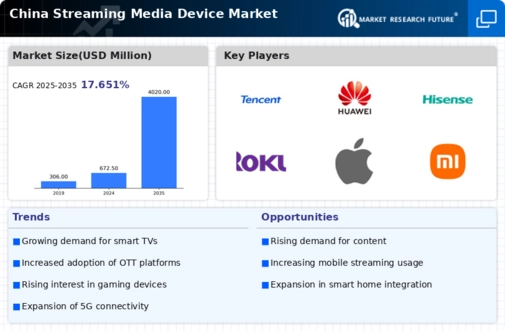
The competitive dynamics within the streaming media device market in China are characterized by rapid innovation and a strong push towards digital transformation. Key players such as Tencent (CN), Alibaba (CN), and Xiaomi (CN) are at the forefront, each adopting distinct strategies that shape the competitive landscape. Tencent (CN) focuses on integrating its vast ecosystem of services, leveraging its social media platforms to enhance user engagement with streaming content. Meanwhile, Alibaba (CN) emphasizes partnerships with content providers to expand its offerings, while Xiaomi (CN) is known for its aggressive pricing strategy and innovative hardware solutions, which appeal to a broad consumer base. Collectively, these strategies foster a competitive environment that is both dynamic and multifaceted.
In terms of business tactics, companies are increasingly localizing manufacturing and optimizing supply chains to enhance efficiency and reduce costs. The market structure appears moderately fragmented, with several players vying for market share. However, the influence of major companies is substantial, as they set trends and standards that smaller competitors often follow. This competitive structure allows for a diverse range of products and services, catering to various consumer preferences and price points.
In December 2025, Tencent (CN) announced a strategic partnership with a leading content production company to enhance its streaming service offerings. This move is significant as it not only broadens Tencent's content library but also strengthens its position against competitors by providing exclusive content that could attract more subscribers. The partnership is expected to drive user engagement and retention, crucial factors in the highly competitive streaming landscape.
In November 2025, Alibaba (CN) launched a new line of smart streaming devices that integrate AI technology for personalized content recommendations. This initiative is pivotal as it aligns with the growing consumer demand for tailored viewing experiences. By leveraging AI, Alibaba (CN) aims to differentiate its products in a crowded market, potentially increasing its market share and enhancing customer loyalty through improved user experiences.
In October 2025, Xiaomi (CN) unveiled a new streaming device that features advanced connectivity options and a user-friendly interface. This launch is indicative of Xiaomi's commitment to innovation and its strategy to capture the tech-savvy segment of the market. The device's competitive pricing, combined with its technological advancements, positions Xiaomi (CN) favorably against its rivals, suggesting a potential increase in its market penetration.
As of January 2026, current trends in the streaming media device market are heavily influenced by digitalization, sustainability, and the integration of AI technologies. Strategic alliances among companies are becoming increasingly common, as they seek to enhance their competitive edge through shared resources and expertise. Looking ahead, it appears that competitive differentiation will evolve, shifting from price-based competition to a focus on innovation, technology, and supply chain reliability. This transition may redefine market dynamics, compelling companies to invest in cutting-edge technologies and sustainable practices to maintain their competitive positions.