×
Request Free Sample ×

Kindly complete the form below to receive a free sample of this Report

* Please use a valid business email

Leading companies partner with us for data-driven Insights

clients tt-cursor
Hero Background

Japan Small Cell Networks Market

ID: MRFR/ICT/56403-HCR
200 Pages
Aarti Dhapte
February 2026

Japan Small Cell Networks Market Size, Share and Trends Analysis Report By Service (Professional Services, Managed Services, Design, Planning, Integration, Support, Maintenance), By Operating Environment (Indoor, Outdoor), By Type (Microcell, Femtocell, Metrocell, Picocell), By Verticals (Retail, Energy, Government, BFSI, Education, Healthcare, Energy and Power) and By End-User (Medium and Small Enterprises, Residential, Large Enterprises)- Forecast to 2035

Share:
Download PDF ×

We do not share your information with anyone. However, we may send you emails based on your report interest from time to time. You may contact us at any time to opt-out.

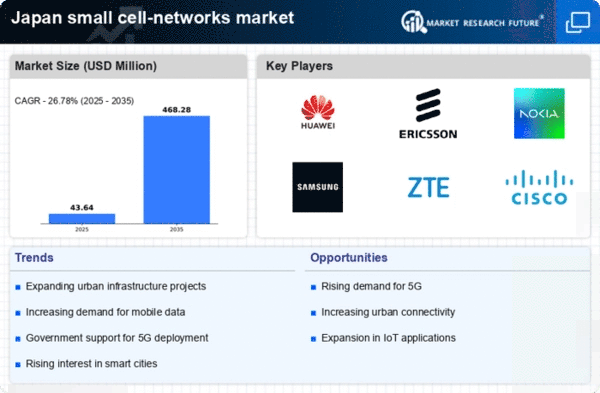
Japan Small Cell Networks Market Infographic
Purchase Options

Japan Small Cell Networks Market Summary

As per Market Research Future analysis, the Japan Small Cell Networks Market size was estimated at 34.42 USD Million in 2024. The Small Cell-networks market is projected to grow from 43.64 USD Million in 2025 to 468.28 USD Million by 2035, exhibiting a compound annual growth rate (CAGR) of 26.7% during the forecast period 2025 - 2035

Key Market Trends & Highlights

The Japan small cell-networks market is experiencing robust growth driven by urban deployment and technological advancements.

  • The market is witnessing a surge in urban deployment as cities seek to enhance connectivity.
  • Energy efficiency is becoming a focal point as operators aim to reduce operational costs.
  • Regulatory support is facilitating infrastructure development, particularly in metropolitan areas.
  • Rising demand for enhanced connectivity and increased investment in smart city initiatives are key drivers of market growth.

Market Size & Forecast

2024 Market Size 34.42 (USD Million)
2035 Market Size 468.28 (USD Million)
CAGR (2025 - 2035) 26.78%

Major Players

Huawei (CN), Ericsson (SE), Nokia (FI), Samsung (KR), ZTE (CN), Cisco (US), Qualcomm (US), CommScope (US), Airspan Networks (US)

Our Impact
Enabled $4.3B Revenue Impact for Fortune 500 and Leading Multinationals
Partnering with 2000+ Global Organizations Each Year
30K+ Citations by Top-Tier Firms in the Industry

Japan Small Cell Networks Market Trends

The Japan Small Cell Networks Market is currently experiencing a notable transformation, driven by the increasing demand for enhanced mobile connectivity and the proliferation of smart devices. In Japan, urban areas are particularly witnessing a surge in the deployment of small cell technology, as it offers a solution to the challenges posed by high user density and limited coverage. This technology facilitates improved data transmission speeds and reduced latency, which are essential for applications such as IoT and 5G services. Furthermore, the Japanese government has been actively promoting the development of advanced telecommunications infrastructure, which further supports the growth of this market. In addition to urban deployment, there is a growing emphasis on energy efficiency and sustainability within the small cell-networks market. Operators are increasingly seeking solutions that not only enhance performance but also minimize environmental impact. This trend aligns with Japan's commitment to reducing carbon emissions and promoting green technology. As a result, innovations in energy-efficient small cell designs and renewable energy integration are becoming more prevalent. Overall, the small cell-networks market in Japan appears poised for continued growth, driven by technological advancements and a supportive regulatory environment.

Urban Deployment Surge

The small cell-networks market is witnessing a significant increase in urban deployments, particularly in densely populated areas. This trend is largely driven by the need for improved mobile connectivity and the growing number of smart devices. Small cells provide a solution to coverage gaps and enhance data transmission speeds, making them essential for urban environments.

Focus on Energy Efficiency

There is a marked emphasis on energy efficiency within the small cell-networks market. Operators are increasingly prioritizing solutions that reduce energy consumption while maintaining high performance. This trend aligns with Japan's environmental goals, leading to innovations in energy-efficient designs and the integration of renewable energy sources.

Regulatory Support for Infrastructure Development

The small cell-networks market benefits from strong regulatory support aimed at enhancing telecommunications infrastructure. The Japanese government is actively promoting the deployment of advanced technologies, which facilitates the growth of small cell networks. This supportive environment encourages investment and innovation in the sector.

Japan Small Cell Networks Market Drivers

Growing Mobile Data Traffic

The small cell-networks market in Japan is being propelled by the exponential growth of mobile data traffic. With the increasing reliance on mobile devices for communication, entertainment, and business operations, the demand for high-capacity networks is more pressing than ever. Reports indicate that mobile data traffic in Japan is expected to increase by over 30% annually, necessitating the deployment of small cell networks to alleviate congestion in existing infrastructure. This trend underscores the importance of small cell networks in ensuring that users experience uninterrupted service and high-speed connectivity, thereby driving market growth.

Supportive Regulatory Environment

The regulatory environment in Japan is fostering the growth of the small cell-networks market. Government policies aimed at promoting telecommunications infrastructure development are creating a favorable landscape for small cell deployment. Regulatory bodies are streamlining the approval processes for small cell installations, which encourages operators to invest in expanding their networks. This supportive framework is essential for addressing the connectivity needs of urban populations and enhancing overall network performance. As a result, the small cell-networks market is likely to benefit from increased investments and accelerated deployment timelines, contributing to its overall expansion.

Rising Demand for Enhanced Connectivity

The small cell-networks market in Japan is experiencing a notable surge in demand for enhanced connectivity solutions. As urban areas become increasingly congested, the need for reliable and high-speed internet access is paramount. This demand is driven by the proliferation of smart devices and the Internet of Things (IoT), which require robust network infrastructure. According to recent data, the small cell-networks market is projected to grow at a CAGR of approximately 15% over the next five years. This growth is indicative of the market's potential to address the connectivity challenges faced by densely populated regions in Japan, thereby fostering a more connected society.

Increased Investment in Smart City Initiatives

Japan's commitment to developing smart cities is significantly impacting the small cell-networks market. Government initiatives aimed at enhancing urban infrastructure are driving investments in advanced communication technologies. The integration of small cell networks is vital for the successful implementation of smart city projects, which rely on seamless connectivity for various applications, including traffic management and public safety. As municipalities allocate funds for these initiatives, the small cell-networks market is poised for growth. It is estimated that investments in smart city projects could exceed $10 billion by 2027, further solidifying the role of small cell networks in urban development.

Technological Advancements in Network Infrastructure

Technological advancements play a crucial role in shaping the small cell-networks market in Japan. Innovations such as 5G technology and advanced antenna systems are enhancing the capabilities of small cell networks, allowing for greater data throughput and reduced latency. These advancements are essential for supporting the increasing data demands of consumers and businesses alike. The integration of artificial intelligence and machine learning into network management systems is also streamlining operations and improving efficiency. As a result, the small cell-networks market is likely to witness a significant transformation, with an expected market value reaching approximately $1 billion by 2026.


Market Segment Insights

By Service: Professional Services (Largest) vs. Managed Services (Fastest-Growing)

In the Japan small cell-networks market, the service segment is primarily dominated by Professional Services, which holds the largest share, accounting for a significant portion of the overall market. This segment encompasses various critical functions, including integration, planning, and design, which are essential for deploying small cell networks effectively. Managed Services are emerging as a robust competitor, with a rapidly growing influence as operators seek efficient and cost-effective solutions to manage their network infrastructure, thereby driving demand in this area. The growth trends within the service segment are propelled by increasing investments in network infrastructure and the rising need for enhanced mobile connectivity. The demand for Managed Services is particularly on the rise, as businesses and telecom operators look to outsource complex network management tasks to specialized service providers. This shift is indicative of a broader trend where companies are prioritizing operational efficiency and focusing on core competencies, further fueling the growth of service offerings related to small cell deployments.

Professional Services (Dominant) vs. Managed Services (Emerging)

Professional Services have established themselves as a dominant force in the service segment, providing essential support in areas such as design, planning, and integration of small cell networks. This service is often characterized by its bespoke nature, tailored to meet the specific needs of telecom operators and enterprises aiming for optimized network performance. Conversely, Managed Services are emerging in response to the increasing complexity of network management. These services offer operators a way to outsource their operational responsibilities, allowing for more focus on innovation and customer experience. The competition between these segments highlights a broader trend where Professional Services continue to thrive while Managed Services rapidly gain ground as businesses adapt to the evolving landscape of network requirements.

By Operating Environment: Indoor (Largest) vs. Outdoor (Fastest-Growing)

In the Japan small cell-networks market, the share distribution between indoor and outdoor segments showcases a clear dominance of indoor applications. Indoor small cell networks account for a significant portion of the market due to the rising demand for enhanced in-building coverage and capacity. With consumers increasingly reliant on mobile data for daily activities, the necessity for robust indoor connectivity solutions has never been more pronounced. This shift towards indoor solutions is evident as businesses and residential areas recognize the need for seamless mobile experiences. On the other hand, outdoor networks are witnessing rapid growth, fueled by the expanding need for widespread wireless coverage in urban and suburban areas. The increasing adoption of smart city initiatives and the rollout of 5G networks have accelerated the deployment of outdoor small cells. This segment is characterized by innovative deployments that address challenges in high-density environments, making outdoor solutions vital for future network expansions.

Indoor (Dominant) vs. Outdoor (Emerging)

The indoor segment in the Japan small cell-networks market remains dominant, primarily driven by the surge in demand for improved in-building connectivity. With high user traffic in commercial buildings, shopping malls, and residential complexes, indoor small cells ensure reliable service and robust performance in these environments. Conversely, the outdoor segment is emerging rapidly, cooperating with ongoing infrastructural developments and 5G advancements. Outdoor small cells are essential for addressing the needs of urban areas by providing data capacity where traditional macro cells may not suffice. The integration of both segments is pivotal for creating a comprehensive network infrastructure that meets the diverse connectivity demands across different environments.

By Type: Picocell (Largest) vs. Femtocell (Fastest-Growing)

In the Japan small cell-networks market, Picocells hold the largest market share, primarily due to their efficiency in urban environments and high-density areas. These small cells provide coverage and capacity enhancements, making them ideal for densely populated cities. On the other hand, Femtocells are gaining traction, particularly in residential and enterprise settings, as they offer network solutions that cater to specific user needs. This dynamic creates a competitive landscape between these two segment values. Growth trends in the Japan small cell-networks market indicate that while Picocells continue to dominate, Femtocells are emerging as the fastest-growing segment, driven by advancements in telecommunications technology. The increasing demand for high-speed mobile internet and the proliferation of smart devices are propelling the adoption of small cell networks. Furthermore, the need for better indoor coverage in commercial spaces is enhancing the appeal of Femtocells, positioning them for significant growth in the coming years.

Picocell (Dominant) vs. Femtocell (Emerging)

Picocells are characterized by their capability to provide enhanced coverage in urban areas where traditional macro networks may struggle. They are designed to handle a higher user capacity, making them crucial for meeting the demands of densely populated environments. In contrast, Femtocells cater to specific indoor applications, offering the ability to connect multiple devices within homes or offices. This emerging segment is gaining popularity as businesses seek reliable connectivity solutions. Both segments face competition from technologies like Wi-Fi 6, but their tailored approaches to enhancing coverage and capacity are vital to their continued success in the Japan small cell-networks market.

By Vertical: Retail (Largest) vs. Healthcare (Fastest-Growing)

The market share distribution among the segments in the Japan small cell-networks market reveals that Retail currently holds the largest share, driven by increasing consumer demand and the need for enhanced connectivity in retail environments. Meanwhile, sectors like Healthcare are rapidly gaining traction, supported by the surge in telehealth services and the digitization of patient management systems. Growth trends indicate a promising landscape for segments such as Healthcare, which is poised to become the fastest-growing segment. The rise in mobile health applications and the increased focus on remote patient monitoring are significant drivers. Conversely, the Retail sector, while dominant, is also innovating with smart technology deployments to enhance customer experiences and operational efficiency.

Retail: Dominant vs. Healthcare: Emerging

The Retail segment, with its dominant position in the Japan small cell-networks market, capitalizes on the necessity for seamless connectivity to improve customer experiences and operational workflows. Retailers are increasingly adopting small cell solutions to ensure robust network performance in high-density areas, enhancing their service offerings. On the other hand, the Healthcare segment, classified as emerging, is experiencing swift advancements fueled by the adoption of digital health technologies. The ongoing shift towards telemedicine and remote consultations necessitates reliable network solutions, highlighting a growing demand for small cells in healthcare facilities to support enhanced communication and data management.

By End-User: Large Enterprises (Largest) vs. Medium and Small Enterprises (Fastest-Growing)

In the Japan small cell-networks market, the distribution of market share among the end-user segments reveals that Large Enterprises hold the largest share, driven by their substantial infrastructure needs and resource availability. Conversely, Medium and Small Enterprises, while currently holding a smaller share, showcase rapid growth potential as they increasingly adopt innovative networking solutions to enhance their operational efficiency. The growth trends in this segment are heavily influenced by the rising demand for reliable and high-capacity networks, particularly in urban areas. Factors such as the proliferation of smart devices and the increasing necessity for seamless connectivity are propelling the adoption of small cell networks among Medium and Small Enterprises, making them one of the fastest-growing segments in the market. This growth is further supported by supportive government policies and advancements in technology that make such solutions more accessible to smaller businesses.

Large Enterprises (Dominant) vs. Medium and Small Enterprises (Emerging)

Large Enterprises are currently the dominant end-user segment in the Japan small cell-networks market due to their extensive infrastructure needs, budget allocation, and technological sophistication. They often leverage small cell networks to enhance coverage, improve connectivity, and handle high data traffic, especially in metropolitan areas. On the other hand, Medium and Small Enterprises are emerging as a significant force in this market as they begin to recognize the benefits of adopting advanced telecommunications solutions. These enterprises are characterized by their agility and innovative approaches to integrating small cell technologies that provide cost-effective and scalable networking solutions, which is essential for their growth and competitiveness in the evolving digital landscape.

Get more detailed insights about Japan Small Cell Networks Market

Key Players and Competitive Insights

The small cell-networks market in Japan is characterized by a dynamic competitive landscape, driven by the increasing demand for enhanced mobile connectivity and the proliferation of IoT devices. Major players such as Huawei (CN), Ericsson (SE), and Nokia (FI) are strategically positioned to leverage their technological expertise and extensive portfolios. Huawei (CN) focuses on innovation in 5G technology, while Ericsson (SE) emphasizes partnerships with local telecom operators to enhance service delivery. Nokia (FI) is actively pursuing digital transformation initiatives, aiming to integrate AI and machine learning into its network solutions. Collectively, these strategies foster a competitive environment that prioritizes technological advancement and customer-centric solutions.
Key business tactics within the market include localizing manufacturing and optimizing supply chains to enhance operational efficiency. The competitive structure appears moderately fragmented, with several key players vying for market share. This fragmentation is indicative of a landscape where innovation and strategic partnerships play a crucial role in shaping competitive dynamics. The influence of these major companies is significant, as they collectively drive advancements in technology and service offerings, thereby impacting overall market growth.
In October 2025, Ericsson (SE) announced a strategic partnership with a leading Japanese telecom operator to deploy advanced small cell solutions across urban areas. This collaboration is expected to enhance network capacity and improve user experience, reflecting Ericsson's commitment to localized solutions that cater to specific market needs. The strategic importance of this partnership lies in its potential to solidify Ericsson's presence in Japan, enabling it to better compete against local and international rivals.
In September 2025, Nokia (FI) launched a new range of small cell products designed to support the growing demand for high-capacity networks in densely populated regions. This product launch is significant as it aligns with the increasing need for robust connectivity solutions in urban environments. By focusing on high-capacity offerings, Nokia (FI) aims to differentiate itself in a competitive market, potentially capturing a larger share of the growing demand for small cell technology.
In November 2025, Huawei (CN) unveiled its latest small cell technology, which integrates AI capabilities to optimize network performance in real-time. This innovation is particularly relevant as it addresses the challenges posed by increasing data traffic and user demands. The introduction of AI-driven solutions may position Huawei (CN) as a leader in technological advancement, further intensifying competition within the market.
As of November 2025, current competitive trends indicate a strong emphasis on digitalization, sustainability, and AI integration within the small cell-networks market. Strategic alliances are increasingly shaping the landscape, as companies recognize the value of collaboration in driving innovation. Looking ahead, competitive differentiation is likely to evolve, with a shift from price-based competition to a focus on technological innovation, reliability, and supply chain efficiency. This transition underscores the importance of adaptability and forward-thinking strategies in maintaining a competitive edge.

Key Companies in the Japan Small Cell Networks Market include

Industry Developments

The Japan Small Cell Networks Market is currently experiencing significant developments, particularly with advancements in 5G technology. Major players such as Cisco, ZTE, Huawei, and Nokia are focusing on enhancing network capacity and user experience through innovative small cell solutions. In September 2023, Infinera announced a collaboration with Fujitsu to deploy advanced small cell infrastructure aimed at improving urban connectivity. Additionally, Qualcomm and Samsung are leading efforts to optimize small cell deployment strategies, catering to Japan’s dense metropolitan areas.

Recent growth in market valuation is evident, with projections indicating a compound annual growth rate of 15% from 2023 to 2025, driven by increasing demand for efficient mobile services. 

In terms of mergers and acquisitions, in August 2023, Cavium completed the acquisition of a technology startup specializing in small cell network solutions, aiming to bolster its technological capabilities. The Japanese government has also launched initiatives to accelerate the rollout of small cell networks, ensuring better coverage and reliability as part of its digital transformation strategy. Major occurrences over the past two years include significant investments in infrastructure from companies like Mitsubishi Electric and NEC, highlighting the competitive landscape within the market.


Future Outlook

Japan Small Cell Networks Market Future Outlook

The small cell-networks market in Japan is projected to grow at a 26.78% CAGR from 2025 to 2035, driven by increasing demand for enhanced connectivity and urbanization.

New opportunities lie in:

  • Deployment of smart city infrastructure integrating small cells for improved connectivity.
  • Partnerships with local governments for public Wi-Fi solutions using small cell technology.
  • Development of customized small cell solutions for high-density urban areas.

By 2035, the small cell-networks market is expected to be robust, driven by innovative applications and strategic partnerships.

Market Segmentation

Japan Small Cell Networks Market Type Outlook

  • Microcell
  • Femtocell
  • Metrocell
  • Picocell

Japan Small Cell Networks Market Service Outlook

  • Professional Services
  • Managed Services
  • Design
  • Planning
  • Integration
  • Support
  • Maintenance

Japan Small Cell Networks Market End-User Outlook

  • Medium and Small Enterprises
  • Residential
  • Large Enterprises

Japan Small Cell Networks Market Vertical Outlook

  • Retail
  • Energy
  • Government
  • BFSI
  • Education
  • Healthcare

Japan Small Cell Networks Market Operating Environment Outlook

  • Indoor
  • Outdoor

Report Scope

MARKET SIZE 2024 34.42(USD Million)
MARKET SIZE 2025 43.64(USD Million)
MARKET SIZE 2035 468.28(USD Million)
COMPOUND ANNUAL GROWTH RATE (CAGR) 26.78% (2025 - 2035)
REPORT COVERAGE Revenue Forecast, Competitive Landscape, Growth Factors, and Trends
BASE YEAR 2024
Market Forecast Period 2025 - 2035
Historical Data 2019 - 2024
Market Forecast Units USD Million
Key Companies Profiled Huawei (CN), Ericsson (SE), Nokia (FI), Samsung (KR), ZTE (CN), Cisco (US), Qualcomm (US), CommScope (US), Airspan Networks (US)
Segments Covered Service, Operating Environment, Type, Vertical, End-User
Key Market Opportunities Expansion of small cell-networks market driven by increasing demand for enhanced mobile connectivity and urban densification.
Key Market Dynamics Rising demand for enhanced mobile connectivity drives innovation in small cell-networks across Japan's urban landscapes.
Countries Covered Japan
Leave a Comment

FAQs

What is the expected market size of the Japan Small Cell Networks Market in 2024?

The Japan Small Cell Networks Market is expected to be valued at 45.9 million USD in 2024.

What is the projected market value of the Japan Small Cell Networks Market by 2035?

By 2035, the Japan Small Cell Networks Market is projected to reach a value of 487.3 million USD.

What is the expected compound annual growth rate (CAGR) for the Japan Small Cell Networks Market from 2025 to 2035?

The expected CAGR for the Japan Small Cell Networks Market from 2025 to 2035 is 23.957 percent.

Who are the key players in the Japan Small Cell Networks Market?

Major players in the Japan Small Cell Networks Market include Cisco, ZTE, Cavium, Airspan Networks, and Huawei.

What is the market value for Professional Services in the Japan Small Cell Networks Market in 2024?

Professional Services in the Japan Small Cell Networks Market is valued at 15.0 million USD in 2024.

What is the estimated market size for Managed Services in 2035?

The market size for Managed Services in the Japan Small Cell Networks Market is estimated to be 103.3 million USD in 2035.

How much is the Design segment valued at in 2024 within the Japan Small Cell Networks Market?

The Design segment within the Japan Small Cell Networks Market is valued at 5.0 million USD in 2024.

What are the challenges and opportunities in the Japan Small Cell Networks Market?

The Japan Small Cell Networks Market faces challenges such as infrastructure costs while presenting opportunities for growth through increasing mobile data demand.

What is the expected value of the Integration service in the Japan Small Cell Networks Market by 2035?

The expected value of the Integration service in the Japan Small Cell Networks Market by 2035 is 101.2 million USD.

How is the current global scenario impacting the Japan Small Cell Networks Market?

The current global scenario may influence supply chain dynamics and investment trends in the Japan Small Cell Networks Market.

Download Free Sample

Kindly complete the form below to receive a free sample of this Report

Compare Licence

×
Features License Type
Single User Multiuser License Enterprise User
Price $4,950 $5,950 $7,250
Maximum User Access Limit 1 User Upto 10 Users Unrestricted Access Throughout the Organization
Free Customization
Direct Access to Analyst
Deliverable Format
Platform Access
Discount on Next Purchase 10% 15% 15%
Printable Versions