×
Request Free Sample ×

Kindly complete the form below to receive a free sample of this Report

* Please use a valid business email

Leading companies partner with us for data-driven Insights

clients tt-cursor
Hero Background

France Small Cell Networks Market

ID: MRFR/ICT/56404-HCR
200 Pages
Aarti Dhapte
February 2026

France Small Cell Networks Market Size, Share and Trends Analysis Report By Service (Professional Services, Managed Services, Design, Planning, Integration, Support, Maintenance), By Operating Environment (Indoor, Outdoor), By Type (Microcell, Femtocell, Metrocell, Picocell), By Verticals (Retail, Energy, Government, BFSI, Education, Healthcare, Energy and Power) and By End-User (Medium and Small Enterprises, Residential, Large Enterprises)- Forecast to 2035

Share:
Download PDF ×

We do not share your information with anyone. However, we may send you emails based on your report interest from time to time. You may contact us at any time to opt-out.

France Small Cell Networks Market Infographic
Purchase Options

France Small Cell Networks Market Summary

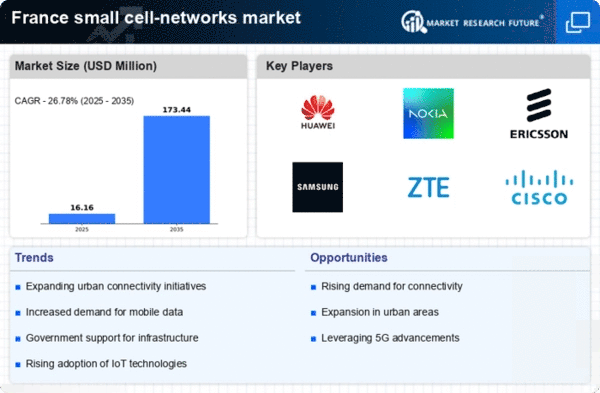
As per Market Research Future analysis, the France Small Cell Networks Market size was estimated at 12.75 USD Million in 2024. The Small Cell-networks market is projected to grow from 16.16 USD Million in 2025 to 173.44 USD Million by 2035, exhibiting a compound annual growth rate (CAGR) of 26.7% during the forecast period 2025 - 2035

Key Market Trends & Highlights

The France small cell-networks market is poised for substantial growth driven by urbanization and technological advancements.

  • The market is experiencing increased urbanization and connectivity needs, particularly in metropolitan areas.
  • Regulatory support for infrastructure development is fostering a conducive environment for small cell deployment.
  • Technological advancements in deployment are enhancing the efficiency and effectiveness of small cell networks.
  • Rising demand for enhanced mobile connectivity and supportive government policies are key drivers propelling market growth.

Market Size & Forecast

2024 Market Size 12.75 (USD Million)
2035 Market Size 173.44 (USD Million)
CAGR (2025 - 2035) 26.78%

Major Players

Huawei (CN), Nokia (FI), Ericsson (SE), Samsung (KR), ZTE (CN), Cisco (US), Qualcomm (US), CommScope (US), Airspan Networks (US)

Our Impact
Enabled $4.3B Revenue Impact for Fortune 500 and Leading Multinationals
Partnering with 2000+ Global Organizations Each Year
30K+ Citations by Top-Tier Firms in the Industry

France Small Cell Networks Market Trends

The France Small Cell Networks Market is currently experiencing a notable transformation, driven by the increasing demand for enhanced mobile connectivity and the proliferation of smart devices. As urban areas continue to expand, the need for robust network infrastructure becomes more pressing. Small cell technology offers a solution by providing localized coverage, thereby alleviating congestion in traditional macro networks. This shift is particularly relevant in densely populated regions, where the demand for high-speed internet and seamless connectivity is paramount. Furthermore, advancements in technology are enabling the deployment of these networks in a more cost-effective manner, which may encourage wider adoption among service providers. In addition, regulatory frameworks in France appear to be evolving to support the deployment of small cell networks. Government initiatives aimed at improving digital infrastructure are likely to facilitate the integration of these systems into existing networks. This regulatory support, combined with the growing consumer expectation for reliable connectivity, suggests a favorable environment for the small cell-networks market. As stakeholders continue to invest in this technology, the market may witness significant growth, driven by both consumer demand and supportive policies. The future landscape of connectivity in urban areas seems poised for a substantial shift, with small cell networks playing a crucial role in meeting the needs of modern society.

Increased Urbanization and Connectivity Needs

The ongoing trend of urbanization is driving the demand for enhanced connectivity solutions. As cities grow, the need for reliable and high-speed internet access becomes critical. Small cell networks provide localized coverage, addressing the challenges posed by dense populations and high data traffic. This trend indicates a shift towards more efficient network solutions that can support the increasing number of connected devices.

Regulatory Support for Infrastructure Development

Recent developments in regulatory frameworks suggest a supportive environment for the deployment of small cell networks. Government initiatives aimed at improving digital infrastructure are likely to facilitate the integration of these networks into existing systems. This regulatory backing may encourage service providers to invest in small cell technology, enhancing overall connectivity.

Technological Advancements in Deployment

Technological innovations are streamlining the deployment of small cell networks, making them more accessible for service providers. Enhanced equipment and installation techniques are reducing costs and deployment times. This trend indicates a potential for rapid expansion in the small cell-networks market, as providers seek to meet the growing demand for reliable connectivity.

France Small Cell Networks Market Drivers

Increased Focus on 5G Deployment

The transition to 5G technology is a major driver for the small cell-networks market in France. As telecommunications companies prepare for the rollout of 5G, the need for small cells becomes more pronounced. These networks are essential for providing the dense coverage and high capacity required for 5G services. With France's 5G rollout expected to reach over 50% of the population by 2026, the small cell-networks market is likely to see substantial growth. The integration of small cells into existing infrastructure will enable operators to enhance network performance and meet the increasing demands of consumers for faster and more reliable mobile services.

Growing Internet of Things (IoT) Applications

The proliferation of Internet of Things (IoT) devices is significantly impacting the small cell-networks market in France. As more devices become interconnected, the demand for robust and reliable network infrastructure increases. Small cells are particularly well-suited to support the diverse connectivity needs of IoT applications, ranging from smart homes to industrial automation. The small cell-networks market is poised to capitalize on this trend, as businesses and consumers alike seek solutions that can accommodate the growing number of connected devices. It is estimated that the number of IoT devices in France will exceed 100 million by 2025, further driving the need for enhanced network capabilities.

Rising Demand for Enhanced Mobile Connectivity

The small cell-networks market in France is experiencing a surge in demand for enhanced mobile connectivity. As urban areas become increasingly congested, the need for reliable and high-speed internet access intensifies. This demand is driven by the proliferation of smart devices and the growing reliance on mobile applications for daily activities. According to recent data, mobile data traffic in France is projected to increase by over 40% annually, necessitating the deployment of small cell networks to alleviate congestion in urban centers. The small cell-networks market is thus positioned to benefit from this trend, as operators seek to improve user experience and meet the expectations of consumers for seamless connectivity.

Supportive Government Policies and Initiatives

Government policies in France are playing a pivotal role in shaping the small cell-networks market. Initiatives aimed at enhancing digital infrastructure are being prioritized, with significant investments allocated to support the deployment of small cell technology. The French government has set ambitious targets for broadband coverage, aiming for 100% connectivity by 2025. This regulatory environment fosters innovation and encourages private sector investment in small cell networks. The small cell-networks market stands to gain from these supportive measures, as they facilitate the necessary framework for operators to expand their networks and improve service delivery across urban and rural areas.

Urban Infrastructure Development and Smart Cities

The development of urban infrastructure and the emergence of smart city initiatives are key factors influencing the small cell-networks market in France. As cities evolve to incorporate smart technologies, the demand for advanced communication networks becomes critical. Small cells play a vital role in supporting the infrastructure required for smart city applications, such as traffic management, public safety, and environmental monitoring. The small cell-networks market is likely to benefit from investments in urban development projects, as municipalities seek to enhance connectivity and improve the quality of life for residents. With an increasing number of cities in France adopting smart city frameworks, the potential for growth in this market segment appears promising.


Market Segment Insights

By Service: Professional Services (Largest) vs. Managed Services (Fastest-Growing)

In the France small cell-networks market, Professional Services holds the largest market share among the service segment values, reflecting its critical role in supporting small cell implementations. Meanwhile, Managed Services is rapidly gaining traction, characterized by a robust demand for outsourced management solutions that allow businesses to focus on their core operations while leveraging expert services. This dynamic landscape indicates a healthy distribution of market share across various service categories, with notable contributions from Design, Planning, Integration, Support, and Maintenance. Growth trends in this sector are being driven by an increase in demand for enhanced connectivity solutions and the expansion of mobile networks. As organizations seek to optimize their operational efficiency, they are turning to Managed Services for their flexibility and scalability. The continuous innovation in integration and support services is also fostering an environment of growth, further indicating a shift towards comprehensive service offerings that meet evolving customer needs in the France small cell-networks market.

Professional Services (Dominant) vs. Managed Services (Emerging)

Professional Services in the France small cell-networks market are characterized by their comprehensive approach to supporting the deployment of small cell technologies, including consultation, design, and execution. This segment is viewed as dominant due to its established relationships with clients, deep knowledge of regulatory requirements, and capacity to deliver tailored solutions. On the other hand, Managed Services, as an emerging player, provide businesses with essential support for their small cell infrastructure, allowing them to outsource critical functions such as monitoring, maintenance, and system updates. This shift is appealing to many companies, particularly those looking to enhance their operational efficiency and reduce costs without compromising service quality.

By Operating Environment: Indoor (Largest) vs. Outdoor (Fastest-Growing)

In the France small cell-networks market, the Indoor segment currently holds a significant share, dominating the landscape with its extensive deployment in commercial and residential settings. The demand for Indoor small cell networks is driven by the increasing number of connected devices and the need for high-quality, reliable mobile services in densely populated areas. Conversely, the Outdoor segment, while smaller in market share, is rapidly gaining ground as urban areas expand and outdoor connectivity becomes essential for public spaces and events. Growth trends indicate a robust trajectory for the Outdoor segment, highlighted by an increased investment in infrastructure and a surge in demand for mobile data services. Key drivers include the evolution of smart city initiatives and the integration of IoT devices, which enhance connectivity in outdoor environments. As technology advances and user expectations rise, the market is expected to see an acceleration in outdoor deployments, further emphasizing its emerging position in the landscape.

Indoor (Dominant) vs. Outdoor (Emerging)

The Indoor segment of the France small cell-networks market is characterized by its prevalence in both residential and commercial buildings, enabling high-capacity wireless communication within confined spaces. Due to the relentless growth of mobile data traffic and the proliferation of smart devices, Indoor small cells have become the backbone of mobile connectivity, effectively alleviating congestion in traditional networks. On the other hand, the Outdoor segment is increasingly recognized as an emerging player, with significant installations in urban areas to enhance public connectivity and support various applications like public safety and smart infrastructure. Its growth is propelled by urbanization trends and government initiatives aimed at improving outdoor wireless infrastructure, making it a critical component for future network developments.

By Type: Microcell (Largest) vs. Femtocell (Fastest-Growing)

The France small cell-networks market exhibits a diverse range of segment values, with Microcells leading the charge. They represent the largest market share, primarily due to their expansive coverage capabilities and cost-effectiveness for urban deployments. Following closely, Femtocells are rapidly gaining traction, particularly as residential and small office solutions. Their ability to enhance indoor coverage and data speeds contributes to their growing appeal, capturing the interest of both consumers and service providers. Growth trends within this segment are fueled by the increasing demand for enhanced connectivity in densely populated areas. The necessity for seamless mobile experiences amid rising data consumption and the proliferation of IoT devices drives investment in small cell technologies. As operators strive to improve service delivery and reduce congestion on traditional networks, the France small cell-networks market is expected to witness a corresponding uptick in the deployment of both Microcells and Femtocells.

Microcell (Dominant) vs. Femtocell (Emerging)

Microcells serve as the backbone of urban connectivity strategies, providing high-capacity coverage and addressing demand in crowded environments. Their robust infrastructure supports a larger number of simultaneous users, making them ideal for public and commercial applications. On the other hand, Femtocells have emerged as a cost-effective solution for improving indoor coverage in residential settings. Designed for smaller areas, they deliver customized connectivity that meets specific user demands. As these technologies evolve, the competition between Microcells and Femtocells is reshaping the landscape, with Microcells maintaining a position of strength while Femtocells continue to carve out their niche in the market for targeted consumer use.

By Vertical: Retail (Largest) vs. Healthcare (Fastest-Growing)

The market share distribution within the France small cell-networks market reveals that the Retail segment holds a significant share, driven by the increasing demand for enhanced customer experiences and seamless connectivity in retail outlets. Other segments like Energy, Government, BFSI, Education, and Healthcare also contribute, but they trail behind in terms of market impact due to varying degrees of adoption and infrastructural development. Each sector's unique requirements dictate its share in the market, with Retail leading the charge. Growth trends indicate that the Healthcare segment is rapidly emerging, characterized by increasing investments in telemedicine and connected health solutions. This rapid growth is fueled by the growing demand for efficient communication, especially in light of recent global health challenges. Other segments, such as BFSI and Government, are also experiencing robust growth as digital transformation initiatives continue to gain momentum, but they are not growing at the pace of Healthcare.

Retail: Dominant vs. Healthcare: Emerging

The Retail segment in the France small cell-networks market is dominant due to its substantial investment in technology to enhance consumer engagement and operational efficiency. Retail establishments are leveraging small cell solutions to deliver robust connectivity, enabling services such as mobile payments and interactive in-store experiences. In contrast, the Healthcare segment, while currently emerging, is experiencing rapid uptake of small cell technology, driven by the need for reliable communications in hospitals and clinics. The shift towards telehealth and interconnected devices for patient monitoring is creating opportunities for small cell deployments, fostering an environment of growth as healthcare providers seek to meet rising patient demands and improve care quality.

By End-User: Large Enterprises (Largest) vs. Medium and Small Enterprises (Fastest-Growing)

In the France small cell-networks market, Large Enterprises hold a significant market share, benefiting from their extensive infrastructure and higher demand for reliable connectivity solutions. Their investments in advanced technologies and seamless integration have positioned them as leaders in this space. Conversely, Medium and Small Enterprises are emerging rapidly, capturing attention with their increasing adoption of small cell technologies to enhance business operations and employee productivity. These businesses recognize the critical need for robust networks to support their growth trajectories. The growth trends in the France small cell-networks market are primarily driven by the digital transformation initiatives across sectors. Large Enterprises are enhancing their networks to handle massive data traffic, while Medium and Small Enterprises are rapidly evolving to meet customer demands. The shift towards remote working models and the need for consistent connectivity in urban areas are further boosting the adoption of small cell solutions. As a result, the segment is witnessing a shift wherein Medium and Small Enterprises are gaining traction as they leverage innovative technologies to improve service delivery.

Large Enterprises (Dominant) vs. Medium and Small Enterprises (Emerging)

Large Enterprises dominate the France small cell-networks market due to their robust infrastructure and significant resource allocation for advanced networking solutions. Their ability to implement large-scale projects helps in mitigating operational challenges while offering enhanced connectivity solutions. On the other hand, Medium and Small Enterprises are emerging players, increasingly prioritizing their network capabilities. Their agility allows them to adopt small cell technologies quickly, helping them improve service delivery and competitiveness. This segment is characterized by a diverse range of solutions tailored to specific business needs, making them vital in the ongoing network evolution. As these enterprises continue to focus on digitalization, their role in enhancing network connectivity will only become more prominent.

Get more detailed insights about France Small Cell Networks Market

Key Players and Competitive Insights

The small cell-networks market in France is characterized by a dynamic competitive landscape, driven by the increasing demand for enhanced mobile connectivity and the proliferation of IoT devices. Major players such as Huawei (CN), Nokia (FI), and Ericsson (SE) are strategically positioned to leverage their technological expertise and extensive portfolios. Huawei (CN) focuses on innovation in 5G technology, while Nokia (FI) emphasizes partnerships with local telecom operators to enhance service delivery. Ericsson (SE) is actively pursuing digital transformation initiatives, which collectively shape a competitive environment that is increasingly reliant on advanced technology and strategic collaborations.
Key business tactics within this market include localizing manufacturing and optimizing supply chains to enhance operational efficiency. The competitive structure appears moderately fragmented, with several key players vying for market share. This fragmentation is indicative of a landscape where innovation and customer-centric solutions are paramount, allowing companies to differentiate themselves through unique offerings and localized services.
In October 2025, Nokia (FI) announced a strategic partnership with a leading French telecom operator to deploy a new small cell solution aimed at enhancing urban connectivity. This collaboration is significant as it not only strengthens Nokia's foothold in the French market but also aligns with the growing demand for robust urban infrastructure capable of supporting high-density environments. The partnership is expected to facilitate the rollout of advanced 5G services, thereby enhancing user experience and operational efficiency.
In September 2025, Ericsson (SE) unveiled its latest small cell technology designed to optimize network performance in challenging environments. This development is crucial as it addresses the increasing need for reliable connectivity in urban areas, where traditional infrastructure may struggle to meet demand. By focusing on innovation, Ericsson (SE) positions itself as a leader in providing solutions that cater to the evolving needs of network operators and end-users alike.
In November 2025, Huawei (CN) launched a new initiative aimed at integrating AI capabilities into its small cell solutions. This move is indicative of a broader trend towards digitalization within the telecommunications sector, as AI can enhance network management and operational efficiency. By incorporating AI, Huawei (CN) not only improves its product offerings but also aligns with the industry's shift towards smarter, more adaptive network solutions.
As of November 2025, current competitive trends in the small cell-networks market are heavily influenced by digitalization, sustainability, and AI integration. Strategic alliances are increasingly shaping the landscape, allowing companies to pool resources and expertise to drive innovation. Looking ahead, competitive differentiation is likely to evolve from traditional price-based competition to a focus on technological advancement, innovation, and supply chain reliability. This shift underscores the importance of agility and responsiveness in meeting the demands of a rapidly changing market.

Key Companies in the France Small Cell Networks Market include

Industry Developments

Recent developments in the France Small Cell Networks Market indicate a significant focus on enhancing connectivity, particularly as municipalities explore solutions for urban density and increased mobile data consumption. In September 2023, Cisco announced strategic partnerships aimed at expanding its small cell offerings tailored to urban environments in France. Furthermore, Mavenir and Nokia have been actively working with local telecom operators to deploy advanced small cell solutions to improve 5G accessibility in both urban and rural settings.

The market has seen notable growth, with high demand for small cells driven by the increasing adoption of mobile broadband across France, reflecting the government's initiative to enhance digital infrastructure. 

In terms of mergers and acquisitions, there have been no recent announcements among the major players like Airspan Networks and Huawei within this specific market segment. Over the past few years, particularly in 2022, France experienced significant advancements in small cell deployment with initiatives led by major companies to ensure seamless connectivity throughout cities, as evidenced by the rollout of 5G small cells for enhanced public services and smart city applications.


Future Outlook

France Small Cell Networks Market Future Outlook

The small cell-networks market in France is projected to grow at a 26.78% CAGR from 2025 to 2035, driven by increasing demand for enhanced connectivity and urban densification.

New opportunities lie in:

  • Deployment of private 5G networks for enterprises
  • Integration of AI-driven analytics for network optimization
  • Expansion of small cell infrastructure in urban areas

By 2035, the market is expected to be robust, driven by technological advancements and increased adoption.

Market Segmentation

France Small Cell Networks Market Type Outlook

  • Microcell
  • Femtocell
  • Metrocell
  • Picocell

France Small Cell Networks Market Service Outlook

  • Professional Services
  • Managed Services
  • Design
  • Planning
  • Integration
  • Support
  • Maintenance

France Small Cell Networks Market End-User Outlook

  • Medium and Small Enterprises
  • Residential
  • Large Enterprises

France Small Cell Networks Market Vertical Outlook

  • Retail
  • Energy
  • Government
  • BFSI
  • Education
  • Healthcare

France Small Cell Networks Market Operating Environment Outlook

  • Indoor
  • Outdoor

Report Scope

MARKET SIZE 2024 12.75(USD Million)
MARKET SIZE 2025 16.16(USD Million)
MARKET SIZE 2035 173.44(USD Million)
COMPOUND ANNUAL GROWTH RATE (CAGR) 26.78% (2025 - 2035)
REPORT COVERAGE Revenue Forecast, Competitive Landscape, Growth Factors, and Trends
BASE YEAR 2024
Market Forecast Period 2025 - 2035
Historical Data 2019 - 2024
Market Forecast Units USD Million
Key Companies Profiled Huawei (CN), Nokia (FI), Ericsson (SE), Samsung (KR), ZTE (CN), Cisco (US), Qualcomm (US), CommScope (US), Airspan Networks (US)
Segments Covered Service, Operating Environment, Type, Vertical, End-User
Key Market Opportunities Expansion of small cell-networks market driven by increasing demand for enhanced mobile connectivity and urban densification.
Key Market Dynamics Rising demand for enhanced mobile connectivity drives investment in small cell networks across urban areas.
Countries Covered France
Leave a Comment

FAQs

What is the expected market size of the France Small Cell Networks Market in 2024?

The France Small Cell Networks Market is expected to be valued at 15.3 million USD in 2024.

What is the projected market size of the France Small Cell Networks Market by 2035?

By 2035, the France Small Cell Networks Market is expected to reach a valuation of 200.0 million USD.

What is the compound annual growth rate (CAGR) for the France Small Cell Networks Market from 2025 to 2035?

The expected CAGR for the France Small Cell Networks Market from 2025 to 2035 is 26.324%.

Who are the key players in the France Small Cell Networks Market?

Major players in the France Small Cell Networks Market include Cisco, Mavenir, Casa Systems, ZTE, Airspan Networks, Huawei, and others.

What are the expected values for Professional Services in the France Small Cell Networks Market by 2035?

Professional Services are projected to be valued at 60.0 million USD by 2035 in the France Small Cell Networks Market.

What is the market value of Managed Services for the France Small Cell Networks Market in 2024?

Managed Services are valued at 3.0 million USD in 2024 within the France Small Cell Networks Market.

What is the growth outlook for the Design segment of the France Small Cell Networks Market?

The Design segment is anticipated to grow from a value of 2.5 million USD in 2024 to 30.0 million USD by 2035.

How much is the Integration service segment expected to be valued by 2035?

The Integration service segment is projected to reach 30.0 million USD by 2035 in the France Small Cell Networks Market.

What is the expected market growth for the Planning service segment between 2024 and 2035?

The Planning service segment is expected to grow from 2.3 million USD in 2024 to 35.0 million USD by 2035.

What is the significance of the growth rate for the France Small Cell Networks Market?

The high CAGR of 26.324% from 2025 to 2035 signifies robust growth opportunities in the France Small Cell Networks Market.

Download Free Sample

Kindly complete the form below to receive a free sample of this Report

Compare Licence

×
Features License Type
Single User Multiuser License Enterprise User
Price $4,950 $5,950 $7,250
Maximum User Access Limit 1 User Upto 10 Users Unrestricted Access Throughout the Organization
Free Customization
Direct Access to Analyst
Deliverable Format
Platform Access
Discount on Next Purchase 10% 15% 15%
Printable Versions