×
Request Free Sample ×

Kindly complete the form below to receive a free sample of this Report

* Please use a valid business email

Leading companies partner with us for data-driven Insights

clients tt-cursor
Hero Background

Germany Small Cell Networks Market

ID: MRFR/ICT/56402-HCR
200 Pages
Aarti Dhapte
February 2026

Germany Small Cell Networks Market Research Report By Service (Professional Services, Managed Services, Design, Planning, Integration, Support, Maintenance), By Operating Environment (Indoor, Outdoor), By Type (Microcell, Femtocell, Metrocell, Picocell), By Verticals (Retail, Energy, Government, BFSI, Education, Healthcare, Energy and Power) and By End-User (Medium and Small Enterprises, Residential, Large Enterprises)- Forecast to 2035

Share:
Download PDF ×

We do not share your information with anyone. However, we may send you emails based on your report interest from time to time. You may contact us at any time to opt-out.

Germany Small Cell Networks Market Infographic
Purchase Options

Germany Small Cell Networks Market Summary

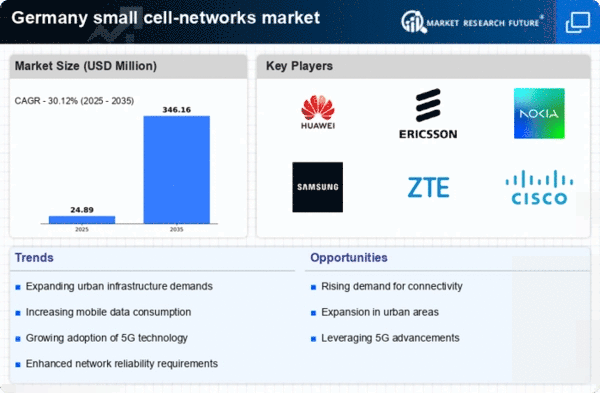
As per Market Research Future analysis, the Germany Small Cell Networks Market size was estimated at 19.12 USD Million in 2024. The Small Cell-networks market is projected to grow from 24.89 USD Million in 2025 to 346.16 USD Million by 2035, exhibiting a compound annual growth rate (CAGR) of 30.1% during the forecast period 2025 - 2035

Key Market Trends & Highlights

The Germany small cell-networks market is poised for substantial growth driven by urban deployment and technological advancements.

  • The market is witnessing increased urban deployment, particularly in major cities like Berlin and Munich.
  • Government support and regulation are fostering a conducive environment for small cell network expansion.
  • Integration with smart technologies is becoming a focal point, enhancing connectivity and user experience.
  • Rising demand for enhanced connectivity and growing adoption of IoT applications are key drivers of market growth.

Market Size & Forecast

2024 Market Size 19.12 (USD Million)
2035 Market Size 346.16 (USD Million)
CAGR (2025 - 2035) 30.12%

Major Players

Huawei (CN), Ericsson (SE), Nokia (FI), Samsung (KR), ZTE (CN), Cisco (US), Qualcomm (US), CommScope (US), Airspan Networks (US)

Our Impact
Enabled $4.3B Revenue Impact for Fortune 500 and Leading Multinationals
Partnering with 2000+ Global Organizations Each Year
30K+ Citations by Top-Tier Firms in the Industry

Germany Small Cell Networks Market Trends

The Germany Small Cell Networks Market is currently experiencing a notable transformation, driven by the increasing demand for enhanced mobile connectivity and the proliferation of smart devices. In Germany, urban areas are particularly focused on deploying small cell technology to address the challenges posed by high user density and the need for improved network capacity. This shift is further supported by government initiatives aimed at expanding digital infrastructure, which appear to encourage investments in advanced telecommunications solutions. As a result, the market is likely to witness a surge in the adoption of small cell systems, which may facilitate better coverage and higher data speeds for consumers and businesses alike. Moreover, the ongoing evolution of mobile technologies, such as the transition to 5G, is expected to play a crucial role in shaping the small cell-networks market. The integration of small cells into existing networks could potentially enhance overall performance and reliability. Additionally, the growing emphasis on smart city initiatives in Germany suggests that small cell deployments will be integral to the development of connected urban environments. This trend indicates a promising future for the small cell-networks market, as stakeholders recognize the importance of robust and flexible network solutions to meet the demands of an increasingly digital society.

Increased Urban Deployment

The small cell-networks market is witnessing a trend towards heightened deployment in urban settings. This shift is largely driven by the need for improved network capacity and coverage in densely populated areas. As cities expand and the number of connected devices rises, small cells are becoming essential for maintaining service quality.

Government Support and Regulation

Government initiatives in Germany are playing a pivotal role in the growth of the small cell-networks market. Regulatory frameworks are being established to facilitate the installation of small cells, which may streamline processes and encourage investment in digital infrastructure. This support is likely to enhance the overall market landscape.

Integration with Smart Technologies

The integration of small cell technology with smart city initiatives is emerging as a significant trend. As urban areas adopt smart solutions, the demand for reliable and high-capacity networks increases. Small cells are positioned to support these technologies, potentially leading to enhanced connectivity and improved urban living.

Germany Small Cell Networks Market Drivers

Growing Adoption of IoT Applications

The small cell-networks market in Germany is significantly influenced by the growing adoption of Internet of Things (IoT) applications. As industries increasingly integrate IoT devices into their operations, the demand for reliable and high-capacity networks becomes paramount. Small cells are well-suited to support the connectivity needs of IoT applications, which often require low latency and high reliability. The small cell-networks market is thus positioned to capitalize on this trend, as businesses seek to implement IoT solutions that enhance efficiency and productivity. Recent studies suggest that the number of connected IoT devices in Germany is expected to reach 1 billion by 2026, further emphasizing the need for robust small cell infrastructure to support this growth. Consequently, the market is likely to see increased investments in small cell technology to accommodate the expanding IoT ecosystem.

Rising Demand for Enhanced Connectivity

The small cell-networks market in Germany is experiencing a notable surge in demand for enhanced connectivity solutions. As urban areas become increasingly populated, the need for reliable and high-speed internet access intensifies. This demand is driven by the proliferation of smart devices and the growing reliance on mobile applications. According to recent data, approximately 80% of mobile data traffic is generated indoors, highlighting the necessity for small cell deployments in urban environments. The small cell-networks market is thus positioned to address these connectivity challenges, providing solutions that enhance user experience and support the increasing data consumption. Furthermore, the integration of small cells into existing infrastructure is expected to facilitate seamless connectivity, thereby driving market growth in the coming years.

Regulatory Support for Network Expansion

Regulatory support is emerging as a crucial driver for the small cell-networks market in Germany. The government is actively promoting the expansion of telecommunications infrastructure to ensure widespread access to high-speed internet. This regulatory environment encourages operators to invest in small cell deployments, particularly in underserved areas. The small cell-networks market benefits from initiatives aimed at streamlining the approval process for small cell installations, thereby reducing barriers to entry. Additionally, government policies that incentivize infrastructure development are likely to stimulate market growth. As a result, the small cell-networks market is expected to flourish in an environment that fosters innovation and supports the expansion of network capabilities, ultimately enhancing connectivity for consumers and businesses alike.

Increased Focus on Indoor Coverage Solutions

The small cell-networks market in Germany is witnessing an increased focus on indoor coverage solutions. With a substantial portion of mobile data being consumed indoors, businesses and service providers are prioritizing the deployment of small cells to enhance indoor connectivity. This trend is particularly evident in commercial buildings, shopping centers, and public venues, where reliable internet access is crucial for customer satisfaction. The small cell-networks market is responding to this demand by offering tailored solutions that address specific indoor coverage challenges. Furthermore, as organizations recognize the importance of robust connectivity for operational efficiency, investments in small cell technology are expected to rise. This shift towards indoor solutions is likely to drive market growth, as stakeholders seek to improve user experiences and optimize network performance.

Technological Advancements in Network Infrastructure

Technological advancements play a pivotal role in shaping the small cell-networks market in Germany. Innovations in network infrastructure, such as the development of 5G technology, are propelling the adoption of small cells. These advancements enable operators to enhance network capacity and coverage, particularly in densely populated areas. The small cell-networks market is likely to benefit from the ongoing evolution of wireless technologies, which are designed to support higher data rates and lower latency. As a result, operators are increasingly investing in small cell solutions to meet the demands of modern consumers. Reports indicate that the market for small cell equipment is projected to grow at a CAGR of 25% over the next five years, underscoring the significance of technological progress in driving market expansion.


Market Segment Insights

By Service: Professional Services (Largest) vs. Managed Services (Fastest-Growing)

In the Germany small cell-networks market, the service segment is characterized by its diverse offerings including professional services, managed services, design, planning, integration, support, and maintenance. Professional services hold the largest share, catering to various clients and enabling efficient implementation of small cell networks. These services typically include consulting and project management, which are critical in ensuring the successful deployment of network solutions. Conversely, managed services are rapidly gaining traction, reflecting a shift toward outsourcing network management functions, which allows enterprises to focus more on their core operations. Growth trends within the service segment are primarily driven by the increasing demand for enhanced mobile connectivity and the adoption of 5G technologies. As businesses and consumers seek better coverage and performance, the need for comprehensive services that ensure seamless integration and support becomes paramount. Managed services, in particular, are expected to experience the fastest growth due to their flexibility and cost-effectiveness, as organizations look to innovate while managing network complexities more efficiently.

Support (Dominant) vs. Maintenance (Emerging)

In the current landscape of the Germany small cell-networks market, support services are recognized as the dominant force, providing essential ongoing assistance to ensure network reliability and performance. These services encompass technical support, troubleshooting, and system optimization, enabling organizations to maintain high-quality service levels. On the other hand, maintenance services are emerging as a critical component, focusing on routine checks, upgrades, and repairs to prevent potential issues. As the market evolves, both support and maintenance services are essential for sustaining operational excellence and catering to the increasing complexity of network environments. Their complementary nature underscores the need for a balanced approach, addressing immediate operational demands while planning for long-term network health.

By Operating Environment: Indoor (Largest) vs. Outdoor (Fastest-Growing)

In the Germany small cell-networks market, the indoor segment commands the largest share, driven by increasing demands for enhanced connectivity in urban environments. As businesses and consumers seek reliable internet and communication services, this segment has solidified its market position, becoming a key player in urban infrastructure development. On the other hand, the outdoor segment is witnessing rapid growth, attributed to increased investment in outdoor coverage and smart city projects. As mobile usage expands beyond indoor spaces, deployments in outdoor environments are becoming crucial for network providers, leading to innovative solutions and improved customer experiences.

Operating Environment: Indoor (Dominant) vs. Outdoor (Emerging)

The indoor segment is characterized by its robust infrastructure aimed at boosting connectivity in densely populated areas like commercial buildings and residential complexes. This segment is preferred due to its ability to support high data traffic and provide seamless service in environments where mobile users demand constant connectivity. Conversely, the outdoor segment is emerging as a vital component for network expansion, focusing on areas like parks, city centers, and transportation hubs. With an emphasis on coverage enhancement and capacity growth, the outdoor market is rapidly advancing, led by the push for wider 5G deployments and IoT integrations.

By Type: Microcell (Largest) vs. Femtocell (Fastest-Growing)

In the Germany small cell-networks market, the market share distribution showcases microcells as the dominant segment, securing the largest portion of installations. Femtocells, while smaller in overall market share, are rapidly gaining traction due to their unique advantages in enhancing indoor wireless connectivity. Both microcells and femtocells play crucial roles in the broader strategy of mobile network operators, but their specific applications and deployment patterns differ significantly. Growth trends indicate that femtocells are emerging as the fastest-growing segment within the Germany small cell-networks market. This growth is primarily driven by the increasing demand for improved indoor coverage and the proliferation of smart devices that require stable and high-speed connections. As urban areas continue to densify, the adaptability and cost-effectiveness of femtocells make them appealing to operators looking to enhance user experience without extensive infrastructure investments.

Microcell (Dominant) vs. Femtocell (Emerging)

Microcells occupy a leadership role in the Germany small cell-networks market, characterized by their ability to cover larger areas compared to other types. They are strategically deployed in urban settings to alleviate network congestion and enhance overall service quality. The adoption of microcells is driven by the need for robust connectivity as mobile usage surges, especially in densely populated regions. Conversely, femtocells are quickly becoming the emerging choice for consumers, particularly in residential and small business applications. Their compact size and easy installation make them attractive for enhancing indoor coverage, responding to the growing need for data capacity driven by smart devices. This dynamic between microcells and femtocells illustrates the evolving landscape of network infrastructure.

By Vertical: Retail (Largest) vs. Healthcare (Fastest-Growing)

In the Germany small cell-networks market, the vertical segment distribution is largely dominated by Retail, capturing the largest share due to its rapid adoption of mobile technologies for enhancing customer engagement and operational efficiency. Other notable segments include Energy and BFSI, which are increasingly leveraging small cell networks for improved connectivity and data management, though they hold lesser market shares compared to Retail. Healthcare is emerging as the fastest-growing segment, driven by the increasing demand for robust communication systems in hospitals and telemedicine services. Factors such as the digital transformation in healthcare, coupled with government support for improved healthcare infrastructure, are propelling the growth of small cell networks in this sector. This trend indicates a shift towards more integrated communication solutions in healthcare facilities across the region.

Retail (Dominant) vs. Healthcare (Emerging)

The Retail segment stands as the dominant player in the vertical markets of the Germany small cell-networks market, emphasizing the need for enhanced mobile connectivity to support customer-facing services and operational improvements. Retailers are increasingly investing in small cell networks to facilitate seamless mobile transactions and real-time inventory management. On the other hand, the Healthcare segment represents an emerging market force, spurred by advances in telehealth services and the necessity for reliable communication among healthcare providers. This segment is characterized by high demand for innovative solutions capable of supporting critical operations and improving patient outcomes. As both segments evolve, competition will intensify, further driving technological advancements and investment in infrastructure.

By End-User: Large Enterprises (Largest) vs. Medium and Small Enterprises (Fastest-Growing)

The market share distribution among the end-user segments reveals that Large Enterprises hold the largest share within the Germany small cell-networks market, leveraging their extensive resources and larger operational requirements. However, Medium and Small Enterprises are rapidly gaining traction, capitalizing on the growing demand for flexible and scalable network solutions tailored to their needs. Growth trends indicate that Medium and Small Enterprises are emerging as the fastest-growing segment due to a shift towards digitalization and increased reliance on mobile connectivity. This growth is driven by favorable government initiatives and technology advancements, which enable smaller companies to adopt small cell networks more easily and benefit from improved network performance and connectivity.

Large Enterprises (Dominant) vs. Medium and Small Enterprises (Emerging)

Large Enterprises dominate the Germany small cell-networks market due to their significant financial strength, enabling them to invest in advanced technologies and infrastructure. They benefit from a higher demand for expansive, high-capacity networks to support their operations. Conversely, Medium and Small Enterprises represent an emerging segment, characterized by a growing need for cost-effective, scalable network solutions. These enterprises are increasingly recognizing the value of improved mobile connectivity to enhance customer experiences and operational efficiencies, positioning themselves as key players in the market, especially as technology becomes more accessible for their utilization.

Get more detailed insights about Germany Small Cell Networks Market

Key Players and Competitive Insights

The small cell-networks market in Germany is characterized by a dynamic competitive landscape, driven by the increasing demand for enhanced mobile connectivity and the proliferation of IoT devices. Key players such as Huawei (CN), Ericsson (SE), and Nokia (FI) are actively shaping the market through strategic innovations and partnerships. Huawei (CN) focuses on advancing its 5G technology, while Ericsson (SE) emphasizes its commitment to sustainability and energy-efficient solutions. Nokia (FI) is leveraging its expertise in network slicing to enhance service delivery, collectively fostering a competitive environment that prioritizes technological advancement and customer-centric solutions.
In terms of business tactics, companies are increasingly localizing manufacturing and optimizing supply chains to enhance operational efficiency. The market structure appears moderately fragmented, with several key players exerting influence over various segments. This fragmentation allows for a diverse range of offerings, yet the collective strategies of major companies create a competitive atmosphere that encourages innovation and responsiveness to market demands.
In October 2025, Ericsson (SE) announced a strategic partnership with a leading German telecommunications provider to deploy a new generation of small cell solutions aimed at urban areas. This collaboration is expected to enhance network capacity and improve user experience, indicating Ericsson's proactive approach to addressing urban connectivity challenges. The partnership underscores the importance of localized solutions in meeting specific market needs.
In September 2025, Nokia (FI) launched a new small cell product line designed to support the growing demand for high-capacity networks in densely populated regions. This initiative reflects Nokia's strategic focus on expanding its product portfolio to cater to evolving customer requirements. By introducing innovative solutions, Nokia aims to solidify its position as a leader in the small cell segment, enhancing its competitive edge.
In November 2025, Huawei (CN) unveiled a new AI-driven management platform for small cell networks, aimed at optimizing network performance and reducing operational costs. This development highlights Huawei's commitment to integrating advanced technologies into its offerings, potentially reshaping the operational landscape for small cell networks. The introduction of AI capabilities may provide Huawei with a competitive advantage in terms of efficiency and service quality.
As of November 2025, current competitive trends in the small cell-networks market are increasingly defined by digitalization, sustainability, and the integration of AI technologies. Strategic alliances among key players are shaping the landscape, fostering innovation and collaborative solutions. The shift from price-based competition to a focus on technological differentiation and supply chain reliability is evident, suggesting that future competitive dynamics will hinge on the ability to innovate and adapt to rapidly changing market conditions.

Key Companies in the Germany Small Cell Networks Market include

Industry Developments

In recent months, the Germany Small Cell Networks Market has experienced notable developments with a significant focus on expanding network capabilities to accommodate increasing data traffic. Companies like Radwin, Cisco, and Mavenir are actively introducing innovative small cell solutions aimed at enhancing connectivity in urban areas. In August 2023, ZTE announced its partnership with local telecom operators to deploy advanced small cell technology, addressing the growing need for better indoor coverage.

Furthermore, in July 2023, Airspan Networks emphasized the integration of open RAN technology into its small cell deployments, reflecting the industry’s shift towards more flexible network solutions.The market has also seen significant growth in valuation, driven by rising demand for mobile broadband and improved connectivity services. 

Companies like Nokia and Ericsson are reporting optimistic projections, contributing positively to their overall market presence in Germany. On the mergers and acquisitions front, certain suggestions have emerged, although no major publicized deals related to the specific companies listed have been recorded in recent months. Over the past two to three years, the adoption of small cell networks in Germany has surged, with substantial investments aimed at optimizing infrastructure in urban and suburban settings, which has been supported by government initiatives to improve digital connectivity.


Future Outlook

Germany Small Cell Networks Market Future Outlook

The small cell-networks market in Germany is projected to grow at a 30.12% CAGR from 2025 to 2035, driven by increasing demand for enhanced connectivity and urban densification.

New opportunities lie in:

  • Deployment of private 5G networks for enterprises
  • Integration of AI-driven network management solutions
  • Expansion of small cell infrastructure in urban areas

By 2035, the market is expected to achieve substantial growth and technological advancement.

Market Segmentation

Germany Small Cell Networks Market Type Outlook

  • Microcell
  • Femtocell
  • Metrocell
  • Picocell

Germany Small Cell Networks Market Service Outlook

  • Professional Services
  • Managed Services
  • Design
  • Planning
  • Integration
  • Support
  • Maintenance

Germany Small Cell Networks Market End-User Outlook

  • Medium and Small Enterprises
  • Residential
  • Large Enterprises

Germany Small Cell Networks Market Vertical Outlook

  • Retail
  • Energy
  • Government
  • BFSI
  • Education
  • Healthcare

Germany Small Cell Networks Market Operating Environment Outlook

  • Indoor
  • Outdoor

Report Scope

MARKET SIZE 2024 19.12(USD Million)
MARKET SIZE 2025 24.89(USD Million)
MARKET SIZE 2035 346.16(USD Million)
COMPOUND ANNUAL GROWTH RATE (CAGR) 30.12% (2025 - 2035)
REPORT COVERAGE Revenue Forecast, Competitive Landscape, Growth Factors, and Trends
BASE YEAR 2024
Market Forecast Period 2025 - 2035
Historical Data 2019 - 2024
Market Forecast Units USD Million
Key Companies Profiled Huawei (CN), Ericsson (SE), Nokia (FI), Samsung (KR), ZTE (CN), Cisco (US), Qualcomm (US), CommScope (US), Airspan Networks (US)
Segments Covered Service, Operating Environment, Type, Vertical, End-User
Key Market Opportunities Expansion of small cell-networks market driven by increasing demand for enhanced mobile connectivity and urban densification.
Key Market Dynamics Rising demand for enhanced mobile connectivity drives investment in small cell networks across urban areas.
Countries Covered Germany
Leave a Comment

FAQs

What is the expected market size of the Germany Small Cell Networks Market in 2024?

The Germany Small Cell Networks Market is expected to be valued at 19.12 million USD in 2024.

What will the market size be by 2035?

By 2035, the market size is projected to reach 72.87 million USD.

What is the expected compound annual growth rate (CAGR) of the market from 2025 to 2035?

The expected CAGR for the Germany Small Cell Networks Market from 2025 to 2035 is 12.931%.

Who are the key players in the Germany Small Cell Networks Market?

Major players in the market include Radwin, Cisco, Mavenir, ZTE, Airspan Networks, and Huawei among others.

What are the valuations of professional services in 2024 and 2035?

Professional services are valued at 4.5 million USD in 2024 and expected to grow to 17.4 million USD by 2035.

What will be the market size for managed services in 2035?

The market size for managed services is projected to reach 15.0 million USD by 2035.

How much is the design service expected to grow from 2024 to 2035?

The design service is expected to grow from 3.2 million USD in 2024 to 12.6 million USD in 2035.

What impact do emerging trends have on the market growth?

Emerging trends in technology and increasing data traffic are driving growth in the Germany Small Cell Networks Market.

How significant is the growth of integration services by 2035?

Integration services are anticipated to grow from 4.62 million USD in 2024 to 16.08 million USD by 2035.

What challenges could impact the growth of the Germany Small Cell Networks Market?

Challenges may include regulatory hurdles and competition among key players in the market landscape.

Download Free Sample

Kindly complete the form below to receive a free sample of this Report

Compare Licence

×
Features License Type
Single User Multiuser License Enterprise User
Price $4,950 $5,950 $7,250
Maximum User Access Limit 1 User Upto 10 Users Unrestricted Access Throughout the Organization
Free Customization
Direct Access to Analyst
Deliverable Format
Platform Access
Discount on Next Purchase 10% 15% 15%
Printable Versions