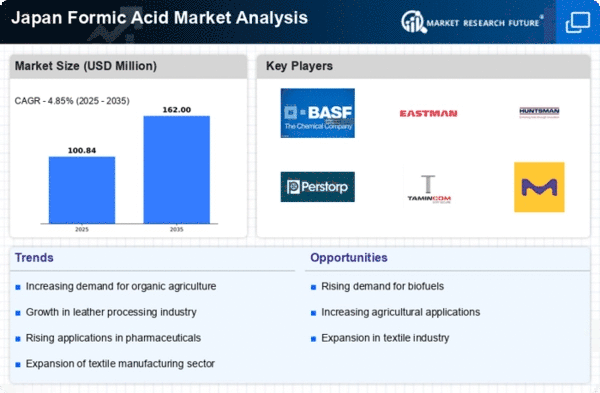
The formic acid market in Japan is characterized by a competitive landscape that is increasingly shaped by innovation, sustainability, and strategic partnerships. Key players such as BASF SE (DE), Eastman Chemical Company (US), and Huntsman Corporation (US) are actively pursuing strategies that enhance their market positioning. BASF SE (DE) focuses on expanding its product portfolio through sustainable practices, while Eastman Chemical Company (US) emphasizes innovation in production processes. Huntsman Corporation (US) is leveraging strategic partnerships to enhance its supply chain efficiency. Collectively, these strategies contribute to a dynamic competitive environment, where companies are not only vying for market share but also striving to meet evolving consumer demands for environmentally friendly products.In terms of business tactics, companies are increasingly localizing manufacturing to reduce lead times and optimize supply chains. The market structure appears moderately fragmented, with several players competing for dominance. This fragmentation allows for a diverse range of products and innovations, yet it also intensifies competition among key players. The collective influence of these companies shapes pricing strategies and product offerings, as they seek to differentiate themselves in a crowded marketplace.
In October BASF SE (DE) announced a new initiative aimed at reducing carbon emissions in its formic acid production process. This strategic move underscores the company's commitment to sustainability and positions it favorably in a market that increasingly values eco-friendly practices. By investing in cleaner technologies, BASF SE (DE) not only enhances its operational efficiency but also aligns itself with global sustainability trends, potentially attracting environmentally conscious consumers.
In September Eastman Chemical Company (US) launched a new line of formic acid products designed specifically for agricultural applications. This strategic expansion into a niche market segment reflects the company's focus on innovation and responsiveness to industry needs. By catering to the agricultural sector, Eastman Chemical Company (US) diversifies its customer base and strengthens its market presence, indicating a proactive approach to capturing emerging opportunities.
In August Huntsman Corporation (US) entered into a strategic partnership with a leading technology firm to enhance its digital capabilities in formic acid production. This collaboration aims to integrate advanced analytics and AI into manufacturing processes, thereby improving efficiency and reducing costs. Such a move not only positions Huntsman Corporation (US) as a forward-thinking player in the market but also highlights the growing importance of digital transformation in the chemical industry.
As of November current trends in the formic acid market are increasingly defined by digitalization, sustainability, and the integration of advanced technologies. Strategic alliances are becoming pivotal in shaping the competitive landscape, as companies seek to leverage each other's strengths. Looking ahead, competitive differentiation is likely to evolve from traditional price-based competition to a focus on innovation, technological advancements, and supply chain reliability. This shift suggests that companies that prioritize these areas will be better positioned to thrive in an ever-evolving market.