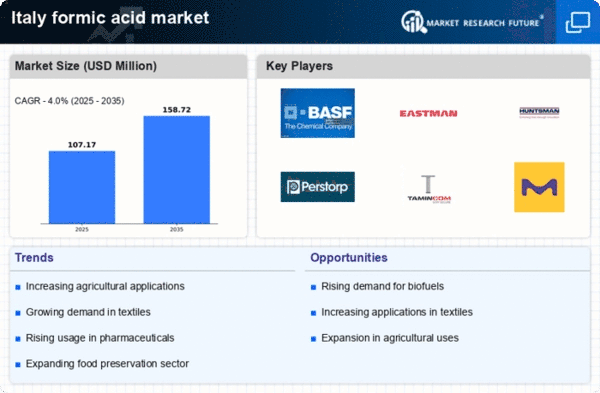
The formic acid market in Italy exhibits a competitive landscape characterized by a blend of established players and emerging companies, driven by increasing demand across various applications such as agriculture, textiles, and pharmaceuticals. Key growth drivers include the rising need for sustainable chemical solutions and the ongoing shift towards bio-based products. Major companies like BASF SE (DE), Eastman Chemical Company (US), and Huntsman Corporation (US) are strategically positioned to leverage innovation and regional expansion to enhance their market presence. Their operational focus on sustainability and digital transformation appears to be shaping the competitive environment, fostering a landscape where technological advancements and eco-friendly practices are paramount.In terms of business tactics, companies are increasingly localizing manufacturing to reduce logistics costs and enhance supply chain efficiency. The market structure is moderately fragmented, with a few dominant players exerting considerable influence. This fragmentation allows for niche players to thrive, yet the collective strategies of key companies like Merck KGaA (DE) and Perstorp Holding AB (SE) indicate a trend towards consolidation and strategic partnerships, which may reshape the competitive dynamics in the near future.
In October BASF SE (DE) announced a significant investment in a new production facility in Italy aimed at increasing its formic acid output. This strategic move is expected to enhance BASF's capacity to meet the growing demand for sustainable chemical solutions in the region, thereby solidifying its market leadership. The investment underscores the company's commitment to innovation and sustainability, aligning with broader industry trends towards eco-friendly production methods.
In September Eastman Chemical Company (US) launched a new line of bio-based formic acid products, targeting the agricultural sector. This initiative reflects Eastman's strategic focus on sustainability and innovation, positioning the company to capture a growing segment of environmentally conscious consumers. The introduction of bio-based products may not only enhance Eastman's product portfolio but also strengthen its competitive edge in a market increasingly driven by sustainability.
In August Huntsman Corporation (US) entered into a strategic partnership with a local Italian firm to enhance its distribution network for formic acid. This collaboration is likely to improve Huntsman's market reach and operational efficiency, allowing for better service delivery to customers. Such partnerships indicate a trend towards localized operations, which may become increasingly vital in a market where supply chain reliability is paramount.
As of November current competitive trends in the formic acid market are heavily influenced by digitalization, sustainability, and the integration of AI technologies. Strategic alliances are becoming a cornerstone of competitive strategy, enabling companies to pool resources and expertise. The shift from price-based competition to a focus on innovation, technology, and supply chain reliability is evident, suggesting that future differentiation will hinge on the ability to adapt to these evolving market dynamics.