×
Request Free Sample ×

Kindly complete the form below to receive a free sample of this Report

* Please use a valid business email

Leading companies partner with us for data-driven Insights

clients tt-cursor
Hero Background

Germany Formic Acid Market

ID: MRFR/CnM/44115-HCR
111 Pages
Chitranshi Jaiswal
February 2026

Germany Formic Acid Market Research Report By Production Method (oxalic acid, carbonylation of methanol) and By Application (rubber, leather production, cleaning agent, finishing textile, preservatives, dyeing, animal feed, others) - Forecast to 2035

Share:
Download PDF ×

We do not share your information with anyone. However, we may send you emails based on your report interest from time to time. You may contact us at any time to opt-out.

Germany Formic Acid Market Infographic
Purchase Options

Germany Formic Acid Market Summary

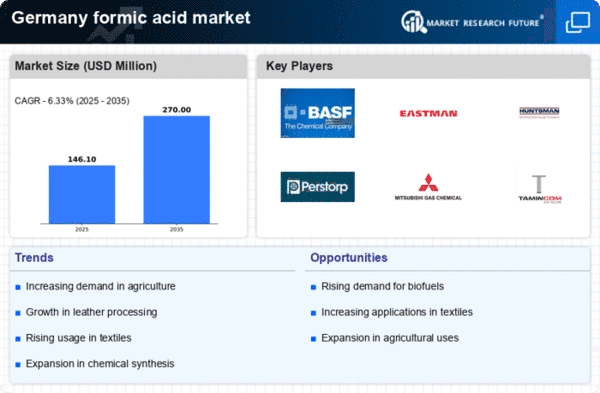
As per Market Research Future analysis, the Germany formic acid market size was estimated at 137.4 $ Million in 2024. The Germany formic acid market is projected to grow from 146.1 $ Million in 2025 to 270.0 $ Million by 2035, exhibiting a compound annual growth rate (CAGR) of 6.3% during the forecast period 2025 - 2035

Key Market Trends & Highlights

The Germany formic acid market is experiencing a shift towards sustainability and innovation.

  • Sustainable agricultural practices are increasingly driving the demand for formic acid in Germany.
  • Technological advancements in production methods are enhancing the efficiency of formic acid manufacturing.
  • The agricultural segment remains the largest, while the industrial applications segment is the fastest-growing in the market.
  • Rising demand in agriculture and environmental regulations are key drivers propelling market growth.

Market Size & Forecast

2024 Market Size 137.4 (USD Million)
2035 Market Size 270.0 (USD Million)
CAGR (2025 - 2035) 6.33%

Major Players

BASF SE (DE), Eastman Chemical Company (US), Huntsman Corporation (US), Perstorp Holding AB (SE), Mitsubishi Gas Chemical Company, Inc. (JP), Taminco (BE), Shandong Jinmei Fenghua Chemical Company (CN), Ferro Corporation (US)

Our Impact
Enabled $4.3B Revenue Impact for Fortune 500 and Leading Multinationals
Partnering with 2000+ Global Organizations Each Year
30K+ Citations by Top-Tier Firms in the Industry

Germany Formic Acid Market Trends

The formic acid market in Germany is currently experiencing notable evolution. This change is driven by various factors, including industrial applications and environmental considerations. This organic compound, known for its utility in agriculture, textiles, and chemical synthesis, is gaining traction due to its effectiveness as a preservative and antibacterial agent. The increasing focus on sustainable practices within industries is likely to enhance the demand for formic acid, as it serves as a more eco-friendly alternative to traditional chemicals. Furthermore, the regulatory landscape in Germany appears to be favoring the use of biodegradable substances, which may further bolster the market's growth. In addition, the formic acid market is influenced by advancements in production technologies and the rising need for efficient manufacturing processes. Innovations in synthesis methods could lead to cost reductions and improved product quality, making formic acid more accessible to various sectors. The agricultural sector, in particular, is expected to play a crucial role in shaping market dynamics, as farmers increasingly adopt organic farming practices. Overall, the formic acid market in Germany seems poised for growth, driven by a combination of regulatory support, technological advancements, and shifting consumer preferences towards sustainable solutions.

Sustainable Agricultural Practices

The formic acid market is witnessing a surge in demand from the agricultural sector, as farmers increasingly adopt sustainable practices. This compound is utilized as a preservative in animal feed and as a pesticide, aligning with the growing trend towards organic farming. The emphasis on reducing chemical residues in food products is likely to enhance the appeal of formic acid, positioning it as a preferred choice among environmentally conscious producers.

Technological Advancements in Production

Innovations in production technologies are shaping the formic acid market, potentially leading to more efficient manufacturing processes. Enhanced synthesis methods may reduce production costs and improve the quality of the final product. As manufacturers seek to optimize their operations, these advancements could make formic acid more competitive against alternative chemicals, thereby expanding its market presence.

Regulatory Support for Eco-Friendly Chemicals

The regulatory environment in Germany appears to be increasingly supportive of eco-friendly chemicals, including formic acid. Stricter regulations on harmful substances are prompting industries to seek safer alternatives. This trend may drive the adoption of formic acid across various applications, as companies strive to comply with environmental standards while meeting consumer demand for sustainable products.


Market Segment Insights

By Production Method: Oxalic Acid (Largest) vs. Carbonylation of Methanol (Fastest-Growing)

In the Germany formic acid market, the production methods of Oxalic Acid and Carbonylation of Methanol display distinct market share dynamics. Oxalic Acid holds a significant portion of the market, benefitting from its wide range of applications in various industries. Meanwhile, Carbonylation of Methanol is carving out its niche, steadily increasing its footprint due to innovative processes and greater efficiency in production. This distribution reflects the varying demand and production capabilities across these two methods. Growth trends in this segment are driven by advancements in production technology and increasing demand for sustainable chemical processes. The emergence of Carbonylation of Methanol as a competitive method highlights a shift towards more efficient, environmentally friendly production techniques. As industries focus on reducing their carbon footprint, the carbonylation process is predicted to grow at an impressive rate, presenting an exciting opportunity for stakeholders in this evolving market.

Production Methods: Oxalic Acid (Dominant) vs. Carbonylation of Methanol (Emerging)

Oxalic Acid is a dominant force in the Germany formic acid market, known for its extensive utility in applications such as bleaching agents and pharmaceuticals. Its established market presence and wide acceptance have solidified its position as the preferred production method. On the other hand, Carbonylation of Methanol is an emerging method that promises increased efficiency and sustainability. As industries pivot towards greener practices, this method is gaining traction due to its potential for lower environmental impact and higher yield. The competition between these two production methods is shaping the future landscape of the market, with Oxalic Acid maintaining dominance while Carbonylation of Methanol is quickly becoming a vital player.

By Application: Rubber (Largest) vs. Cleaning Agent (Fastest-Growing)

In the Germany formic acid market, the application segment is led by rubber manufacturing, which holds a significant share due to its extensive use in producing tires and other rubber products. Following rubber, the leather production and cleaning agent segments are also notable, contributing to the overall market dynamics. Other applications such as preservatives and dyeing are emerging but still occupy smaller market shares compared to the leading segments. The growth trends in the application segment are driven largely by increasing demand for sustainable and eco-friendly products across various industries. The rubber and leather production segments are expected to maintain strong growth trajectories, while the cleaning agent application is rapidly gaining traction due to a rising preference for biodegradable cleaning solutions. This shift is propelling investment and innovation across the board.

Rubber (Dominant) vs. Cleaning Agent (Emerging)

Rubber remains the dominant application in the Germany formic acid market, primarily due to its essential role in the production of high-performance tires which are vital for the automotive industry. With a steadfast demand for rubber goods, the formic acid used in this sector is poised for consistent growth. In contrast, the cleaning agent segment is emerging, buoyed by growing consumer awareness regarding eco-friendly products and cleaning solutions. As regulations demand greener formulations, manufacturers are innovating to replace traditional chemicals with sustainable alternatives. This dynamic is reshaping the competitive landscape, with both segments likely to co-exist and thrive in the evolving market.

Get more detailed insights about Germany Formic Acid Market

Key Players and Competitive Insights

The formic acid market in Germany is characterized by a competitive landscape that is increasingly shaped by innovation, sustainability, and strategic partnerships. Key players such as BASF SE (DE), Eastman Chemical Company (US), and Huntsman Corporation (US) are actively pursuing strategies that emphasize technological advancements and operational efficiencies. BASF SE (DE) has positioned itself as a leader in sustainable practices, focusing on reducing carbon emissions in its production processes. Meanwhile, Eastman Chemical Company (US) is leveraging its expertise in specialty chemicals to enhance its product offerings, thereby catering to a diverse range of applications. Huntsman Corporation (US) appears to be concentrating on expanding its market reach through strategic acquisitions and collaborations, which collectively contribute to a dynamic competitive environment.
The business tactics employed by these companies reflect a concerted effort to optimize supply chains and localize manufacturing. The market structure is moderately fragmented, with several players vying for market share. This fragmentation allows for a variety of competitive strategies, as companies seek to differentiate themselves through innovation and customer service. The influence of these key players is significant, as they not only drive market trends but also set benchmarks for operational excellence.
In October 2025, BASF SE (DE) announced a new initiative aimed at enhancing its production efficiency by integrating AI technologies into its manufacturing processes. This move is expected to streamline operations and reduce costs, thereby reinforcing BASF's competitive edge in the market. The strategic importance of this initiative lies in its potential to improve product quality while minimizing environmental impact, aligning with the growing demand for sustainable solutions.
In September 2025, Eastman Chemical Company (US) launched a new line of formic acid derivatives designed specifically for the agricultural sector. This product expansion is indicative of Eastman's commitment to innovation and its responsiveness to market needs. By diversifying its product portfolio, Eastman not only strengthens its market position but also addresses the increasing demand for eco-friendly agricultural solutions.
In August 2025, Huntsman Corporation (US) completed the acquisition of a regional competitor, which is anticipated to enhance its production capabilities and market presence in Germany. This strategic acquisition underscores Huntsman's focus on growth through consolidation, allowing it to leverage synergies and expand its customer base. The implications of this move are profound, as it positions Huntsman to better compete against larger players in the market.
As of November 2025, the competitive trends in the formic acid market are increasingly defined by digitalization, sustainability, and the integration of advanced technologies. Strategic alliances are becoming more prevalent, as companies recognize the value of collaboration in driving innovation and enhancing supply chain reliability. Looking ahead, the competitive differentiation in this market is likely to evolve from traditional price-based competition to a focus on technological advancements and sustainable practices. This shift may redefine the landscape, compelling companies to innovate continuously and adapt to changing consumer preferences.

Key Companies in the Germany Formic Acid Market include

Industry Developments

The Germany Formic Acid Market has seen significant developments recently, particularly with strategic moves by key players such as BASF and Merck Group, which are focusing on expanding their production capacities to meet rising demand, particularly in agricultural applications. In September 2023, Perstorp announced a notable growth in its market valuation due to increased demand from the leather and textile industries, which has positively impacted the overall market sentiment.

Additionally, in August 2023, a merger between Hualu Hengsheng and Jiangshan Chemical was publicly confirmed, signaling industry consolidation that could enhance supply chain efficiencies in the region. Reports indicate that Eastman Chemical Company has also ramped up investment in sustainable production methods, aligning with Germany's strong environmental regulations. The market's growth trajectory has been further buoyed by a stronger focus on bio-based formic acid production methods, catering to a more ecologically conscious European market. Over the last few years, such dynamics have substantively transformed the competitive landscape in the region, emphasizing technological advancements and collaborative agreements among these industry leaders.

Future Outlook

Germany Formic Acid Market Future Outlook

The formic acid market in Germany is projected to grow at a 6.33% CAGR from 2025 to 2035, driven by increasing demand in agriculture, textiles, and chemical industries.

New opportunities lie in:

  • Development of bio-based formic acid production methods.
  • Expansion into emerging markets with tailored product offerings.
  • Investment in advanced storage and transportation solutions for formic acid.

By 2035, the formic acid market is expected to achieve robust growth and enhanced market positioning.

Market Segmentation

Germany Formic Acid Market Application Outlook

  • Rubber
  • Leather Production
  • Cleaning Agent
  • Finishing Textile
  • Preservatives
  • Dyeing
  • Animal Feed
  • Others

Germany Formic Acid Market Production Method Outlook

  • Oxalic Acid
  • Carbonylation of Methanol

Report Scope

MARKET SIZE 2024 137.4(USD Million)
MARKET SIZE 2025 146.1(USD Million)
MARKET SIZE 2035 270.0(USD Million)
COMPOUND ANNUAL GROWTH RATE (CAGR) 6.33% (2025 - 2035)
REPORT COVERAGE Revenue Forecast, Competitive Landscape, Growth Factors, and Trends
BASE YEAR 2024
Market Forecast Period 2025 - 2035
Historical Data 2019 - 2024
Market Forecast Units USD Million
Key Companies Profiled BASF SE (DE), Eastman Chemical Company (US), Huntsman Corporation (US), Perstorp Holding AB (SE), Mitsubishi Gas Chemical Company, Inc. (JP), Taminco (BE), Shandong Jinmei Fenghua Chemical Company (CN), Ferro Corporation (US)
Segments Covered Production Method, Application
Key Market Opportunities Growing demand for sustainable agricultural practices enhances opportunities in the formic acid market.
Key Market Dynamics Rising demand for sustainable agriculture drives growth in the formic acid market amid regulatory support in Germany.
Countries Covered Germany
Leave a Comment

FAQs

What is the expected market size of the Germany Formic Acid Market in 2024?

The Germany Formic Acid Market is expected to be valued at 137.4 USD Million in 2024.

What will the market value of the Germany Formic Acid Market be in 2035?

By 2035, the Germany Formic Acid Market is projected to reach a value of 292.0 USD Million.

What is the expected compound annual growth rate (CAGR) for the Germany Formic Acid Market from 2025 to 2035?

The market is expected to grow at a CAGR of 7.094% from 2025 to 2035.

Which production method is projected to dominate the Germany Formic Acid Market by 2035?

The carbonylation of methanol production method is projected to be valued at 196.0 USD Million by 2035.

What is the market value of the oxalic acid production method in 2024?

The oxalic acid production method in the Germany Formic Acid Market is valued at 45.0 USD Million in 2024.

What are the key applications driving the growth of the Germany Formic Acid Market?

Key applications include agriculture, leather tanning, and as a preservative in animal feed.

Who are the major players in the Germany Formic Acid Market?

Major players in the market include Merck Group, BASF, and Eastman Chemical Company among others.

What is the expected market growth rate for the Germany Formic Acid Market?

The market is expected to grow steadily due to increasing demand in various applications.

What challenges might impact the Germany Formic Acid Market in the coming years?

Challenges include regulatory changes and fluctuations in raw material prices.

How will the market landscape of the Germany Formic Acid Market evolve by 2035?

The market is set to expand significantly, reflecting shifts in production methods and growing applications.

Download Free Sample

Kindly complete the form below to receive a free sample of this Report

Compare Licence

×
Features License Type
Single User Multiuser License Enterprise User
Price $4,950 $5,950 $7,250
Maximum User Access Limit 1 User Upto 10 Users Unrestricted Access Throughout the Organization
Free Customization
Direct Access to Analyst
Deliverable Format
Platform Access
Discount on Next Purchase 10% 15% 15%
Printable Versions