×
Request Free Sample ×

Kindly complete the form below to receive a free sample of this Report

* Please use a valid business email

Leading companies partner with us for data-driven Insights

clients tt-cursor
Hero Background

Italy Anticoagulation Market

ID: MRFR/HC/47899-HCR
200 Pages
Rahul Gotadki
February 2026

Italy Anticoagulation Market Research Report By Drug Type (Vitamin K Antagonists, Direct Oral Anticoagulants, Heparin), By Route of Administration (Oral, Injectable, Transdermal), By Indication (Atrial Fibrillation, Deep Vein Thrombosis, Pulmonary Embolism, Myocardial Infarction) and By End Use (Hospitals, Home Care, Clinics) - Growth & Industry Forecast 2025 To 2035

Share:
Download PDF ×

We do not share your information with anyone. However, we may send you emails based on your report interest from time to time. You may contact us at any time to opt-out.

Italy Anticoagulation Market Infographic
Purchase Options

Italy Anticoagulation Market Summary

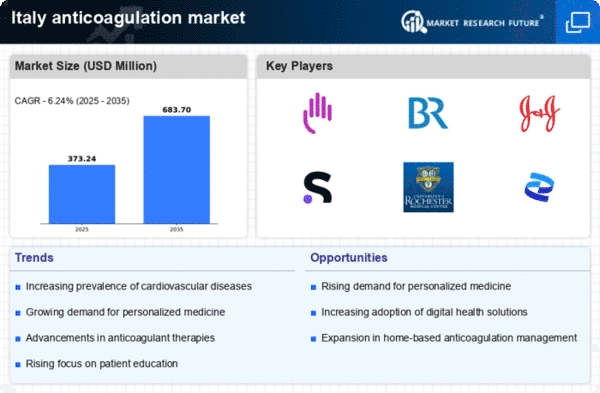
As per Market Research Future analysis, the Italy anticoagulation market Size was estimated at 351.32 USD Million in 2024. The Italy anticoagulation market is projected to grow from 373.24 USD Million in 2025 to 683.7 USD Million by 2035, exhibiting a compound annual growth rate (CAGR) of 6.2% during the forecast period 2025 - 2035

Key Market Trends & Highlights

The Italy anticoagulation market is experiencing a notable shift towards innovative therapies and increased patient engagement.

  • The market is witnessing a shift towards Novel Oral Anticoagulants, which are gaining popularity due to their ease of use.
  • Regulatory enhancements are facilitating the approval and adoption of new anticoagulant therapies in Italy.
  • Increased patient education initiatives are improving awareness and adherence to anticoagulation treatments among patients.
  • The rising incidence of cardiovascular diseases and enhanced awareness of thrombosis risks are key drivers propelling market growth.

Market Size & Forecast

2024 Market Size 351.32 (USD Million)
2035 Market Size 683.7 (USD Million)
CAGR (2025 - 2035) 6.24%

Major Players

Bristol-Myers Squibb (US), Bayer (DE), Johnson & Johnson (US), Sanofi (FR), Roche (CH), Pfizer (US), AstraZeneca (GB), Daiichi Sankyo (JP), Merck & Co. (US)

Our Impact
Enabled $4.3B Revenue Impact for Fortune 500 and Leading Multinationals
Partnering with 2000+ Global Organizations Each Year
30K+ Citations by Top-Tier Firms in the Industry

Italy Anticoagulation Market Trends

The anticoagulation market in Italy is currently experiencing notable developments, driven by an increasing prevalence of thromboembolic disorders and a growing awareness of the importance of anticoagulation therapy. Healthcare providers are increasingly adopting novel oral anticoagulants (NOACs), which offer advantages over traditional therapies, such as reduced monitoring requirements and a more favorable safety profile. This shift is indicative of a broader trend towards personalized medicine, where treatment regimens are tailored to individual patient needs. Furthermore, the Italian healthcare system is adapting to these changes by enhancing access to anticoagulation therapies, thereby improving patient outcomes and reducing the burden of related complications. In addition, the regulatory landscape is evolving, with authorities focusing on ensuring the safety and efficacy of anticoagulant medications. This includes rigorous evaluation processes for new drugs entering the market. The emphasis on patient education and adherence to therapy is also gaining traction, as healthcare professionals recognize the critical role of informed patients in achieving optimal therapeutic results. Overall, the anticoagulation market in Italy appears poised for growth, driven by innovation, regulatory support, and a commitment to improving patient care.

Shift Towards Novel Oral Anticoagulants

The anticoagulation market is witnessing a significant transition towards the adoption of novel oral anticoagulants (NOACs). These medications are preferred due to their ease of use and reduced need for regular monitoring compared to traditional anticoagulants. This trend reflects a broader movement towards more patient-friendly treatment options.

Regulatory Enhancements

Regulatory bodies in Italy are intensifying their focus on the safety and efficacy of anticoagulant therapies. This includes stringent evaluation processes for new medications, ensuring that only the most effective and safe options are available to patients. Such measures are likely to foster confidence among healthcare providers and patients alike.

Increased Patient Education Initiatives

There is a growing emphasis on patient education regarding anticoagulation therapy. Healthcare professionals are recognizing the importance of informing patients about their treatment options, potential side effects, and the necessity of adherence. This trend aims to empower patients, potentially leading to improved health outcomes.

Italy Anticoagulation Market Drivers

Enhanced Awareness of Thrombosis Risks

The heightened awareness of thrombosis risks among the Italian population is influencing the anticoagulation market. Public health campaigns and educational initiatives have successfully informed individuals about the dangers of blood clots and the importance of anticoagulation therapy. As a result, more patients are seeking medical advice and treatment options for thromboembolic conditions. This increased awareness is reflected in the rising number of prescriptions for anticoagulants, which have reportedly increased by 15% over the past year. Healthcare providers are also more proactive in screening at-risk populations, further driving demand for anticoagulant therapies. The collaboration between healthcare professionals and patient advocacy groups is likely to continue fostering this awareness, thereby contributing to the growth of the anticoagulation market. Overall, the enhanced awareness of thrombosis risks is a key factor propelling market dynamics in Italy.

Rising Incidence of Cardiovascular Diseases

The increasing prevalence of cardiovascular diseases in Italy is a primary driver for the anticoagulation market. According to recent health statistics, cardiovascular diseases account for approximately 35% of all deaths in the country. This alarming trend necessitates effective anticoagulation therapies to manage conditions such as atrial fibrillation and venous thromboembolism. As the population ages, the demand for anticoagulants is expected to rise significantly. The Italian healthcare system is likely to allocate more resources towards anticoagulation treatments, thereby expanding the market. Furthermore, the growing awareness among healthcare professionals regarding the importance of anticoagulation therapy in preventing strokes and other complications is anticipated to bolster market growth. Overall, the rising incidence of cardiovascular diseases appears to be a crucial factor influencing the anticoagulation market in Italy.

Regulatory Support for Anticoagulant Therapies

Regulatory support for anticoagulant therapies is a vital driver of the anticoagulation market in Italy. The Italian Medicines Agency (AIFA) has implemented streamlined approval processes for new anticoagulant medications, facilitating quicker access to innovative treatments for patients. This regulatory environment encourages pharmaceutical companies to invest in research and development, leading to a broader range of anticoagulant options available in the market. Furthermore, the government's commitment to improving healthcare access and affordability is likely to enhance the adoption of anticoagulant therapies. Recent policy changes have also focused on reducing the financial burden of anticoagulation treatments for patients, which may further stimulate market growth. As regulatory support continues to evolve, it is expected to play a crucial role in shaping the future landscape of the anticoagulation market in Italy.

Technological Advancements in Drug Development

Technological innovations in drug development are transforming the anticoagulation market in Italy. The emergence of novel oral anticoagulants (NOACs) has revolutionized treatment protocols, offering patients more convenient options compared to traditional therapies. These advancements are supported by significant investments in research and development, with the Italian pharmaceutical sector reportedly investing over €1 billion annually in innovative drug solutions. The introduction of point-of-care testing devices has also enhanced patient management, allowing for more personalized treatment plans. As healthcare providers increasingly adopt these technologies, the market is likely to experience accelerated growth. Moreover, the integration of digital health solutions, such as telemedicine and mobile health applications, is expected to improve patient adherence to anticoagulation therapies, further driving market expansion. Thus, technological advancements are poised to play a pivotal role in shaping the future of the anticoagulation market.

Aging Population and Increased Healthcare Expenditure

Italy's aging population is a significant driver of the anticoagulation market. With approximately 23% of the population aged 65 and older, the demand for anticoagulation therapies is likely to escalate as older adults are at a higher risk for thromboembolic events. This demographic shift is prompting the Italian government to increase healthcare expenditure, with projections indicating a rise in healthcare spending to €200 billion by 2026. Such financial commitment is expected to enhance access to anticoagulant medications and related healthcare services. Additionally, the growing emphasis on preventive healthcare measures among the elderly population is likely to contribute to the increased utilization of anticoagulants. Consequently, the aging population, coupled with rising healthcare expenditure, appears to be a driving force behind the growth of the anticoagulation market in Italy.


Market Segment Insights

By Type: Direct Oral Anticoagulants (Largest) vs. Heparin (Fastest-Growing)

The Italy anticoagulation market exhibits a diverse range of anticoagulant types, with Vitamin K Antagonists holding a sizable share. However, Direct Oral Anticoagulants have established themselves as the largest segment due to their ease of use and favorable patient compliance, surpassing traditional options. Heparin is gaining traction as a key player, especially in hospital settings, making significant inroads in terms of utilization among healthcare professionals. Growth trends within the Italy anticoagulation market reveal a shift towards Direct Oral Anticoagulants and Heparin. The adoption of Direct Oral Anticoagulants has been driven by their convenience and reduced monitoring requirements, contributing to their increasing dominance. Conversely, Heparin's rapid expansion can be attributed to its effectiveness in acute care and ongoing healthcare initiatives focused on improving patient outcomes.

Vitamin K Antagonists (Dominant) vs. Heparin (Emerging)

Vitamin K Antagonists are viewed as the dominant anticoagulant type within the Italy anticoagulation market, given their established efficacy and long-standing history. They are primarily used for long-term management of thromboembolic disorders and remain popular among clinicians and patients due to their familiarity and comprehensive clinical guidelines. On the other hand, Heparin is characterized as an emerging segment, rapidly gaining recognition for its crucial role in surgical and acute care environments. Its quick action and reversibility make it indispensable, particularly in emergency situations, positioning it as a vital component of contemporary anticoagulant therapy.

By Route of Administration: Oral (Largest) vs. Injectable (Fastest-Growing)

In the Italy anticoagulation market, the 'Route of Administration' segment shows a competitive distribution among its values. Oral administration holds the largest market share due to its ease of use and patient compliance, making it a preferred choice among healthcare professionals and patients alike. Conversely, injectable forms are gaining traction, particularly in clinical settings where rapid therapeutic action is essential, thus positioning them for notable growth. Growth trends in this segment are driven by increasing awareness and prevalence of anticoagulation therapies. The demand for injectable forms is rising due to advancements in drug formulations that enhance patient experience and compliance. Moreover, as healthcare providers focus on personalized medicine, the differentiation between injectables and oral anticoagulants will continue to shape the competitive landscape, driving innovation and expansion in the market.

Oral (Dominant) vs. Injectable (Emerging)

Oral anticoagulants remain the dominant route of administration, known for their convenience and patient adherence. This form comprises a broad range of medications that do not require hospitalization or specialized administration, fostering better patient outcomes through regular and consistent use. On the other hand, injectable anticoagulants are emerging as a vital alternative, favored in urgent care scenarios or specific patient populations requiring immediate anticoagulation. These injectable therapies, which include both subcutaneous and intravenous options, are increasingly designed for ease of administration, often requiring minimal training. As healthcare systems evolve, the integration of these two delivery methods will likely enhance treatment protocols, catering to diverse patient needs and preferences.

By Indication: Atrial Fibrillation (Largest) vs. Deep Vein Thrombosis (Fastest-Growing)

In the Italy anticoagulation market, Atrial Fibrillation stands out as the largest segment, capturing a significant share of the overall market. This indication is crucial for patients as it is linked to serious complications like strokes, raising the demand for effective anticoagulants. Conversely, Deep Vein Thrombosis is emerging rapidly, driven by increasing awareness about venous thromboembolism and its prevention, fostering its market growth as a key focus area in healthcare. Growth trends in the Italy anticoagulation market highlight a strong upward trajectory for both Atrial Fibrillation and Deep Vein Thrombosis. The primary drivers include the aging population, enhanced diagnosis, and treatment protocols. While Atrial Fibrillation remains dominant due to its prevalence, Deep Vein Thrombosis benefits from advancements in therapeutics and patient management strategies, indicating a shift towards a broader recognition of various indications within anticoagulation therapy.

Atrial Fibrillation (Dominant) vs. Deep Vein Thrombosis (Emerging)

Atrial Fibrillation is characterized by its prevalence in the aging population, making it a dominant force in the Italy anticoagulation market. This segment sees extensive pharmaceutical developments aimed at minimizing the risks associated with strokes. On the other hand, Deep Vein Thrombosis is regarded as an emerging segment, highlighted by significant investments in research and therapeutic innovations. The increasing incidence rates paired with public health campaigns advocating for preventive measures are key indicators of its potential. Both segments represent critical areas for pharmaceutical companies aiming to enhance patient outcomes and expand their market presence.

By End Use: Hospitals (Largest) vs. Home Care (Fastest-Growing)

In the Italy anticoagulation market, the distribution of market share among the end use segments reveals that hospitals dominate significantly, accounting for a substantial portion of the overall market. Home care, while smaller in comparison, is witnessing rapid growth and is becoming an increasingly important segment, driven by changes in patient preferences and advancements in healthcare technology. The growth trends within this segment are largely influenced by the aging population and the rising prevalence of cardiovascular diseases, leading to a growing demand for anticoagulation therapies. Hospitals continue to enhance their offerings by integrating newer technologies and treatment protocols. Meanwhile, home care settings are capitalizing on the shift towards outpatient care, allowing patients to manage their conditions more effectively at home and driving the emergence of innovative solutions for remote monitoring and patient management.

Hospitals (Dominant) vs. Home Care (Emerging)

Hospitals represent the dominant end use in the Italy anticoagulation market, characterized by their comprehensive facilities, access to advanced medical technologies, and specialized healthcare providers. They play a critical role in managing acute cases requiring immediate anticoagulation therapies while also providing education and follow-up care. Conversely, home care is emerging as a significant segment, driven by increasing patient autonomy and the preference for receiving care in familiar environments. This shift aligns with broader healthcare trends focused on personalized medicine and cost-effectiveness, as organizations develop portable anticoagulation management devices that facilitate safe home monitoring and treatment adherence. As a result, both segments are crucial, with hospitals providing essential care while home care expands its footprint in the market.

Get more detailed insights about Italy Anticoagulation Market

Key Players and Competitive Insights

The anticoagulation market in Italy is characterized by a competitive landscape that is increasingly shaped by innovation, strategic partnerships, and a focus on patient-centric solutions. Key players such as Bristol-Myers Squibb (US), Bayer (DE), and Johnson & Johnson (US) are actively engaged in enhancing their product offerings and expanding their market presence. Bristol-Myers Squibb (US) has positioned itself as a leader in novel anticoagulants, emphasizing research and development to introduce cutting-edge therapies. Bayer (DE) focuses on leveraging its established portfolio while exploring digital health solutions to improve patient adherence and outcomes. Johnson & Johnson (US) is investing in strategic collaborations to enhance its product pipeline, particularly in the realm of personalized medicine, which appears to be a growing trend in the market.The business tactics employed by these companies reflect a concerted effort to optimize supply chains and localize manufacturing processes. The market structure is moderately fragmented, with several players vying for market share, yet dominated by a few key companies that exert considerable influence. This competitive dynamic fosters an environment where innovation and strategic positioning are paramount, as companies seek to differentiate themselves in a crowded marketplace.

In October Bayer (DE) announced a partnership with a leading digital health company to develop a mobile application aimed at improving patient engagement and medication adherence for anticoagulant therapies. This strategic move underscores Bayer's commitment to integrating technology into its offerings, potentially enhancing patient outcomes and solidifying its market position. The collaboration may also serve to attract a tech-savvy demographic, aligning with broader trends in healthcare.

In September Bristol-Myers Squibb (US) launched a new clinical trial focused on a novel anticoagulant that targets specific patient populations with unique needs. This initiative not only demonstrates the company's dedication to innovation but also highlights its strategic focus on addressing unmet medical needs. By tailoring therapies to specific demographics, Bristol-Myers Squibb (US) may enhance its competitive edge and foster greater patient loyalty.

In August Johnson & Johnson (US) expanded its anticoagulation portfolio through the acquisition of a biotech firm specializing in next-generation anticoagulants. This acquisition is likely to bolster Johnson & Johnson's capabilities in developing advanced therapies, positioning the company to better compete in a rapidly evolving market. The integration of new technologies and expertise could lead to the introduction of groundbreaking products that meet the demands of healthcare providers and patients alike.

As of November the competitive trends in the anticoagulation market are increasingly defined by digitalization, sustainability, and the integration of artificial intelligence (AI) into product development and patient management. Strategic alliances are becoming more prevalent, as companies recognize the value of collaboration in driving innovation and enhancing operational efficiencies. Looking ahead, the competitive differentiation in this market is expected to shift from traditional price-based competition to a focus on technological advancements, innovative therapies, and reliable supply chains. This evolution suggests that companies that prioritize these aspects will likely emerge as leaders in the anticoagulation market.

Key Companies in the Italy Anticoagulation Market include

Industry Developments

Recent developments in the Italy Anticoagulation Market have showcased a dynamic landscape, particularly concerning major pharmaceutical firms such as Bristol Myers Squibb, AstraZeneca, Novartis, and Merck. In October 2023, Bristol Myers Squibb announced advancements in their anticoagulation products following regulatory approvals that enhance their portfolio in Italy. AstraZeneca has continued to expand its market presence through various strategic partnerships focusing on innovative therapies.

From a financial perspective, companies like Pfizer and Roche are experiencing considerable growth, positively impacting market valuation amid the increasing prevalence of thromboembolic disorders. However, no significant mergers or acquisitions related to the aforementioned companies have been reported within Italy recently, suggesting a stable competitive environment. Notably, the Italian Medicines Agency has implemented new guidelines in late 2022 for the safer and more effective use of anticoagulants, reflecting heightened regulatory scrutiny.

Furthermore, the Italian healthcare system continues to adapt to demographic changes, leading to expanded anticoagulation therapy usage, particularly among the aging population. Over the past two to three years, collaborations and innovations have been vital in shaping market dynamics, with ongoing developments likely to influence future trends in Italy's anticoagulation landscape.

Future Outlook

Italy Anticoagulation Market Future Outlook

The Anticoagulation Market in Italy is projected to grow at a 6.24% CAGR from 2025 to 2035, driven by technological advancements and increasing patient awareness.

New opportunities lie in:

  • Development of personalized anticoagulation management software solutions.
  • Expansion of telehealth services for anticoagulation monitoring.
  • Investment in point-of-care testing devices for rapid INR results.

By 2035, the market is expected to achieve substantial growth, reflecting evolving healthcare needs.

Market Segmentation

Italy Anticoagulation Market Type Outlook

  • Vitamin K Antagonists
  • Direct Oral Anticoagulants
  • Heparin

Italy Anticoagulation Market End Use Outlook

  • Hospitals
  • Home Care
  • Clinics

Italy Anticoagulation Market Indication Outlook

  • Atrial Fibrillation
  • Deep Vein Thrombosis
  • Pulmonary Embolism
  • Myocardial Infarction

Italy Anticoagulation Market Route of Administration Outlook

  • Oral
  • Injectable
  • Transdermal

Report Scope

MARKET SIZE 2024 351.32(USD Million)
MARKET SIZE 2025 373.24(USD Million)
MARKET SIZE 2035 683.7(USD Million)
COMPOUND ANNUAL GROWTH RATE (CAGR) 6.24% (2025 - 2035)
REPORT COVERAGE Revenue Forecast, Competitive Landscape, Growth Factors, and Trends
BASE YEAR 2024
Market Forecast Period 2025 - 2035
Historical Data 2019 - 2024
Market Forecast Units USD Million
Key Companies Profiled Bristol-Myers Squibb (US), Bayer (DE), Johnson & Johnson (US), Sanofi (FR), Roche (CH), Pfizer (US), AstraZeneca (GB), Daiichi Sankyo (JP), Merck & Co. (US)
Segments Covered Type, Route of Administration, Indication, End Use
Key Market Opportunities Emerging digital health solutions enhance patient adherence in the anticoagulation market.
Key Market Dynamics Rising demand for novel anticoagulants drives competition and innovation in the Italian anticoagulation market.
Countries Covered Italy
Leave a Comment

FAQs

What is the expected market size of the Italy Anticoagulation Market in 2024?

The Italy Anticoagulation Market is expected to be valued at 439.25 million USD in 2024.

What will the market size be in 2035?

By 2035, the Italy Anticoagulation Market is projected to reach a value of 687.35 million USD.

What is the expected compound annual growth rate (CAGR) for the market from 2025 to 2035?

The Italy Anticoagulation Market is anticipated to grow at a CAGR of 4.155% from 2025 to 2035.

Which drug type accounts for the largest market share in 2024?

In 2024, Direct Oral Anticoagulants are expected to hold the largest market share, valued at 200.0 million USD.

What is the projected market value for Vitamin K Antagonists in 2035?

The market value for Vitamin K Antagonists is expected to reach 157.35 million USD by 2035.

What are the anticipated market figures for Heparin in 2024 and 2035?

Heparin is projected to be valued at 139.0 million USD in 2024 and 215.0 million USD in 2035.

Who are the key players in the Italy Anticoagulation Market?

Major players in the market include Bristol Myers Squibb, AstraZeneca, Novartis, Merck, and Daiichi Sankyo.

What is the market growth rate for Direct Oral Anticoagulants from 2025 to 2035?

The market for Direct Oral Anticoagulants is expected to grow significantly, contributing to the overall CAGR of 4.155%.

What challenges does the Italy Anticoagulation Market currently face?

The market faces challenges such as regulatory hurdles and competition among existing players affecting growth.

Are there any emerging trends in the Italy Anticoagulation Market?

Emerging trends include the development of novel anticoagulant drugs and increasing awareness of anticoagulation therapy.

What is the expected market size of the Italy Anticoagulation Market in 2024?

The Italy Anticoagulation Market is expected to be valued at 439.25 million USD in 2024.

What will the market size be in 2035?

By 2035, the Italy Anticoagulation Market is projected to reach a value of 687.35 million USD.

What is the expected compound annual growth rate (CAGR) for the market from 2025 to 2035?

The Italy Anticoagulation Market is anticipated to grow at a CAGR of 4.155% from 2025 to 2035.

Which drug type accounts for the largest market share in 2024?

In 2024, Direct Oral Anticoagulants are expected to hold the largest market share, valued at 200.0 million USD.

What is the projected market value for Vitamin K Antagonists in 2035?

The market value for Vitamin K Antagonists is expected to reach 157.35 million USD by 2035.

What are the anticipated market figures for Heparin in 2024 and 2035?

Heparin is projected to be valued at 139.0 million USD in 2024 and 215.0 million USD in 2035.

Who are the key players in the Italy Anticoagulation Market?

Major players in the market include Bristol Myers Squibb, AstraZeneca, Novartis, Merck, and Daiichi Sankyo.

What is the market growth rate for Direct Oral Anticoagulants from 2025 to 2035?

The market for Direct Oral Anticoagulants is expected to grow significantly, contributing to the overall CAGR of 4.155%.

What challenges does the Italy Anticoagulation Market currently face?

The market faces challenges such as regulatory hurdles and competition among existing players affecting growth.

Are there any emerging trends in the Italy Anticoagulation Market?

Emerging trends include the development of novel anticoagulant drugs and increasing awareness of anticoagulation therapy.

Download Free Sample

Kindly complete the form below to receive a free sample of this Report

Compare Licence

×
Features License Type
Single User Multiuser License Enterprise User
Price $4,950 $5,950 $7,250
Maximum User Access Limit 1 User Upto 10 Users Unrestricted Access Throughout the Organization
Free Customization
Direct Access to Analyst
Deliverable Format
Platform Access
Discount on Next Purchase 10% 15% 15%
Printable Versions