×
Request Free Sample ×

Kindly complete the form below to receive a free sample of this Report

* Please use a valid business email

Leading companies partner with us for data-driven Insights

clients tt-cursor
Hero Background

India Embedded AI Market

ID: MRFR/ICT/57954-HCR
200 Pages
Aarti Dhapte
February 2026

India Embedded AI Market Size, Share and Trends Analysis Report By Application (Smart Home Devices, Industrial Automation, Healthcare Devices, Automotive Systems, Consumer Electronics), By Component (Processors, Sensors, Software, Memory Devices, Connectivity Modules), By Technology (Machine Learning, Natural Language Processing, Computer Vision, Deep Learning, Robotics) and By End Use (Consumer, Commercial, Healthcare, Manufacturing, Transportation)-Forecast to 2035

Share:
Download PDF ×

We do not share your information with anyone. However, we may send you emails based on your report interest from time to time. You may contact us at any time to opt-out.

India Embedded AI Market Infographic
Purchase Options

India Embedded AI Market Summary

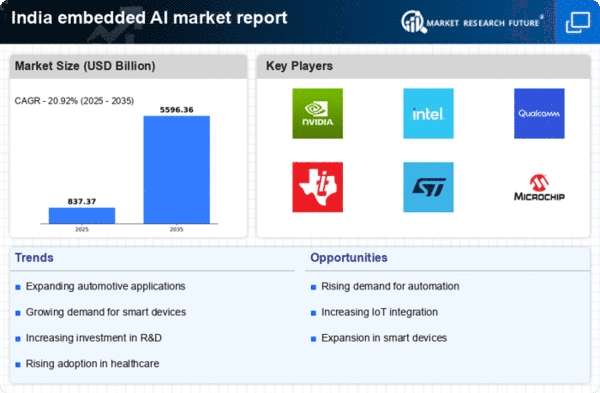
As per Market Research Future analysis, The India Embedded AI Market size  was estimated at 692.5 USD Billion in 2024. The Embedded Ai market is projected to grow from 837.37 USD Billion in 2025 to 5596.36 USD Billion by 2035, exhibiting a compound annual growth rate (CAGR) of 20.9% during the forecast period 2025 - 2035

Key Market Trends & Highlights

The India embedded AI market is experiencing robust growth driven by technological advancements and increasing application across various sectors.

  • The manufacturing sector emerges as the largest segment, showcasing a notable increase in embedded AI adoption.
  • Healthcare applications represent the fastest-growing segment, reflecting a surge in demand for AI-driven solutions.
  • The automotive sector is expanding rapidly, with embedded AI enhancing vehicle safety and automation features.
  • Key market drivers include the rising demand for smart devices and government initiatives supporting AI integration.

Market Size & Forecast

2024 Market Size 692.5 (USD Billion)
2035 Market Size 5596.36 (USD Billion)
CAGR (2025 - 2035) 20.92%

Major Players

NVIDIA (US), Intel (US), Qualcomm (US), Texas Instruments (US), STMicroelectronics (FR), Microchip Technology (US), Renesas Electronics (JP), Analog Devices (US), Infineon Technologies (DE)

Our Impact
Enabled $4.3B Revenue Impact for Fortune 500 and Leading Multinationals
Partnering with 2000+ Global Organizations Each Year
30K+ Citations by Top-Tier Firms in the Industry

India Embedded AI Market Trends

The The market is experiencing notable growth, driven by advancements in technology and increasing demand for automation across various sectors. is experiencing notable growth, driven by advancements in technology and increasing demand for automation across various sectors. Industries such as manufacturing, healthcare, and automotive are integrating embedded ai solutions to enhance efficiency and improve decision-making processes. This trend is further supported by government initiatives aimed at promoting digital transformation and innovation. As organizations seek to leverage data for competitive advantage, the adoption of embedded ai technologies is likely to accelerate, fostering a more intelligent and responsive operational environment. Moreover, the rise of the Internet of Things (IoT) is creating new opportunities for embedded ai applications. Devices equipped with ai capabilities are becoming more prevalent, enabling real-time data analysis and smarter interactions. This shift is indicative of a broader trend towards interconnected systems that can learn and adapt autonomously. As the embedded ai market continues to evolve, it appears poised to play a crucial role in shaping the future of various industries, enhancing productivity and driving economic growth.

Increased Adoption in Manufacturing

The embedded ai market is witnessing a surge in adoption within the manufacturing sector. Companies are increasingly utilizing ai-driven solutions to optimize production processes, reduce downtime, and enhance quality control. This trend is likely to lead to more efficient operations and improved product outcomes.

Growth in Healthcare Applications

Healthcare organizations are increasingly integrating embedded ai technologies to improve patient care and streamline operations. From diagnostic tools to personalized treatment plans, the potential for ai to enhance healthcare delivery is becoming more apparent, suggesting a transformative impact on the industry.

Expansion in Automotive Sector

The automotive industry is rapidly embracing embedded ai for applications such as autonomous driving and advanced driver-assistance systems. This trend indicates a shift towards smarter vehicles, enhancing safety and user experience, while also contributing to the overall growth of the embedded ai market.

India Embedded AI Market Drivers

Growth of IoT Ecosystem

The rapid expansion of the Internet of Things (IoT) ecosystem in India is a significant driver for the embedded ai market. With an estimated 1.5 billion connected devices by 2025, the demand for intelligent embedded systems is surging. These systems are essential for processing data locally, enabling real-time decision-making and enhancing operational efficiency. Industries such as agriculture, manufacturing, and logistics are increasingly adopting IoT solutions, which often incorporate embedded AI to optimize processes. This trend indicates a strong potential for growth in the embedded ai market, as companies seek to leverage AI capabilities to improve productivity and reduce costs.

Rising Demand for Smart Devices

The proliferation of smart devices in India is a key driver for the The proliferation of smart devices in India is a key driver for growth.. As consumers increasingly seek advanced functionalities in their gadgets, manufacturers are integrating AI capabilities to enhance user experience. This trend is evident in sectors such as consumer electronics, where smart home devices are projected to grow at a CAGR of 25% from 2025 to 2030. The embedded ai market is likely to benefit from this surge, as companies invest in AI technologies to meet consumer expectations. Furthermore, the Indian government’s push for digitalization and smart city initiatives is expected to further stimulate demand for smart devices, thereby propelling the embedded ai market forward.

Government Initiatives and Support

Government initiatives aimed at promoting AI technologies are significantly impacting the embedded ai market in India. Programs such as the National AI Strategy and various funding schemes for startups are fostering innovation in AI applications. The government has allocated approximately $1 billion to support AI research and development, which is likely to enhance the capabilities of embedded systems. This support not only encourages local startups to develop AI solutions but also attracts foreign investments, thereby expanding the embedded ai market. As a result, the collaboration between government and industry stakeholders is expected to drive advancements in AI technologies, further solidifying India's position in the embedded ai market.

Increasing Focus on Energy Efficiency

The growing emphasis on energy efficiency is emerging as a vital driver for the embedded ai market in India. As industries strive to reduce their carbon footprint and operational costs, the integration of AI in embedded systems is becoming increasingly important. AI algorithms can optimize energy consumption in real-time, leading to significant savings. For instance, smart grids and energy management systems are utilizing embedded AI to enhance efficiency. This focus on sustainability is likely to propel the embedded ai market, as companies seek innovative solutions to meet regulatory requirements and consumer expectations for greener technologies.

Advancements in Semiconductor Technology

Advancements in semiconductor technology are playing a crucial role in shaping the embedded ai market in India. The development of smaller, more efficient chips enables the integration of AI algorithms directly into devices, enhancing their performance and capabilities. As semiconductor manufacturers invest in research and development, the cost of producing AI-enabled chips is expected to decrease, making them more accessible to a wider range of industries. This trend is likely to drive innovation in the embedded ai market, as companies can now implement AI solutions in various applications, from consumer electronics to industrial automation, thereby expanding the market's reach.


Market Segment Insights

By Application: Smart Home Devices (Largest) vs. Industrial Automation (Fastest-Growing)

In the India In the India market, the application segments showcase a notable distribution., the application segments showcase a notable distribution, with Smart Home Devices capturing the largest share due to the heightened demand for connected living solutions. This segment maintains a significant lead, reflecting consumer trends that favor convenience and automation in daily life. In contrast, Industrial Automation is gaining traction as manufacturers increasingly adopt embedded AI technologies to enhance efficiency and productivity in operations, showcasing its rapid growth potential as businesses cluster around innovation. The growth trends in the India embedded ai market suggest a robust expansion across these segments. Smart Home Devices benefit from ongoing advancements in AI that improve user experience and integration with other smart technologies, driving user adoption. Meanwhile, the Industrial Automation sector is being propelled by the need for smarter, data-driven solutions to meet market demands, thus positioning it as the fastest-growing sector, attracting significant investment from key players looking to capitalize on this emerging trend.

Smart Home Devices (Dominant) vs. Automotive Systems (Emerging)

Smart Home Devices represent a dominant segment in the India embedded ai market, characterized by their ability to significantly enhance lifestyle through automation, security, and energy management solutions. This segment leads the market as consumers opt for intelligent appliances that can be controlled remotely, reflecting broader trends in connectivity. On the other hand, Automotive Systems are viewed as an emerging segment, increasingly integrating AI capabilities to enhance vehicle performance and safety features. The growth in this sector is fueled by the demand for advanced driver-assistance systems (ADAS) and increasing consumer interest in connected vehicles. As the automotive industry pivots towards electrification and smart technologies, this segment is expected to gain substantial traction in the coming years.

By Component: Processors (Largest) vs. Sensors (Fastest-Growing)

In the India embedded ai market, the dominant segment is Processors, taking a significant share due to their foundational role in AI applications. Following Processors, Sensors are gaining traction, driven by the increasing demand for smart automation and monitoring devices across various industries. This growing interest is reflected in the emerging market dynamics that highlight the potential of these components for enhancing user experiences. Growth trends in this segment are influenced by technological advancements and evolving consumer preferences. The surge in IoT devices and smart technologies has accelerated the need for more efficient and powerful Processors while boosting the deployment of various Sensors. Moreover, innovations in software and connectivity modules are creating synergy, further propelling growth in the component segment of the embedded AI landscape in India.

Processors (Dominant) vs. Sensors (Emerging)

Processors represent the dominant force in the India embedded ai market, primarily due to their critical function in executing algorithms and processing large datasets. Their continued innovation is essential for performance enhancements in AI applications. On the other hand, Sensors are emerging as key players, particularly with rising interest in automation and smart technologies. They enable enhanced connectivity and data collection capabilities, paving the way for new applications in sectors such as healthcare, automotive, and manufacturing. As these components evolve, their integration with software and connectivity solutions amplifies their market position, promoting advanced functionalities and efficiency.

By Technology: Machine Learning (Largest) vs. Natural Language Processing (Fastest-Growing)

The India embedded ai market shows a diverse distribution of market share among various technologies, with Machine Learning leading the segment as the largest contributor. Following closely is Natural Language Processing, which is carving out a significant portion of the market. Computer Vision and Deep Learning also hold noteworthy shares, demonstrating the balanced growth across these technologies while Robotics continues to evolve with a smaller footprint yet potential for substantial growth. Recent trends in the India embedded ai market indicate a robust acceleration, particularly in Natural Language Processing, which has emerged as the fastest-growing segment due to increased adoption in customer service solutions. The demand for advanced analytics and automation is driving Machine Learning, while advancements in image recognition fuel the growth of Computer Vision. Robotics is gaining traction, especially within industrial applications, showcasing a shift towards intelligent automation.

Machine Learning: Dominant vs. Natural Language Processing: Emerging

Machine Learning stands out as the dominant force in the India embedded ai market, characterized by its widespread application across sectors like finance, healthcare, and e-commerce. Its ability to analyze vast datasets and make predictive models has positioned it as a foundational technology in AI initiatives. On the other hand, Natural Language Processing is emerging rapidly, primarily due to growing functionalities in speech recognition and sentiment analysis, enhancing customer engagement and operational efficiency. Both technologies, while distinct, are interconnected as Machine Learning often underpins advancements in Natural Language Processing, thus driving innovation across the market.

By End Use: Healthcare (Largest) vs. Consumer (Fastest-Growing)

The India embedded ai market exhibits a diverse distribution among various end use segments. Healthcare leads as the largest segment due to its expanding demand for AI-driven diagnostics and treatment solutions. Following closely are commercial applications, which leverage embedded AI for enhanced operational efficiencies. Meanwhile, manufacturing and transportation sectors also contribute significantly by integrating AI for process automation and logistics optimization. The growth trends in this segment are driven by increasing investments in technology and a rising need for automation. Healthcare continues to evolve as more institutions adopt AI solutions, while the consumer segment is gaining traction, particularly with advancements in smart devices. Commercial applications are also experiencing significant growth as companies pursue digital transformation efforts, further catalyzing the embedded ai market.

Healthcare: Dominant vs. Consumer: Emerging

In the India embedded ai market, healthcare stands out as the dominant segment, characterized by its integration of AI in various applications, including telemedicine, patient management, and advanced diagnostics. This sector's growth is fueled by an increasing emphasis on improving healthcare outcomes and optimizing resource management. On the other hand, the consumer segment is emerging rapidly, driven by the proliferation of smart appliances and wearable technologies that incorporate embedded AI. This segment is characterized by innovation, focusing on enhancing user experience and personalization, making it essential for market players to adapt quickly to changing consumer demands.

Get more detailed insights about India Embedded AI Market

Key Players and Competitive Insights

The embedded AI market in India is characterized by a rapidly evolving competitive landscape, driven by technological advancements and increasing demand for intelligent systems across various sectors. Key players such as NVIDIA (US), Intel (US), and Qualcomm (US) are at the forefront, leveraging their expertise in AI and machine learning to enhance product offerings. NVIDIA (US) focuses on high-performance computing and AI-driven solutions, while Intel (US) emphasizes its commitment to integrating AI capabilities into its semiconductor products. Qualcomm (US) is strategically positioned in the mobile and IoT sectors, aiming to embed AI functionalities into devices, thereby enhancing user experiences. Collectively, these strategies foster a competitive environment that prioritizes innovation and technological integration.In terms of business tactics, companies are increasingly localizing manufacturing and optimizing supply chains to enhance operational efficiency. The market structure appears moderately fragmented, with several players vying for market share. However, the influence of major companies is substantial, as they set benchmarks for technological advancements and operational standards. This competitive dynamic encourages smaller firms to innovate and adapt, thereby contributing to the overall growth of the embedded AI market.
In October NVIDIA (US) announced a partnership with a leading Indian tech firm to develop AI solutions tailored for the automotive sector. This collaboration is significant as it aligns with the growing demand for smart vehicles in India, potentially positioning NVIDIA as a key player in this niche market. The partnership is expected to leverage NVIDIA's advanced AI capabilities, enhancing the development of autonomous driving technologies.
In September Intel (US) unveiled its latest AI-optimized chip designed specifically for edge computing applications. This strategic move is crucial as it addresses the increasing need for real-time data processing in various industries, including manufacturing and healthcare. By focusing on edge AI solutions, Intel aims to capture a larger share of the market, responding to the demand for efficient and localized data processing.
In August Qualcomm (US) expanded its AI research and development center in India, signaling its commitment to fostering innovation in the region. This expansion is likely to enhance Qualcomm's capabilities in developing AI-driven mobile technologies, which are essential for the growing IoT ecosystem. By investing in local talent and resources, Qualcomm positions itself to better meet the specific needs of the Indian market.
As of November the competitive trends in the embedded AI market are increasingly defined by digitalization, sustainability, and the integration of AI technologies. Strategic alliances among key players are shaping the landscape, fostering innovation and collaboration. The shift from price-based competition to a focus on technological differentiation and supply chain reliability is evident. Companies are likely to prioritize innovation and sustainability in their strategies, ensuring they remain competitive in a rapidly changing market.

Key Companies in the India Embedded AI Market include

Industry Developments

The India Embedded AI Market has witnessed significant developments recently, particularly with notable activities from major companies like Qualcomm, Tech Mahindra, and NVIDIA. In October 2023, Qualcomm announced a collaboration with several Indian educational institutions to promote an AI-centric curriculum and innovation. Additionally, Tech Mahindra launched an Embedded AI platform aimed at enhancing automation across industries.

The market has shown robust growth, with the valuation expected to reach approximately USD 2 billion by 2025, driven by the increasing demand for smart appliances and IoT solutions.Moreover, in September 2023, Wipro acquired a tech startup specializing in AI-driven analytics, bolstering its capabilities in the Embedded AI domain. In August 2023, L&T Technology Services announced enhanced partnerships with Bosch and Siemens, focusing on smart manufacturing solutions integrating AI technologies.

In the last few years, there has been a surge in the adoption of Embedded AI across various sectors in India, including automotive, healthcare, and agriculture, driven by investments from giants like Intel and Tata Consultancy Services, who are expanding their AI portfolios. This dynamic landscape reflects India’s commitment to becoming a leader in the AI and embedded systems space, aligning with national initiatives for technological advancement.

Future Outlook

India Embedded AI Market Future Outlook

The Embedded AI Market is projected to grow at a 20.92% CAGR from 2025 to 2035, driven by advancements in IoT, automation, and data analytics.

New opportunities lie in:

  • Development of AI-driven predictive maintenance solutions for manufacturing equipment. Integration of embedded AI in smart home devices for enhanced user experience. Creation of AI-powered edge computing platforms for real-time data processing.

By 2035, the embedded AI market is expected to achieve substantial growth and innovation.

Market Segmentation

India Embedded AI Market End Use Outlook

  • Consumer
  • Commercial
  • Healthcare
  • Manufacturing
  • Transportation

India Embedded AI Market Component Outlook

  • Processors
  • Sensors
  • Software
  • Memory Devices
  • Connectivity Modules

India Embedded AI Market Technology Outlook

  • Machine Learning
  • Natural Language Processing
  • Computer Vision
  • Deep Learning
  • Robotics

India Embedded AI Market Application Outlook

  • Smart Home Devices
  • Industrial Automation
  • Healthcare Devices
  • Automotive Systems
  • Consumer Electronics

Report Scope

MARKET SIZE 2024 692.5(USD Billion)
MARKET SIZE 2025 837.37(USD Billion)
MARKET SIZE 2035 5596.36(USD Billion)
COMPOUND ANNUAL GROWTH RATE (CAGR) 20.92% (2025 - 2035)
REPORT COVERAGE Revenue Forecast, Competitive Landscape, Growth Factors, and Trends
BASE YEAR 2024
Market Forecast Period 2025 - 2035
Historical Data 2019 - 2024
Market Forecast Units USD Billion
Key Companies Profiled NVIDIA (US), Intel (US), Qualcomm (US), Texas Instruments (US), STMicroelectronics (FR), Microchip Technology (US), Renesas Electronics (JP), Analog Devices (US), Infineon Technologies (DE)
Segments Covered Application, Component, Technology, End Use
Key Market Opportunities Integration of advanced machine learning algorithms in consumer electronics enhances functionality and user experience.
Key Market Dynamics Rising demand for smart devices drives innovation and competition in the embedded AI market.
Countries Covered India
Leave a Comment

FAQs

What is the expected market size of the India Embedded AI Market in 2024?

The India Embedded AI Market is expected to be valued at 570.0 million USD in 2024.

What will be the market size of the India Embedded AI Market in 2035?

By 2035, the India Embedded AI Market is projected to reach a valuation of 1700.0 million USD.

What is the expected CAGR for the India Embedded AI Market from 2025 to 2035?

The anticipated CAGR for the India Embedded AI Market is 10.444% during the forecast period from 2025 to 2035.

Which application segment will have the highest value in the India Embedded AI Market in 2035?

The Automotive Systems application segment is expected to be valued at 450.0 million USD in 2035, making it one of the highest in value.

What market value is projected for Smart Home Devices in India by 2035?

Smart Home Devices are projected to reach a market value of 240.0 million USD by 2035.

Who are the major players in the India Embedded AI Market?

Key players in the India Embedded AI Market include Qualcomm, Tech Mahindra, Cognizant, and NVIDIA among others.

What is the market value for Industrial Automation applications in 2024?

The Industrial Automation segment is expected to be valued at 120.0 million USD in 2024.

What growth trends are expected for Healthcare Devices in the India Embedded AI Market?

Healthcare Devices are expected to grow from a market value of 100.0 million USD in 2024 to 300.0 million USD by 2035.

How much is the Consumer Electronics segment expected to grow by 2035?

The Consumer Electronics segment is projected to grow to a market value of 350.0 million USD by 2035.

What challenges might impact the growth of the India Embedded AI Market?

The market may face challenges such as rapid technological changes and competition among major players as it grows.

Download Free Sample

Kindly complete the form below to receive a free sample of this Report

Compare Licence

×
Features License Type
Single User Multiuser License Enterprise User
Price $4,950 $5,950 $7,250
Maximum User Access Limit 1 User Upto 10 Users Unrestricted Access Throughout the Organization
Free Customization
Direct Access to Analyst
Deliverable Format
Platform Access
Discount on Next Purchase 10% 15% 15%
Printable Versions