×
Request Free Sample ×

Kindly complete the form below to receive a free sample of this Report

* Please use a valid business email

Leading companies partner with us for data-driven Insights

clients tt-cursor
Hero Background

Germany Blockchain in Retail Market

ID: MRFR/ICT/57398-HCR
200 Pages
Aarti Dhapte
February 2026

Germany Blockchain in Retail Market Size, Share and Trends Analysis Report By Type (Public, Private, Consortium), By Platform (Bitcoin, Ripple, Ethereum, R3 Corda, Hyperledger Fabric, Multichain, Quorum, Others), By Organization Size (Large Enterprises, SMEs) and By Application (Compliance Management, Database Management, Auditing, Payment Management, Inventory Management, Loyalty And Rewards Management, Fraud Management, Others) - Forecast to 2035

Share:
Download PDF ×

We do not share your information with anyone. However, we may send you emails based on your report interest from time to time. You may contact us at any time to opt-out.

Germany Blockchain in Retail Market Infographic
Purchase Options

Germany Blockchain in Retail Market Summary

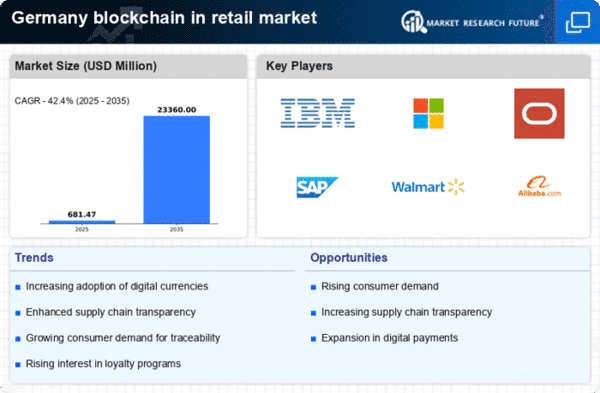
As per Market Research Future analysis, the Germany Blockchain in Retail Market size was estimated at 478.56 USD Million in 2024. The Blockchain In-retail market is projected to grow from 681.47 USD Million in 2025 to 23360.0 USD Million by 2035, exhibiting a compound annual growth rate (CAGR) of 42% during the forecast period 2025 - 2035

Key Market Trends & Highlights

The Germany blockchain in-retail market is poised for substantial growth driven by technological advancements and evolving consumer expectations.

  • Enhanced supply chain transparency is becoming a critical focus for retailers in Germany, facilitating better tracking of products from origin to consumer.
  • Smart contracts are increasingly utilized for automated transactions, streamlining processes and reducing operational costs in the retail sector.
  • Consumer-centric loyalty programs leveraging blockchain technology are gaining traction, enhancing customer engagement and retention.
  • Increased demand for traceability and regulatory compliance drives the market. These factors are essential for building consumer trust and ensuring product authenticity.

Market Size & Forecast

2024 Market Size 478.56 (USD Million)
2035 Market Size 23360.0 (USD Million)
CAGR (2025 - 2035) 42.4%

Major Players

IBM (US), Microsoft (US), Oracle (US), SAP (DE), Walmart (US), Alibaba (CN), Amazon (US), VeChain (CN), Modum (CH)

Our Impact
Enabled $4.3B Revenue Impact for Fortune 500 and Leading Multinationals
Partnering with 2000+ Global Organizations Each Year
30K+ Citations by Top-Tier Firms in the Industry

Germany Blockchain in Retail Market Trends

The blockchain in-retail market is currently experiencing a notable transformation, driven by advancements in technology and increasing consumer demand for transparency and security. Retailers are increasingly adopting blockchain solutions to enhance supply chain management, improve traceability of products, and streamline payment processes. This shift appears to be influenced by a growing awareness among consumers regarding the origins of their purchases, leading to a heightened emphasis on ethical sourcing and sustainability. As a result, businesses are exploring innovative ways to leverage blockchain technology to build trust and foster customer loyalty. In addition, regulatory frameworks in Germany are evolving to accommodate the integration of blockchain within the retail sector. This regulatory support may encourage further investment and development of blockchain applications tailored to retail needs. Moreover, collaborations between technology providers and retail companies are likely to increase, fostering an environment conducive to innovation. The potential for enhanced operational efficiency and reduced costs through blockchain adoption is becoming increasingly apparent, suggesting a promising future for the Germany Blockchain in Retail Market.

Enhanced Supply Chain Transparency

The blockchain in-retail market is experiencing improved supply chain transparency. Retailers are utilizing blockchain technology to track products from origin to consumer, ensuring authenticity and reducing fraud. This transparency not only builds consumer trust but also aids in compliance with regulatory standards.

Smart Contracts for Automated Transactions

Another emerging trend involves the use of smart contracts within the blockchain in-retail market. These self-executing contracts facilitate automated transactions, reducing the need for intermediaries. This innovation streamlines processes, potentially lowering operational costs and enhancing transaction speed.

Consumer-Centric Loyalty Programs

The blockchain in-retail market is also seeing the development of consumer-centric loyalty programs. By leveraging blockchain, retailers can create secure and transparent loyalty systems that reward customers for their purchases. This approach not only enhances customer engagement but also provides valuable data insights for retailers.

Germany Blockchain in Retail Market Drivers

Enhanced Customer Experience

The blockchain in-retail market focuses on enhancing customer experience through innovative solutions. Retailers in Germany are leveraging blockchain to create personalized shopping experiences, which are becoming essential in a competitive landscape. By utilizing blockchain, retailers can securely store customer data and preferences, enabling tailored marketing strategies. This personalization can lead to increased customer satisfaction and loyalty, as consumers are more likely to engage with brands that understand their needs. Additionally, the integration of blockchain can streamline payment processes, reducing transaction times and enhancing convenience. Reports indicate that retailers implementing blockchain solutions have observed a 30% increase in customer retention rates. As the demand for personalized experiences grows, the blockchain in-retail market is expected to expand, driven by the need for improved customer engagement.

Collaboration and Partnerships

The blockchain in-retail market is characterized by collaboration and partnerships among various stakeholders. Retailers, technology providers, and logistics companies in Germany are recognizing the potential of blockchain to enhance supply chain efficiency and transparency. Collaborative initiatives, such as shared blockchain platforms, are emerging to facilitate data sharing and improve operational workflows. These partnerships can lead to innovative solutions that address common challenges faced by the retail sector, such as inventory discrepancies and delivery delays. Furthermore, joint ventures can enable smaller retailers to access advanced blockchain technologies that they might not afford independently. As the market evolves, the trend towards collaboration is likely to strengthen, fostering a more interconnected and efficient blockchain in-retail market.

Increased Demand for Traceability

The blockchain in-retail market is experiencing a notable surge in demand for traceability solutions. Consumers in Germany are increasingly concerned about the origins of their products, particularly in sectors such as food and fashion. This heightened awareness has led retailers to adopt blockchain technology to provide transparent supply chain information. According to recent data, approximately 70% of German consumers express a preference for brands that offer clear product provenance. This trend is likely to drive investment in blockchain solutions, as retailers seek to enhance consumer trust and loyalty. Furthermore, the integration of blockchain can potentially reduce fraud and counterfeiting, which are significant issues in the retail sector. As a result, the blockchain in-retail market is poised for growth as businesses strive to meet consumer expectations for transparency.

Cost Reduction and Efficiency Gains

The blockchain in-retail market is shifting towards cost reduction and efficiency gains as retailers optimize their operations. By implementing blockchain technology, businesses can streamline various processes, such as inventory management and payment processing. This technology reduces the need for intermediaries, which can lead to significant cost savings. For instance, studies suggest that retailers could save up to 15% on transaction costs by utilizing blockchain for payment solutions. Moreover, the enhanced transparency and traceability offered by blockchain can minimize losses due to fraud and errors, further contributing to cost efficiency. As retailers in Germany continue to face pressure to improve margins, the adoption of blockchain technology is likely to accelerate, positioning the market for substantial growth in the coming years.

Regulatory Compliance and Standards

The blockchain in-retail market is significantly influenced by the evolving regulatory landscape in Germany. As the government implements stricter regulations regarding data protection and consumer rights, retailers are compelled to adopt technologies that ensure compliance. Blockchain offers a decentralized and secure method for managing sensitive information, which aligns with the General Data Protection Regulation (GDPR) requirements. This compliance is crucial for retailers to avoid hefty fines, which can reach up to €20 million or 4% of annual global turnover, whichever is higher. Consequently, the adoption of blockchain technology is likely to increase as retailers seek to mitigate legal risks and enhance operational efficiency. The proactive approach to regulatory compliance through blockchain could also serve as a competitive advantage in the market, further driving its adoption.


Market Segment Insights

By Type: Public (Largest) vs. Private (Fastest-Growing)

In the Germany blockchain in-retail market, the Public segment dominates the landscape, claiming a majority share due to its wide accessibility and adoption among various retail entities. This segment enjoys strong backing from numerous institutions, which further enhances its footprint in the region. Conversely, the Private segment is gaining traction as businesses look for tailored solutions that provide enhanced security and control over their transactions. This leads to a notable increase in interest and participation over recent years. Growth trends indicate a shift towards more private and consortium blockchains as retailers seek to capitalize on the benefits of customization and collaboration. The rise of digital transactions and demand for secure data management are also driving innovation in the Private segment, while the Consortium model is increasingly viewed as a viable middle ground, allowing for shared governance and resource pooling between multiple retail entities. This collective approach enables quicker implementation and broader adoption of blockchain technology in retail.

Public (Dominant) vs. Private (Emerging)

The Public segment stands out as the dominant force in the Germany blockchain in-retail market, characterized by its open-access nature and widespread applicability across various retail sectors. This segment is defined by transparency and inclusivity, allowing multiple stakeholders to participate, which significantly drives innovation and collaboration. In contrast, the Private segment is emerging as a key player, appealing to businesses that prioritize data privacy and exclusive access to their blockchain networks. With the ability to customize controls and governance structures, the Private segment enables retailers to design systems that align closely with their operational needs, thereby fostering a secure and efficient environment for transaction processing.

By Platform: Ethereum (Largest) vs. Bitcoin (Fastest-Growing)

In the Germany blockchain in-retail market, Ethereum holds the largest share among platform segment values, demonstrating its strong adoption across various retail applications. Meanwhile, Bitcoin continues to grow rapidly, attracting the attention of retailers exploring decentralized payment options. The segment also includes other platforms like Ripple, R3 Corda, and Hyperledger Fabric, though they occupy smaller portions of the market share. The growth trends in this segment are primarily driven by the increasing demand for transparent and secure transactions in the retail sector. Retailers are seeking solutions that facilitate faster payment processing and enhance customer engagement. Additionally, technological advancements and strategic partnerships between blockchain providers and retail companies are fueling the rapid expansion of Ethereum, while Bitcoin is emerging as a popular choice for those looking to integrate cryptocurrency payments into their operations.

Ethereum (Dominant) vs. Ripple (Emerging)

Ethereum, as the dominant platform in the Germany blockchain in-retail market, offers a robust framework for developing decentralized applications tailored for retail needs. Its smart contract capabilities enable automated transactions, enhancing efficiency and reducing costs. In contrast, Ripple, categorized as an emerging platform, focuses on facilitating cross-border payments and optimizing transaction speeds. Its unique consensus mechanism sets it apart, making it an attractive option for retailers engaged in international trade. As businesses strive for innovation in their payment systems, both platforms cater to different needs within the retail sector, with Ethereum leading in versatility and Ripple growing in niche areas of payment solutions.

By Organization Size: Large Enterprises (Largest) vs. SMEs (Fastest-Growing)

In the Germany blockchain in-retail market, Large Enterprises dominate the landscape, holding a significant portion of the market share due to their established infrastructure and greater resources for blockchain integration. Their extensive operational capabilities allow them to leverage blockchain technology to enhance efficiency, transparency, and security in their processes. On the other hand, SMEs are witnessing rapid growth, driven by the increasing accessibility of blockchain solutions and the need for innovative ways to compete in a highly competitive marketplace. The growth trends in this segment show that while Large Enterprises continue to lead, SMEs are emerging as a formidable force, as they adopt blockchain technology to streamline operations and improve customer engagement. Factors contributing to this growth include lower costs of implementation, the flexibility of blockchain solutions tailored to smaller businesses, and growing awareness of the potential benefits of blockchain. This dynamic is reshaping the market, leading to a more balanced distribution of organizational engagement in blockchain applications.

Large Enterprises (Dominant) vs. SMEs (Emerging)

Large Enterprises in the Germany blockchain in-retail market exemplify stability and reliability, leveraging their significant resources to implement robust blockchain systems. Their ability to invest in advanced technologies facilitates a comprehensive approach toward digital transformation, setting industry standards. On the contrary, SMEs represent an emerging segment characterized by agility and innovation. They are increasingly adopting blockchain solutions that are suited for their size and operational complexity, allowing them to enhance their service offerings without overwhelming their resources. The flexibility of blockchain technology enables SMEs to thrive in niche markets, fostering competition against larger players and driving industry evolution. Both segments play critical roles, with Large Enterprises solidifying market foundations while SMEs spur innovative practices.

By Application: Payment Management (Largest) vs. Compliance Management (Fastest-Growing)

In the Germany blockchain in-retail market, payment management has emerged as the largest segment, capturing a significant share of the market due to its critical role in facilitating secure and efficient transactions. Other notable segments include compliance and inventory management, which also contribute to the evolving landscape. As the industry adapts to new technologies, the distribution of market shares sees a gradual shift towards innovative solutions that enhance operational efficiencies and improve customer experience. The growth trends for this segment indicate a robust future driven by the increasing adoption of blockchain technology. Factors such as demand for transparency and traceability, coupled with regulatory pressures, are propelling compliance management as the fastest-growing segment. Retailers are anticipated to invest heavily in auditing and loyalty management solutions, further diversifying the market and fostering competition across all application categories.

Payment Management: Dominant vs. Compliance Management: Emerging

Payment management stands as the dominant force within the Germany blockchain in-retail market, as it addresses the fundamental need for secure transactions in a digital economy. With the ability to streamline payment processes dramatically, it enhances customer satisfaction and trust. Compliance management, categorized as an emerging segment, is gaining traction due to increasing regulations and the need for transparent operations. This segment is evolving rapidly as retailers seek to mitigate risks associated with fraud and non-compliance. The integration of blockchain technology not only boosts credibility but also fosters greater accountability among stakeholders, thereby making both segments critical to the sustainability and growth of the retail market.

Get more detailed insights about Germany Blockchain in Retail Market

Key Players and Competitive Insights

The blockchain in-retail market in Germany is characterized by a dynamic competitive landscape, driven by technological advancements and increasing consumer demand for transparency and efficiency. Major players such as IBM (US), SAP (DE), and VeChain (CN) are actively shaping the market through innovative solutions and strategic partnerships. IBM (US) focuses on leveraging its extensive cloud infrastructure to enhance supply chain transparency, while SAP (DE) emphasizes integrating blockchain with its existing enterprise resource planning (ERP) systems to streamline operations. VeChain (CN), on the other hand, positions itself as a leader in product lifecycle management, utilizing blockchain to ensure product authenticity and traceability, thereby enhancing consumer trust. Collectively, these strategies foster a competitive environment that prioritizes technological integration and operational efficiency.
Key business tactics within this market include localizing manufacturing and optimizing supply chains to meet the demands of a rapidly evolving retail landscape. The competitive structure appears moderately fragmented, with several key players vying for market share. This fragmentation is indicative of a diverse range of solutions being offered, which allows retailers to select tailored blockchain applications that best fit their operational needs. The influence of these major players is substantial, as they set benchmarks for innovation and operational excellence that smaller firms often strive to emulate.
In October 2025, IBM (US) announced a partnership with a leading German supermarket chain to implement a blockchain-based solution aimed at enhancing food safety and traceability. This strategic move is significant as it not only reinforces IBM's commitment to the retail sector but also highlights the growing importance of food safety in consumer purchasing decisions. By providing real-time data on product origins and handling, this initiative is likely to enhance consumer confidence and loyalty.
In September 2025, SAP (DE) launched a new blockchain module designed to integrate seamlessly with its existing ERP systems, allowing retailers to track inventory and transactions in real-time. This development is crucial as it enables retailers to optimize their supply chains and reduce operational costs. The integration of blockchain technology into established systems signifies a shift towards more efficient and transparent retail operations, which could potentially reshape the competitive landscape.
In August 2025, VeChain (CN) expanded its collaboration with a prominent European luxury brand to enhance product authentication through blockchain technology. This partnership is particularly noteworthy as it underscores the increasing demand for authenticity in luxury goods, a sector where counterfeiting poses significant challenges. By leveraging blockchain, VeChain (CN) not only addresses these challenges but also positions itself as a key player in the luxury retail market, potentially driving further adoption of its solutions.
As of November 2025, current competitive trends in the blockchain in-retail market are heavily influenced by digitalization, sustainability, and the integration of artificial intelligence (AI). Strategic alliances among key players are increasingly shaping the landscape, fostering innovation and enhancing operational capabilities. The shift from price-based competition to a focus on technological advancement and supply chain reliability is evident, suggesting that future competitive differentiation will hinge on the ability to innovate and adapt to changing consumer expectations.

Key Companies in the Germany Blockchain in Retail Market include

Industry Developments

In recent months, the Germany Blockchain in Retail Market has witnessed significant developments, particularly with companies like SAP, Porsche, and Lidl actively exploring blockchain applications for enhancing supply chain transparency and consumer trust. Notably, in September 2023, Siemens and Bosch announced a collaboration to develop blockchain solutions that optimize logistics operations, aimed at reducing inefficiencies in the retail sector. Moreover, the demand for blockchain technology in retail has spurred substantial growth, with valuations for key players such as Zalando and Allianz increasing as they integrate blockchain for secure digital transactions.

Additionally, a notable acquisition occurred in August 2023 when Chainstep was acquired by a consortium led by BMW to enhance its blockchain capabilities in the automotive retail space, streamlining the purchase process. Over the past two years, the adoption of blockchain for tracking products from origin to consumer has increased among major retailers, with initiatives launched by companies like Volkswagen focusing on sustainability and ethical sourcing. Overall, these advancements underscore Germany's commitment to leveraging blockchain technology to foster innovation in the retail industry.

Future Outlook

Germany Blockchain in Retail Market Future Outlook

The blockchain in-retail market in Germany is projected to grow at a 42.4% CAGR from 2025 to 2035, driven by enhanced supply chain transparency, consumer demand for security, and operational efficiency.

New opportunities lie in:

  • Integration of blockchain for real-time inventory tracking systems.
  • Development of decentralized loyalty programs to enhance customer engagement.
  • Implementation of smart contracts for automated payment processing.

By 2035, the market is expected to achieve substantial growth, driven by innovative applications and increased adoption.

Market Segmentation

Germany Blockchain in Retail Market Type Outlook

  • Public
  • Private
  • Consortium

Germany Blockchain in Retail Market Platform Outlook

  • Bitcoin
  • Ripple
  • Ethereum
  • R3 Corda
  • Hyperledger Fabric
  • Multichain
  • Quorum
  • Others

Germany Blockchain in Retail Market Application Outlook

  • Compliance Management
  • Database Management
  • Auditing
  • Payment Management
  • Inventory Management
  • Loyalty and Rewards Management
  • Fraud Management
  • Others

Germany Blockchain in Retail Market Organization Size Outlook

  • Large Enterprises
  • SMEs

Report Scope

MARKET SIZE 2024 478.56(USD Million)
MARKET SIZE 2025 681.47(USD Million)
MARKET SIZE 2035 23360.0(USD Million)
COMPOUND ANNUAL GROWTH RATE (CAGR) 42.4% (2025 - 2035)
REPORT COVERAGE Revenue Forecast, Competitive Landscape, Growth Factors, and Trends
BASE YEAR 2024
Market Forecast Period 2025 - 2035
Historical Data 2019 - 2024
Market Forecast Units USD Million
Key Companies Profiled IBM (US), Microsoft (US), Oracle (US), SAP (DE), Walmart (US), Alibaba (CN), Amazon (US), VeChain (CN), Modum (CH)
Segments Covered Type, Platform, Organization Size, Application
Key Market Opportunities Integration of blockchain enhances supply chain transparency and consumer trust in the retail sector.
Key Market Dynamics Growing adoption of blockchain enhances transparency and efficiency in retail supply chains across Germany.
Countries Covered Germany
Leave a Comment

FAQs

What is the expected market size of the Germany Blockchain in Retail Market by 2024?

The Germany Blockchain in Retail Market is expected to be valued at 483.83 million USD by the year 2024.

What will be the market size of the Germany Blockchain in Retail Market in 2035?

By 2035, the Germany Blockchain in Retail Market is projected to reach a value of 1857.6 million USD.

What is the expected compound annual growth rate (CAGR) for the Germany Blockchain in Retail Market from 2025 to 2035?

The market is expected to witness a CAGR of 13.009 percent from 2025 to 2035.

Which type of blockchain will have the largest market share in Germany by 2035?

The Private blockchain type is expected to dominate the market with a projected value of 680.3 million USD in 2035.

What is the expected market value for Public blockchain in Germany by 2035?

The Public blockchain segment is anticipated to reach a market value of 420.1 million USD by the year 2035.

Who are the major players in the Germany Blockchain in Retail Market?

Key players in the market include SAP, Porsche, Lidl, Zalando, and IBM among others.

What is the projected market value of the Consortium blockchain by 2035?

The Consortium blockchain segment is expected to be valued at 757.2 million USD in 2035.

How is the current market growth rate for the Germany Blockchain in Retail Market anticipated?

The growth rate is expected to maintain a steady pace, driven by innovations and increased technology adoption.

How does the current global scenario impact the Germany Blockchain in Retail Market?

Various global shifts and technological advancements are anticipated to influence market dynamics positively.

What opportunities are present for growth in the Germany Blockchain in Retail Market?

Emerging trends in automation and supply chain transparency offer significant growth opportunities in the market.

Download Free Sample

Kindly complete the form below to receive a free sample of this Report

Compare Licence

×
Features License Type
Single User Multiuser License Enterprise User
Price $4,950 $5,950 $7,250
Maximum User Access Limit 1 User Upto 10 Users Unrestricted Access Throughout the Organization
Free Customization
Direct Access to Analyst
Deliverable Format
Platform Access
Discount on Next Purchase 10% 15% 15%
Printable Versions