×
Request Free Sample ×

Kindly complete the form below to receive a free sample of this Report

* Please use a valid business email

Leading companies partner with us for data-driven Insights

clients tt-cursor
Hero Background

Japan Blockchain in Retail Market

ID: MRFR/ICT/57399-HCR
200 Pages
Garvit Vyas
February 2026

Japan Blockchain in Retail Market Size, Share and Trends Analysis Report By Type (Public, Private, Consortium), By Platform (Bitcoin, Ripple, Ethereum, R3 Corda, Hyperledger Fabric, Multichain, Quorum, Others), By Organization Size (Large Enterprises, SMEs) and By Application (Compliance Management, Database Management, Auditing, Payment Management, Inventory Management, Loyalty And Rewards Management, Fraud Management, Others) - Forecast to 2035

Share:
Download PDF ×

We do not share your information with anyone. However, we may send you emails based on your report interest from time to time. You may contact us at any time to opt-out.

Japan Blockchain in Retail Market Infographic
Purchase Options

Japan Blockchain in Retail Market Summary

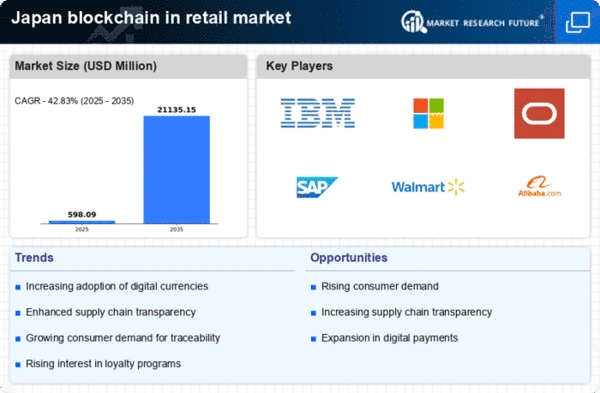
As per Market Research Future analysis, the Japan Blockchain in Retail Market size was estimated at 418.74 USD Million in 2024. The Blockchain In-retail market is projected to grow from 598.09 USD Million in 2025 to 21135.15 USD Million by 2035, exhibiting a compound annual growth rate (CAGR) of 42.8% during the forecast period 2025 - 2035

Key Market Trends & Highlights

The Japan blockchain in-retail market is poised for substantial growth driven by technological advancements and evolving consumer preferences.

  • Enhanced supply chain transparency is becoming a critical focus for retailers in Japan, facilitating trust and traceability.
  • Decentralized payment solutions are gaining traction, offering consumers more secure and efficient transaction methods.
  • Smart contracts are increasingly utilized to streamline operational efficiency, reducing costs and enhancing service delivery.
  • Rising consumer demand for authenticity and regulatory support for blockchain adoption are key drivers propelling market expansion.

Market Size & Forecast

2024 Market Size 418.74 (USD Million)
2035 Market Size 21135.15 (USD Million)
CAGR (2025 - 2035) 42.83%

Major Players

IBM (US), Microsoft (US), Oracle (US), SAP (DE), Walmart (US), Alibaba (CN), VeChain (SG), Modum (CH)

Our Impact
Enabled $4.3B Revenue Impact for Fortune 500 and Leading Multinationals
Partnering with 2000+ Global Organizations Each Year
30K+ Citations by Top-Tier Firms in the Industry

Japan Blockchain in Retail Market Trends

The blockchain in-retail market is currently experiencing a transformative phase, driven by advancements in technology and increasing consumer demand for transparency and security. In Japan, retailers are increasingly adopting blockchain solutions to enhance supply chain management, improve traceability of products, and streamline payment processes. This shift appears to be influenced by a growing awareness of the benefits of decentralized systems, which can potentially reduce fraud and enhance customer trust. Furthermore, the Japanese government has been supportive of blockchain initiatives, fostering an environment conducive to innovation and collaboration among various stakeholders in the retail sector. As of November 2025, the Japan Blockchain in Retail Market in Japan seems to be evolving rapidly. Retailers are exploring various applications, from loyalty programs to digital identity verification, which may enhance customer engagement and operational efficiency. The integration of blockchain technology is likely to reshape traditional retail practices, offering new avenues for growth and competitiveness. Additionally, partnerships between technology providers and retail businesses are becoming more common, indicating a trend towards collaborative efforts to harness the full potential of blockchain solutions. Overall, the future of the blockchain in-retail market in Japan appears promising, with ongoing developments suggesting a robust trajectory for growth and innovation.

Enhanced Supply Chain Transparency

The blockchain in-retail market is witnessing a trend towards improved supply chain transparency. Retailers are utilizing blockchain to track products from origin to shelf, ensuring authenticity and quality. This transparency not only builds consumer trust but also aids in compliance with regulations.

Decentralized Payment Solutions

There is a growing interest in decentralized payment solutions within the blockchain in-retail market. Retailers are exploring cryptocurrencies and blockchain-based payment systems to offer customers more secure and efficient transaction methods, potentially reducing transaction fees.

Smart Contracts for Operational Efficiency

The adoption of smart contracts is becoming prevalent in the blockchain in-retail market. These self-executing contracts facilitate automated transactions and agreements, streamlining processes such as inventory management and supplier agreements, thereby enhancing operational efficiency.

Japan Blockchain in Retail Market Drivers

Increased Focus on Cybersecurity

As the blockchain in-retail market expands, the emphasis on cybersecurity becomes increasingly critical. Retailers in Japan are recognizing the potential vulnerabilities associated with digital transactions and data management. Blockchain technology, with its inherent security features, offers a robust solution to mitigate risks related to data breaches and fraud. A recent study indicates that cyberattacks on retail businesses have increased by 40% in the past year, prompting retailers to invest in blockchain solutions that enhance data integrity and security. By prioritizing cybersecurity through blockchain, retailers can protect consumer information and maintain trust, which is essential for long-term success in the market.

Rising Consumer Demand for Authenticity

In the context of the blockchain in-retail market, there is a notable increase in consumer demand for authenticity and traceability of products. Japanese consumers are becoming increasingly aware of the origins of their purchases, particularly in sectors such as food and luxury goods. This trend is evidenced by a survey indicating that approximately 70% of consumers in Japan express a preference for brands that provide transparent information about product sourcing. Blockchain technology offers a solution by enabling retailers to provide verifiable information about product origins, thus enhancing consumer trust. As a result, retailers adopting blockchain solutions may experience a competitive advantage, potentially leading to increased market share and customer loyalty.

Emergence of Collaborative Retail Models

The blockchain in-retail market is also being driven by the emergence of collaborative retail models that leverage shared resources and data. In Japan, retailers are increasingly exploring partnerships that utilize blockchain to create shared platforms for inventory management and customer engagement. This collaborative approach not only reduces operational costs but also enhances the customer experience by providing seamless access to products and services. Market analysis suggests that collaborative models could lead to a 25% reduction in supply chain costs for participating retailers. As these models gain traction, they may redefine traditional retail dynamics, fostering innovation and efficiency in the blockchain in-retail market.

Regulatory Support for Blockchain Adoption

The blockchain in-retail market in Japan is witnessing a favorable regulatory environment that encourages the adoption of blockchain technologies. The Japanese government has been proactive in establishing guidelines and frameworks that support the integration of blockchain in various sectors, including retail. For instance, the Financial Services Agency (FSA) has introduced measures to promote innovation while ensuring consumer protection. This regulatory support is likely to facilitate investment in blockchain solutions, with projections suggesting that the market could grow by over 30% in the next five years. Retailers that align with these regulations may find themselves better positioned to leverage blockchain for operational efficiency and enhanced customer engagement.

Integration of IoT with Blockchain Solutions

The convergence of Internet of Things (IoT) technology with blockchain in the retail sector is emerging as a pivotal driver. In Japan, the integration of IoT devices with blockchain systems allows for real-time data collection and analysis, enhancing supply chain management and inventory control. This synergy is particularly relevant in sectors such as logistics and food safety, where tracking and monitoring are crucial. Reports indicate that the IoT market in Japan is expected to reach ¥1 trillion by 2025, and its integration with blockchain could streamline operations, reduce costs, and improve transparency. Retailers that harness this technology may gain a significant edge in the competitive landscape.


Market Segment Insights

By Type: Public (Largest) vs. Private (Fastest-Growing)

In the Japan blockchain in-retail market, the market share distribution reveals that the public segment is the largest, accounting for a significant portion of the overall market. This dominance is attributed to its openness and accessibility, enabling broader participation by various stakeholders in the retail sector. Conversely, the private segment is not far behind, capturing a growing share as businesses seek enhanced security and control over their blockchain networks, further diversifying the market landscape. Growth trends indicate that while the public segment remains a stable foundation, the private segment is emerging rapidly as companies increasingly recognize the advantages of private blockchains, such as improved data privacy and customizable features. Consortium blockchains, while smaller, also contribute to collaborative efforts among multiple organizations, signaling a shift towards tailored blockchain solutions that address specific retail challenges. The overall market dynamics reflect a balance between open accessibility and specialized, secure applications.

Public (Dominant) vs. Private (Emerging)

The public segment stands out as the dominant force within the Japan blockchain in-retail market, providing a decentralized platform that enhances transparency and trust among consumers and retailers alike. Its established presence allows for widespread acceptance and usage, fostering an ecosystem where innovation can thrive. On the other hand, the private segment is emerging as a vital player, driven by the need for secure transactions and efficient private data management. While the public blockchain offers broad applicability, private blockchains cater to specific business needs, delivering heightened control and specific compliance with regulatory standards. This duality of dominance and emergence highlights a complex and evolving landscape, where both segments play critical roles in shaping the future of blockchain technology in retail.

By Platform: Bitcoin (Largest) vs. Ethereum (Fastest-Growing)

In the Japan blockchain in-retail market, Bitcoin dominates the platform segment with the largest share, thanks to its early adoption and strong brand recognition. Ethereum follows closely, leveraging its smart contract capabilities and establishing itself as a critical player in decentralized applications. Other platforms like Ripple, R3 Corda, and Hyperledger Fabric contribute to a diverse landscape, but they hold smaller shares compared to Bitcoin and Ethereum. Growth trends indicate a rising interest in Ethereum as it evolves to support more complex transactions and decentralized finance applications. The rapid adoption of these technologies is driven by the increasing demand for transparency and security in retail transactions. Furthermore, innovations in scalability and functionality continue to attract new users to the Japan blockchain in-retail market, enhancing competition among platforms.

Bitcoin (Dominant) vs. Ethereum (Emerging)

Bitcoin remains the dominant force in the market, characterized by its widespread use and recognition as a store of value and a digital currency. It is favored by traditional retailers seeking a reliable platform for transactions. On the other hand, Ethereum is emerging as a robust alternative with its capabilities for smart contracts and dApps, driving innovative solutions in retail. Its growing ecosystem enables businesses to integrate complex functionalities, thus attracting an increasing user base. This diversity and capability shift the competitive landscape, positioning Ethereum as a significant player that complements Bitcoin while also appealing to forward-thinking retailers.

By Organization Size: Large Enterprises (Largest) vs. SMEs (Fastest-Growing)

In the Japan blockchain in-retail market, large enterprises significantly dominate the organization size segment, commanding a substantial share due to their extensive resources and ability to implement blockchain technology effectively. Their influence is driven by robust infrastructure and an established customer base, facilitating a more seamless integration of blockchain solutions compared to smaller entities. Conversely, SMEs are emerging as the fastest-growing segment within this market. This growth is attributed to increasing digitalization and the desire for cost-efficient solutions amongst smaller retailers. As adoption barriers continue to diminish, SMEs are tapping into blockchain's potential to enhance transparency, improve supply chain efficiency, and foster customer trust, thereby driving their rapid expansion.

Large Enterprises: Dominant vs. SMEs: Emerging

Large enterprises in the Japan blockchain in-retail market are characterized by their significant resources, technical expertise, and established brand recognition. They leverage these advantages to implement blockchain solutions that enhance operational efficiency and security, creating a competitive edge. On the other hand, SMEs are rapidly positioning themselves as emerging players. Their agility and willingness to adopt innovative technologies present unique opportunities in the market. By utilizing blockchain, SMEs can optimize their supply chains and improve customer engagement, ensuring they remain competitive in a rapidly evolving retail landscape.

By Application: Payment Management (Largest) vs. Compliance Management (Fastest-Growing)

In the Japan blockchain in-retail market, Payment Management holds the largest share among the application segments, showcasing its vital role in facilitating secure and efficient transactions. Following closely is Compliance Management, which, due to increasing regulatory requirements, is gaining prominence and rapidly expanding its market presence. The distribution among the various applications, including Database Management and Fraud Management, indicates a diverse ecosystem where each segment caters to specific retail needs. The growth trends in this market are driven by the rising demand for secure payment solutions and regulatory compliance. Retailers are increasingly adopting blockchain technologies to enhance transparency in transactions, streamline processes, and improve customer trust. As technology evolves, areas like Inventory Management and Loyalty and Rewards Management are also seeing marked interest, indicating a shift towards holistic management solutions that integrate multiple functionalities underpinned by blockchain technology.

Payment Management (Dominant) vs. Compliance Management (Emerging)

Payment Management stands out as the dominant application within the Japan blockchain in-retail market, underpinned by the critical need for secure, swift, and transparent payment processes. It ensures that transactions are processed efficiently while minimizing risks associated with fraud and chargebacks. Conversely, Compliance Management is rapidly emerging as a key player, driven by escalating regulatory frameworks focused on data protection and consumer rights. Businesses are increasingly recognizing the importance of compliance solutions to avoid legal repercussions and to foster trust in their operations. Together, these segments reflect the shifting dynamics in retail, where security and compliance are paramount, drawing significant investments and innovation in their respective domains.

Get more detailed insights about Japan Blockchain in Retail Market

Key Players and Competitive Insights

The blockchain in-retail market in Japan is characterized by a dynamic competitive landscape, driven by technological advancements and increasing consumer demand for transparency and efficiency. Major players such as IBM (US), Microsoft (US), and VeChain (SG) are actively shaping the market through strategic initiatives focused on innovation and partnerships. IBM (US) emphasizes its blockchain-as-a-service offerings, which facilitate supply chain transparency, while Microsoft (US) leverages its Azure platform to provide scalable blockchain solutions tailored for retail applications. VeChain (SG), on the other hand, focuses on enhancing product traceability and authenticity, positioning itself as a leader in supply chain management solutions. Collectively, these strategies foster a competitive environment that prioritizes technological integration and customer-centric solutions.
Key business tactics within this market include localizing manufacturing processes and optimizing supply chains to enhance operational efficiency. The competitive structure appears moderately fragmented, with several key players exerting influence over various segments. This fragmentation allows for niche players to emerge, while larger corporations leverage their resources to establish a more significant market presence. The interplay between established firms and emerging startups creates a dynamic ecosystem that encourages innovation and responsiveness to market demands.
In October 2025, IBM (US) announced a partnership with a leading Japanese retail chain to implement a blockchain solution aimed at improving inventory management and reducing waste. This strategic move underscores IBM's commitment to sustainability and operational efficiency, aligning with the growing consumer preference for environmentally responsible practices. By enhancing supply chain transparency, IBM (US) not only strengthens its market position but also addresses the increasing demand for sustainable retail solutions.
In September 2025, Microsoft (US) launched a new blockchain toolkit specifically designed for the retail sector, enabling businesses to integrate blockchain technology seamlessly into their existing operations. This initiative reflects Microsoft's focus on digital transformation and its intent to empower retailers with the tools necessary to enhance customer engagement and streamline processes. The toolkit's introduction is likely to bolster Microsoft's competitive edge by providing retailers with innovative solutions that address current market challenges.
In August 2025, VeChain (SG) expanded its collaboration with a prominent Japanese e-commerce platform to enhance product traceability through blockchain technology. This partnership aims to provide consumers with verified product information, thereby increasing trust and transparency in the retail sector. VeChain's strategic focus on traceability aligns with the growing consumer demand for authenticity, positioning the company favorably in a market that increasingly values transparency.
As of November 2025, current trends in the blockchain in-retail market include a pronounced shift towards digitalization, sustainability, and the integration of artificial intelligence (AI) into supply chain processes. Strategic alliances among key players are shaping the competitive landscape, fostering innovation and collaboration. Looking ahead, it appears that competitive differentiation will increasingly hinge on technological advancements and supply chain reliability, rather than solely on price. This evolution suggests a market where innovation and customer-centric solutions will define success.

Key Companies in the Japan Blockchain in Retail Market include

Industry Developments

Recent developments in the Japan Blockchain in Retail Market have shown significant advancements and collaborations among leading companies. Asahi Shimbun announced a partnership with LINE Corporation in July 2023 to utilize blockchain technology for enhancing digital content monetization, which is expected to streamline transactions and ensure content ownership. Meanwhile, in August 2023, Nippon Telegraph and Telephone Corporation revealed its investment in a blockchain pilot project aimed at improving supply chain transparency in retail, emphasizing the technology's increasing relevance in logistics.

Moreover, in September 2023, Nomura Holdings and SBI Holdings jointly launched a blockchain-based payment service, facilitating seamless cross-border transactions for retail businesses in Japan. In terms of mergers and acquisitions, there were discussions of a potential collaboration between CyberAgent and Fujitsu in March 2023; however, no formal acquisition has been confirmed yet.

Over the past couple of years, companies like Rakuten and Panasonic have focused on exploring the integration of blockchain solutions into their operational frameworks, contributing to the overall market growth. The Japanese government has also been advocating for blockchain adoption in retail, reinforcing the role of digital currencies and blockchain technology in economic revitalization efforts.

Future Outlook

Japan Blockchain in Retail Market Future Outlook

The blockchain in-retail market in Japan is poised for growth at 42.83% CAGR from 2025 to 2035, driven by enhanced transparency, security, and operational efficiency.

New opportunities lie in:

  • Integration of blockchain for supply chain traceability solutions.
  • Development of decentralized payment systems for retail transactions.
  • Implementation of smart contracts for automated inventory management.

By 2035, the market is expected to achieve substantial growth and innovation.

Market Segmentation

Japan Blockchain in Retail Market Type Outlook

  • Public
  • Private
  • Consortium

Japan Blockchain in Retail Market Platform Outlook

  • Bitcoin
  • Ripple
  • Ethereum
  • R3 Corda
  • Hyperledger Fabric
  • Multichain
  • Quorum
  • Others

Japan Blockchain in Retail Market Application Outlook

  • Compliance Management
  • Database Management
  • Auditing
  • Payment Management
  • Inventory Management
  • Loyalty and Rewards Management
  • Fraud Management
  • Others

Japan Blockchain in Retail Market Organization Size Outlook

  • Large Enterprises
  • SMEs

Report Scope

MARKET SIZE 2024 418.74(USD Million)
MARKET SIZE 2025 598.09(USD Million)
MARKET SIZE 2035 21135.15(USD Million)
COMPOUND ANNUAL GROWTH RATE (CAGR) 42.83% (2025 - 2035)
REPORT COVERAGE Revenue Forecast, Competitive Landscape, Growth Factors, and Trends
BASE YEAR 2024
Market Forecast Period 2025 - 2035
Historical Data 2019 - 2024
Market Forecast Units USD Million
Key Companies Profiled IBM (US), Microsoft (US), Oracle (US), SAP (DE), Walmart (US), Alibaba (CN), VeChain (SG), Modum (CH)
Segments Covered Type, Platform, Organization Size, Application
Key Market Opportunities Integration of blockchain enhances supply chain transparency and consumer trust in the blockchain in-retail market.
Key Market Dynamics Rising adoption of blockchain enhances transparency and efficiency in Japan's retail supply chains.
Countries Covered Japan
Leave a Comment

FAQs

What is the expected market size of the Japan Blockchain in Retail Market in 2024?

The Japan Blockchain in Retail Market is expected to be valued at 635.03 million USD in 2024.

What will be the projected market value of the Japan Blockchain in Retail Market by 2035?

By 2035, the projected market value for the Japan Blockchain in Retail Market is 3080.0 million USD.

What is the expected CAGR for the Japan Blockchain in Retail Market from 2025 to 2035?

The Japan Blockchain in Retail Market is anticipated to grow at a CAGR of 15.436% from 2025 to 2035.

Which type of blockchain is expected to dominate the market by 2035?

By 2035, the Public blockchain type is expected to dominate the market with a value of 1200.0 million USD.

What are the estimated market sizes for Private blockchain by 2035?

The Private blockchain segment is estimated to reach a market size of 1100.0 million USD by 2035.

How much is the Consortium blockchain expected to be valued in 2035?

The Consortium blockchain is projected to be valued at 780.0 million USD by 2035.

Who are the key players in the Japan Blockchain in Retail Market?

Key players in the Japan Blockchain in Retail Market include Nippon Telegraph and Telephone Corporation, Rakuten, and Sony among others.

What opportunities are driving the growth of the Japan Blockchain in Retail Market?

Opportunities such as enhanced supply chain transparency and improved customer trust are driving market growth.

How does the growth rate vary across different regions in Japan?

The growth rate is generally consistent across regions, though metropolitan areas show higher adoption rates.

What challenges does the Japan Blockchain in Retail Market currently face?

Challenges such as regulatory hurdles and technology integration issues are currently impacting the market.

Download Free Sample

Kindly complete the form below to receive a free sample of this Report

Compare Licence

×
Features License Type
Single User Multiuser License Enterprise User
Price $4,950 $5,950 $7,250
Maximum User Access Limit 1 User Upto 10 Users Unrestricted Access Throughout the Organization
Free Customization
Direct Access to Analyst
Deliverable Format
Platform Access
Discount on Next Purchase 10% 15% 15%
Printable Versions