×
Request Free Sample ×

Kindly complete the form below to receive a free sample of this Report

* Please use a valid business email

Leading companies partner with us for data-driven Insights

clients tt-cursor
Hero Background

UK Blockchain in Retail Market

ID: MRFR/ICT/57396-HCR
200 Pages
Aarti Dhapte
February 2026

UK Blockchain in Retail Market Research Report By Type (Public, Private, Consortium), By Platform (Bitcoin, Ripple, Ethereum, R3 Corda, Hyperledger Fabric, Multichain, Quorum, Others), By Organization Size (Large Enterprises, SMEs) and By Application (Compliance Management, Database Management, Auditing, Payment Management, Inventory Management, Loyalty And Rewards Management, Fraud Management, Others)- Forecast to 2035

Share:
Download PDF ×

We do not share your information with anyone. However, we may send you emails based on your report interest from time to time. You may contact us at any time to opt-out.

UK Blockchain in Retail Market Infographic
Purchase Options

UK Blockchain in Retail Market Summary

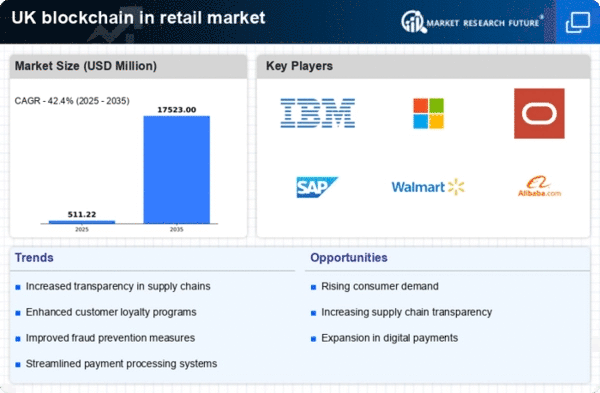
As per Market Research Future analysis, the UK blockchain in-retail market size was estimated at 359.0 USD Million in 2024. The UK blockchain in-retail market is projected to grow from 511.22 USD Million in 2025 to 17523.0 USD Million by 2035, exhibiting a compound annual growth rate (CAGR) of 42% during the forecast period 2025 - 2035

Key Market Trends & Highlights

The UK blockchain in-retail market is poised for substantial growth driven by technological advancements and evolving consumer expectations.

  • Enhanced supply chain transparency is becoming a critical focus for retailers seeking to build consumer trust.
  • Streamlined payment solutions are gaining traction, facilitating faster transactions and improving customer experiences.
  • Regulatory developments are shaping the landscape, ensuring compliance and fostering innovation within the sector.
  • Increased consumer demand for transparency and enhanced security are key drivers propelling market growth.

Market Size & Forecast

2024 Market Size 359.0 (USD Million)
2035 Market Size 17523.0 (USD Million)
CAGR (2025 - 2035) 42.4%

Major Players

IBM (US), Microsoft (US), Oracle (US), SAP (DE), Walmart (US), Alibaba (CN), Amazon (US), VeChain (SG), Modum (CH)

Our Impact
Enabled $4.3B Revenue Impact for Fortune 500 and Leading Multinationals
Partnering with 2000+ Global Organizations Each Year
30K+ Citations by Top-Tier Firms in the Industry

UK Blockchain in Retail Market Trends

The blockchain in-retail market is currently experiencing a transformative phase. This transformation is driven by advancements in technology and increasing consumer demand for transparency and security. Retailers are increasingly adopting blockchain solutions to enhance supply chain management, improve traceability of products, and streamline payment processes. This shift appears to be motivated by a desire to build trust with consumers, as they seek assurance regarding the authenticity and ethical sourcing of products. Furthermore, the integration of blockchain technology is likely to facilitate more efficient operations, potentially reducing costs and improving overall customer satisfaction. In addition, the regulatory landscape surrounding blockchain technology is evolving, with government bodies exploring frameworks that could support its adoption in retail. This regulatory interest suggests a recognition of the potential benefits that blockchain can bring to the sector. As retailers navigate these changes, they may find opportunities to leverage blockchain for innovative marketing strategies and enhanced customer engagement. Overall, the blockchain in-retail market seems poised for growth, with various stakeholders exploring its applications to meet the demands of a modern consumer base.

Enhanced Supply Chain Transparency

The blockchain market is witnessing a trend towards improved transparency in supply chains. Retailers are utilizing blockchain to track products from origin to shelf, allowing consumers to verify the authenticity and ethical sourcing of items. This transparency not only builds consumer trust but also helps retailers manage recalls and ensure compliance with regulations.

Streamlined Payment Solutions

Another notable trend is the adoption of blockchain for payment processing. Retailers are exploring decentralized payment systems that can reduce transaction fees and enhance security. This shift may lead to faster transactions and improved cash flow, benefiting both retailers and consumers.

Regulatory Developments and Compliance

The evolving regulatory environment is shaping the blockchain in-retail market. Government initiatives aimed at establishing clear guidelines for blockchain use are emerging. Retailers are likely to adapt their strategies to align with these regulations, ensuring compliance while leveraging the benefits of blockchain technology.

UK Blockchain in Retail Market Drivers

Enhanced Security and Fraud Prevention

Security concerns remain a critical issue in the retail sector, particularly regarding payment systems and customer data protection. The blockchain in-retail market offers robust security features that can mitigate risks associated with fraud and data breaches. By utilizing cryptographic techniques, blockchain ensures that transactions are secure and tamper-proof. A study indicates that retailers adopting blockchain technology can reduce fraud-related losses by as much as 50%. This enhanced security not only protects retailers but also instills confidence in consumers, thereby promoting the adoption of blockchain solutions in the retail industry.

Integration with Emerging Technologies

The blockchain market is increasingly being integrated with other emerging technologies such as artificial intelligence (AI) and the Internet of Things (IoT). This convergence allows for more sophisticated data analytics and real-time tracking of inventory and customer preferences. For instance, retailers can leverage AI algorithms to analyze blockchain data, leading to improved decision-making and personalized customer experiences. The potential for synergy between these technologies suggests a transformative impact on the retail landscape, driving further investment and innovation within the blockchain in-retail market.

Increased Consumer Demand for Transparency

The blockchain market is experiencing a notable surge in consumer demand for transparency regarding product origins and supply chain processes. As consumers become more conscious of ethical sourcing and sustainability, retailers are compelled to adopt blockchain technology to provide verifiable information about their products. This shift is evidenced by a survey indicating that approximately 73% of UK consumers are willing to pay more for products that offer transparency in sourcing. Consequently, retailers integrating blockchain solutions can enhance their brand reputation and foster customer loyalty, thereby driving growth in the blockchain in-retail market.

Regulatory Support and Framework Development

The regulatory environment surrounding blockchain technology is evolving, with UK authorities actively exploring frameworks to support its adoption in the retail sector. This regulatory support is crucial for fostering innovation and ensuring compliance with existing laws. The UK government has initiated discussions on creating guidelines that facilitate the safe use of blockchain while protecting consumer rights. As regulatory clarity improves, retailers are likely to feel more confident in investing in blockchain solutions, thereby propelling growth in the blockchain in-retail market. This supportive environment may also attract new entrants, further diversifying the market.

Cost Reduction through Operational Efficiency

The implementation of blockchain technology in the retail sector is poised to significantly reduce operational costs. By automating processes such as inventory management and payment reconciliation, retailers can minimize human error and streamline operations. Reports suggest that businesses utilizing blockchain can achieve cost savings of up to 30% in supply chain management. This efficiency not only enhances profitability but also allows retailers to allocate resources more effectively, thereby stimulating further investment in the blockchain in-retail market. As operational costs decrease, the attractiveness of blockchain solutions increases for retailers seeking competitive advantages.


Market Segment Insights

By Type: Public (Largest) vs. Private (Fastest-Growing)

In the UK blockchain in-retail market, the market share distribution among the three segments—Public, Private, and Consortium—reveals that Public blockchains hold the largest share due to their transparency and accessibility features. Private blockchains, while smaller in share, are gaining traction in sectors where confidentiality and control are prioritized, serving key roles in private retail networks. Consortium blockchains are also relevant, functioning as a middle ground that encourages collaboration among multiple parties without sacrificing confidentiality. Growth trends in this segment reflect a robust shift towards Private blockchains, driven by increased data privacy concerns and the need for enhanced security in transactions. Public blockchains continue to thrive, driven by their broad acceptance and innovative applications like cryptocurrencies. The rise of Consortium blockchains signifies a growing preference for partnerships that leverage shared infrastructure while minimizing operational risks, thus painting a diverse landscape for future adoption in the UK blockchain in-retail market.

Public (Dominant) vs. Private (Emerging)

Public blockchains are characterized by their openness, allowing anyone with internet access to participate in the network. This structure fosters accountability and transparency, making them particularly attractive in the retail sector for applications that require trust among users. Examples include cryptocurrency transactions and reward systems that benefit from decentralization. In contrast, Private blockchains are emerging as pivotal players in retail environments where sensitive data handling is paramount. They offer enhanced privacy and control mechanisms, allowing companies to dictate who has access to their network, thereby ensuring that competitive data is protected. This characteristic makes Private blockchains particularly attractive to retail businesses looking to implement blockchain technology while minimizing risks associated with data breaches.

By Platform: Ethereum (Largest) vs. Bitcoin (Fastest-Growing)

In the UK blockchain in-retail market, Ethereum currently holds the largest market share among platforms, showing strong adoption in various retail applications due to its robust smart contract capabilities. Bitcoin, however, is emerging rapidly as a preferred option for transactions, reflecting growing interest in its use as a digital currency for retail purchases. Other platforms like Ripple and R3 Corda also contribute to the landscape, but their share remains smaller as the focus shifts towards scalable and interoperable solutions. The growth dynamics in this sector are driven by the increasing demand for decentralized finance (DeFi) solutions and the rising acceptance of cryptocurrencies in retail payments. Ethereum's versatility allows it to adapt to new retail scenarios, while Bitcoin's branding as the first cryptocurrency is gaining traction in retail environments. Furthermore, innovations from platforms like Hyperledger Fabric and Quorum are fostering an ecosystem that encourages collaborations and enhances the transaction speed, leading to an overall positive outlook in this segment.

Ethereum (Dominant) vs. Bitcoin (Emerging)

Ethereum stands out in the UK blockchain in-retail market as a dominant platform due to its advanced smart contract functionality, allowing retailers to create automated processes and enhance transparency. As an open-source platform, it enables various applications ranging from supply chain management to consumer loyalty programs. Conversely, Bitcoin is emerging as a formidable player, primarily recognized for enabling peer-to-peer transactions. Its growing acceptance by major retailers is indicative of its potential to reshape traditional payment methods. The fundamental difference lies in Ethereum's focus on programmability and Bitcoin's role as a store of value, creating a dynamic interplay between these platforms as they evolve within the retail sector.

By Organization Size: Large Enterprises (Largest) vs. SMEs (Fastest-Growing)

The UK blockchain in-retail market shows a significant distribution of market share between large enterprises and small to medium enterprises (SMEs). Large enterprises hold a substantial portion of the market due to their robust infrastructure, established customer bases, and significant investment capabilities. SMEs, on the other hand, are increasingly carving out their niche, leveraging the flexibility and innovative potential that come with smaller operations. Growth trends indicate that while large enterprises currently dominate the market, SMEs are emerging as the fastest-growing segment. This growth is driven by the increasing adoption of blockchain technology among smaller retailers looking to enhance operational efficiencies and customer engagement. The rise of digital payment solutions and the demand for transparency in transactions are also fueling this growth among SMEs.

Large Enterprises (Dominant) vs. SMEs (Emerging)

Large enterprises in the UK blockchain in-retail market are characterized by their comprehensive resource availability, advanced technological expertise, and established market presence. They leverage blockchain technology to enhance supply chain transparency and improve customer trust. In contrast, SMEs are recognized for their agility and innovative approaches, often adopting blockchain solutions tailored to their unique needs. While they may lack the financial clout of large enterprises, SMEs are increasingly attracting investments and focusing on niche markets, positioning themselves as emerging players in this dynamic landscape. Their adaptability allows them to quickly implement blockchain solutions, making them vital contributors to the future growth of the UK blockchain in-retail market.

By Application: Payment Management (Largest) vs. Inventory Management (Fastest-Growing)

In the UK blockchain in-retail market, the application segment is diverse, with Payment Management holding the largest share due to its crucial role in facilitating secure and efficient transactions. Other significant areas include Compliance Management and Inventory Management, which contribute to overall market functionality. This segment's distribution demonstrates varying degrees of adoption and investment, with Payment Management leading due to the increasing demand for secure payment solutions. Growth trends in the application segment reflect a broadening focus on enhancing operational efficiencies through blockchain technology. As retailers embrace digital transformation, there is a notable increase in investment for emerging applications such as Fraud Management and Loyalty and Rewards Management. The push for transparency, security, and improved customer engagement drives market expansion, indicating a shift towards innovative frameworks in retail operations.

Payment Management (Dominant) vs. Inventory Management (Emerging)

Payment Management stands as the dominant application in the UK blockchain in-retail market, characterized by its ability to streamline transactions, reduce fraud, and enhance customer trust. Its established presence is supported by growing consumer demand for seamless payment experiences. In contrast, Inventory Management is emerging rapidly as retailers seek to optimize supply chain efficiencies and enhance stock control processes. This segment leverages blockchain's capabilities for real-time tracking and transparency, thus reducing discrepancies. Both applications are instrumental in reshaping retail operations, focusing on security and efficiency, while fostering customer loyalty through enhanced service delivery.

Get more detailed insights about UK Blockchain in Retail Market

Key Players and Competitive Insights

The blockchain in-retail market is currently characterized by a dynamic competitive landscape, driven by technological advancements and increasing consumer demand for transparency and efficiency. Major players such as IBM (US), Microsoft (US), and VeChain (SG) are at the forefront, leveraging their technological prowess to enhance operational efficiencies and customer engagement. IBM (US) focuses on providing robust blockchain solutions tailored for supply chain management, while Microsoft (US) emphasizes its Azure platform to facilitate blockchain integration across various retail applications. VeChain (SG), on the other hand, positions itself as a leader in product lifecycle management, utilizing blockchain to ensure product authenticity and traceability, thereby shaping a competitive environment that prioritizes innovation and customer trust.
Key business tactics within this market include localizing manufacturing and optimizing supply chains to enhance responsiveness to consumer needs. The competitive structure appears moderately fragmented, with a mix of established tech giants and emerging startups. This fragmentation allows for diverse approaches to blockchain implementation, with key players influencing market dynamics through strategic partnerships and technological advancements.
In October 2025, IBM (US) announced a collaboration with a leading UK supermarket chain to implement a blockchain-based solution aimed at improving food safety and traceability. This strategic move is significant as it not only enhances consumer confidence but also positions IBM (US) as a pivotal player in the retail sector's digital transformation. The partnership is expected to streamline supply chain processes, thereby reducing waste and improving operational efficiency.
In September 2025, Microsoft (US) launched a new initiative focused on integrating AI with its blockchain services, targeting retail businesses seeking to enhance customer experiences through personalized offerings. This initiative underscores Microsoft's commitment to innovation, suggesting that the convergence of AI and blockchain could redefine customer engagement strategies in the retail sector. By harnessing data analytics, retailers can potentially offer tailored solutions that meet evolving consumer preferences.
In August 2025, VeChain (SG) expanded its partnership with a prominent luxury goods retailer to enhance product authentication through blockchain technology. This collaboration is particularly noteworthy as it addresses the growing concern over counterfeit products in the luxury market. By ensuring product authenticity, VeChain (SG) not only strengthens its market position but also contributes to building consumer trust in high-value retail segments.
As of November 2025, current trends in the blockchain in-retail market indicate a strong emphasis on digitalization, sustainability, and the integration of AI technologies. Strategic alliances among key players are increasingly shaping the competitive landscape, fostering innovation and collaborative solutions. Looking ahead, it appears that competitive differentiation will evolve from traditional price-based strategies to a focus on technological innovation, supply chain reliability, and enhanced customer experiences. This shift suggests that companies prioritizing these aspects may gain a competitive edge in an increasingly complex market.

Key Companies in the UK Blockchain in Retail Market include

Industry Developments

The UK Blockchain in Retail Market has seen significant developments recently, notably with companies such as Ripple and VeChain actively enhancing their blockchain solutions to improve supply chain transparency and traceability. In July 2023, Accenture announced a collaboration with several UK retailers to implement blockchain technology for streamlining operations and ensuring data integrity. Furthermore, Lynx launched a pilot project in London aimed at utilizing blockchain for secure consumer transactions, marking a notable advancement in retail payment solutions. 

Major players like IBM and Oracle continue to invest in Research and Development to create more robust systems tailored for retail applications, addressing issues from authenticity to fraud prevention. The market valuation of companies involved in blockchain technology has surged, driven by the increasing demand for secure and efficient retail processes. In the last couple of years, events such as the rise of decentralized finance and NFT marketplaces have also reshaped the UK retail landscape.

Notably, in August 2022, Coinbase expanded its services within the UK, further integrating blockchain solutions into everyday retail interactions, reflecting an evident shift towards digital asset adopters in the retail sector.


Future Outlook

UK Blockchain in Retail Market Future Outlook

The blockchain in-retail market is poised for growth at 42.4% CAGR from 2025 to 2035, driven by enhanced supply chain transparency, consumer demand for security, and operational efficiency.

New opportunities lie in:

  • Integration of blockchain for real-time inventory tracking systems.
  • Development of decentralized loyalty programs to enhance customer engagement.
  • Implementation of smart contracts for automated payment processing.

By 2035, the market is expected to achieve substantial growth, transforming retail operations and consumer interactions.

Market Segmentation

UK Blockchain in Retail Market Type Outlook

  • Public
  • Private
  • Consortium

UK Blockchain in Retail Market Platform Outlook

  • Bitcoin
  • Ripple
  • Ethereum
  • R3 Corda
  • Hyperledger Fabric
  • Multichain
  • Quorum
  • Others

UK Blockchain in Retail Market Application Outlook

  • Compliance Management
  • Database Management
  • Auditing
  • Payment Management
  • Inventory Management
  • Loyalty and Rewards Management
  • Fraud Management
  • Others

UK Blockchain in Retail Market Organization Size Outlook

  • Large Enterprises
  • SMEs

Report Scope

MARKET SIZE 2024 359.0(USD Million)
MARKET SIZE 2025 511.22(USD Million)
MARKET SIZE 2035 17523.0(USD Million)
COMPOUND ANNUAL GROWTH RATE (CAGR) 42.4% (2025 - 2035)
REPORT COVERAGE Revenue Forecast, Competitive Landscape, Growth Factors, and Trends
BASE YEAR 2024
Market Forecast Period 2025 - 2035
Historical Data 2019 - 2024
Market Forecast Units USD Million
Key Companies Profiled IBM (US), Microsoft (US), Oracle (US), SAP (DE), Walmart (US), Alibaba (CN), Amazon (US), VeChain (SG), Modum (CH)
Segments Covered Type, Platform, Organization Size, Application
Key Market Opportunities Integration of blockchain enhances supply chain transparency and consumer trust in the retail sector.
Key Market Dynamics Growing adoption of blockchain technology enhances transparency and efficiency in retail supply chains across the UK.
Countries Covered UK
Leave a Comment

FAQs

What is the projected market size of the UK Blockchain in Retail Market by 2024?

The UK Blockchain in Retail Market is projected to be valued at 362.88 million USD by 2024.

What will the market size of the UK Blockchain in Retail Market be by 2035?

By 2035, the UK Blockchain in Retail Market is expected to reach a valuation of 1500.0 million USD.

What is the expected CAGR for the UK Blockchain in Retail Market from 2025 to 2035?

The expected compound annual growth rate for the UK Blockchain in Retail Market from 2025 to 2035 is 13.771 percent.

What are the key types in the UK Blockchain in Retail Market?

The key types in the UK Blockchain in Retail Market are Public, Private, and Consortium blockchain.

What is the market value for Public blockchain in the UK by 2035?

The market value for Public blockchain in the UK is expected to be 550.0 million USD by 2035.

What is the expected market value for Private blockchain in the UK by 2035?

By 2035, the market value for Private blockchain in the UK is anticipated to be 600.0 million USD.

What is the projected market value for Consortium blockchain in the UK by 2035?

The projected market value for Consortium blockchain in the UK is expected to reach 350.0 million USD by 2035.

Who are the major players in the UK Blockchain in Retail Market?

Some of the major players in the UK Blockchain in Retail Market include Ripple, Blockstream, Cisco, and VeChain.

What are some emerging trends in the UK Blockchain in Retail Market?

Emerging trends in the UK Blockchain in Retail Market include increased adoption for supply chain transparency and enhanced customer engagement.

How is the current economic climate impacting the UK Blockchain in Retail Market?

The current economic climate is resulting in greater focus on efficiency and transparency in the UK Blockchain in Retail Market.

Download Free Sample

Kindly complete the form below to receive a free sample of this Report

Compare Licence

×
Features License Type
Single User Multiuser License Enterprise User
Price $4,950 $5,950 $7,250
Maximum User Access Limit 1 User Upto 10 Users Unrestricted Access Throughout the Organization
Free Customization
Direct Access to Analyst
Deliverable Format
Platform Access
Discount on Next Purchase 10% 15% 15%
Printable Versions