×
Request Free Sample ×

Kindly complete the form below to receive a free sample of this Report

* Please use a valid business email

Leading companies partner with us for data-driven Insights

clients tt-cursor
Hero Background

France Biometric Banking Market

ID: MRFR/BS/57219-HCR
200 Pages
Garvit Vyas
February 2026

France Biometric Banking Market Size, Share and Research Report By Product Type (Hardware, Software) and By Application (Finger Print, Facial Recognition, Hand Geometry, Iris Recognition, Others)- Industry Forecast Till 2035

Share:
Download PDF ×

We do not share your information with anyone. However, we may send you emails based on your report interest from time to time. You may contact us at any time to opt-out.

France Biometric Banking Market Infographic
Purchase Options

France Biometric Banking Market Summary

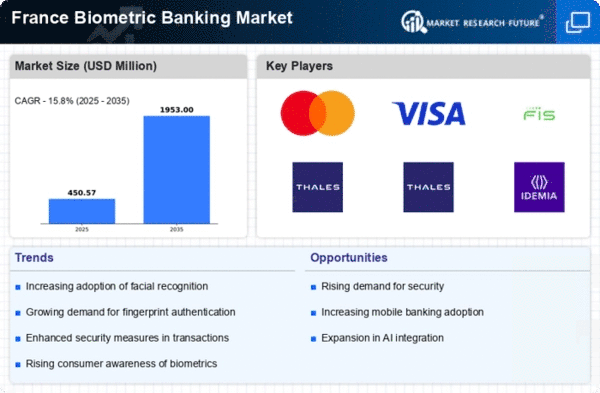
As per Market Research Future analysis, the France biometric banking market Size was estimated at 389.09 USD Million in 2024. The France biometric banking market is projected to grow from 450.57 USD Million in 2025 to 1953.0 USD Million by 2035, exhibiting a compound annual growth rate (CAGR) of 15% during the forecast period 2025 - 2035

Key Market Trends & Highlights

The France biometric banking market is experiencing robust growth driven by technological advancements and regulatory support.

  • The market is witnessing increased adoption of biometric authentication methods across various financial institutions.
  • Regulatory support for biometric solutions is enhancing the credibility and implementation of these technologies in banking.
  • The retail banking segment remains the largest, while the wealth management segment is emerging as the fastest-growing area in biometric banking.
  • Rising cybersecurity concerns and consumer demand for enhanced security features are key drivers propelling market growth.

Market Size & Forecast

2024 Market Size 389.09 (USD Million)
2035 Market Size 1953.0 (USD Million)
CAGR (2025 - 2035) 15.8%

Major Players

Mastercard (US), Visa (US), FIS (US), Gemalto (NL), Thales (FR), IDEMIA (FR), BioCatch (IL), SecuGen (US), NEC (JP), Fingerprint Cards (SE)

Our Impact
Enabled $4.3B Revenue Impact for Fortune 500 and Leading Multinationals
Partnering with 2000+ Global Organizations Each Year
30K+ Citations by Top-Tier Firms in the Industry

France Biometric Banking Market Trends

The biometric banking market is experiencing notable advancements, driven by the increasing demand for secure and efficient banking solutions. In France, financial institutions are progressively adopting biometric technologies to enhance customer authentication processes. This shift appears to be influenced by a growing awareness of cybersecurity threats and the need for robust identity verification methods. As a result, banks are integrating biometric systems such as fingerprint recognition, facial recognition, and voice authentication into their services. This trend not only aims to improve security but also to streamline user experiences, making transactions faster and more convenient. Moreover, regulatory frameworks in France are evolving to accommodate these technological innovations. The government is actively promoting digital transformation within the financial sector, which includes the implementation of biometric solutions. This regulatory support seems to encourage banks to invest in advanced technologies, thereby fostering a competitive landscape. As the biometric banking market continues to develop, it is likely that consumer trust will increase, leading to broader acceptance of these technologies in everyday banking activities. Overall, the future of the biometric banking market in France appears promising, with ongoing innovations and regulatory backing paving the way for enhanced financial services.

Increased Adoption of Biometric Authentication

Financial institutions are increasingly implementing biometric authentication methods to enhance security. This trend is driven by the need to protect sensitive customer information and reduce fraud. As banks adopt technologies like fingerprint and facial recognition, they aim to provide a seamless and secure banking experience.

Regulatory Support for Biometric Solutions

The French government is actively promoting the use of biometric technologies in the banking sector. Regulatory frameworks are evolving to support the integration of these solutions, encouraging banks to invest in advanced security measures. This support is likely to accelerate the adoption of biometric systems.

Focus on Customer Experience

There is a growing emphasis on improving customer experience within the biometric banking market. Financial institutions are leveraging biometric technologies to streamline processes, making transactions quicker and more user-friendly. This focus on convenience is expected to drive further adoption of biometric solutions.

France Biometric Banking Market Drivers

Rising Cybersecurity Concerns

The biometric banking market in France is experiencing growth driven by escalating concerns regarding cybersecurity. As financial institutions face increasing threats from cybercriminals, the need for robust security measures becomes paramount. Biometric authentication methods, such as fingerprint and facial recognition, offer enhanced security features that traditional methods cannot match. According to recent data, approximately 70% of French banks are investing in biometric solutions to mitigate risks associated with identity theft and fraud. This trend indicates a shift towards more secure banking practices, thereby propelling the biometric banking market forward. The integration of biometric technology not only enhances security but also fosters customer trust, which is essential for the long-term sustainability of financial institutions in France.

Consumer Demand for Enhanced Security Features

Consumer demand for enhanced security features is a significant driver of the biometric banking market in France. As customers become more aware of the risks associated with traditional banking methods, they increasingly seek solutions that offer greater protection for their financial information. Surveys indicate that over 60% of French consumers prefer biometric authentication methods over traditional passwords due to their perceived security benefits. This shift in consumer preference is prompting banks to invest in biometric technologies to meet customer expectations. The biometric banking market is likely to benefit from this trend, as financial institutions strive to provide secure and user-friendly services that align with consumer demands for safety and convenience.

Technological Advancements in Biometric Systems

Technological advancements play a crucial role in the expansion of the biometric banking market in France. Innovations in biometric recognition technologies, such as improved algorithms and machine learning capabilities, enhance the accuracy and speed of authentication processes. These advancements enable banks to offer seamless and efficient services to their customers. For instance, the implementation of advanced facial recognition systems has shown to reduce transaction times by up to 30%. As a result, financial institutions are increasingly adopting these technologies to streamline operations and improve customer satisfaction. The ongoing evolution of biometric systems suggests a promising future for the biometric banking market, as banks seek to leverage cutting-edge technology to stay competitive in a rapidly changing landscape.

Competitive Pressure Among Financial Institutions

Competitive pressure among financial institutions in France is a notable driver of the biometric banking market. As banks strive to differentiate themselves in a crowded marketplace, the adoption of innovative technologies, including biometrics, becomes essential. Financial institutions are increasingly recognizing that offering biometric authentication can enhance their value proposition and attract tech-savvy customers. Reports suggest that banks implementing biometric solutions experience a 20% increase in customer retention rates. This competitive dynamic is likely to propel the biometric banking market, as institutions seek to leverage technology to gain a competitive edge and meet the evolving expectations of their clientele.

Regulatory Framework Supporting Biometric Solutions

The regulatory framework in France is evolving to support the adoption of biometric solutions in the banking sector. Government initiatives aimed at enhancing financial security and consumer protection are encouraging banks to implement biometric technologies. Recent regulations emphasize the importance of secure authentication methods, which aligns with the capabilities offered by biometric systems. This supportive regulatory environment is likely to facilitate the growth of the biometric banking market, as banks are incentivized to adopt compliant solutions that enhance security. Furthermore, the alignment of regulatory standards with biometric technologies may lead to increased consumer confidence, further driving market expansion.


Market Segment Insights

By Product Type: Hardware (Largest) vs. Software (Fastest-Growing)

In the France biometric banking market, the distribution of market share between Hardware and Software indicates a clear preference for physical devices that facilitate biometric authentication. Hardware holds a substantial share due to its established role in securing banking transactions and ensuring user identification. The reliability and robustness of hardware solutions, such as biometric scanners and identification devices, have made them the preferred choice among financial institutions looking to enhance security protocols. On the other hand, the Software segment is experiencing rapid growth, driven by technological advancements and the increasing need for comprehensive biometric solutions. Innovations in software solutions that integrate machine learning and artificial intelligence are propelling this segment forward. Factors such as the growing focus on enhancing customer experience and the need for advanced fraud prevention measures are key drivers of the software segment's emergence in the market.

Hardware: Dominant vs. Software: Emerging

Hardware solutions in the France biometric banking market are characterized by their physical presence and reliability. Devices such as fingerprint scanners and facial recognition systems are critical for secure banking operations, making this segment dominant due to widespread adoption by banks and financial institutions. Meanwhile, Software solutions, though emerging, are gaining traction rapidly due to their ability to integrate seamlessly with existing banking systems and enhance security measures through advanced algorithms. The software segment is favored for its adaptability and the ongoing development of new functionalities that cater to evolving banking needs, positioning it as a crucial component alongside established hardware solutions.

By Product Application: Finger Print (Largest) vs. Facial Recognition (Fastest-Growing)

In the France biometric banking market, the product application segment showcases a diverse distribution of biometric technologies. Finger print technology retains the largest share, appealing to traditional banking practices due to its reliability and user acceptance. Following closely, facial recognition is rapidly gaining traction driven by advancements in AI and an increasing focus on secure customer authentication, positioning itself as a strong contender in the market. Growth trends indicate a rising adoption rate of facial recognition as financial institutions prioritize enhancing security measures against fraud and data breaches. The substantial investments in artificial intelligence and machine learning are nurturing this segment's expansion, making it one of the fastest-growing applications in the biometric banking landscape. Understanding customer preferences and regulatory compliance are critical factors in shaping this segment's trajectory.

Finger Print (Dominant) vs. Facial Recognition (Emerging)

Finger print technology has established itself as the dominant force in the France biometric banking market, leveraging its ease of use and historical reliability to secure customer identities. This established method enjoys significant trust from consumers, ensuring a steady demand from banks looking to maintain secure transactions. Conversely, facial recognition is emerging as a compelling option due to its non-intrusive nature and rapid authentication capabilities. With technological breakthroughs enhancing its accuracy and speed, facial recognition is capturing attention for its potential to streamline user experiences while bolstering security protocols. As banks seek innovative solutions, the juxtaposition of finger print technology's dominance with facial recognition's emerging presence indicates a dynamic shift in the market landscape.

Get more detailed insights about France Biometric Banking Market

Key Players and Competitive Insights

The biometric banking market in France is characterized by a rapidly evolving competitive landscape, driven by technological advancements and increasing consumer demand for secure banking solutions. Key players such as Mastercard (US), Thales (France), and IDEMIA (France) are at the forefront, each adopting distinct strategies to enhance their market presence. Mastercard (US) focuses on innovation through partnerships with fintech companies, aiming to integrate biometric solutions into their payment systems. Thales (France) emphasizes regional expansion, leveraging its expertise in security to offer comprehensive biometric solutions tailored to local regulations. IDEMIA (France) positions itself as a leader in identity verification, investing heavily in R&D to develop cutting-edge biometric technologies that enhance user experience and security. Collectively, these strategies contribute to a competitive environment that prioritizes technological innovation and customer-centric solutions.
In terms of business tactics, companies are increasingly localizing manufacturing and optimizing supply chains to enhance efficiency and reduce costs. The market appears moderately fragmented, with several key players exerting influence over various segments. This fragmentation allows for niche players to emerge, fostering innovation and competition. The collective influence of major companies shapes the market dynamics, as they strive to differentiate themselves through unique offerings and strategic partnerships.
In October 2025, Mastercard (US) announced a collaboration with a leading fintech startup to develop a biometric payment solution that utilizes facial recognition technology. This strategic move is significant as it not only enhances Mastercard's product portfolio but also positions the company to capture a growing segment of tech-savvy consumers who prioritize convenience and security in their transactions. The partnership is expected to accelerate the adoption of biometric payments in France, aligning with broader trends in digital banking.
In September 2025, IDEMIA (France) launched a new biometric authentication platform designed specifically for mobile banking applications. This initiative underscores IDEMIA's commitment to innovation and its focus on enhancing user experience. By providing a seamless and secure authentication process, IDEMIA aims to strengthen its position in the biometric banking market, catering to the increasing demand for mobile banking solutions that prioritize security without compromising usability.
In August 2025, Thales (France) expanded its biometric identity verification services by acquiring a smaller tech firm specializing in AI-driven biometric solutions. This acquisition is indicative of Thales's strategy to bolster its technological capabilities and enhance its service offerings. By integrating advanced AI technologies, Thales aims to provide more robust and efficient biometric solutions, thereby reinforcing its competitive edge in the market.
As of November 2025, current trends in the biometric banking market include a strong emphasis on digitalization, sustainability, and the integration of AI technologies. Strategic alliances among key players are shaping the competitive landscape, fostering innovation and collaboration. Looking ahead, it appears that competitive differentiation will increasingly hinge on technological advancements and supply chain reliability, rather than solely on price. Companies that prioritize innovation and customer-centric solutions are likely to thrive in this dynamic environment.

Key Companies in the France Biometric Banking Market include

Industry Developments

Recent developments in the France Biometric Banking Market have showcased significant advancements and shifts in strategy by major players such as Crédit Agricole, BNP Paribas, and Société Générale. The trend towards enhanced security measures has led to the increasing adoption of biometric technologies like fingerprint and facial recognition systems in banking services. Notably, in December 2022, Orange Bank announced the integration of biometric identification features to streamline customer verification processes. In February 2023, LCL launched a new biometric payment solution that enables customers to make secure transactions without the use of cards. 

Additionally, in July 2023, Société Générale revealed plans to strengthen its biometric authentication strategy, aiming to enhance security while improving customer experience. Growth in market valuation has been noteworthy, with several banks reporting increases in user trust and satisfaction through biometric solutions, directly impacting customer retention and acquisition strategies. Over the past two to three years, the focus on digital transformation and reduced fraud rates has further standardized biometrics in banking practices across France. The French government's emphasis on cybersecurity has also propelled investment in secure banking technologies, supporting the transition to more robust biometric systems in financial institutions.

Future Outlook

France Biometric Banking Market Future Outlook

The biometric banking market in France is projected to grow at a 15.8% CAGR from 2025 to 2035, driven by technological advancements and increasing security demands.

New opportunities lie in:

  • Integration of biometric authentication in mobile banking apps
  • Development of biometric-enabled ATMs for enhanced security
  • Partnerships with fintech firms for innovative biometric solutions

By 2035, the biometric banking market is expected to achieve substantial growth and innovation.

Market Segmentation

France Biometric Banking Market Product Type Outlook

  • Hardware
  • Software

France Biometric Banking Market Product Application Outlook

  • Finger Print
  • Facial recognition
  • Hand Geometry
  • Iris Recognition
  • Others

Report Scope

MARKET SIZE 2024 389.09(USD Million)
MARKET SIZE 2025 450.57(USD Million)
MARKET SIZE 2035 1953.0(USD Million)
COMPOUND ANNUAL GROWTH RATE (CAGR) 15.8% (2025 - 2035)
REPORT COVERAGE Revenue Forecast, Competitive Landscape, Growth Factors, and Trends
BASE YEAR 2024
Market Forecast Period 2025 - 2035
Historical Data 2019 - 2024
Market Forecast Units USD Million
Key Companies Profiled Mastercard (US), Visa (US), FIS (US), Gemalto (NL), Thales (FR), IDEMIA (FR), BioCatch (IL), SecuGen (US), NEC (JP), Fingerprint Cards (SE)
Segments Covered Product Type, Product Application
Key Market Opportunities Integration of advanced biometric technologies enhances security and customer experience in the biometric banking market.
Key Market Dynamics Rising consumer demand for secure transactions drives innovation in biometric banking technologies and regulatory adaptations.
Countries Covered France
Leave a Comment

FAQs

What is the expected market size of the France Biometric Banking Market by 2035?

The France Biometric Banking Market is expected to be valued at 1300.0 USD Million by 2035.

What market value is projected for the France Biometric Banking Market in 2024?

In 2024, the France Biometric Banking Market is projected to be valued at 388.8 USD Million.

What is the expected CAGR for the France Biometric Banking Market from 2025 to 2035?

The expected CAGR for the France Biometric Banking Market from 2025 to 2035 is 11.598%.

Which segment of the France Biometric Banking Market is expected to lead in market value by 2035?

The Hardware segment of the France Biometric Banking Market is expected to lead with a value of 550.0 USD Million by 2035.

What is the projected market value for the Software segment of the France Biometric Banking Market in 2035?

The Software segment is projected to be valued at 750.0 USD Million in 2035.

Which companies are considered key players in the France Biometric Banking Market?

Key players in the France Biometric Banking Market include Crédit Agricole, BNP Paribas, and Société Générale.

What are the application areas driving the growth of the France Biometric Banking Market?

The growth of the France Biometric Banking Market is driven by applications in secure payment processing and customer identification.

What challenges does the France Biometric Banking Market currently face?

The France Biometric Banking Market faces challenges such as ensuring data security and consumer trust in biometric technologies.

How does the competitive landscape appear in the France Biometric Banking Market?

The competitive landscape features a mix of traditional banks and fintech companies offering biometric solutions.

What growth drivers are contributing to the expansion of the France Biometric Banking Market?

Key growth drivers include increasing security concerns and the rising adoption of digital banking solutions.

Download Free Sample

Kindly complete the form below to receive a free sample of this Report

Compare Licence

×
Features License Type
Single User Multiuser License Enterprise User
Price $4,950 $5,950 $7,250
Maximum User Access Limit 1 User Upto 10 Users Unrestricted Access Throughout the Organization
Free Customization
Direct Access to Analyst
Deliverable Format
Platform Access
Discount on Next Purchase 10% 15% 15%
Printable Versions