×
Request Free Sample ×

Kindly complete the form below to receive a free sample of this Report

* Please use a valid business email

Leading companies partner with us for data-driven Insights

clients tt-cursor
Hero Background

China Security Assertion Markup Language Authentication Market

ID: MRFR/ICT/60095-HCR
200 Pages
Aarti Dhapte
February 2026

China Security Assertion Markup Language Authentication Market Research Report By Application (Single Sign-On, Identity Federation, Web Services Security, Mobile Applications), By Deployment Type (Cloud-based, On-premises), By Organization Size (Small Enterprises, Medium Enterprises, Large Enterprises), and By Service Type (Professional Services, Managed Services)- Forecast to 2035

Share:
Download PDF ×

We do not share your information with anyone. However, we may send you emails based on your report interest from time to time. You may contact us at any time to opt-out.

China Security Assertion Markup Language Authentication Market Infographic
Purchase Options

China Security Assertion Markup Language Authentication Market Summary

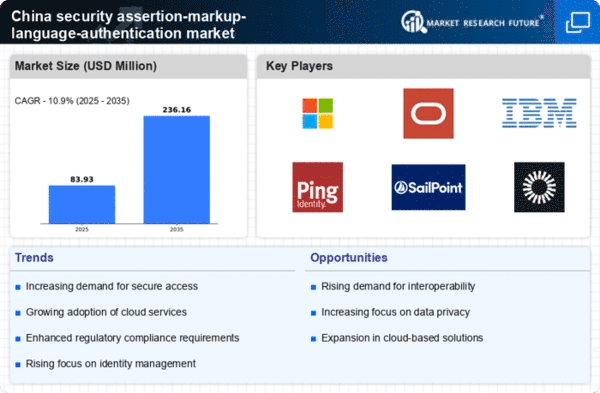
As per Market Research Future analysis, the China Security Assertion Markup Language Authentication Market size was estimated at 75.68 USD Million in 2024. The Security Assertion-markup-language-authentication market is projected to grow from 83.93 USD Million in 2025 to 236.16 USD Million by 2035, exhibiting a compound annual growth rate (CAGR) of 10% during the forecast period 2025 - 2035

Key Market Trends & Highlights

The China security assertion-markup-language-authentication market is experiencing robust growth driven by increasing demand for secure transactions and cloud integration.

  • The market is witnessing a rising demand for secure transactions, particularly in the e-commerce segment, which is the largest.
  • Integration with cloud services is becoming a critical trend, especially among businesses seeking scalable solutions.
  • Support from regulatory frameworks is enhancing market stability, with the fastest-growing segment being online services.
  • Increasing cybersecurity threats and government initiatives for digital security are key drivers propelling market expansion.

Market Size & Forecast

2024 Market Size 75.68 (USD Million)
2035 Market Size 236.16 (USD Million)
CAGR (2025 - 2035) 10.9%

Major Players

Microsoft (US), Oracle (US), IBM (US), Ping Identity (US), SailPoint Technologies (US), Okta (US), ForgeRock (US), OneLogin (US)

Our Impact
Enabled $4.3B Revenue Impact for Fortune 500 and Leading Multinationals
Partnering with 2000+ Global Organizations Each Year
30K+ Citations by Top-Tier Firms in the Industry

China Security Assertion Markup Language Authentication Market Trends

The China Security Assertion Markup Language Authentication Market is experiencing notable growth, driven by the increasing demand for secure online transactions and data protection. As organizations in various sectors prioritize cybersecurity, the adoption of SAML-based solutions is becoming more prevalent. This trend is particularly evident industries such as finance, healthcare, and e-commerce, where safeguarding sensitive information is paramount. Furthermore, the integration of SAML with cloud services is enhancing its appeal, as businesses seek to streamline access management while ensuring robust security measures are in place. In addition, regulatory frameworks in China are evolving to support the implementation of advanced authentication methods. The government is actively promoting digital transformation initiatives, which further fuels the need for secure authentication solutions. As a result, the security assertion-markup-language-authentication market is poised for continued expansion, with organizations increasingly recognizing the importance of adopting SAML to mitigate risks associated with identity theft and unauthorized access. This shift towards enhanced security protocols is likely to shape the future landscape of digital authentication in the region.

Rising Demand for Secure Transactions

The security assertion-markup-language-authentication market is witnessing a surge in demand for secure online transactions. Organizations are increasingly adopting SAML solutions to protect sensitive data and ensure secure access to applications. This trend is particularly pronounced in sectors such as finance and healthcare, where data breaches can have severe consequences.

Integration with Cloud Services

The integration of security assertion-markup-language-authentication with cloud services is becoming a prominent trend. As businesses migrate to cloud-based platforms, the need for seamless and secure authentication processes is critical. SAML provides a standardized approach to manage user identities across multiple cloud applications.

Support from Regulatory Frameworks

Regulatory frameworks in China are evolving to encourage the adoption of advanced authentication methods. The government is promoting digital security initiatives, which are likely to drive the growth of the security assertion-markup-language-authentication market. Compliance with these regulations is becoming essential for organizations to safeguard their digital assets.

China Security Assertion Markup Language Authentication Market Drivers

Increasing Cybersecurity Threats

The rise in cybersecurity threats in China has propelled the demand for robust authentication mechanisms, particularly in the security assertion-markup-language-authentication market. As organizations face sophisticated attacks, the need for secure identity management solutions becomes paramount. Reports indicate that cybercrime costs in China could reach $1 trillion by 2025, highlighting the urgency for effective security measures. This environment fosters a growing reliance on SAML-based authentication, which offers enhanced security features. Consequently, businesses are increasingly adopting SAML to protect sensitive data and maintain customer trust, thereby driving growth in the security assertion-markup-language-authentication market.

Increased Focus on User Experience

In the competitive landscape of digital services, enhancing user experience has become a priority for businesses in China. The security assertion-markup-language-authentication market is influenced by the need for seamless and efficient authentication processes. SAML enables organizations to provide a smooth user experience through single sign-on capabilities, reducing friction during the login process. As companies strive to retain customers and improve satisfaction, the adoption of SAML solutions is likely to increase. This focus on user experience, combined with the necessity for security, positions the security assertion-markup-language-authentication market for continued growth.

Rising Adoption of Cloud Computing

The increasing adoption of cloud computing in China is a significant driver for the security assertion-markup-language-authentication market. As organizations migrate to cloud-based services, the need for secure access and identity management becomes critical. SAML facilitates single sign-on (SSO) capabilities, allowing users to access multiple cloud applications with a single set of credentials. This convenience, coupled with enhanced security features, makes SAML an attractive option for businesses. The cloud services market in China is anticipated to grow at a CAGR of over 30% through 2025, indicating a robust demand for SAML solutions in the security assertion-markup-language-authentication market.

Growth of E-commerce and Online Services

The rapid expansion of e-commerce and online services in China has created a pressing need for secure authentication solutions, thereby influencing the security assertion-markup-language-authentication market. With online retail sales projected to surpass $2 trillion by 2025, businesses are increasingly focused on safeguarding customer data. SAML provides a seamless and secure method for user authentication across multiple platforms, which is essential for maintaining consumer confidence. As more companies transition to digital platforms, the demand for SAML-based solutions is expected to rise, further propelling the growth of the security assertion-markup-language-authentication market.

Government Initiatives for Digital Security

The Chinese government has implemented various initiatives aimed at enhancing digital security, which significantly impacts the security assertion-markup-language-authentication market. Policies promoting cybersecurity standards and frameworks encourage organizations to adopt advanced authentication technologies. For instance, the Cybersecurity Law of 2017 mandates that companies implement stringent security measures, including identity verification protocols. This regulatory landscape fosters a conducive environment for SAML adoption, as organizations seek compliance with government mandates. As a result, the security assertion-markup-language-authentication market is likely to experience substantial growth, driven by the need for adherence to these regulations.

Market Segment Insights

By Application: Single Sign-On (Largest) vs. Identity Federation (Fastest-Growing)

In the China security assertion-markup-language-authentication market, Single Sign-On (SSO) dominates the application segment, accounting for the largest share of market distribution. This is largely due to the increasing demand for streamlined user authentication processes across various platforms and services, which enhances user experience and security. Identity Federation also plays a significant role but is emerging rapidly as organizations seek to integrate multiple identity management systems, particularly for enhanced security and collaboration across borders. The growth trends in this segment are primarily driven by the increasing need for robust cybersecurity measures and the proliferation of digital services. SSO is favored by businesses looking to simplify user access while maintaining safety, leading to its steady rise in adoption rates. Meanwhile, Identity Federation is experiencing the fastest growth as organizations adapt their existing systems for greater interoperability and compliance with international standards. The push towards mobile applications further fuels the demand, positioning both segments for continued expansion in the coming years.

Single Sign-On (Dominant) vs. Identity Federation (Emerging)

Single Sign-On (SSO) stands out as the dominant application in the China security assertion-markup-language-authentication market, providing users with a seamless login experience across multiple platforms. Its ability to enhance security while simplifying the authentication process has made it an essential tool for businesses. On the other hand, Identity Federation is emerging as a critical solution for enterprises looking to integrate various identity management systems, allowing for secure data sharing and collaboration across different organizations. This segment is characterized by its flexibility and ability to meet complex regulatory requirements, making it increasingly attractive in a globalized market. Both segments showcase varying levels of maturity, with SSO being widely adopted while Identity Federation is rapidly gaining traction.

By Deployment Type: Cloud-based (Largest) vs. On-premises (Fastest-Growing)

In the deployment type segment of the China security assertion-markup-language-authentication market, cloud-based solutions currently hold the largest market share, attributed to their scalability and ease of integration within existing systems. The increased adoption of cloud services by organizations is driving this trend, as they seek to enhance flexibility and reduce operational costs. In contrast, on-premises solutions, while smaller in share, are experiencing rapid growth as organizations prioritize data governance and security, necessitating a shift back to more controlled environments. The growth trends indicate a strong push towards hybrid deployment models that combine both cloud and on-premises advantages. Several factors are contributing to this, including regulatory compliance, evolving security threats, and the demand for customized solutions. As end-users recognize the benefits of a dual approach, the market is poised to see significant shifts, with on-premises deployments emerging as a necessary component in a diversified security strategy.

Cloud-based: Dominant vs. On-premises: Emerging

Cloud-based authentication solutions are characterized by their robust scalability, allowing organizations to easily adjust resources according to their needs. This flexibility is appealing in today’s dynamic business environment, where organizations require rapid deployment and updates. Furthermore, these solutions benefit from continuous updates and improvements without the need for substantial hardware investments. On the other hand, on-premises solutions are becoming increasingly popular among entities requiring stringent compliance and data protection measures. These systems offer greater control over sensitive data and align more closely with traditional IT infrastructure. As security concerns continue to grow, on-premises is regaining traction, making it the fastest-growing option as organizations seek to balance flexibility with security.

By Organization Size: Small Enterprises (Largest) vs. Large Enterprises (Fastest-Growing)

The China security assertion-markup-language-authentication market showcases a distinctive distribution of market share among various organization sizes. Small Enterprises hold a significant portion of the market, making them the largest segment due to their extensive adoption of cost-effective authentication solutions. Conversely, Large Enterprises are witnessing a notable increase in market share as they adopt advanced security measures to protect their assets and sensitive information, reflecting a shift in focus towards comprehensive security protocols. Growth trends indicate that Small Enterprises will continue to be the dominant force within this market segment, primarily driven by increasing digitalization and the need for secure online transactions. On the other hand, Large Enterprises represent the fastest-growing segment, fueled by regulatory compliance and a rising emphasis on cybersecurity risks. This dynamic showcases a competitive landscape where businesses of varying sizes are actively engaging with innovative solutions to enhance their security postures.

Small Enterprises (Dominant) vs. Large Enterprises (Emerging)

Small Enterprises in the China security assertion-markup-language-authentication market are characterized by their agile operations and a keen alignment with budget-friendly authentication solutions. They typically prioritize simplicity and effectiveness, allowing them to rapidly adopt security protocols tailored to their unique needs. In contrast, Large Enterprises exhibit a more complex security infrastructure, requiring sophisticated authentication mechanisms to manage extensive networks and sensitive data. As the Emerging segment, Large Enterprises are investing in advanced technologies to enhance their security frameworks, reflecting a growing recognition of the significance of robust authentication measures in a rapidly evolving digital landscape.

By Service Type: Managed Services (Largest) vs. Professional Services (Fastest-Growing)

In the current landscape of the market, Managed Services account for a substantial share, distinguishing themselves as the largest component within the Service Type segment. This dominance is primarily due to the rising demand for comprehensive solutions that integrate multiple security protocols and frameworks, making them a preferred choice among organizations. Meanwhile, Professional Services, although smaller in market share, exhibit robust growth, driven by the increasing need for specialized expertise in implementing and managing security solutions effectively. Growth trends indicate that both segments are benefiting from the evolving cybersecurity landscape, but Professional Services are on a faster trajectory. The demand for tailored consulting and training services has surged as organizations seek to enhance their security posture amidst escalating threats. Additionally, Managed Services continue to thrive due to their scalability and cost-effectiveness, appealing to a broader range of clients who prefer outsourcing their security needs to expert providers.

Managed Services (Dominant) vs. Professional Services (Emerging)

Managed Services stand out as the dominant segment, focusing on delivering comprehensive and outsourced security solutions, allowing organizations to streamline their operations and enhance security without heavy investments in in-house teams. This approach caters to various industries, ensuring constant monitoring and immediate responses to security threats. On the other hand, Professional Services represent the emerging segment, characterized by their bespoke offerings that include consultancy, training, and implementation services. These services are vital for organizations needing specialized knowledge and support, particularly as cybersecurity regulations become more stringent, making Professional Services crucial for compliance and effective risk management.

Get more detailed insights about China Security Assertion Markup Language Authentication Market

Key Players and Competitive Insights

The security assertion-markup-language-authentication market is currently characterized by a dynamic competitive landscape, driven by the increasing demand for secure identity management solutions. Key players such as Microsoft (US), Oracle (US), and IBM (US) are at the forefront, leveraging their technological prowess to enhance their offerings. Microsoft (US) focuses on integrating advanced AI capabilities into its authentication solutions, thereby improving user experience and security. Oracle (US) emphasizes strategic partnerships to expand its market reach, while IBM (US) invests heavily in research and development to innovate its security frameworks. Collectively, these strategies foster a competitive environment that is both innovative and responsive to market needs.In terms of business tactics, companies are increasingly localizing their operations to better serve the Chinese market, optimizing supply chains to enhance efficiency. The market structure appears moderately fragmented, with several players vying for market share. However, the influence of major companies is substantial, as they set industry standards and drive technological advancements that smaller firms often follow.

In October Microsoft (US) announced a significant upgrade to its Azure Active Directory, incorporating enhanced security features that utilize machine learning to detect anomalies in user behavior. This strategic move not only strengthens its position in the market but also aligns with the growing trend of AI integration in security solutions, potentially setting a new benchmark for competitors.

In September Oracle (US) launched a new suite of identity management tools designed specifically for the Asia-Pacific region, which includes tailored features for compliance with local regulations. This initiative underscores Oracle's commitment to regional expansion and highlights the importance of localized solutions in meeting diverse customer needs, thereby enhancing its competitive edge.

In August IBM (US) entered into a partnership with a leading Chinese technology firm to co-develop advanced security solutions aimed at the financial sector. This collaboration not only broadens IBM's market access but also signifies a strategic alignment with local expertise, which is crucial for navigating the regulatory landscape in China.

As of November the competitive trends in the market are increasingly defined by digitalization, sustainability, and the integration of AI technologies. Strategic alliances are becoming more prevalent, as companies recognize the value of collaboration in enhancing their service offerings. Looking ahead, competitive differentiation is likely to evolve from traditional price-based strategies to a focus on innovation, technological advancement, and supply chain reliability, suggesting a shift towards a more sophisticated competitive paradigm.

Key Companies in the China Security Assertion Markup Language Authentication Market include

Industry Developments

Microsoft explained in August 2023 that typical SAML federation is not possible in China's local Azure areas since SAML is not supported in Azure run by 21Vianet, the partner cloud based in China. Rather, limited federation models appropriate for domestic use continue to support Azure Entra ID services in China.Alibaba Cloud's IAM platform incorporated standardized SAML 2.0 federation functionality in early 2024, allowing for enterprise-grade single sign-on connections with both domestic and international SaaS providers. 

Guidelines for integrating Okta as a SAML 2.0 identity provider to authenticate users for Tencent Cloud services deployed in China were formally released by Tencent Cloud in the middle of 2024.In order to support SAML SSO for internal enterprise app access, particularly in financial and public sector enterprises, Palo Alto Networks strengthened its firewall/identity gateway products sold in China in late 2024.

Additionally, Huawei Cloud added SAML assertions for cross-app authentication in corporate and domestic government deployments to its Identity and Access Management (IAM) platform. In the meantime, SAML-capable ID gateways and VPN authentication modules that are extensively used in China's regulated enterprise infrastructure are still available from companies like Fortinet and Check Point Software.Global giants like Okta do not have native China-region infrastructure, despite the fact that they are nonetheless reachable within China and provide SAML federation capabilities (even with Azure China).

Future Outlook

China Security Assertion Markup Language Authentication Market Future Outlook

The Security Assertion Markup Language Authentication Market is projected to grow at a 10.9% CAGR from 2025 to 2035, driven by increasing cybersecurity demands and digital transformation initiatives.

New opportunities lie in:

  • Development of tailored SAML solutions for e-commerce platforms
  • Integration of SAML with emerging AI-driven security tools
  • Expansion into cloud-based SAML authentication services for enterprises

By 2035, the market is expected to achieve robust growth, reflecting its critical role in cybersecurity.

Market Segmentation

China Security Assertion Markup Language Authentication Market Application Outlook

  • Single Sign-On
  • Identity Federation
  • Web Services Security
  • Mobile Applications

China Security Assertion Markup Language Authentication Market Service Type Outlook

  • Professional Services
  • Managed Services

China Security Assertion Markup Language Authentication Market Deployment Type Outlook

  • Cloud-based
  • On-premises

China Security Assertion Markup Language Authentication Market Organization Size Outlook

  • Small Enterprises
  • Medium Enterprises
  • Large Enterprises

Report Scope

MARKET SIZE 2024 75.68(USD Million)
MARKET SIZE 2025 83.93(USD Million)
MARKET SIZE 2035 236.16(USD Million)
COMPOUND ANNUAL GROWTH RATE (CAGR) 10.9% (2025 - 2035)
REPORT COVERAGE Revenue Forecast, Competitive Landscape, Growth Factors, and Trends
BASE YEAR 2024
Market Forecast Period 2025 - 2035
Historical Data 2019 - 2024
Market Forecast Units USD Million
Key Companies Profiled Microsoft (US), Oracle (US), IBM (US), Ping Identity (US), SailPoint Technologies (US), Okta (US), ForgeRock (US), OneLogin (US)
Segments Covered Application, Deployment Type, Organization Size, Service Type
Key Market Opportunities Integration of advanced identity management solutions enhances security assertion-markup-language-authentication market growth.
Key Market Dynamics Rising demand for secure digital identities drives innovation in security assertion-markup-language-authentication solutions across various sectors.
Countries Covered China
Leave a Comment

FAQs

What is the projected market size of the China Security Assertion Markup Language Authentication Market in 2024?

The projected market size of the China Security Assertion Markup Language Authentication Market in 2024 is expected to reach 80.0 million USD.

What is the expected value of the China Security Assertion Markup Language Authentication Market in 2035?

By 2035, the overall value of the China Security Assertion Markup Language Authentication Market is anticipated to be 250.0 million USD.

What is the expected CAGR for the China Security Assertion Markup Language Authentication Market from 2025 to 2035?

The expected compound annual growth rate (CAGR) for the China Security Assertion Markup Language Authentication Market from 2025 to 2035 is 10.914%.

Which application segment is projected to dominate the market by 2035?

The Single Sign-On application segment is projected to dominate the market by 2035, with an estimated value of 80.0 million USD.

What are the projected revenues for the Identity Federation application segment by 2035?

The Identity Federation application segment is expected to generate revenues of 70.0 million USD by 2035.

What is the expected market size for Web Services Security in 2024?

The expected market size for Web Services Security in 2024 is anticipated to be 18.0 million USD.

Who are the major players in the China Security Assertion Markup Language Authentication Market?

Major players in the market include Microsoft, JD.com, ZTE, CyberArk, Alibaba, Baidu, Palo Alto Networks, Tencent, and Huawei.

What is the market size for Mobile Applications in 2035?

The market size for Mobile Applications in 2035 is projected to reach 45.0 million USD.

What growth opportunities exist in the China Security Assertion Markup Language Authentication Market?

Growth opportunities include increasing demand for secure authentication solutions and advancements in mobile applications.

How does the China Security Assertion Markup Language Authentication Market growth rate compare across different application segments?

The growth rate of the market varies by application segment, with Single Sign-On exhibiting particularly strong growth from 2025 to 2035.

Download Free Sample

Kindly complete the form below to receive a free sample of this Report

Compare Licence

×
Features License Type
Single User Multiuser License Enterprise User
Price $4,950 $5,950 $7,250
Maximum User Access Limit 1 User Upto 10 Users Unrestricted Access Throughout the Organization
Free Customization
Direct Access to Analyst
Deliverable Format
Platform Access
Discount on Next Purchase 10% 15% 15%
Printable Versions