×
Request Free Sample ×

Kindly complete the form below to receive a free sample of this Report

* Please use a valid business email

Leading companies partner with us for data-driven Insights

clients tt-cursor
Hero Background

China Embedded AI Market

ID: MRFR/ICT/57955-HCR
200 Pages
Aarti Dhapte
February 2026

China Embedded AI Market Research Report By Application (Smart Home Devices, Industrial Automation, Healthcare Devices, Automotive Systems, Consumer Electronics), By Component (Processors, Sensors, Software, Memory Devices, Connectivity Modules), By Technology (Machine Learning, Natural Language Processing, Computer Vision, Deep Learning, Robotics) and By End Use (Consumer, Commercial, Healthcare, Manufacturing, Transportation)-Forecast to 2035

Share:
Download PDF ×

We do not share your information with anyone. However, we may send you emails based on your report interest from time to time. You may contact us at any time to opt-out.

China Embedded AI Market Infographic
Purchase Options

China Embedded AI Market Summary

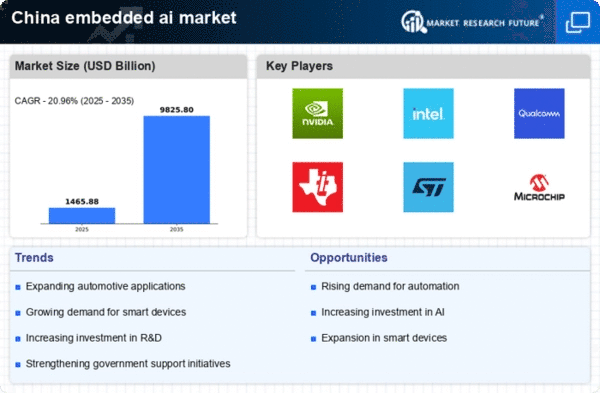
As per Market Research Future analysis, the China Embedded AI Market size was estimated at 1211.87 USD Billion in 2024. The Embedded Ai market industry is projected to grow from 1465.88 USD Billion in 2025 to 9825.8 USD Billion by 2035, exhibiting a compound annual growth rate (CAGR) of 20.9% during the forecast period 2025 - 2035

Key Market Trends & Highlights

The China embedded AI market is experiencing robust growth driven by technological advancements and increasing demand across various sectors.

  • The largest segment in the China embedded AI market is consumer electronics, while automotive applications are the fastest-growing segment.
  • There is a notable trend towards the integration of AI in consumer electronics, enhancing user experiences and functionalities.
  • Energy efficiency and sustainability are becoming focal points in the development of embedded AI solutions across industries.
  • The rising demand for smart devices and government initiatives are key drivers propelling the growth of the embedded AI market.

Market Size & Forecast

2024 Market Size 1211.87 (USD Billion)
2035 Market Size 9825.8 (USD Billion)
CAGR (2025 - 2035) 20.96%

Major Players

NVIDIA (US), Intel (US), Qualcomm (US), Texas Instruments (US), STMicroelectronics (FR), Microchip Technology (US), Renesas Electronics (JP), Analog Devices (US), Infineon Technologies (DE)

Our Impact
Enabled $4.3B Revenue Impact for Fortune 500 and Leading Multinationals
Partnering with 2000+ Global Organizations Each Year
30K+ Citations by Top-Tier Firms in the Industry

China Embedded AI Market Trends

The China Embedded AI Market is experiencing notable growth, driven by advancements in technology and increasing demand for automation across various sectors. In recent years, there has been a marked shift towards integrating artificial intelligence capabilities into embedded systems, enhancing their functionality and efficiency. This trend is particularly evident in industries such as automotive, consumer electronics, and industrial automation, where smart devices are becoming increasingly prevalent. The push for smart manufacturing and the Internet of Things (IoT) is further propelling the adoption of embedded ai solutions, as companies seek to optimize operations and improve decision-making processes. Moreover, the regulatory environment in China is evolving to support innovation in the embedded ai market. Government initiatives aimed at fostering research and development are likely to encourage investment in this sector. As a result, companies are expected to focus on creating more sophisticated embedded ai applications that can cater to specific industry needs. The emphasis on energy efficiency and sustainability is also shaping product development, as manufacturers strive to meet both consumer expectations and regulatory standards. Overall, the embedded ai market is poised for continued expansion, with a strong emphasis on innovation and adaptability to changing market demands.

Increased Integration of AI in Consumer Electronics

The trend towards embedding artificial intelligence in consumer electronics is becoming more pronounced. Devices such as smart home appliances and wearables are increasingly incorporating ai capabilities, enhancing user experience and functionality. This integration allows for personalized features and improved energy management, appealing to tech-savvy consumers.

Growth in Automotive Applications

The automotive sector is witnessing a surge in the adoption of embedded ai technologies. Features such as advanced driver-assistance systems (ADAS) and autonomous driving capabilities are driving this trend. Manufacturers are investing in ai-driven solutions to enhance safety, efficiency, and overall vehicle performance.

Focus on Energy Efficiency and Sustainability

There is a growing emphasis on energy efficiency within the embedded ai market. Companies are developing solutions that not only improve performance but also reduce energy consumption. This trend aligns with global sustainability goals and reflects consumer demand for environmentally friendly products.

China Embedded AI Market Drivers

Rising Demand for Smart Devices

The increasing consumer preference for smart devices is a pivotal driver for the embedded ai market in China. As households and businesses seek to enhance efficiency and convenience, the integration of AI capabilities into everyday devices becomes essential. Reports indicate that the smart home market in China is projected to reach approximately $50 billion by 2025, with a substantial portion attributed to embedded AI technologies. This trend is likely to stimulate innovation and investment in the embedded ai market, as manufacturers strive to meet consumer expectations for intelligent functionalities. Furthermore, the proliferation of IoT devices, which often rely on embedded AI for data processing and decision-making, further underscores the importance of this driver in shaping the market landscape.

Government Initiatives and Support

The Chinese government has been actively promoting the development of AI technologies, which significantly impacts the embedded ai market. Initiatives such as the 'New Generation Artificial Intelligence Development Plan' aim to position China as a leader in AI by 2030. This strategic focus is likely to result in increased funding and resources allocated to research and development in the embedded ai market. Moreover, government support for AI startups and collaborations between public and private sectors may foster innovation and accelerate the adoption of embedded AI solutions across various industries. As a result, the embedded ai market is expected to benefit from a conducive regulatory environment and enhanced investment opportunities.

Growing Interest in Edge Computing

The rise of edge computing is reshaping the landscape of the embedded ai market in China. As organizations seek to process data closer to the source, the need for embedded AI solutions that can operate efficiently at the edge becomes paramount. This shift is driven by the increasing volume of data generated by IoT devices and the necessity for real-time analytics. The edge computing market in China is projected to grow significantly, potentially reaching $30 billion by 2026. This growth is likely to create new opportunities for embedded AI applications, as businesses look to enhance data processing capabilities while minimizing latency and bandwidth usage.

Advancements in Semiconductor Technology

Technological advancements in semiconductor manufacturing are crucial for the growth of the embedded ai market in China. The development of more efficient and powerful chips enables the integration of sophisticated AI algorithms into smaller devices. For instance, the introduction of 5nm and 7nm process technologies has allowed for significant improvements in processing power and energy efficiency. This is particularly relevant as the demand for compact and energy-efficient devices continues to rise. The embedded ai market is likely to see a surge in applications across sectors such as consumer electronics, automotive, and industrial automation, driven by these advancements in semiconductor technology.

Increased Focus on Automation in Industries

The push for automation across various industries in China is a significant driver for the embedded ai market. As companies strive to enhance productivity and reduce operational costs, the adoption of AI-driven automation solutions becomes increasingly prevalent. Industries such as manufacturing, logistics, and agriculture are integrating embedded AI technologies to optimize processes and improve decision-making. Reports suggest that the automation market in China could reach $200 billion by 2025, with embedded AI playing a critical role in this transformation. This trend indicates a robust demand for embedded AI solutions, as businesses seek to leverage technology for competitive advantage.


Market Segment Insights

By Application: Smart Home Devices (Largest) vs. Healthcare Devices (Fastest-Growing)

The application segment of the embedded ai market showcases a diverse distribution among various categories. Smart home devices have emerged as the largest segment, driven by increasing consumer demand for automation and connectivity in everyday living. In contrast, healthcare devices are marked as the fastest-growing area, spurred by innovative AI solutions in patient monitoring and diagnostics that are gaining traction. As more industries adopt AI technologies, the embedded ai market experiences a notable shift towards applications that enhance operational efficiency and user experience. Industrial automation is seeing steady growth due to the push for smart manufacturing, while consumer electronics maintain a strong presence in the market, benefiting from advancements in AI integration. Overall, the continuous investment in AI capabilities propels growth across these diverse sectors.

Smart Home Devices (Dominant) vs. Healthcare Devices (Emerging)

Smart home devices represent the dominant force within the application segment, characterized by their advanced AI functions enabling personalized automation solutions for households. These devices, including smart speakers, thermostats, and security systems, are becoming increasingly integral to modern living. On the other hand, healthcare devices are emerging as a critical application area, leveraging AI to enhance patient care through real-time monitoring and intelligent diagnostic tools. This sector is rapidly evolving as healthcare providers seek innovative technologies to improve patient outcomes and operational efficiency. The contrasting positions of these two segments highlight the varied applications of embedded AI, with smart home devices offering established market presence while healthcare devices reflect the burgeoning potential of advanced AI solutions.

By Component: Processors (Largest) vs. Sensors (Fastest-Growing)

In the China embedded ai market, the distribution of market share among the component segments highlights Processors as the largest segment, commanding significant interest from developers due to their critical role in embedded systems. Sensors, while smaller in market share currently, are rapidly gaining traction as they play a crucial role in the growing IoT and smart device sectors, indicating a shift in consumer preference toward more interconnected and responsive systems. The growth trends within this segment reveal a burgeoning demand for advanced functionalities provided by these components. Factors driving growth include the increasing integration of AI into various applications, the push for improved device interoperability, and advancements in manufacturing technologies. As the market evolves, the competition is intensifying, particularly among software and memory devices, which are becoming essential for handling complex data processing needs.

Processors (Dominant) vs. Sensors (Emerging)

Processors are the dominant force in the China embedded ai market, being integral to the functionality and performance of embedded systems. They serve as the brain of devices, powering applications from basic functionalities to complex AI-driven processes. Their evolution is marked by increasing efficiency and reduced power consumption, catering to the demands of modern applications. In contrast, Sensors represent an emerging segment that is seeing exponential growth due to the rising trend towards automation and smart technologies. Sensors enable devices to collect real-time data, thus enhancing operational efficiency and user experience. As industries lean towards digitization, the reliance on both Processors and Sensors will continue to shape the landscape of the embedded ai market.

By Technology: Machine Learning (Largest) vs. Natural Language Processing (Fastest-Growing)

In the China embedded ai market, Machine Learning holds a significant share, positioning itself as the largest segment due to its extensive applications across various industries such as finance, healthcare, and manufacturing. Meanwhile, Natural Language Processing follows as a rapidly expanding segment, driven by the increasing demand for AI-driven language solutions, chatbots, and virtual assistants, indicating a robust market interest in this area. The growth trends in the China embedded ai market are largely influenced by advancements in cloud computing and the proliferation of IoT devices, making it easier for businesses to adopt machine learning and natural language processing technologies. Furthermore, the rise of big data analytics and the need for optimizing operational efficiency are also significant drivers, leading to increased investment and innovation within these segments.

Machine Learning (Dominant) vs. Robotics (Emerging)

Machine Learning stands out as the dominant technology within the China embedded ai market, enabling systems to learn from data and improve performance without explicit programming. This dominance trends from its versatility, allowing applications in predictive analytics, automation, and customer experience enhancement. Conversely, Robotics is an emerging segment that complements machine learning. It utilizes AI algorithms to enhance machine functionalities, enabling robots to perform complex tasks across manufacturing, logistics, and service sectors. The intersection of machine learning with robotics is crucial, as it makes robots smarter and more efficient, thus expanding their utility and adoption across various industries.

By End Use: Consumer (Largest) vs. Healthcare (Fastest-Growing)

In the embedded ai market, the Consumer segment holds a dominant position, leveraging the adoption of smart devices and home automation systems. This segment represents a significant portion of the overall market share due to increasing demand for AI-driven solutions in everyday consumer products. Following closely is the Healthcare sector, which, while smaller in share, is quickly gaining traction due to advancements in AI technology for diagnostics and patient management. Growth trends indicate that the Healthcare segment is on an upward trajectory, driven by the need for improved patient outcomes and operational efficiencies. AI applications such as predictive analytics and personalized medicine are catalyzing this growth. In contrast, the Consumer segment thrives on the continuous evolution of smart technology, driving innovations that enhance user experience, thereby sustaining its market leadership.

Consumer (Dominant) vs. Healthcare (Emerging)

The Consumer segment in the embedded ai market is characterized by its extensive application across various smart devices, including smartphones, appliances, and personal gadgets. This segment capitalizes on trends such as IoT integration and interactive technologies, making it highly attractive to manufacturers and tech companies looking to enhance consumer engagement. On the other hand, the Healthcare segment is emerging with innovative AI solutions that improve diagnostic accuracy and treatment methods. With a focus on telemedicine and health data management, it is rapidly modernizing healthcare delivery, making it a key area of investment and growth. Both segments, while distinct in their applications and user bases, showcase the versatility and potential of embedded AI technologies.

Get more detailed insights about China Embedded AI Market

Key Players and Competitive Insights

The embedded AI market in China is characterized by a rapidly evolving competitive landscape, driven by technological advancements and increasing demand for intelligent systems across various sectors. Key players such as NVIDIA (US), Intel (US), and Qualcomm (US) are at the forefront, leveraging their expertise in AI and semiconductor technologies to enhance their market positions. NVIDIA (US) focuses on innovation in AI computing platforms, while Intel (US) emphasizes its commitment to integrating AI capabilities into its processors. Qualcomm (US) is strategically positioned in mobile and IoT applications, indicating a diverse operational focus that collectively shapes a competitive environment marked by innovation and strategic partnerships.In terms of business tactics, companies are increasingly localizing manufacturing and optimizing supply chains to enhance operational efficiency. The market structure appears moderately fragmented, with several key players exerting significant influence. This fragmentation allows for a variety of competitive strategies, as companies seek to differentiate themselves through technological advancements and localized solutions tailored to the Chinese market.

In October NVIDIA (US) announced a partnership with a leading Chinese tech firm to develop AI-driven solutions for smart cities. This collaboration is strategically important as it aligns with China's push for urban digitalization and sustainability, potentially positioning NVIDIA (US) as a key player in the burgeoning smart city sector. The partnership not only enhances NVIDIA's (US) market presence but also facilitates access to local expertise and resources.

In September Intel (US) unveiled its latest AI-optimized chip designed specifically for edge computing applications in China. This move underscores Intel's (US) commitment to addressing the unique demands of the Chinese market, particularly in sectors such as manufacturing and logistics. By focusing on edge AI solutions, Intel (US) aims to capture a larger share of the growing demand for real-time data processing and analytics.

In August Qualcomm (US) expanded its AI research and development center in Shenzhen, reflecting its long-term strategy to enhance AI capabilities in mobile devices. This expansion is significant as it not only strengthens Qualcomm's (US) R&D capabilities but also reinforces its commitment to innovation in the highly competitive mobile market. The center is expected to drive advancements in AI applications, further solidifying Qualcomm's (US) position in the embedded AI landscape.

As of November current trends in the embedded AI market include a strong emphasis on digitalization, sustainability, and the integration of AI across various applications. Strategic alliances are increasingly shaping the competitive landscape, enabling companies to pool resources and expertise. Looking ahead, competitive differentiation is likely to evolve from traditional price-based competition to a focus on innovation, advanced technology, and supply chain reliability. This shift suggests that companies that prioritize R&D and strategic partnerships will be better positioned to thrive in the dynamic embedded AI market.

Key Companies in the China Embedded AI Market include

Industry Developments

Recent developments in the China Embedded AI Market indicate significant advancements and growth among major players such as Cambricon, Tencent, ZTE, Hikvision, Huawei, iFlytek, Unisound, SenseTime, DJI, Baidu, Xiaomi, Lenovo, Megvii, Yitu Technology, and Alibaba. In August 2023, Cambricon announced a strategic partnership with Baidu to enhance AI capabilities in cloud services. In the same vein, Tencent and Huawei have focused on integrating embedded AI within their cloud platforms to optimize resource management.

The market has experienced a noticeable valuation increase, bolstered by government initiatives supporting technological innovation. Comparatively, ZTE reported a 30% growth in its AI-driven revenue in Q3 2023. Merger activity includes Hikvision acquiring a small AI startup in July 2023, aimed at expanding its product offerings. Meanwhile, Xiaomi has ramped up its investment in smart home devices featuring embedded AI. Over the last few years, the ecosystem has grown, with investments in Research and Development doubling from 2019 to 2022. The robust government backing for technological ventures has positioned China as a leading hub for embedded AI development.

Future Outlook

China Embedded AI Market Future Outlook

The Embedded AI Market in China is projected to grow at a 20.96% CAGR from 2025 to 2035, driven by advancements in IoT, automation, and data analytics.

New opportunities lie in:

  • Development of AI-driven smart home devices for energy efficiency
  • Integration of embedded AI in automotive systems for enhanced safety
  • Creation of AI-powered industrial automation solutions to optimize production processes.

By 2035, the embedded AI market is expected to achieve substantial growth and innovation.

Market Segmentation

China Embedded AI Market End Use Outlook

  • Consumer
  • Commercial
  • Healthcare
  • Manufacturing
  • Transportation

China Embedded AI Market Component Outlook

  • Processors
  • Sensors
  • Software
  • Memory Devices
  • Connectivity Modules

China Embedded AI Market Technology Outlook

  • Machine Learning
  • Natural Language Processing
  • Computer Vision
  • Deep Learning
  • Robotics

China Embedded AI Market Application Outlook

  • Smart Home Devices
  • Industrial Automation
  • Healthcare Devices
  • Automotive Systems
  • Consumer Electronics

Report Scope

MARKET SIZE 2024 1211.87(USD Billion)
MARKET SIZE 2025 1465.88(USD Billion)
MARKET SIZE 2035 9825.8(USD Billion)
COMPOUND ANNUAL GROWTH RATE (CAGR) 20.96% (2025 - 2035)
REPORT COVERAGE Revenue Forecast, Competitive Landscape, Growth Factors, and Trends
BASE YEAR 2024
Market Forecast Period 2025 - 2035
Historical Data 2019 - 2024
Market Forecast Units USD Billion
Key Companies Profiled NVIDIA (US), Intel (US), Qualcomm (US), Texas Instruments (US), STMicroelectronics (FR), Microchip Technology (US), Renesas Electronics (JP), Analog Devices (US), Infineon Technologies (DE)
Segments Covered Application, Component, Technology, End Use
Key Market Opportunities Integration of advanced machine learning algorithms in consumer electronics enhances functionality in the embedded ai market.
Key Market Dynamics Rapid advancements in embedded AI technologies drive competitive innovation and regulatory adaptations in the market.
Countries Covered China
Leave a Comment

FAQs

What is the projected market size of the China Embedded AI Market in 2024?

The projected market size of the China Embedded AI Market in 2024 is expected to be valued at 1.75 billion USD.

What is the expected market value of the China Embedded AI Market by 2035?

The expected market value of the China Embedded AI Market by 2035 is anticipated to reach 5.35 billion USD.

What is the expected CAGR for the China Embedded AI Market from 2025 to 2035?

The expected CAGR for the China Embedded AI Market from 2025 to 2035 is approximately 10.693 percent.

Which application segment is projected to have the largest value in the China Embedded AI Market by 2035?

The Smart Home Devices segment is projected to have the largest value in the China Embedded AI Market by 2035, estimated at 1.05 billion USD.

What is the expected market value for Industrial Automation in the China Embedded AI Market by 2035?

The expected market value for Industrial Automation in the China Embedded AI Market by 2035 is projected to be 1.15 billion USD.

Who are some key players in the China Embedded AI Market?

Key players in the China Embedded AI Market include Cambricon, Tencent, ZTE, Hikvision, and Huawei.

What is the anticipated market value for Healthcare Devices in China’s Embedded AI Market in 2035?

The anticipated market value for Healthcare Devices in China's Embedded AI Market by 2035 is expected to be 0.9 billion USD.

What is the market size for Consumer Electronics in the China Embedded AI Market for the year 2024?

The market size for Consumer Electronics in the China Embedded AI Market for the year 2024 is projected at 0.45 billion USD.

What are the anticipated market values for Automotive Systems in the China Embedded AI Market by 2035?

The anticipated market value for Automotive Systems in the China Embedded AI Market by 2035 is expected to be 0.75 billion USD.

What growth opportunities exist in the China Embedded AI Market?

Growth opportunities in the China Embedded AI Market stem from advancements in smart home technology and increasing automation across industries.

Download Free Sample

Kindly complete the form below to receive a free sample of this Report

Compare Licence

×
Features License Type
Single User Multiuser License Enterprise User
Price $4,950 $5,950 $7,250
Maximum User Access Limit 1 User Upto 10 Users Unrestricted Access Throughout the Organization
Free Customization
Direct Access to Analyst
Deliverable Format
Platform Access
Discount on Next Purchase 10% 15% 15%
Printable Versions