×
Request Free Sample ×

Kindly complete the form below to receive a free sample of this Report

* Please use a valid business email

Leading companies partner with us for data-driven Insights

clients tt-cursor
Hero Background

Canada Submarine Power Cable Market

ID: MRFR/EnP/53059-HCR
128 Pages
Snehal Singh
February 2026

Canada Submarine Power Cable Market Research Report By Type (AC, DC), By Core Type (Single Core, Multi-Core), By Insulation Type (Cross-Linked Polyethylene (XLPE), Ethylene Propylene Rubber (EPR)), By Voltage (Up to 66 KV, 66 KV-220 KV, Above 220 KV), By Conductor Material (Copper, Aluminum) and By End-Use (Offshore Wind Power Generation, Offshore Oil & Gas, Island Connection, Wave & Tidal Power Generation) - Forecast to 2035

Share:
Download PDF ×

We do not share your information with anyone. However, we may send you emails based on your report interest from time to time. You may contact us at any time to opt-out.

Canada Submarine Power Cable Market Infographic
Purchase Options

Canada Submarine Power Cable Market Summary

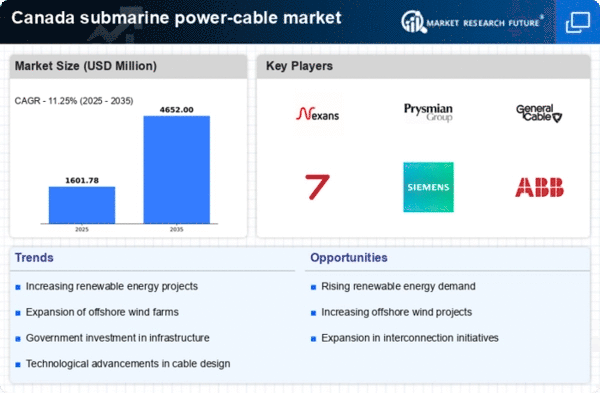
As per Market Research Future analysis, the Canada Submarine Power Cable Market size was estimated at 1439.8 USD Million in 2024. The Canada submarine power-cable market is projected to grow from 1601.78 USD Million in 2025 to 4652.0 USD Million by 2035, exhibiting a compound annual growth rate (CAGR) of 11.2% during the forecast period 2025 - 2035

Key Market Trends & Highlights

The Canada submarine power-cable market is experiencing robust growth driven by renewable energy initiatives and technological advancements.

  • The market is witnessing a rising demand for renewable energy, particularly in the largest segment of offshore wind power.
  • Infrastructure development initiatives are accelerating the deployment of submarine power cables across Canada.
  • Technological advancements in cable design are enhancing efficiency and reliability, contributing to market expansion.
  • Key drivers include increased investment in renewable projects and regulatory support for clean energy initiatives.

Market Size & Forecast

2024 Market Size 1439.8 (USD Million)
2035 Market Size 4652.0 (USD Million)
CAGR (2025 - 2035) 11.25%

Major Players

Nexans (FR), Prysmian Group (IT), General Cable (US), Subsea 7 (GB), Siemens (DE), ABB (CH), JDR Cable Systems (GB), LS Cable & System (KR)

Our Impact
Enabled $4.3B Revenue Impact for Fortune 500 and Leading Multinationals
Partnering with 2000+ Global Organizations Each Year
30K+ Citations by Top-Tier Firms in the Industry

Canada Submarine Power Cable Market Trends

The Canada Submarine Power Cable Market is experiencing notable growth, driven by the increasing demand for renewable energy sources and the need for efficient energy transmission. As Canada invests in offshore wind farms and other renewable projects, the requirement for robust submarine cables becomes more pronounced. These cables facilitate the connection of remote energy generation sites to the main grid, ensuring a stable and reliable power supply. Furthermore, advancements in cable technology are enhancing the performance and durability of these systems, making them more appealing to investors and developers alike. In addition to renewable energy initiatives, the submarine power-cable market is also influenced by the growing emphasis on interconnectivity between provinces. Enhanced grid interconnections can lead to improved energy security and efficiency. The Canadian government is actively promoting infrastructure development, which includes the expansion of submarine cable networks. This trend indicates a shift towards a more integrated energy landscape, where submarine cables play a crucial role in meeting future energy demands and supporting economic growth.

Rising Demand for Renewable Energy

The push for renewable energy sources is significantly impacting the submarine power-cable market. As Canada focuses on expanding its offshore wind and solar energy projects, the need for reliable submarine cables to transmit this energy becomes essential. This trend suggests a long-term growth trajectory for the market.

Infrastructure Development Initiatives

Government initiatives aimed at enhancing energy infrastructure are likely to bolster the submarine power-cable market. Investments in new projects and upgrades to existing systems indicate a commitment to improving energy transmission capabilities across regions.

Technological Advancements in Cable Design

Innovations in cable technology are transforming the submarine power-cable market. Enhanced materials and designs are improving the efficiency and lifespan of cables, making them more suitable for challenging underwater environments. This trend may attract further investment and development.

Canada Submarine Power Cable Market Drivers

Growing Interconnection Projects

The need for interconnection between provinces and territories in Canada is driving the submarine power-cable market. As provinces seek to enhance energy security and reliability, several interconnection projects are underway, including the Atlantic Loop initiative. This project aims to connect the electricity grids of Atlantic Canada, facilitating the transfer of renewable energy. The submarine power-cable market is expected to benefit from these developments, with estimated investments of over $5 billion in interconnection infrastructure by 2030. Such projects highlight the critical role of submarine cables in achieving a more integrated and resilient energy system.

Rising Demand for Energy Security

The increasing focus on energy security in Canada is a crucial driver for the submarine power-cable market. As the country aims to diversify its energy sources and reduce reliance on fossil fuels, the demand for reliable and efficient energy transmission solutions is growing. Submarine cables play a vital role in connecting remote renewable energy sources to urban centers, ensuring a stable energy supply. The submarine power-cable market is expected to expand as energy security becomes a priority, with investments projected to exceed $7 billion by 2028 to enhance the existing infrastructure.

Increased Investment in Renewable Projects

The submarine power-cable market in Canada is experiencing a surge in investment driven by the country's commitment to renewable energy sources. With the government aiming for a 50% reduction in greenhouse gas emissions by 2030, substantial funding is being allocated to offshore wind and tidal energy projects. This investment is expected to reach approximately $10 billion by 2027, creating a robust demand for submarine power cables to connect these renewable energy sources to the grid. The submarine power-cable market is thus poised for growth as these projects necessitate advanced cable solutions to ensure efficient energy transmission over long distances.

Regulatory Support for Clean Energy Initiatives

The Canadian government has implemented various policies and regulations to support the transition to clean energy, which significantly impacts the submarine power-cable market. Initiatives such as the Clean Growth Program and the Pan-Canadian Framework on Clean Growth and Climate Change are designed to facilitate the development of renewable energy infrastructure. These regulations not only promote investment but also create a favorable environment for the submarine power-cable market. As a result, the demand for submarine cables is likely to increase, with projections indicating a growth rate of around 8% annually over the next five years.

Technological Innovations in Cable Manufacturing

Advancements in cable manufacturing technology are significantly influencing the submarine power-cable market in Canada. Innovations such as improved insulation materials and enhanced cable designs are enabling the production of cables that can withstand harsh marine environments. These technological improvements not only increase the lifespan of submarine cables but also reduce installation and maintenance costs. The submarine power-cable market is likely to see a shift towards these advanced solutions, with manufacturers investing in R&D to develop cables that meet the growing demands of offshore renewable energy projects.


Market Segment Insights

By Type: Multi-Core (Largest) vs. Single Core (Fastest-Growing)

In the Canada submarine power-cable market, the Multi-Core segment currently holds a significant share, driven by its capacity to transmit more power over a single cable. This segment's efficiency and cost-effectiveness make it a preferred choice for various applications, including renewable energy projects and utility installations. Conversely, the Single Core segment, although smaller in overall market share, is emerging as a preferred solution for specialized applications that require less complexity and lower installation costs. Growth trends within these segments indicate that while Multi-Core cables continue to dominate, the Single Core segment is experiencing rapid development due to increasing demand for simpler and more streamlined cable solutions. Innovation in manufacturing techniques and materials is also driving this growth, enabling Single Core cables to be utilized in an expanding range of projects, particularly in remote or challenging locations where ease of deployment is crucial.

Multi-Core (Dominant) vs. Single Core (Emerging)

Multi-Core cables are characterized by their ability to carry multiple electrical conductors within a single sheath, making them ideal for high-capacity power transmission. This segment is well-established in the market, particularly for large-scale installations, due to its superior performance and reduced overall costs. On the other hand, Single Core cables represent an emerging trend in the Canada submarine power-cable market, providing a streamlined solution for specific applications where lightness and ease of installation are paramount. These cables are becoming increasingly popular among constructors and engineers looking for efficient solutions in infrastructure development, particularly in areas where extensive trenching is impractical.

By Insulation Type: Cross-linked polyethylene (XLPE) (Largest) vs. Ethylene propylene rubber (EPR) (Fastest-Growing)

In the Canada submarine power-cable market, Cross-linked polyethylene (XLPE) holds the largest market share, thanks to its excellent electrical properties and thermal resistance. It's widely favored for submarine cable applications due to its durability and performance in harsh environments. On the other hand, Ethylene propylene rubber (EPR) is gaining traction, albeit with a smaller share. Its flexibility and resistance to moisture make it an appealing option for specific submarine cable needs, particularly where environmental conditions are a concern. Growth trends for insulation types in this market show a significant shift towards EPR, which is projected to be the fastest-growing segment in the coming years. This growth can be attributed to the increasing demand for flexible and resilient cable systems that can withstand underwater challenges. Furthermore, as renewable energy projects expand, the need for advanced insulation materials that provide reliable performance under water pressure and thermal conditions is driving the market towards EPR alternatives, while XLPE continues to hold its ground as the dominant choice.

Insulation Type: XLPE (Dominant) vs. EPR (Emerging)

Cross-linked polyethylene (XLPE) is the dominant insulation type, known for its high dielectric strength and thermal stability, making it ideal for high-voltage submarine power cables. Its ability to resist aging and environmental factors ensures longevity and reliability in underwater applications. Conversely, Ethylene propylene rubber (EPR) represents the emerging trend within the insulation segment, offering exceptional flexibility and moisture resistance. As environmental legislation pushes for more sustainable and adaptable solutions, EPR becomes increasingly favorable for specialized projects, particularly those involving dynamic underwater conditions. The unique characteristics of both insulation types position them strategically within the Canada submarine power-cable market, catering to different operational needs.

By Conductor Material: Copper (Largest) vs. Aluminum (Fastest-Growing)

In the Canada submarine power-cable market, copper holds a significant portion of the market share, recognized for its superior conductivity and reliability in power transmission applications. Its established presence and proven performance make it the preferred choice among many project developers, especially for high-capacity installations. In contrast, aluminum, while traditionally viewed as less efficient, is gaining traction due to its lower cost and reduced weight, enabling easier installation and handling, thus capturing an increasing share of the market. Growth trends in the conductor material segment are leaning towards aluminum, driven by innovations in manufacturing and growing demand for cost-effective solutions. The push for sustainable energy projects and increasing investments in renewable energy infrastructure in Canada further bolster aluminum's position as a viable alternative to copper. This shift is expected to accelerate as developers look for more cost-efficient materials that do not compromise performance, indicating a dynamic change in the market landscape.

Conductor Material: Copper (Dominant) vs. Aluminum (Emerging)

Copper remains the dominant conductor material in the Canada submarine power-cable market, appreciated for its excellent electrical conductivity, long-term durability, and resistance to corrosion. Its heavy usage in high-voltage applications underscores its reliability, making it the go-to choice for critical infrastructure. On the other hand, aluminum is emerging as a competitive alternative due to its lower initial costs and lightweight characteristics. This has made it increasingly popular for new projects, particularly where budget constraints are a priority. As technology evolves, the gap in efficiency is narrowing, allowing aluminum to potentially occupy a larger share of the market in the coming years.

By End Use: Offshore Wind Power Generation (Largest) vs. Offshore Oil & Gas (Fastest-Growing)

The Canada submarine power-cable market exhibits a diverse landscape across its end-use segments, with Offshore Wind Power Generation commanding the largest share. This segment benefits from extensive investments in renewable energy initiatives aimed at reducing carbon emissions and promoting sustainable power solutions. Conversely, Offshore Oil & Gas is witnessing rapid growth, owing to increasing drilling activities and exploration efforts in offshore reserves, which bolsters demand for advanced subsea cable technologies. In recent years, the trend toward renewable energy has significantly influenced the dynamics within the Canada submarine power-cable market. Offshore Wind Power Generation remains in the spotlight as provinces pursue ambitious clean energy targets. Meanwhile, Offshore Oil & Gas is driven by technological advancements and the revitalization of oil exploration, marking it as the fastest-growing segment. Both segments showcase the shift in energy strategies, balancing traditional resources with cutting-edge, eco-friendly solutions.

Offshore Wind Power Generation (Dominant) vs. Offshore Oil & Gas (Emerging)

Offshore Wind Power Generation stands out as the dominant player in the Canada submarine power-cable market due to its scale and longstanding investment trajectory in renewables. Its infrastructure is heavily supported by government policies promoting clean energy, positioning it as a key contributor to the energy mix. Conversely, Offshore Oil & Gas serves as an emerging segment fueled by the industry's recovery and modernization efforts. This segment requires innovative submarine cable solutions to enhance connectivity and efficiency in extraction processes. The growing focus on environmental responsibility also pressures this segment to integrate sustainability measures while maintaining operational efficacy, thus highlighting the contrasting nature of these two segments in the evolving energy landscape.

By Voltage: 66 KV-220 KV (Largest) vs. Above 220 KV (Fastest-Growing)

In the Canada submarine power-cable market, the market share is predominantly held by the 66 KV-220 KV segment, which caters to a wide range of medium to high voltage applications. This significant representation emphasizes the necessity of robust infrastructure for both industrial and renewable energy sources. Meanwhile, the Up to 66 KV segment captures a smaller share, serving lower demand applications, while the Above 220 KV segment is attracting attention as it becomes increasingly essential for high-capacity transmission systems. The growth trends within this segment are propelled by rising renewable energy initiatives and the need for reliable infrastructure to support expanding electricity networks. Increasing investments in offshore wind and interconnector projects are driving the Above 220 KV segment's rapid growth, positioning it as a critical component for future energy transitions. Technological advancements and regulatory support are also fueling the demand for these higher voltage systems, which facilitates the efficient transfer of electricity across vast distances.

66 KV-220 KV (Dominant) vs. Above 220 KV (Emerging)

The 66 KV-220 KV segment is characterized by its adaptability for both onshore and offshore applications, making it the dominant choice for utilities and energy companies in the Canada submarine power-cable market. This segment predominantly caters to medium to high voltage transmission needs, ensuring a reliable supply of electricity for various sectors. In contrast, the Above 220 KV segment emerges as a critical player, focused on high-capacity transmission necessary for major infrastructure projects. This segment is gaining momentum due to increasing investments in large-scale renewable energy projects, like offshore wind farms, necessitating robust cable solutions to transmit large amounts of energy efficiently. Together, these segments reflect a dynamic interplay of established and emerging technologies tailored to meet the country’s evolving energy demands.

Get more detailed insights about Canada Submarine Power Cable Market

Key Players and Competitive Insights

The submarine power-cable market in Canada is characterized by a dynamic competitive landscape, driven by increasing demand for renewable energy sources and the expansion of offshore wind farms. Key players such as Nexans (FR), Prysmian Group (IT), and Siemens (DE) are strategically positioned to leverage these growth opportunities. Nexans (FR) focuses on innovation and sustainability, emphasizing the development of eco-friendly cable solutions. Meanwhile, Prysmian Group (IT) has been actively pursuing mergers and acquisitions to enhance its market presence and technological capabilities. Siemens (DE) is concentrating on digital transformation, integrating advanced technologies into its operations to improve efficiency and reduce costs. Collectively, these strategies contribute to a competitive environment that is increasingly focused on technological advancement and sustainability.
In terms of business tactics, companies are localizing manufacturing to reduce lead times and optimize supply chains. The market appears moderately fragmented, with several key players exerting influence over their respective segments. This fragmentation allows for a variety of competitive strategies, as companies seek to differentiate themselves through innovation and operational efficiency.
In October 2025, Nexans (FR) announced a partnership with a leading renewable energy firm to develop a new range of high-capacity submarine cables designed specifically for offshore wind projects. This collaboration is strategically significant as it positions Nexans (FR) at the forefront of the renewable energy transition, potentially increasing its market share in a rapidly growing sector. The focus on high-capacity solutions aligns with global trends towards larger offshore wind installations, indicating a proactive approach to market demands.
In September 2025, Prysmian Group (IT) completed the acquisition of a regional cable manufacturer, enhancing its production capabilities and expanding its footprint in North America. This acquisition is likely to bolster Prysmian's competitive edge by streamlining operations and increasing its ability to meet local demand. The move reflects a broader trend of consolidation within the industry, as companies seek to enhance their operational efficiencies and market reach.
In August 2025, Siemens (DE) launched a new digital platform aimed at optimizing the design and installation processes of submarine cables. This initiative is indicative of the growing importance of digitalization in the sector, as companies increasingly rely on advanced technologies to improve project outcomes. By investing in digital solutions, Siemens (DE) is not only enhancing its service offerings but also positioning itself as a leader in the integration of technology within the submarine power-cable market.
As of November 2025, current trends in the submarine power-cable market include a strong emphasis on sustainability, digitalization, and the integration of artificial intelligence (AI) into operations. Strategic alliances are becoming increasingly prevalent, as companies recognize the value of collaboration in driving innovation and enhancing competitive positioning. Looking ahead, it appears that competitive differentiation will evolve from traditional price-based competition to a focus on technological innovation, supply chain reliability, and sustainable practices. This shift may redefine the competitive landscape, compelling companies to adapt and innovate continuously.

Key Companies in the Canada Submarine Power Cable Market include

Industry Developments

The Canada Submarine Power Cable Market has seen significant developments recently, with increasing demand for renewable energy sources underscoring the importance of submarine power cables in connecting remote and offshore wind farms to the grid. Companies like Prysmian Group and NKT are actively engaging in the market, leveraging technological advancements for enhanced cable performance. Notably, in June 2023, Subsea 7 announced a partnership with General Cable to expand cable installation services in Canadian waters, reflecting a strategic move to enhance operational capabilities. 

Recent market valuations indicate robust growth, influenced by government initiatives aimed at fostering clean energy transitions, especially under the Canada Energy Regulator's guidelines. In January 2023, HengTong Group entered into discussions for a strategic alliance with Siemens, aiming to bolster local manufacturing capacities. The sector has experienced steady investment inflow, indicative of its potential, with major projects being executed in the Atlantic region.

Furthermore, the demand for interconnections to support electricity trade between provinces and the United States remains a critical driver for new submarine cable installations in Canada, emphasizing the importance of collaborative efforts amongst industry players like ABB and Nexans.

Future Outlook

Canada Submarine Power Cable Market Future Outlook

The Submarine Power Cable Market in Canada is projected to grow at 11.25% CAGR from 2025 to 2035, driven by renewable energy expansion, technological advancements, and increased offshore wind projects.

New opportunities lie in:

  • Investment in advanced cable manufacturing technologies to enhance efficiency.
  • Development of integrated monitoring systems for real-time cable performance.
  • Expansion into emerging markets for offshore renewable energy projects.
By 2035, the submarine power-cable market is expected to achieve robust growth and increased market share.

Market Segmentation

Canada Submarine Power Cable Market Type Outlook

  • Single Core
  • Multi-Core

Canada Submarine Power Cable Market End Use Outlook

  • Offshore Wind Power Generation
  • Offshore Oil & Gas
  • Island Connection
  • Wave & Tidal Power Generation

Canada Submarine Power Cable Market Voltage Outlook

  • Up to 66 KV
  • 66 KV-220 KV
  • Above 220 KV

Canada Submarine Power Cable Market Insulation Type Outlook

  • Cross-linked polyethylene (XLPE)
  • Ethylene propylene rubber (EPR)

Canada Submarine Power Cable Market Conductor Material Outlook

  • Copper
  • Aluminum

Report Scope

MARKET SIZE 2024 1439.8(USD Million)
MARKET SIZE 2025 1601.78(USD Million)
MARKET SIZE 2035 4652.0(USD Million)
COMPOUND ANNUAL GROWTH RATE (CAGR) 11.25% (2025 - 2035)
REPORT COVERAGE Revenue Forecast, Competitive Landscape, Growth Factors, and Trends
BASE YEAR 2024
Market Forecast Period 2025 - 2035
Historical Data 2019 - 2024
Market Forecast Units USD Million
Key Companies Profiled Nexans (FR), Prysmian Group (IT), General Cable (US), Subsea 7 (GB), Siemens (DE), ABB (CH), JDR Cable Systems (GB), LS Cable & System (KR)
Segments Covered Type, Insulation Type, Conductor Material, End Use, Voltage
Key Market Opportunities Growing demand for renewable energy integration drives innovation in submarine power-cable market technologies.
Key Market Dynamics Rising demand for renewable energy drives investment in submarine power-cable infrastructure and technology advancements.
Countries Covered Canada
Leave a Comment

FAQs

What is the expected market size of the Canada Submarine Power Cable Market in 2024?

The expected market size of the Canada Submarine Power Cable Market in 2024 is valued at 1.77 billion USD.

What is the projected market value of the Canada Submarine Power Cable Market by 2035?

The projected market value of the Canada Submarine Power Cable Market by 2035 is estimated to reach 5.22 billion USD.

What is the compound annual growth rate (CAGR) of the Canada Submarine Power Cable Market from 2025 to 2035?

The compound annual growth rate (CAGR) of the Canada Submarine Power Cable Market from 2025 to 2035 is expected to be 10.332 percent.

Which type of submarine power cables is expected to have the highest market value in 2035?

The AC submarine power cables segment is expected to have the highest market value of 2.7 billion USD in 2035.

What market size is projected for DC submarine power cables by 2035?

The projected market size for DC submarine power cables by 2035 is 2.52 billion USD.

Who are the major players in the Canada Submarine Power Cable Market?

Key players in the Canada Submarine Power Cable Market include HengTong Group, NKT, and Prysmian Group among others.

What growth opportunities exist in the Canada Submarine Power Cable Market?

There are significant growth opportunities driven by increasing demand for renewable energy and offshore wind farms.

How is the competition structured in the Canada Submarine Power Cable Market?

The competition is structured among major entities like Siemens, Subsea 7, and ABB that dominate the market landscape.

What are the key applications driving growth in the Canada Submarine Power Cable Market?

Key applications driving growth include offshore wind energy, interconnectors, and subsea power distribution.

What is the expected growth rate for AC submarine power cables from 2025 to 2035?

The AC submarine power cables segment is anticipated to experience robust growth during the period from 2025 to 2035.

Download Free Sample

Kindly complete the form below to receive a free sample of this Report

Compare Licence

×
Features License Type
Single User Multiuser License Enterprise User
Price $4,950 $5,950 $7,250
Maximum User Access Limit 1 User Upto 10 Users Unrestricted Access Throughout the Organization
Free Customization
Direct Access to Analyst
Deliverable Format
Platform Access
Discount on Next Purchase 10% 15% 15%
Printable Versions