×
Request Free Sample ×

Kindly complete the form below to receive a free sample of this Report

* Please use a valid business email

Leading companies partner with us for data-driven Insights

clients tt-cursor
Hero Background

UK Submarine Power Cable Market

ID: MRFR/EnP/53053-HCR
200 Pages
Snehal Singh
February 2026

UK Submarine Power Cable Market Research Report By Type (AC, DC), By Core Type (Single Core, Multi-Core), By Insulation Type (Cross-Linked Polyethylene (XLPE), Ethylene Propylene Rubber (EPR)), By Voltage (Up to 66 KV, 66 KV-220 KV, Above 220 KV), By Conductor Material (Copper, Aluminum) andBy End-Use (Offshore Wind Power Generation, Offshore Oil & Gas, Island Connection, Wave & Tidal Power Generation)- Forecast to 2035

Share:
Download PDF ×

We do not share your information with anyone. However, we may send you emails based on your report interest from time to time. You may contact us at any time to opt-out.

UK Submarine Power Cable Market Infographic
Purchase Options

UK Submarine Power Cable Market Summary

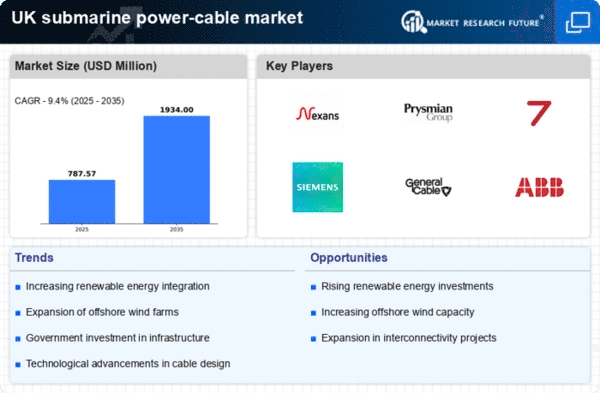
As per Market Research Future analysis, the UK submarine power-cable market size was estimated at 719.9 USD Million in 2024. The UK submarine power-cable market is projected to grow from 787.57 USD Million in 2025 to 1934.0 USD Million by 2035, exhibiting a compound annual growth rate (CAGR) of 9% during the forecast period 2025 - 2035

Key Market Trends & Highlights

The UK submarine power-cable market is experiencing robust growth driven by renewable energy initiatives and technological advancements.

  • The largest segment in the UK submarine power-cable market is the offshore wind sector, which is witnessing substantial investments.
  • Technological innovations in cable design are enhancing efficiency and reducing costs, thereby attracting more projects.
  • The fastest-growing segment is the interconnectors, which facilitate energy exchange with Europe and support grid stability.
  • Key market drivers include increasing energy security needs and government initiatives aimed at expanding offshore wind projects.

Market Size & Forecast

2024 Market Size 719.9 (USD Million)
2035 Market Size 1934.0 (USD Million)
CAGR (2025 - 2035) 9.4%

Major Players

Nexans (FR), Prysmian Group (IT), Subsea 7 (GB), Siemens (DE), General Cable (US), ABB (CH), JDR Cable Systems (GB), LS Cable & System (KR)

Our Impact
Enabled $4.3B Revenue Impact for Fortune 500 and Leading Multinationals
Partnering with 2000+ Global Organizations Each Year
30K+ Citations by Top-Tier Firms in the Industry

UK Submarine Power Cable Market Trends

The submarine power-cable market is currently experiencing a notable transformation, driven by the increasing demand for renewable energy sources and the need for efficient energy transmission. As the UK government emphasizes its commitment to reducing carbon emissions, investments in offshore wind farms and other renewable projects are on the rise. This shift towards sustainable energy solutions necessitates the development of advanced submarine power cables, which are essential for connecting offshore generation sites to the mainland grid. The integration of these cables into the energy infrastructure is crucial for achieving the UK's ambitious climate goals. Moreover, technological advancements in cable manufacturing and installation techniques are enhancing the performance and reliability of submarine power cables. Innovations such as improved insulation materials and enhanced cable laying methods are likely to reduce costs and increase the lifespan of these systems. As the submarine power-cable market evolves, stakeholders are focusing on collaboration between public and private sectors to ensure the successful deployment of these critical assets. The future landscape appears promising, with a growing emphasis on sustainability and technological progress shaping the market dynamics.

Rising Demand for Renewable Energy

The transition towards renewable energy sources is significantly influencing the submarine power-cable market. As the UK aims to enhance its offshore wind capacity, the need for robust and efficient cable systems becomes paramount. This trend indicates a shift in energy infrastructure, aligning with national sustainability goals.

Technological Innovations

Advancements in cable technology are transforming the submarine power-cable market. Innovations in materials and installation techniques are enhancing performance and reliability. These developments suggest a potential reduction in costs and an increase in the operational lifespan of submarine cables.

Regulatory Support and Investment

Government policies and incentives are playing a crucial role in shaping the submarine power-cable market. Increased funding for renewable projects and supportive regulations indicate a favorable environment for investment, which may lead to accelerated growth in the sector.

UK Submarine Power Cable Market Drivers

Increasing Energy Security Needs

The submarine power-cable market is experiencing a notable surge due to the increasing energy security needs in the UK. As the nation seeks to diversify its energy sources, the reliance on renewable energy, particularly offshore wind farms, has become paramount. The UK government aims to generate 40 GW of offshore wind energy by 2030, which necessitates robust submarine power-cable infrastructure. This infrastructure is essential for transmitting electricity from remote wind farms to the mainland grid, thereby enhancing energy security. The submarine power-cable market is thus positioned to benefit from this strategic shift towards energy independence and sustainability.

Government Initiatives and Funding

Government initiatives and funding play a pivotal role in shaping the submarine power-cable market. The UK government has committed to substantial investments in renewable energy infrastructure, with a focus on enhancing grid connectivity. The Offshore Transmission Network Review aims to streamline the regulatory framework, potentially leading to a £10 billion investment in submarine power-cable projects by 2030. This financial backing is crucial for the submarine power-cable market, as it encourages innovation and the development of advanced technologies, ultimately facilitating the transition to a low-carbon energy system.

Expansion of Offshore Wind Projects

The expansion of offshore wind projects is a critical driver for the submarine power-cable market. The UK has established itself as a leader in offshore wind energy, with over 10 GW of installed capacity as of 2023. This growth trajectory is expected to continue, with projections indicating an increase to 30 GW by 2030. Such ambitious targets necessitate extensive submarine power-cable installations to connect these wind farms to the national grid. The submarine power-cable market is likely to see substantial investments and developments as stakeholders recognize the importance of reliable and efficient energy transmission systems.

Rising Interconnectivity with Europe

The rising interconnectivity with Europe is influencing the submarine power-cable market significantly. The UK is enhancing its electricity interconnections with neighboring countries, such as France and the Netherlands, to bolster energy security and facilitate cross-border electricity trading. Projects like the IFA2 interconnector, which connects the UK to France, exemplify this trend. The submarine power-cable market is likely to benefit from these developments, as increased interconnectivity requires the installation of additional submarine cables to support the growing demand for electricity exchange and to stabilize the grid.

Technological Advancements in Cable Design

Technological advancements in cable design are transforming the submarine power-cable market. Innovations such as high-voltage direct current (HVDC) technology enable more efficient long-distance electricity transmission, reducing energy losses. The adoption of advanced materials and manufacturing techniques is also enhancing the durability and performance of submarine cables. As the submarine power-cable market embraces these technological improvements, it is expected to witness increased demand for modern cable solutions that can support the growing offshore renewable energy sector and meet the challenges of harsh marine environments.


Market Segment Insights

By Type: Multi-Core (Largest) vs. Single Core (Fastest-Growing)

In the UK submarine power-cable market, the distribution of market share between Multi-Core and Single Core segments is notable. Multi-Core cables dominate the market, primarily due to their efficiency in transmitting electricity over long distances. Their design allows for greater capacity and flexibility, making them suitable for large-scale offshore projects and interconnected energy systems. Conversely, Single Core cables hold a smaller share but are gaining traction as demand for specialized applications increases. Growth trends indicate that Single Core cables are emerging as the fastest-growing segment in the UK submarine power-cable market. This growth is driven by the increasing adoption of renewable energy projects, where Single Core cables offer advantages in terms of installation ease and performance in specific configurations. As the industry seeks to enhance connectivity and support renewable energy initiatives, Single Core cables are positioning themselves as essential components in future energy infrastructure.

Multi-Core (Dominant) vs. Single Core (Emerging)

Multi-Core cables are characterized by their complex structure, consisting of multiple insulated conductors grouped together, which enhances their capability for power transmission. Their dominant position in the market stems from their suitability for high-capacity applications, particularly in offshore wind farms and large underwater installations. Meanwhile, Single Core cables are gaining attention as an emerging technology, as they are lightweight and simplify installation processes for specific applications. As energy distribution systems evolve, both segments highlight the push towards more efficient and sustainable technologies, catering to different needs within the growing market.

By Insulation Type: Cross-linked polyethylene (XLPE) (Largest) vs. Ethylene propylene rubber (EPR) (Fastest-Growing)

The market share distribution in the insulation type segment of the UK submarine power-cable market highlights the dominance of cross-linked polyethylene (XLPE), which is favored for its thermal resistance and durability. In contrast, ethylene propylene rubber (EPR) is gaining traction, capturing an increasing share due to its flexibility and excellent electrical insulation properties. As the demand for reliable and efficient power transmission escalates, these materials are central to the submarine cable supply chain. The growth trends in this segment are influenced by the rising need for renewable energy sources and advancements in underwater power transmission technologies. XLPE is expected to maintain its market leadership due to its robust performance, while EPR's emerging position reflects its potential to meet the demands of newer installations and innovative applications. The transition towards more sustainable energy solutions is further driving the adoption of both insulation types, reflecting their integral role in the evolving UK submarine power-cable landscape.

Insulation Type: XLPE (Dominant) vs. EPR (Emerging)

Cross-linked polyethylene (XLPE) stands as the dominant insulation material within the UK submarine power-cable market, known for its superior thermal properties, resistance to electrical stresses, and longevity. This material is extensively utilized in high-voltage applications due to its ability to perform under harsh marine conditions. Meanwhile, ethylene propylene rubber (EPR) is increasingly recognized as an emerging solution, valued for its flexibility and resilience, particularly in dynamic underwater environments. With a growing emphasis on renewable energy projects, EPR is positioned to meet the specific requirements of modern installations, complementing the established strengths of XLPE. Both materials play critical roles in enhancing the efficiency and reliability of power transmission, catering to the evolving needs of the energy sector.

By Conductor Material: Copper (Largest) vs. Aluminum (Fastest-Growing)

In the UK submarine power-cable market, the conductor material segment reveals a significant preference for copper, which dominates the market share due to its superior conductivity and reliability. This material is widely adopted across various projects, making it a favored choice for developers and utility providers. On the other hand, aluminum is carving out its niche, appealing to cost-sensitive projects where some performance trade-offs are acceptable. With ongoing advancements in material technology, both segments are positioned to perform well. Growth trends in this segment indicate a steady demand for copper, spurred by the increasing investments in renewable energy and infrastructure upgrades. Meanwhile, aluminum is emerging rapidly, driven by its lower cost and increasing applications in power transmission. Factors such as sustainability initiatives and innovation in manufacturing processes are propelling aluminum’s acceptance in projects that prioritize economic efficiency without compromising on performance, thus altering the landscape for conductor materials in the market.

Conductor Material: Copper (Dominant) vs. Aluminum (Emerging)

Copper remains the dominant conductor material in the market, recognized for its exceptional electrical conductivity, durability, and thermal efficiency. Its proven track record and longstanding usage in various applications solidify its leadership in the market. Conversely, aluminum is emerging as a competitive alternative, particularly in scenarios where cost considerations play a crucial role. This material offers a lighter weight, facilitating easier installation and transportation, making it an attractive option for new projects. Despite its lower conductivity compared to copper, advancements in alloying and manufacturing are enhancing aluminum's performance, allowing it to capture an increasing share of the market as the demand for economical solutions rises.

By End Use: Offshore Wind Power Generation (Largest) vs. Offshore Oil & Gas (Fastest-Growing)

In the UK submarine power-cable market, Offshore Wind Power Generation currently dominates, holding the largest share of market activity driven by government incentives and increasing investments in renewable sources. Following closely, Offshore Oil & Gas is experiencing a surge in demand as technologies evolve and efforts to reduce carbon footprints gain traction, leading to an increasingly competitive landscape among these key end-use segments. Growth trends indicate that Offshore Wind Power Generation is benefitting from a strong push for sustainable energy solutions, further propelled by the UK’s commitment to achieving zero net emissions by 2050. Conversely, Offshore Oil & Gas is emerging as the fastest-growing segment, primarily due to the rising demand for energy globally and innovative exploration techniques that make previously unviable sources more accessible and cost-effective.

Offshore Wind Power Generation (Dominant) vs. Offshore Oil & Gas (Emerging)

Offshore Wind Power Generation stands as the dominant end-use segment within the UK submarine power-cable market, characterized by large-scale projects and substantial investments aimed at harnessing renewable energy. The segment benefits from favorable regulatory frameworks and societal shifts toward clean energy. In contrast, Offshore Oil & Gas represents an emerging segment, adapting to current environmental challenges while continuing to play a vital role in meeting energy demands. This segment is increasingly incorporating advanced technologies and sustainable practices, positioning it advantageously for future growth in a transitioning energy landscape.

By Voltage: 66 KV-220 KV (Largest) vs. Above 220 KV (Fastest-Growing)

In the UK submarine power-cable market, the voltage segments showcase diverse distribution patterns. The 66 KV-220 KV segment is currently the largest, capturing a significant portion of the market share due to its reliability and versatility in various applications. Meanwhile, the other segments, particularly those above 220 KV, are increasingly gaining traction as demand for higher capacity and efficiency grows, marking a shift in market dynamics. Growth trends indicate that the Above 220 KV segment is poised to be the fastest-growing due to the rising renewable energy projects and the need for interconnectivity between energy grids. The adoption of high-voltage cables is driven by the urgency to enhance energy transmission efficiency and support expanding offshore wind farms. This promotes technological advancements in insulation and cable design, setting the stage for sustained growth across all voltage segments.

66 KV-220 KV (Dominant) vs. Above 220 KV (Emerging)

The 66 KV-220 KV segment remains dominant in the UK submarine power-cable market, serving a wide array of applications, including wind energy and inter-island connections. Its robustness and compatibility with existing infrastructure make it a preferred choice for many projects. On the other hand, the Above 220 KV segment is emerging, showing rapid growth potential as it caters to high-capacity needs and supports large-scale renewable energy integrations. This segment's development is fueled by advancements in cable technology and increasing investments in renewables, which are essential for meeting future energy demands. The competitive landscape for both segments continues to evolve, with manufacturers focusing on innovation and efficiency.

Get more detailed insights about UK Submarine Power Cable Market

Key Players and Competitive Insights

The submarine power-cable market is currently characterized by a dynamic competitive landscape, driven by increasing demand for renewable energy and the expansion of offshore wind farms. Key players such as Nexans (FR), Prysmian Group (IT), and Siemens (DE) are strategically positioning themselves through innovation and partnerships. Nexans (FR) focuses on enhancing its technological capabilities, while Prysmian Group (IT) emphasizes regional expansion and digital transformation. Siemens (DE) is leveraging its expertise in automation and digitalization to optimize operations. Collectively, these strategies contribute to a competitive environment that is increasingly focused on technological advancement and sustainability.
In terms of business tactics, companies are localizing manufacturing and optimizing supply chains to enhance efficiency and reduce costs. The market appears moderately fragmented, with several key players exerting considerable influence. This structure allows for a diverse range of offerings, yet the collective actions of these companies shape the competitive dynamics significantly, as they vie for market share in a growing sector.
In October 2025, Prysmian Group (IT) announced a strategic partnership with a leading offshore wind developer to supply advanced submarine cables for a new wind farm project. This collaboration is expected to enhance Prysmian's market position by integrating cutting-edge technology into their offerings, thereby addressing the increasing demand for sustainable energy solutions. The partnership underscores the importance of aligning with renewable energy initiatives, which are pivotal for future growth.
In September 2025, Siemens (DE) unveiled a new digital platform aimed at optimizing the installation and maintenance of submarine power cables. This initiative is significant as it reflects Siemens' commitment to digital transformation, potentially reducing operational costs and improving service delivery. By harnessing digital tools, Siemens is likely to enhance its competitive edge in a market that increasingly values efficiency and innovation.
In August 2025, Nexans (FR) completed the acquisition of a local cable manufacturer in the UK, which is anticipated to bolster its production capabilities and market reach. This move is strategically important as it allows Nexans to localize its supply chain further, thereby reducing lead times and enhancing responsiveness to market demands. Such acquisitions may become a trend as companies seek to strengthen their foothold in key regions.
As of November 2025, current competitive trends indicate a strong emphasis on digitalization, sustainability, and the integration of AI technologies within operations. Strategic alliances are increasingly shaping the landscape, as companies recognize the value of collaboration in addressing complex challenges. Looking ahead, competitive differentiation is likely to evolve from traditional price-based competition to a focus on innovation, technological advancements, and supply chain reliability. This shift suggests that companies that prioritize these areas may secure a more favorable position in the submarine power-cable market.

Key Companies in the UK Submarine Power Cable Market include

Industry Developments

In recent months, the UK Submarine Power Cable Market has seen significant developments with an increasing focus on renewable energy infrastructure. The market is experiencing growth driven by projects related to offshore wind farms and interconnectors. Companies like Prysmian Group and Nexans are notably engaged in the installation and supply of submarine power cables for these projects. Southwire and General Cable have also expanded their capabilities in this sector. There have been reports of mergers and acquisitions, including DONG Energy acquiring additional stake in offshore wind projects in March 2023, enhancing its position in the renewable sector.

In April 2023, Siemens announced a partnership with JDR Cable Systems to develop advanced cable technology, indicating strong collaboration and investment in innovation. The government’s commitment to renewable energy targets has spurred these developments further, with a projected increase in demand for submarine cables to facilitate electricity transmission from offshore sources. Moreover, the UK aims to significantly expand its offshore wind capacity by 2030, further solidifying the strategic importance of companies like Subsea 7 and Cavotec in the market. Overall, the UK Submarine Power Cable Market is dynamically evolving with a strong emphasis on sustainability and innovation.

Future Outlook

UK Submarine Power Cable Market Future Outlook

The Submarine Power Cable Market is projected to grow at a 9.4% CAGR from 2025 to 2035, driven by renewable energy expansion, technological advancements, and increasing offshore wind projects.

New opportunities lie in:

  • Development of advanced cable-laying vessels for efficient installation.
  • Investment in R&D for high-capacity, low-loss cable technologies.
  • Partnerships with renewable energy firms for integrated power solutions.

By 2035, the submarine power-cable market is expected to achieve substantial growth and innovation.

Market Segmentation

UK Submarine Power Cable Market Type Outlook

  • Single Core
  • Multi-Core

UK Submarine Power Cable Market End Use Outlook

  • Offshore Wind Power Generation
  • Offshore Oil & Gas
  • Island Connection
  • Wave & Tidal Power Generation

UK Submarine Power Cable Market Voltage Outlook

  • Up to 66 KV
  • 66 KV-220 KV
  • Above 220 KV

UK Submarine Power Cable Market Insulation Type Outlook

  • Cross-linked polyethylene (XLPE)
  • Ethylene propylene rubber (EPR)

UK Submarine Power Cable Market Conductor Material Outlook

  • Copper
  • Aluminum

Report Scope

MARKET SIZE 2024 719.9(USD Million)
MARKET SIZE 2025 787.57(USD Million)
MARKET SIZE 2035 1934.0(USD Million)
COMPOUND ANNUAL GROWTH RATE (CAGR) 9.4% (2025 - 2035)
REPORT COVERAGE Revenue Forecast, Competitive Landscape, Growth Factors, and Trends
BASE YEAR 2024
Market Forecast Period 2025 - 2035
Historical Data 2019 - 2024
Market Forecast Units USD Million
Key Companies Profiled Nexans (FR), Prysmian Group (IT), Subsea 7 (GB), Siemens (DE), General Cable (US), ABB (CH), JDR Cable Systems (GB), LS Cable & System (KR)
Segments Covered Type, Insulation Type, Conductor Material, End Use, Voltage
Key Market Opportunities Growing demand for renewable energy integration drives innovation in submarine power-cable market technologies.
Key Market Dynamics Rising demand for renewable energy drives innovation and competition in the submarine power-cable market.
Countries Covered UK
Leave a Comment

FAQs

What is the current market size of the UK Submarine Power Cable Market in 2024?

The UK Submarine Power Cable Market is expected to be valued at 409.5 million USD in 2024.

What is the projected market size for the UK Submarine Power Cable Market by 2035?

By 2035, the UK Submarine Power Cable Market is projected to reach a value of 1227.0 million USD.

What is the expected compound annual growth rate (CAGR) for the UK Submarine Power Cable Market from 2025 to 2035?

The expected CAGR for the UK Submarine Power Cable Market from 2025 to 2035 is 10.491 percent.

Which type of submarine power cable is expected to dominate the market?

Both AC and DC submarine power cable types are valued similarly, with AC at 204.5 million USD and DC at 205.0 million USD in 2024.

What will be the market size for AC submarine power cables by 2035?

The market size for AC submarine power cables is expected to reach 614.1 million USD by 2035.

What will be the market size for DC submarine power cables by 2035?

The market size for DC submarine power cables is anticipated to be 612.9 million USD by 2035.

Who are the key players in the UK Submarine Power Cable Market?

Major players in the market include DNV GL, Southwire, General Cable, DONG Energy, and Nexans.

What are the key growth drivers for the UK Submarine Power Cable Market?

Key growth drivers include increasing demand for renewable energy and the need for enhanced grid connectivity.

Are there any emerging trends in the UK Submarine Power Cable Market?

Emerging trends include advancements in cable technology and increased investments in offshore renewable energy projects.

What challenges does the UK Submarine Power Cable Market face?

Challenges include high installation costs and environmental regulations related to submarine cable installation.

Download Free Sample

Kindly complete the form below to receive a free sample of this Report

Compare Licence

×
Features License Type
Single User Multiuser License Enterprise User
Price $4,950 $5,950 $7,250
Maximum User Access Limit 1 User Upto 10 Users Unrestricted Access Throughout the Organization
Free Customization
Direct Access to Analyst
Deliverable Format
Platform Access
Discount on Next Purchase 10% 15% 15%
Printable Versions