×
Request Free Sample ×

Kindly complete the form below to receive a free sample of this Report

* Please use a valid business email

Leading companies partner with us for data-driven Insights

clients tt-cursor
Hero Background

Bio-Based Platform Chemicals Market

ID: MRFR/CnM/5141-CR
111 Pages
Chitranshi Jaiswal
September 2019

Bio-based Platform Chemicals Market Research Report Information By Product Category (Platform Chemicals; Polymers for Plastics; Paints, Coatings, Inks & Dyes; Surfactants; Cosmetics & Personal Care; Adhesives; Man-made fibers, and Others), By Application (Industrial, Agricultural, Pharmaceutical, and Others) And By Region (North America, Europe, Asia-Pacific, And Rest Of The World) – Market Forecast Till 2035.

Share:
Download PDF ×

We do not share your information with anyone. However, we may send you emails based on your report interest from time to time. You may contact us at any time to opt-out.

Bio-Based Platform Chemicals Market Infographic
Purchase Options

Bio-Based Platform Chemicals Market Summary

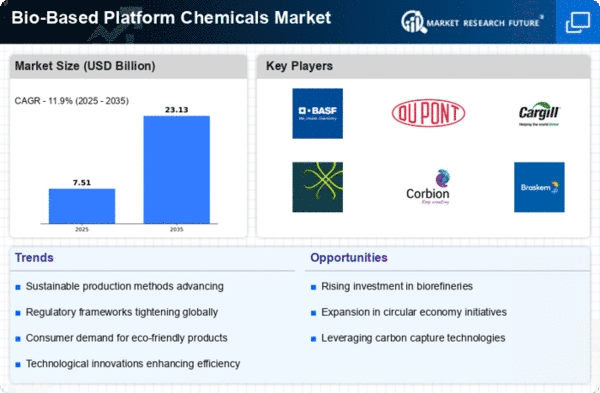
As per MRFR analysis, the Bio-Based Platform Chemicals Market was estimated at 6.71 USD Billion in 2024. The Bio-Based Platform Chemicals industry is projected to grow from 7.51 USD Billion in 2025 to 23.13 USD Billion by 2035, exhibiting a compound annual growth rate (CAGR) of 11.9 during the forecast period 2025 - 2035.

Key Market Trends & Highlights

The Bio-Based Platform Chemicals Market is experiencing robust growth driven by sustainability and innovation.

  • The market is witnessing a rising demand for sustainable products, particularly in North America.
  • Technological advancements in production processes are enhancing efficiency and reducing costs in the Asia-Pacific region.
  • Regulatory support and incentives are fostering a favorable environment for bio-based chemicals across various industries.
  • Increasing consumer awareness and supportive government policies are key drivers propelling market growth in both North America and Asia-Pacific.

Market Size & Forecast

2024 Market Size 6.71 (USD Billion)
2035 Market Size 23.13 (USD Billion)
CAGR (2025 - 2035) 11.9%

Major Players

BASF SE (DE), DuPont de Nemours Inc (US), Cargill Inc (US), Novozymes A/S (DK), Corbion NV (NL), Braskem S.A. (BR), LyondellBasell Industries N.V. (NL), Mitsubishi Chemical Corporation (JP), Evonik Industries AG (DE)

Our Impact
Enabled $4.3B Revenue Impact for Fortune 500 and Leading Multinationals
Partnering with 2000+ Global Organizations Each Year
30K+ Citations by Top-Tier Firms in the Industry

Bio-Based Platform Chemicals Market Trends

The Bio-Based Platform Chemicals Market is currently experiencing a notable transformation, driven by increasing environmental awareness and the demand for sustainable alternatives to traditional petrochemicals. This shift is largely influenced by regulatory frameworks that promote the use of renewable resources, as well as consumer preferences leaning towards eco-friendly products. Companies are actively investing in research and development to innovate and enhance the production processes of bio-based chemicals, which are derived from biomass feedstocks. This evolution not only supports the reduction of greenhouse gas emissions but also aligns with global efforts to transition towards a circular economy. Moreover, the Bio-Based Platform Chemicals Market is characterized by a growing collaboration between various stakeholders, including academia, industry players, and government entities. Such partnerships are essential for advancing technology and scaling up production capabilities. The market appears poised for further growth as advancements in biotechnology and fermentation processes continue to emerge. As a result, the landscape of bio-based chemicals is likely to expand, offering a diverse range of applications across multiple sectors, including pharmaceuticals, agriculture, and packaging. This dynamic environment suggests that the Bio-Based Platform Chemicals Market will play a crucial role in shaping a sustainable future.

Rising Demand for Sustainable Products

There is an increasing consumer preference for products that are environmentally friendly. This trend is pushing manufacturers to explore bio-based alternatives, thereby driving growth in the Bio-Based Platform Chemicals Market.

Technological Advancements in Production

Innovations in biotechnology and fermentation processes are enhancing the efficiency of bio-based chemical production. These advancements are likely to lower costs and improve the overall viability of bio-based products.

Regulatory Support and Incentives

Government policies and incentives aimed at promoting renewable resources are fostering a favorable environment for the Bio-Based Platform Chemicals Market. Such regulations encourage investment and development in sustainable chemical solutions.

Bio-Based Platform Chemicals Market Drivers

Increasing Consumer Awareness

The Bio-Based Platform Chemicals Market is experiencing a notable shift in consumer preferences towards sustainable and eco-friendly products. As awareness regarding environmental issues escalates, consumers are increasingly opting for products derived from renewable resources. This trend is reflected in market data, which indicates a growing demand for bio-based chemicals, projected to reach USD 30 billion by 2027. Companies are responding by reformulating their product lines to include bio-based alternatives, thereby enhancing their market competitiveness. This consumer-driven demand is likely to propel the growth of the Bio-Based Platform Chemicals Market, as manufacturers strive to align their offerings with the values of environmentally conscious consumers.

Supportive Government Policies

Government policies and regulations are playing a pivotal role in shaping the Bio-Based Platform Chemicals Market. Many governments are implementing supportive measures, such as tax incentives and subsidies, to encourage the adoption of bio-based chemicals. For instance, several countries have established mandates for the use of renewable resources in chemical production, which is expected to drive market growth. The Bio-Based Platform Chemicals Market stands to benefit from these initiatives, as they create a favorable environment for investment and innovation. This regulatory support is likely to enhance the competitiveness of bio-based products compared to their fossil fuel-derived counterparts.

Growing Industrial Applications

The Bio-Based Platform Chemicals Market is witnessing an expansion in its industrial applications, which is contributing to its growth. Industries such as automotive, packaging, and textiles are increasingly incorporating bio-based chemicals into their production processes. For example, the use of bio-based plastics in packaging is projected to grow at a CAGR of 12% over the next five years. This trend indicates a shift towards sustainable materials, driven by both consumer demand and regulatory pressures. As more industries adopt bio-based alternatives, the Bio-Based Platform Chemicals Market is likely to experience a significant increase in demand, further solidifying its position in the chemical landscape.

Rising Investment in Research and Development

Investment in research and development (R&D) within the Bio-Based Platform Chemicals Market is on the rise, as companies seek innovative solutions to enhance production efficiency and reduce costs. This trend is underscored by the fact that R&D expenditures in the bio-based sector have increased by approximately 15% over the past few years. Such investments are crucial for developing advanced technologies that can optimize the conversion of biomass into platform chemicals. As a result, the Bio-Based Platform Chemicals Market is likely to witness a surge in new product offerings and improved production processes, which could further stimulate market growth.

Technological Innovations in Production Processes

Technological innovations are transforming the Bio-Based Platform Chemicals Market by enhancing production processes and reducing costs. Advances in biotechnology and chemical engineering are enabling more efficient conversion of biomass into platform chemicals. For instance, the development of new catalysts and fermentation technologies has improved yield rates significantly. Market data suggests that these innovations could reduce production costs by up to 20%, making bio-based chemicals more competitive with traditional fossil fuel-based products. As these technologies continue to evolve, the Bio-Based Platform Chemicals Market is poised for substantial growth, driven by increased efficiency and lower barriers to entry for new market players.


Market Segment Insights

By Application: Solvents (Largest) vs. Adhesives (Fastest-Growing)

In the Bio-Based Platform Chemicals Market, the application segment is diverse, with solvents occupying the largest share. Solvents are widely utilized across several industries, including pharmaceuticals, paints, and coatings, owing to their essential role in enhancing product performance. Adhesives, on the other hand, represent the fastest-growing segment, driven by advancements in technology and increasing demand in automotive and construction applications. This trend indicates a shifting preference towards sustainable options as industries seek eco-friendly solutions.

Solvents (Dominant) vs. Adhesives (Emerging)

Solvents in the Bio-Based Platform Chemicals Market stand as the dominant application, characterized by their extensive use in various industries for formulation and product development, emphasizing performance and regulatory compliance. They are primarily derived from renewable resources, aligning with the growing demand for sustainable products. Conversely, adhesives are emerging strongly in the market, fueled by their unique properties and versatility across numerous applications like packaging, automotive, and construction. The push for low-VOC and bio-based materials is propelling adhesives into the limelight, with manufacturers focusing on innovation to meet environmental standards and consumer expectations.

By End Use: Consumer Goods (Largest) vs. Automotive (Fastest-Growing)

In the Bio-Based Platform Chemicals Market, the distribution among end-use segments reveals that Consumer Goods holds the largest market share, driven by its widespread application in sustainable packaging and personal care products. Automotive follows as a significant segment, benefitting from the rising shift towards eco-friendly vehicles which increasingly utilize bio-based chemicals in manufacturing processes. Other segments like Construction, Electronics, and Agriculture are also influential but come in with smaller shares comparatively. Growth trends indicate a robust expansion for Automotive as the demand for sustainable materials accelerates in the wake of environmental concerns and regulatory pressures. Consumer Goods remains strong, thanks to innovations in biopolymers and an increased consumer preference for sustainable products. Meanwhile, segments like Agriculture are emerging as key players with the rising demand for bio-based pesticides and fertilizers, showing promising growth in response to the global shift towards organic farming practices.

Consumer Goods: Dominant vs. Automotive: Emerging

The Consumer Goods segment is characterized by its extensive use of bio-based platform chemicals in biodegradable packaging, personal care products, and household items, positioning it as the dominant force in this market. Its established presence is buoyed by consumer preferences leaning towards sustainability, fostering innovation in renewable resource applications. On the other hand, the Automotive sector is regarded as an emerging player, rapidly adopting bio-based chemicals due to the push for greener technologies. Key drivers include the increasing regulatory mandates for lower carbon emissions and the automotive industry's transition towards electric and hybrid vehicles. The interplay between these segments illustrates a dynamic market landscape, where Consumer Goods maintains its dominance while Automotive seeks to capture growing interests in sustainable manufacturing.

By Source: Plant-Based Feedstock (Largest) vs. Waste Biomass (Fastest-Growing)

In the Bio-Based Platform Chemicals Market, the segment of Plant-Based Feedstock holds a significant share, driven by a growing preference for sustainable and renewable sources of raw materials. It is widely recognized for its superior availability and consistent quality, making it the backbone of bio-based chemical production. On the other hand, Waste Biomass has gained traction due to its low-cost potential and high availability, particularly as industries aim to minimize waste and adopt circular economy principles, increasing its share in the overall market.

Plant-Based Feedstock (Dominant) vs. Waste Biomass (Emerging)

Plant-Based Feedstock is characterized by its reliance on crops such as corn, sugarcane, and other agricultural products, which provide a stable source of high-quality inputs for bio-based platform chemicals. This sector is heavily supported by government incentives and consumer demand for eco-friendly products. In contrast, Waste Biomass is emerging as a critical player in the market, utilizing byproducts from agricultural, industrial, and municipal sources. This approach not only reduces dependency on traditional feedstocks but also addresses waste management issues, positioning waste biomass as a sustainable alternative with strong growth potential.

By Chemical Type: Alcohols (Largest) vs. Acids (Fastest-Growing)

In the Bio-Based Platform Chemicals Market, the segment of Chemical Types is primarily dominated by Alcohols, which hold the largest market share due to their versatility and wide application across various industries such as pharmaceuticals, personal care, and food and beverages. Following closely are Acids, which are gaining traction owing to their importance in industrial applications and sustainable development initiatives. The share of Esters, Aldehydes, and Ketones is relatively smaller but is significant for specific applications, thereby contributing to the overall market dynamics.

Alcohols: Dominant vs. Acids: Emerging

Alcohols remain the dominant force in the Bio-Based Platform Chemicals Market, cherished for their multifunctionality and robustness across diverse industrial applications, driving their sustained prevalence and demand. As a result, they are extensively utilized in solvents, disinfectants, and intermediates for production processes. On the other hand, Acids represent an emerging opportunity within this segment. Their increasing adoption is linked with sustainable manufacturing practices, wherein they are utilized as catalysts and key ingredients in bio-based reactions, embracing the shift towards eco-friendly chemical processes.

By Production Process: Fermentation (Largest) vs. Thermochemical Conversion (Fastest-Growing)

In the Bio-Based Platform Chemicals Market, the production processes reveal a diverse landscape where fermentation holds the largest market share. It is widely favored due to its efficiency and the ability to transform a variety of biomass feedstocks into valuable chemicals. On the other hand, thermochemical conversion is rapidly gaining traction and is recognized as the fastest-growing segment. Its innovative approaches to utilize heat and catalysts in converting biomass to chemicals are increasingly sought after for their potential to enhance yields and reduce costs.

Production Process: Fermentation (Dominant) vs. Biochemical Conversion (Emerging)

Fermentation remains the dominant production process in the Bio-Based Platform Chemicals Market, renowned for its capability to cater to diverse chemical outputs from renewable resources. Characterized by high efficiency and scalability, it processes organic materials like sugars and starches through microbial action. In contrast, biochemical conversion is emerging as a significant player, utilizing enzymatic methods to convert biomass into platform chemicals. This technique is gaining attention for its potential environmental benefits and cost-effectiveness, fostering a growing interest in integrating biochemical processes into established production frameworks.

Get more detailed insights about Bio-Based Platform Chemicals Market

Regional Insights

North America : Innovation and Market Leadership

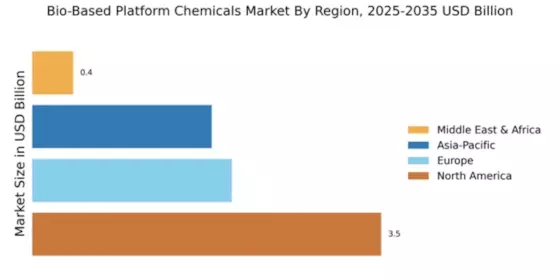
North America dominates the Bio-Based Platform Chemicals Market, holding a significant share of 3.5 billion in 2024. The region's growth is driven by increasing demand for sustainable products, favorable government policies, and advancements in biotechnology. Regulatory support for bio-based initiatives, including tax incentives and grants, further catalyzes market expansion. The shift towards renewable resources is also a key factor, as industries seek to reduce their carbon footprint and comply with environmental regulations. The competitive landscape in North America is robust, featuring key players such as BASF SE, DuPont de Nemours Inc, and Cargill Inc. These companies are investing heavily in R&D to innovate and enhance their product offerings. The U.S. and Canada are leading countries in this sector, with a strong focus on developing bio-based alternatives to traditional chemicals. The presence of established firms and a growing number of startups contribute to a dynamic market environment, fostering collaboration and technological advancements.

Europe : Sustainability and Regulatory Support

Europe's Bio-Based Platform Chemicals Market is valued at 2.0 billion, reflecting a strong commitment to sustainability and environmental responsibility. The region benefits from stringent regulations aimed at reducing greenhouse gas emissions and promoting renewable resources. Initiatives like the European Green Deal and various national policies encourage investment in bio-based technologies, driving demand for sustainable chemicals across multiple industries. Leading countries in Europe include Germany, France, and the Netherlands, where companies like Novozymes A/S and Corbion NV are at the forefront of innovation. The competitive landscape is characterized by a mix of established firms and emerging startups, all focused on developing bio-based solutions. The European market is also witnessing increased collaboration between academia and industry, enhancing research capabilities and accelerating the commercialization of bio-based products.

Asia-Pacific : Emerging Markets and Growth Potential

The Asia-Pacific region, with a market size of 1.8 billion, is rapidly emerging as a significant player in the Bio-Based Platform Chemicals Market. The growth is fueled by rising consumer awareness regarding sustainability and government initiatives promoting bio-based products. Countries like China and India are increasingly adopting bio-based alternatives to traditional chemicals, driven by both regulatory pressures and market demand for greener solutions. China is leading the charge in the region, with substantial investments in bio-based technologies and a growing number of local players entering the market. The competitive landscape is evolving, with established companies like Mitsubishi Chemical Corporation and new entrants focusing on innovation. The region's diverse industrial base, including agriculture and manufacturing, presents ample opportunities for bio-based chemicals, further enhancing market growth prospects.

Middle East and Africa : Resource-Rich Opportunities

The Middle East and Africa (MEA) region, with a market size of 0.41 billion, is in the nascent stages of developing its Bio-Based Platform Chemicals Market. The growth potential is significant, driven by increasing investments in sustainable practices and a growing awareness of environmental issues. Governments in the region are beginning to implement policies that support the transition to bio-based alternatives, although the market is still largely dependent on traditional fossil fuels. Countries like South Africa and the UAE are taking steps to promote bio-based initiatives, with local companies exploring opportunities in biofuels and bioplastics. The competitive landscape is still developing, with a few key players beginning to establish a foothold. As the region continues to diversify its economy and invest in renewable resources, the bio-based market is expected to gain traction, presenting new opportunities for growth.

Bio-Based Platform Chemicals Market Regional Image

Key Players and Competitive Insights

The Bio-Based Platform Chemicals Market is currently characterized by a dynamic competitive landscape, driven by increasing demand for sustainable alternatives to traditional petrochemicals. Key players are actively engaging in innovation and strategic partnerships to enhance their market positioning. For instance, BASF SE (Germany) has been focusing on expanding its portfolio of bio-based products, leveraging its extensive research capabilities to develop sustainable solutions. Similarly, DuPont de Nemours Inc (US) is emphasizing digital transformation and sustainability in its operations, aiming to reduce its carbon footprint while enhancing product performance. These strategies collectively contribute to a competitive environment that prioritizes sustainability and innovation.

In terms of business tactics, companies are increasingly localizing manufacturing to reduce supply chain vulnerabilities and enhance responsiveness to market demands. The market structure appears moderately fragmented, with several key players exerting significant influence. This fragmentation allows for a diverse range of products and innovations, although it also intensifies competition among established and emerging firms.

In January 2026, Cargill Inc (US) announced a strategic partnership with a leading biotechnology firm to develop advanced bio-based chemicals derived from agricultural feedstocks. This collaboration is expected to enhance Cargill's capabilities in producing sustainable chemicals, aligning with the growing consumer demand for eco-friendly products. The strategic importance of this partnership lies in its potential to accelerate innovation and expand Cargill's market reach in the bio-based sector.

In December 2025, Novozymes A/S (Denmark) launched a new enzyme product designed to optimize the production of bio-based chemicals. This innovation is anticipated to improve efficiency and reduce costs in the manufacturing process, thereby enhancing Novozymes' competitive edge. The introduction of this product underscores the company's commitment to driving sustainability through technological advancements.

In February 2026, Braskem S.A. (Brazil) unveiled its latest initiative aimed at increasing the production capacity of its bio-based polyethylene. This expansion is likely to position Braskem as a leader in the bio-based plastics market, responding to the rising demand for sustainable packaging solutions. The strategic significance of this move is evident in its alignment with global sustainability goals and the increasing regulatory pressures on plastic production.

As of February 2026, current competitive trends indicate a strong focus on digitalization, sustainability, and the integration of AI technologies within the Bio-Based Platform Chemicals Market. Strategic alliances are becoming increasingly vital, as companies seek to leverage complementary strengths to enhance innovation and market presence. Looking ahead, competitive differentiation is expected to evolve, shifting from price-based competition to a focus on innovation, technological advancements, and supply chain reliability. This transition reflects a broader industry trend towards sustainability and efficiency, which will likely define the future landscape of the market.

Key Companies in the Bio-Based Platform Chemicals Market include

Industry Developments

Dec 2020, Kemira Oyj and DuPont Nutrition & Biosciences declared a select collaboration for the expansion and commercialization of DuPont's enzymatic polymerization-based polysaccharide platform technology for specific uses. The partnership will convey novel, biobased, and integrally biodegradable product lines to Kemira's tactical markets, together with water treatment, paper & board, and the oil & gas industries. Under the alliance terms, DuPont will provide Kemira with access to its newest material platform technology, which uses enzymatic polymerization to design and manufacture polysaccharide materials from simple sugars directly.

Dec 2020, Ginkgo Bioworks, the organism business, revealed that it has recently accomplished the purchase of the main assets of Novogy, Inc. Ginkgo will take in Novogy's strain assets and IP portfolio and mix Novogy's codebase and profound expertise in lipid production into Ginkgo's bioengineering platform. For the most part, Novogy's talented technical team has also merged with Ginkgo, as Ginkgo carries on to the scale and attaches the power of biology to meet the augmented demand for more maintainable, adequate sources of bio-based oils.

August 2023, Archer Daniels Midland (ADM) announces plans to build a new bio-based isobutanol plant in Illinois. ADM is a US-based agricultural processor and food ingredients company. Isobutanol is a bio-based platform chemical that can be used to produce a variety of downstream products, including plastics, fuels, and lubricants. The new plant is expected to be operational in 2025 and will have a capacity of 250,000 tons per year.

Future Outlook

Bio-Based Platform Chemicals Market Future Outlook

The Bio-Based Platform Chemicals Market is projected to grow at 11.9% CAGR from 2024 to 2035, driven by sustainability initiatives, regulatory support, and technological advancements.

New opportunities lie in:

  • Development of biorefinery integration systems for enhanced efficiency.
  • Expansion into emerging markets with tailored bio-based solutions.
  • Investment in R&D for innovative bio-based chemical applications.

By 2035, the market is expected to solidify its position as a leader in sustainable chemical production.

Market Segmentation

Bio-Based Platform Chemicals Market Source Outlook

  • Plant-Based Feedstock
  • Waste Biomass
  • Algae
  • Microbial Fermentation
  • Animal By-Products

Bio-Based Platform Chemicals Market End Use Outlook

  • Automotive
  • Construction
  • Consumer Goods
  • Electronics
  • Agriculture

Bio-Based Platform Chemicals Market Application Outlook

  • Solvents
  • Adhesives
  • Coatings
  • Plastics
  • Textiles

Bio-Based Platform Chemicals Market Chemical Type Outlook

  • Alcohols
  • Acids
  • Esters
  • Aldehydes
  • Ketones

Bio-Based Platform Chemicals Market Production Process Outlook

  • Fermentation
  • Thermochemical Conversion
  • Biochemical Conversion
  • Transesterification
  • Hydrolysis

Report Scope

MARKET SIZE 20246.71(USD Billion)
MARKET SIZE 20257.51(USD Billion)
MARKET SIZE 203523.13(USD Billion)
COMPOUND ANNUAL GROWTH RATE (CAGR)11.9% (2024 - 2035)
REPORT COVERAGERevenue Forecast, Competitive Landscape, Growth Factors, and Trends
BASE YEAR2024
Market Forecast Period2025 - 2035
Historical Data2019 - 2024
Market Forecast UnitsUSD Billion
Key Companies ProfiledBASF SE (DE), DuPont de Nemours Inc (US), Cargill Inc (US), Novozymes A/S (DK), Corbion NV (NL), Braskem S.A. (BR), LyondellBasell Industries N.V. (NL), Mitsubishi Chemical Corporation (JP), Evonik Industries AG (DE)
Segments CoveredApplication, End Use, Source, Chemical Type, Production Process
Key Market OpportunitiesGrowing demand for sustainable alternatives drives innovation in the Bio-Based Platform Chemicals Market.
Key Market DynamicsRising demand for sustainable alternatives drives innovation and competition in the bio-based platform chemicals sector.
Countries CoveredNorth America, Europe, APAC, South America, MEA

Market Highlights

Author
Chitranshi Jaiswal
Research Analyst Level I

In her 3 years of experience in the market research field, she has handled critical cross-domain projects. She has an in-depth knowledge of market estimation & analysis, problem-solving, primary as well as secondary research, and team management.She holds an engineering degree and is an MBA professional from a well-known university, capable of evaluating the market and competitive conditions. An exceptional strategist with excellent communication skills and a passion for delivering cutting-edge & practical insights for the market. Proficient in multi-tasking, and can successfully deal with competing demands, while maintaining complete confidentiality. Generated business through active client and project development, networking, and high-quality responses. Her knowledge and skills have helped in making solid business decisions, securing funding from investors, and avoiding business failures.

Leave a Comment

FAQs

What is the current valuation of the bio-based platform chemicals market?

As of 2024, the market valuation was 0.839 USD Billion.

What is the projected market size for the bio-based platform chemicals market by 2035?

The market is projected to reach 2.58 USD Billion by 2035.

What is the expected CAGR for the bio-based platform chemicals market during the forecast period 2025 - 2035?

The expected CAGR for the market during 2025 - 2035 is 10.76%.

Which companies are considered key players in the bio-based platform chemicals market?

Key players include DuPont, Cargill, BASF, Genomatica, Novozymes, Amyris, LanzaTech, Green Biologics, and BioAmber.

What are the main applications of bio-based platform chemicals market?

Main applications include solvents, adhesives, coatings, plastics, and surfactants, with valuations ranging from 0.04 to 0.75 USD Billion.

How does the end-use segment break down in the bio-based platform chemicals market?

The end-use segment includes automotive, construction, consumer goods, agriculture, and electronics, with valuations from 0.125 to 0.6 USD Billion.

Download Free Sample

Kindly complete the form below to receive a free sample of this Report

Compare Licence

×
Features License Type
Single User Multiuser License Enterprise User
Price $4,950 $5,950 $7,250
Maximum User Access Limit 1 User Upto 10 Users Unrestricted Access Throughout the Organization
Free Customization
Direct Access to Analyst
Deliverable Format
Platform Access
Discount on Next Purchase 10% 15% 15%
Printable Versions