
×
Request Free Sample ×

Kindly complete the form below to receive a free sample of this Report

* Please use a valid business email

Leading companies partner with us for data-driven Insights

clients tt-cursor
Hero Background

Aluminum Market

ID: MRFR/CnM/1499-CR
111 Pages
Chitranshi Jaiswal
January 2026

Aluminum Market Research Report Information By Type (Primary, Secondary), By Product Type (Flat Rolled, Castings, Extrusion, Rod & Bar, Forgings, Others), By Application (Building &, Construction, Automotive & Transportation, Foil & Packaging, Power, Machinery & Equipment (Industrial), Consumer Goods, Others ), By Region – Forecast to 2035

Share:
Download PDF ×

We do not share your information with anyone. However, we may send you emails based on your report interest from time to time. You may contact us at any time to opt-out.

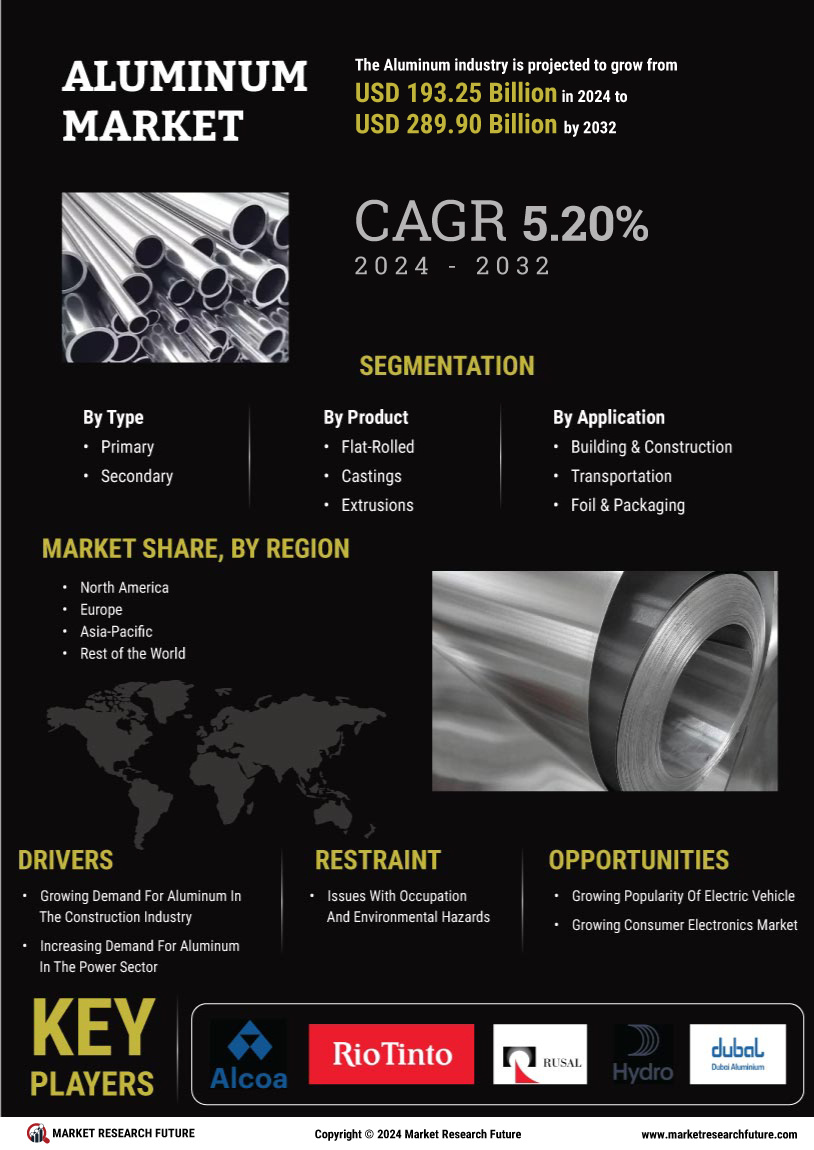
Aluminum Market Infographic
Purchase Options

Aluminum Market Summary

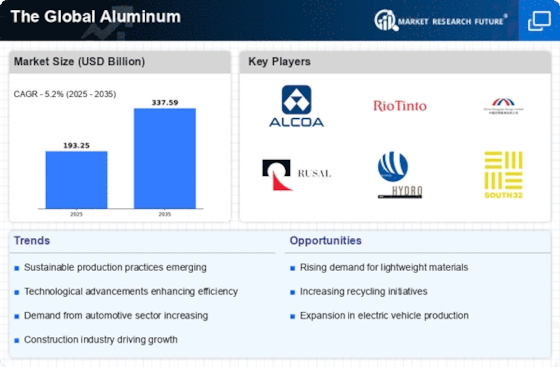
As per Market Research Future analysis, The Aluminum Market Size was valued at USD 1,95,126.7 million in 2024. The Aluminum Market Industry is projected to grow from USD 2,05,592.1 million in 2025 to USD 3,47,442.9 million by 2035, exhibiting a compound annual growth rate (CAGR) of 5.385% during the forecast period (2025 - 2035).

Key Market Trends & Highlights

The Aluminum Market is experiencing robust structural trends driven by electrification, sustainability mandates, and supply constraints.

  • Electric vehicles (EVs) propel aluminium use, with EVs requiring 30-50% more aluminium than internal combustion models for batteries, chassis, and structures. Renewable energy, especially solar panels.
  • Global inventories hit multi-year lows, with LME stocks down 20% year-on-year, signaling physical tightness. China's production caps, energy shortages, and stalled expansions limit output growth, fostering deficits projected at 365,000 tonnes in 2026.
  • Bauxite shortages loom as Guinea's exports falter amid political unrest, hiking alumina costs 25% year-on-year. Water scarcity curtails Middle East smelters, idling 300,000 tonnes capacity. Cybersecurity threats target automated casting lines, prompting USD 2 billion in industry-wide defenses.
  • Additive manufacturing integrates aluminium alloys for complex aerospace and automotive parts, cutting weight by 20-30% while enhancing strength. Nano-aluminizing improves corrosion resistance in marine and EV applications, extending lifespans by 40%.

Market Size & Forecast

2024 Market Size 1,95,126.7 (USD Million)
2035 Market Size 3,47,442.9 (USD Million)
CAGR (2025 - 2035) 5.385%

Major Players

Blue Diamond growers, Treehouse California Almonds LLC, Barry Callebaut, Royal Nut Company, Olam Group Limited, Harris Woolf Almonds, Almondco Australia, Borges Agricultural & Industrial Nuts, Select Harvest Limited, and Mariani Nut Company.
Our Impact
Enabled $4.3B Revenue Impact for Fortune 500 and Leading Multinationals
Partnering with 2000+ Global Organizations Each Year
30K+ Citations by Top-Tier Firms in the Industry

Aluminum Market Trends

The aluminum market is experiencing robust growth, fueled by rising demand across a variety of industries, including automotive, aerospace, construction, packaging, and electronics. Aluminum’s distinctive properties—such as its lightweight nature, corrosion resistance, recyclability, and impressive strength-to-weight ratio—make it an ideal material for modern applications. These qualities have positioned aluminum as a key material in sectors focused on efficiency, sustainability, and performance. The increasing emphasis on reducing carbon footprints has significantly boosted aluminum's adoption as industries seek alternatives to heavier materials like steel. This shift aligns with the global push toward sustainability, which has sparked substantial investments in both primary aluminum production and the recycling of secondary aluminum.

Leading aluminum-producing regions, including China, India, and the Middle East, continue to expand smelting and refining capacities to meet growing global demand, while advanced economies like the U.S. and Europe focus on enhancing recycling capabilities to minimize reliance on energy intensive primary production. The aluminum market is also influenced by geopolitical factors, energy costs, and supply chain dynamics, with fluctuations in bauxite and alumina prices affecting overall production costs. Furthermore, governments worldwide are implementing regulations and providing incentives to promote aluminum’s use in sectors aligned with decarbonization go.

Aluminum Market Drivers

Growth Of Automotive Industry

The global automotive industry is undergoing a rapid transformation driven by the increasing use of lightweight materials like aluminum. By 2030, it is projected that approximately 570 pounds of aluminum will be used per light vehicle in North America, with the content per vehicle growing at a compound annual growth rate (CAGR) of around 3.5% from 1975 to 2030. This surge in aluminum adoption is primarily due to its lightweight properties, corrosion resistance, and recyclability, making it an ideal choice for automakers seeking to enhance fuel efficiency, safety, and performance. Aluminum is used extensively in various vehicle components, including body panels, engines, wheels, suspension systems, doors, and windows. The growing shift towards aluminum has been further accelerated by the transition to electric vehicles (EVs), where weight reduction plays a critical role in improving battery efficiency and range. The automotive industry's push for sustainability has also bolstered aluminum's adoption, given its infinite recyclability and ability to contribute to reducing overall vehicle emissions.
 
One of the primary reasons aluminum has become a preferred material in automotive manufacturing is its significant contribution to weight reduction. Compared to steel, aluminum is significantly lighter, leading to improved fuel efficiency, lower emissions, and enhanced overall vehicle performance. For internal combustion engine (ICE) vehicles, weight reduction translates to better fuel economy, while for electric vehicles, it enables longer driving ranges and lower power consumption. Various aluminum alloys, including 3003, 3004, 3105, and high-strength alloys like 2024 and 6061, are used in automotive applications based on their strength, corrosion resistance, and durability. Aluminum components such as engine blocks, cylinder heads, and intake manifolds contribute to the efficiency and longevity of automotive engines, while forged aluminum wheels and suspension systems enhance driving dynamics. The automotive industry is continuously innovating to develop new aluminum alloys that optimize strength-to-weight ratios, ensuring that vehicles remain lightweight without compromising structural integrity or safety.

Rapid Urbanization and Rising Construction Spending

Urbanization and infrastructure development are among the most significant drivers of the aluminum market, shaping its growth over the coming decades. Aluminum, due to its unique properties such as lightness, corrosion resistance, and versatility, has become a staple material in the construction sector. The demand for aluminum is closely tied to the continuous growth of urban areas and the increasing need for modern infrastructure. By 2025, the global urban population will be highly concentrated in certain regions, with North America and Latin America & the Caribbean leading the way, having urban population shares of 83% and 82%, respectively. Europe follows closely with 76%, while Oceania stands at 70%. On the other hand, Asia and Africa, while showing significant urbanization rates, still have much room for growth, with urban populations expected to reach 53% and 45%, respectively.

Market Segment Insights

By Product Type: Flat Rolled (Largest) vs. Rods & Bars (Fastest-Growing)

On the basis of Product Type, has been segmented into Flat Rolled, Castings, Extrusion, Rods & Bars, Forgings and Others. In the Flat Rolled segment drove the Aluminum market by holding a substantial market share. Flat rolled aluminum refers to products such as sheets, plates, and foils, manufactured through a rolling process that reduces the thickness of aluminum while improving its mechanical properties. This segment plays a vital role in industries such as automotive, aerospace, packaging, and construction due to aluminum’s lightweight, corrosion resistance, and excellent formability. One of the largest applications of flat rolled aluminum is in the automotive sector, where it is used in body panels, hoods, roofs, and structural components to enhance fuel efficiency and meet stringent emission regulations. The aerospace industry also relies on flat rolled aluminum for aircraft fuselage, wings, and interior structures, benefiting from its high strength-to-weight ratio and durability. In the packaging industry, aluminum foil is widely used for food preservation, pharmaceutical blister packs, and beverage cans, as it provides an excellent barrier against moisture, light, and oxygen. Additionally, flat rolled aluminum is used in building facades, roofing, and insulation panels in the construction sector. The demand for flat rolled aluminum continues to rise due to advancements in automotive lightweighting, the growth of sustainable packaging, and increased infrastructure development.

By Application: Automotive & Transportation vs. Machinery & Equipment: Emerging

On the basis of Application, has been segmented into Building & Construction, Automotive & Transportation, Foil & Packaging, Power, Machinery & Equipment (Industrial), Consumer Goods and Others. In 2024, the Automotive & Transportation segment drove the Aluminum market by holding a substantial market share. The automotive & transportation industry is a key driver of aluminum demand, leveraging its lightweight and high-strength properties to enhance fuel efficiency, safety, and vehicle performance. In automobiles, aluminum is used in body panels, chassis, engine blocks, transmission housing, and structural components, replacing heavier steel parts to meet strict emission regulations and improve mileage in internal combustion engine (ICE) vehicles. The growing popularity of electric vehicles (EVs) has further fueled demand for aluminum, as automakers seek lightweight battery enclosures, crash management systems, and heat exchangers to enhance range and energy efficiency.

By Type: Primary (Largest) vs. Secondary (Fastest-Growing)

Based on Type, has been segmented into Primary and Secondary. In the Primary segment drove the Aluminum market by holding a substantial market share. Primary aluminum is widely used in transportation, aerospace, construction, packaging, and electrical applications due to its strength-to-weight ratio, durability, and conductivity. The automotive and aerospace sectors rely on primary aluminum for lightweight structures, which improve fuel efficiency and reduce emissions. In the construction industry, primary aluminum is used in window frames, curtain walls, and roofing due to its corrosion resistance and recyclability. The electrical sector benefits from aluminum's excellent conductivity, making it a popular material for power transmission lines. Additionally, aluminum packaging, such as beverage cans and foil, takes advantage of the metal’s lightweight and non-toxic properties.

Get more detailed insights about Aluminum Market

Regional Insights

North America: increased domestic consumption

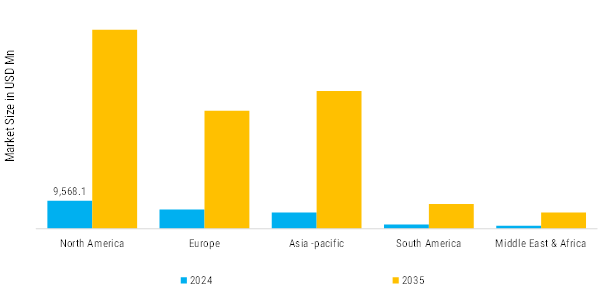
North America's Aluminum Market thrives on domestic production strengths, EV adoption, and protective trade policies as of early 2026. Regional demand centers on high-value sectors like aerospace and autos, bolstered by tariffs shielding local smelter. US primary output rises via expansions adding 500,000 tonnes yearly, aided by 50% tariffs on Chinese imports redirecting flows domestically. Recycling hits 25-30% mandates for federal projects, curbing scrap imports. Midwest premiums climb toward USD 4,000 by 2030 amid tightness.

Aluminum Market Regional Insights

Europe: Emerging Automotive Market

Europe's Aluminum Market navigates regulatory pressures, tepid demand, and sustainability. In the Automotive and aerospace sustain uptake via lightweight alloys for EVs and aircraft; construction lags at 60-70% capacity in Italy due to economic woes. Renewables like solar frames add modest gains, but overall buying remains cautious with four-day workweeks prevalent. Recycling hits records, with 580,000 tonnes in beverage cans alone. Hydro closes five extrusion plants amid weak demand; energy scarcity and global overcapacity exacerbate declines. Imports dominate at 6.5 million tonnes versus 1.62 million exports in 2024, prompting calls for fair trade measures. Secondary producers grapple with scrap shortages and high costs

Asia-Pacific: Rapidly Growing industry Sector

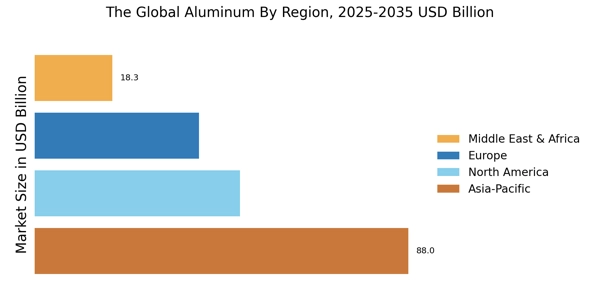
Asia-Pacific dominates the Aluminum Market, commanding 60-64% share through China's production prowess, India's infrastructure boom, and Southeast Asia's industrialization in early 2026. Rapid urbanization, EV adoption, and green manufacturing propel growth amid supply discipline. China's capacity caps and power curbs limit output growth to 2-3%, creating deficits despite Indonesia's bauxite ramps. Recycling expands with low-carbon tech, but scrap shortages pinch secondary output; Japan innovates high-strength alloys for autos.

Middle East and Africa: Emerging aluminium Frontier

Middle East & Africa (MEA) Aluminum Markets leverage abundant energy and strategic ports for production leadership, though water scarcity and power disruptions challenge growth in early 2026. UAE and Saudi Arabia anchor smelting hubs, while South Africa and emerging African nations drive downstream demand. Low-cost power fuels UAE/Bahrain/Saudi smelters producing 2-3 million tonnes yearly; South Africa leads primary output despite load-shedding. Bauxite access in Guinea/Mozambique supports alumina feeds, with exports rising sharply

South America: Rapidly Develop Aluminium

South America's Aluminum Market grows steadily through bauxite abundance and automotive expansion, though it remains a smaller global player in early 2026. Brazil and Argentina lead production and consumption amid infrastructure investments Brazil's Albras and Argentina's Aluar anchor primary output; bauxite from Guyana and Brazil supports exports despite energy volatility. Recycling expands for cost efficiency, with alloys tailored for transportation.

Aluminum Market Regional Image

Key Players and Competitive Insights

Many global, regional, and local vendors characterize the Aluminum Market. The market is highly competitive, with all the players competing to gain market share. Intense competition, rapid advances in technology, frequent changes in government policies, and environmental regulations are key factors that confront market growth. The vendors compete based on cost, product quality, reliability, and government regulations. Vendors must provide cost-efficient, high-quality products to survive and succeed in an intensely competitive market.
The major players in the market include include Alcoa Corporation, Rio Tinto, Century Aluminum Company, JW Aluminum, Kaiser Aluminum, Novelis Inc, C-KOE Metals, UC Rusal, Norsk Hydro ASA, Hindalco Industries, National Aluminium Company Limited, National ALUMINIUM EXTRUSION CO. LLC strategic market developments and decisions to improve operational effectiveness.

Key Companies in the Aluminum Market include

Industry Developments

In 2023, a wide range of value-added products, including aluminum plates, sheets, coils, and extruded products in various end-market applications such as Aero/HS products, automotive, extrusions, and GE products.

Future Outlook

Aluminum Market Future Outlook

The Aluminum Market is projected to grow at a 5.385% CAGR from 2025 to 2035, driven by growing geriatric population and technological advancements.

New opportunities lie in:

  • Increasing Demand in Aeronautical Applications
  • Rising Use of Aluminum in Packaging

By 2035, the market is expected to solidify its position as a leader in sustainable materials.

Market Segmentation

Aluminum Market Type Outlook

  • Primary
  • Secondary

Aluminum Market Application Outlook

  • Building & Construction
  • Automotive & Transportation
  • Foil & Packaging
  • Power
  • Machinery & Equipment (Industrial)
  • Consumer Goods
  • Others

Aluminum Market Product Type Outlook

  • Flat Rolled
  • Castings
  • Extrusion
  • Rod & Bar
  • Forgings
  • Others

Report Scope

Market Size 2024

24,184.27 (USD Million)

Market Size 2025

25,274.98 (USD Million)

Market Size 2035

39,288.85 (USD Million)

Compound Annual Growth Rate (CAGR)

5.385% (2025 - 2035)

Report Coverage

Revenue Forecast, Competitive Landscape, Growth Factors, and Trends

Base Year

2024

Market Forecast Period

2025 - 2035

Historical Data

2019 - 2023

Market Forecast Units

USD Million

Key Companies Profiled

Alcoa Corporation, Rio Tinto, Century Aluminum Company, JW Aluminum, Kaiser Aluminum, Novelis Inc, C-KOE Metals, UC Rusal, Norsk Hydro ASA, Hindalco Industries, National Aluminium Company Limited, National ALUMINIUM EXTRUSION CO. LLC

Segments Covered

By Type, By Product Type, By Application

Key Market Opportunities

  • Increasing Demand in Aeronautical Applications
  • Rising Use of Aluminum in Packaging

Key Market Dynamics

·      Rapid Urbanization and Rising Construction Spending

·      Growth of Automotive Industry

Regional Covered

North America, Europe, Asia Pacific, Latin America, Middle East & Africa.

Market Highlights

Author
Chitranshi Jaiswal
Research Analyst Level I

In her 3 years of experience in the market research field, she has handled critical cross-domain projects. She has an in-depth knowledge of market estimation & analysis, problem-solving, primary as well as secondary research, and team management.She holds an engineering degree and is an MBA professional from a well-known university, capable of evaluating the market and competitive conditions. An exceptional strategist with excellent communication skills and a passion for delivering cutting-edge & practical insights for the market. Proficient in multi-tasking, and can successfully deal with competing demands, while maintaining complete confidentiality. Generated business through active client and project development, networking, and high-quality responses. Her knowledge and skills have helped in making solid business decisions, securing funding from investors, and avoiding business failures.

Leave a Comment

FAQs

How much is the Aluminum Market?

The Aluminum Market size is expected to be valued at USD 25,274.98 Million in 2025.

What is the growth rate of the Aluminum Market?

The global market is projected to grow at a CAGR of 5.385% during the forecast period, 2025-2035.

Which region held the largest market share in the Aluminum Market?

North America had the largest share of the global market.

Who are the key players in the Aluminum Market?

The key players in the market Alcoa Corporation, Rio Tinto, Century Aluminum Company, JW Aluminum, Kaiser Aluminum, Novelis Inc, C-KOE Metals, UC Rusal, Norsk Hydro ASA, Hindalco Industries, National Aluminium Company Limited, National ALUMINIUM EXTRUSION CO. LLC.

Which type segment led the Aluminum Market?

The Primary dominated the market in 2025

Download Free Sample

Kindly complete the form below to receive a free sample of this Report

Compare Licence

×
Features License Type
Single User Multiuser License Enterprise User
Price $4,950 $5,950 $7,250
Maximum User Access Limit 1 User Upto 10 Users Unrestricted Access Throughout the Organization
Free Customization
Direct Access to Analyst
Deliverable Format
Platform Access
Discount on Next Purchase 10% 15% 15%
Printable Versions