×
Request Free Sample ×

Kindly complete the form below to receive a free sample of this Report

* Please use a valid business email

Leading companies partner with us for data-driven Insights

clients tt-cursor
Hero Background

Russia Aluminum Market

ID: MRFR/CnM/44029-HCR
111 Pages
Chitranshi Jaiswal
February 2026

Russia Aluminum Market Research Report: By Type (Primary, Secondary), By Product Type (Flat Rolled, Castings, Extrusions, Rod Bar, Forgings, Others) and By Application (Building Construction, Automotive Transportation, Foil Packaging, Power, Machinery Equipment Industrial), Consumer Goods, Others) - Forecast to 2035

Share:
Download PDF ×

We do not share your information with anyone. However, we may send you emails based on your report interest from time to time. You may contact us at any time to opt-out.

Russia Aluminum Market Infographic
Purchase Options

Russia Aluminum Market Summary

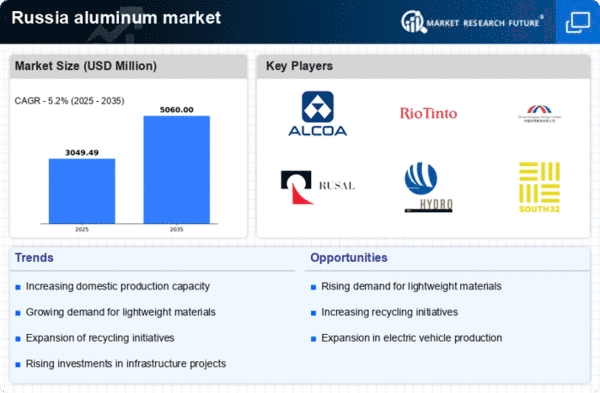
As per Market Research Future analysis, the Russia aluminum market Size was estimated at 2898.75 USD Million in 2024. The Aluminum market is projected to grow from 3049.49 USD Million in 2025 to 5060.0 USD Million by 2035, exhibiting a compound annual growth rate (CAGR) of 5% during the forecast period 2025 - 2035

Key Market Trends & Highlights

The Russia aluminum market is currently experiencing a robust upward trajectory driven by various factors.

  • The automotive sector represents the largest segment, reflecting a growing demand for lightweight materials.
  • Domestic production is expanding, positioning Russia as a key player in the global aluminum landscape.
  • Geopolitical factors are influencing trade dynamics, impacting supply chains and pricing strategies.
  • Technological advancements in production and infrastructure development initiatives are major drivers of market growth.

Market Size & Forecast

2024 Market Size 2898.75 (USD Million)
2035 Market Size 5060.0 (USD Million)
CAGR (2025 - 2035) 5.2%

Major Players

Alcoa Corporation (US), Rio Tinto Group (GB), China Hongqiao Group Limited (CN), Rusal (RU), Norsk Hydro ASA (NO), South32 Limited (AU), Constellium SE (NL), Kaiser Aluminum Corporation (US), Novelis Inc. (US)

Our Impact
Enabled $4.3B Revenue Impact for Fortune 500 and Leading Multinationals
Partnering with 2000+ Global Organizations Each Year
30K+ Citations by Top-Tier Firms in the Industry

Russia Aluminum Market Trends

The aluminum market in Russia is currently experiencing a dynamic phase characterized by various influencing factors. The demand for aluminum products is on the rise, driven by sectors such as construction, automotive, and packaging. This growth is likely attributed to the material's lightweight properties, corrosion resistance, and recyclability, which align with modern sustainability goals. Furthermore, the domestic production capabilities appear to be expanding, with several initiatives aimed at enhancing efficiency and reducing costs. This trend may lead to increased competitiveness in both local and international markets. In addition, the geopolitical landscape seems to play a crucial role in shaping the aluminum market. Trade policies and international relations may impact the availability of raw materials and export opportunities. As a result, stakeholders in the industry are closely monitoring these developments to adapt their strategies accordingly. The interplay between domestic production and external market conditions could potentially influence pricing and supply chain dynamics in the near future.

Rising Demand in Key Sectors

The aluminum market is witnessing heightened demand from critical sectors such as construction and automotive. This trend is likely driven by the material's advantageous properties, which support innovative applications and sustainable practices.

Expansion of Domestic Production

There appears to be a concerted effort to enhance domestic production capabilities within the aluminum market. Investments in technology and infrastructure may lead to improved efficiency and cost-effectiveness, positioning local producers favorably.

Impact of Geopolitical Factors

Geopolitical dynamics seem to significantly influence the aluminum market. Trade relations and policies may affect raw material availability and export potential, prompting industry players to remain vigilant and adaptable.

Market Segment Insights

By Type: Primary (Largest) vs. Secondary (Fastest-Growing)

In the Russia aluminum market, the primary segment commands a significant share, representing the largest portion of the overall consumption. This dominance is driven by extensive applications in industries such as automotive, construction, and packaging, where primary aluminum is preferred for its high quality and performance standards. Conversely, the secondary segment is gaining traction, although it currently holds a smaller share compared to primary aluminum. This segment benefits from growing recycling initiatives and environmental considerations, which are steadily increasing its relevance in the market. Growth trends within the aluminum types indicate a robust future for both segments. While primary aluminum remains strong, the secondary segment is noted for its rapid expansion, fueled by rising demand for sustainable practices and the circular economy. Factors such as increased regulatory support for recycling, technological advancements in recycling processes, and a shift in consumer preferences toward greener choices are driving this growth. As a result, the market is expected to see a more balanced distribution between primary and secondary aluminum in the coming years.

Primary: Dominant vs. Secondary: Emerging

The primary segment of the Russia aluminum market is characterized by its established reputation and extensive application range, making it the dominant choice for high-quality products. This segment serves critical industries, including transportation and construction, where performance and reliability are paramount. On the other hand, the secondary segment is emerging as an important player, driven by increasing environmental awareness and the push for sustainability. Secondary aluminum offers a more cost-effective and eco-friendly alternative, appealing to manufacturers looking to reduce their carbon footprints. As recycling technologies improve, the secondary segment is positioned to gain market share, reflecting a growing trend towards resource efficiency and waste reduction.

By Product Type: Flat Rolled (Largest) vs. Extrusion (Fastest-Growing)

In the Russia aluminum market, the product type segment is significantly characterized by the dominance of flat rolled products, which capture a substantial share due to their extensive applications across various industries. The casting and extrusion segments also hold notable market shares, with extrusion witnessing increasing attention as industries adopt more efficient and innovative manufacturing processes. Flat rolled products are considered critical for automotive and construction applications, bolstering their standing as the largest segment. Growth trends indicate a robust future for the aluminum sector, driven by the rising demand for lightweight materials in transportation and construction to enhance energy efficiency. Extrusion is emerging rapidly due to advancements in technology, enabling the production of complex shapes that cater to diverse applications. Additionally, sustainability trends are pushing manufacturers to innovate, possibly leading to a shift in market preferences as environmental regulations tighten, especially impacting casting and forgings segments.

Flat Rolled (Dominant) vs. Extrusion (Emerging)

Flat rolled products represent the dominant force within the Russia aluminum market, primarily due to their versatility and widespread use in multiple sectors, particularly automotive and construction. These products are prized for their strength-to-weight ratio and design flexibility, making them highly sought after for both structural and aesthetic applications. In contrast, the extrusion segment is emerging as a key player, driven by technological advancements that allow for lightweight, complex geometries. Manufacturers are increasingly adopting extrusion processes to meet bespoke demands, highlighting an evolving market that favors innovative production methods while addressing environmental considerations.

By Application: Building & Construction (Largest) vs. Automotive & Transportation (Fastest-Growing)

In the Russia aluminum market, the application segments are diverse, with Building & Construction leading the market share, driven by the ongoing demand for lightweight construction materials. Automotive & Transportation follows closely, capitalizing on the need for more fuel-efficient vehicles and lighter components, which is driving significant growth. Other segments such as Foil & Packaging and Power also hold notable shares, reflecting diverse applications across industries. Growth trends indicate a robust expansion in Automotive & Transportation due to regulatory measures promoting fuel efficiency. Meanwhile, Building & Construction remains steady as infrastructure projects flourish. The rise in demand for sustainable and recyclable materials has also contributed to the growth across Foil & Packaging and Consumer Goods, indicating a shift towards environmentally-friendly practices in manufacturing.

Building & Construction: Dominant vs. Automotive & Transportation: Emerging

The Building & Construction segment in the Russia aluminum market is characterized by its extensive use of aluminum in structural applications, façades, and roofing, making it the dominant application. This segment leverages aluminum's lightweight properties and strength, providing vital advantages in construction efficiency. Conversely, the Automotive & Transportation segment is emerging rapidly as manufacturers increasingly seek innovative ways to reduce vehicle weight for improved fuel efficiency and emissions compliance. This shift is leading to a surge in aluminum use in vehicle chassis, body panels, and components, making it a crucial area for future growth and investment. As the market evolves, both segments will adapt to meet changing consumer preferences and regulatory demands.

Get more detailed insights about Russia Aluminum Market

Key Players and Competitive Insights

The aluminum market in Russia is characterized by a competitive landscape that is shaped by both domestic and international players. Key growth drivers include increasing demand for lightweight materials in the automotive and aerospace sectors, as well as a push towards sustainable production practices. Major companies such as Rusal (RU), Alcoa Corporation (US), and China Hongqiao Group Limited (CN) are actively engaged in strategies that emphasize innovation and sustainability. Rusal, for instance, focuses on reducing its carbon footprint through advanced technologies, while Alcoa Corporation (US) is investing in new production methods that enhance efficiency and lower emissions. These strategies collectively contribute to a dynamic competitive environment, where companies are not only vying for market share but also striving to meet evolving regulatory standards and consumer expectations.In terms of business tactics, localizing manufacturing and optimizing supply chains are critical for success in the Russian aluminum market. The market structure appears moderately fragmented, with several key players holding substantial shares. This fragmentation allows for a variety of competitive strategies, as companies leverage their unique strengths to capture different segments of the market. The collective influence of these players fosters an environment where innovation and operational efficiency are paramount, driving the industry forward.

In October Rusal (RU) announced a partnership with a leading technology firm to develop AI-driven solutions aimed at enhancing production efficiency. This strategic move is significant as it aligns with the broader industry trend towards digital transformation, potentially allowing Rusal to reduce operational costs and improve product quality. The integration of AI technologies may also enable the company to better predict market demands and adjust production schedules accordingly, thereby enhancing its competitive edge.

In September Alcoa Corporation (US) unveiled a new initiative focused on sustainable sourcing of raw materials. This initiative is particularly relevant given the increasing scrutiny on environmental practices within the aluminum industry. By committing to sustainable sourcing, Alcoa not only addresses regulatory pressures but also appeals to a growing segment of environmentally conscious consumers. This strategic focus on sustainability could position Alcoa favorably in a market that is increasingly prioritizing eco-friendly practices.

In August China Hongqiao Group Limited (CN) expanded its operations in Russia by acquiring a local aluminum smelting facility. This acquisition is indicative of the company's strategy to enhance its production capacity and strengthen its foothold in the region. By increasing its operational presence, China Hongqiao may benefit from reduced transportation costs and improved supply chain efficiencies, which are critical in a market where logistics can significantly impact profitability.

As of November current competitive trends in the aluminum market are heavily influenced by digitalization, sustainability, and the integration of advanced technologies. Strategic alliances are becoming increasingly important, as companies seek to pool resources and expertise to navigate the complexities of the market. Looking ahead, competitive differentiation is likely to evolve from traditional price-based competition towards a focus on innovation, technological advancements, and supply chain reliability. This shift underscores the necessity for companies to adapt and innovate continuously in order to maintain their competitive positions in an ever-changing landscape.


Key Companies in the Russia Aluminum Market include

Industry Developments

In recent months, the Russia Aluminum Market has experienced notable developments influenced by a mix of geopolitical tensions and performance metrics from key players. In September 2023, Rusal announced plans to ramp up production at its Krasnoyarsk Aluminium Plant, aiming to meet rising global demand and stabilize prices. Meanwhile, in a significant move, Tacomat finalized an acquisition of a stake in the Ural Aluminum plant in October 2023, which is expected to enhance its production capacity.

The Republic Koryak Aluminum has reported working on expanding its infrastructure to leverage the increasing investment in the Far East region, reflecting a broader trend in regional development. Over the past couple of years, between 2021 and 2023, the market has seen fluctuations tied to sanctions that impacted exports and pricing dynamics, yet companies like Aluminium Norilsk Nickel and Bashkir Soda Company have maintained robust growth trajectories, emphasizing vertical integration strategies.

As of recent reports, investment in the aluminum sector in Russia is projected to rise sharply, driven by both domestic demand and international market trends, helping to solidify Russia's position as a significant player in the global aluminum industry.

Russia

Future Outlook

Russia Aluminum Market Future Outlook

The aluminum market in Russia is projected to grow at a 5.2% CAGR from 2025 to 2035, driven by increasing demand in construction, automotive, and packaging sectors.

New opportunities lie in:

  • Investment in advanced recycling technologies to reduce raw material costs.
  • Development of lightweight aluminum alloys for automotive applications.
  • Expansion of aluminum product lines for renewable energy infrastructure.

By 2035, the aluminum market is expected to achieve robust growth, driven by innovation and strategic investments.

Market Segmentation

Russia Aluminum Market Type Outlook

  • Primary
  • Secondary

Russia Aluminum Market Application Outlook

  • Building & Construction
  • Automotive & Transportation
  • Foil & Packaging
  • Power
  • Machinery & Equipment (Industrial)
  • Consumer Goods
  • Others

Russia Aluminum Market Product Type Outlook

  • Flat Rolled
  • Castings
  • Extrusion
  • Rod & Bar
  • Forgings
  • Others

Report Scope

MARKET SIZE 2024 2898.75(USD Million)
MARKET SIZE 2025 3049.49(USD Million)
MARKET SIZE 2035 5060.0(USD Million)
COMPOUND ANNUAL GROWTH RATE (CAGR) 5.2% (2025 - 2035)
REPORT COVERAGE Revenue Forecast, Competitive Landscape, Growth Factors, and Trends
BASE YEAR 2024
Market Forecast Period 2025 - 2035
Historical Data 2019 - 2024
Market Forecast Units USD Million
Key Companies Profiled Alcoa Corporation (US), Rio Tinto Group (GB), China Hongqiao Group Limited (CN), Rusal (RU), Norsk Hydro ASA (NO), South32 Limited (AU), Constellium SE (NL), Kaiser Aluminum Corporation (US), Novelis Inc. (US)
Segments Covered Type, Product Type, Application
Key Market Opportunities Adoption of lightweight aluminum solutions in automotive and aerospace sectors enhances efficiency and sustainability.
Key Market Dynamics Regulatory changes and local demand shifts drive competitive dynamics in the aluminum market in Russia.
Countries Covered Russia
Leave a Comment

FAQs

What is the expected market size of the Russia Aluminum Market in 2024?

The Russia Aluminum Market is projected to be valued at 3.6 billion USD in 2024.

What will the market size of the Russia Aluminum Market be in 2035?

By the year 2035, the market size is expected to reach 7.6 billion USD.

What is the expected CAGR for the Russia Aluminum Market from 2025 to 2035?

The expected CAGR for the Russia Aluminum Market during the period from 2025 to 2035 is 7.029%.

Which segment of the Russia Aluminum Market has a market valuation of 1.8 billion USD in 2024?

Both the Primary and Secondary segments of the Russia Aluminum Market are valued at 1.8 billion USD in 2024.

What is the projected market size for the Primary segment of the Russia Aluminum Market in 2035?

The Primary segment is anticipated to grow to 3.8 billion USD by 2035.

Who are the major players in the Russia Aluminum Market?

Key players in the market include Rusal, Krasnoyarsk Aluminium Plant, and SUAL Group, among others.

What challenges are currently facing the Russia Aluminum Market?

The market faces challenges including geopolitical tensions that could impact supply chains and pricing.

What growth drivers are expected to influence the Russia Aluminum Market?

Growth will be driven by increasing demand in various applications, including automotive and construction sectors.

How is the competition structured within the Russia Aluminum Market?

Competition is marked by several established companies like Rusal and Krasnoyarsk Metallurgical Complex, holding significant market shares.

What are the emerging trends in the Russia Aluminum Market?

Emerging trends include a shift towards sustainable production methods and increased recycling efforts in the aluminum sector.

Download Free Sample

Kindly complete the form below to receive a free sample of this Report

Compare Licence

×
Features License Type
Single User Multiuser License Enterprise User
Price $4,950 $ $7,250
Maximum User Access Limit 1 User Upto 10 Users Unrestricted Access Throughout the Organization
Free Customization
Direct Access to Analyst
Deliverable Format
Platform Access
Discount on Next Purchase 10% 15% 15%
Printable Versions