×
Request Free Sample ×

Kindly complete the form below to receive a free sample of this Report

* Please use a valid business email

Leading companies partner with us for data-driven Insights

clients tt-cursor
Hero Background

US Wholesale Telecom Carrier Market

ID: MRFR/ICT/57393-HCR
100 Pages
Aarti Dhapte
February 2026

US Wholesale Telecom Carrier Market Research Report: By Solutions (Voice Termination, SMS Messaging Services, VoIP Solutions, Data Roaming Services, International Call Services, SIP Trunking, Mobile Number Portability, Cloud Communication Services, Network Security Solutions), By Organization Size (SMEs, Large Enterprises) and By Passive Device Type (Internet Service Providers (ISPS), Mobile Network Operators (MNOs), VoIP Service Providers, Cable TV Operators, Government Agencies, Educational Institutes, Content Providers, Others) - Forecast to 2035

Share:
Download PDF ×

We do not share your information with anyone. However, we may send you emails based on your report interest from time to time. You may contact us at any time to opt-out.

US Wholesale Telecom Carrier Market Infographic
Purchase Options

US Wholesale Telecom Carrier Market Summary

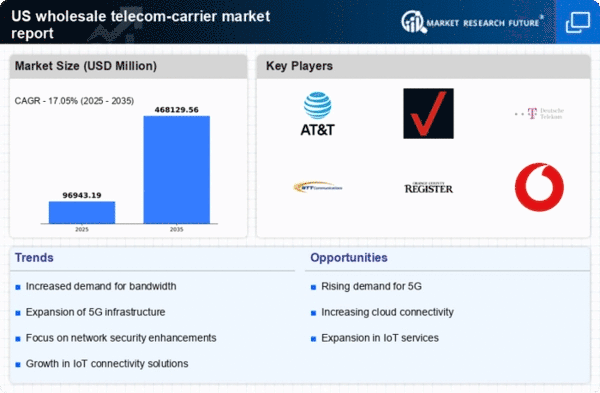
As per Market Research Future analysis, the US wholesale telecom-carrier market size was estimated at 82822.04 USD Million in 2024.. The US wholesale telecom-carrier market is projected to grow from 96943.19 USD Million in 2025 to 468129.56 USD Million by 2035, exhibiting a compound annual growth rate (CAGR) of 17.0% during the forecast period 2025 - 2035

Key Market Trends & Highlights

The US wholesale telecom-carrier market is experiencing robust growth driven by technological advancements and evolving consumer demands.

  • The demand for bandwidth continues to rise, reflecting the increasing consumption of data across various sectors.
  • Network resilience has become a focal point for carriers, as they seek to enhance service reliability and performance.
  • The IoT connectivity segment is the fastest-growing, driven by the proliferation of smart devices and applications.
  • Technological advancements in infrastructure and the expansion of cloud services are key drivers propelling market growth.

Market Size & Forecast

2024 Market Size 82822.04 (USD Million)
2035 Market Size 468129.56 (USD Million)
CAGR (2025 - 2035) 17.05%

Major Players

AT&T (US), Verizon (US), Deutsche Telekom (DE), NTT Communications (JP), Orange (FR), Vodafone (GB), Telefónica (ES), China Telecom (CN), T-Mobile (US)

Our Impact
Enabled $4.3B Revenue Impact for Fortune 500 and Leading Multinationals
Partnering with 2000+ Global Organizations Each Year
30K+ Citations by Top-Tier Firms in the Industry

US Wholesale Telecom Carrier Market Trends

The wholesale telecom-carrier market is currently experiencing a transformative phase. This phase is characterized by rapid technological advancements and evolving consumer demands.. As the landscape shifts, carriers are increasingly focusing on enhancing their infrastructure to support higher data speeds and improved connectivity. This evolution is driven by the growing reliance on digital services, which necessitates robust and reliable networks. Additionally, The competitive environment compels carriers to innovate and differentiate their offerings. This leads to a surge in partnerships and collaborations aimed at expanding service capabilities.. Moreover, regulatory frameworks are adapting to the changing dynamics of the wholesale telecom-carrier market. Policymakers are emphasizing the importance of fostering competition and ensuring fair access to essential network resources. This regulatory support is likely to encourage new entrants, thereby enhancing market diversity. As the demand for bandwidth continues to rise, the wholesale telecom-carrier market is poised for sustained growth, with an emphasis on sustainability and efficiency.. The interplay between technological innovation and regulatory measures will shape the future landscape, presenting both challenges and opportunities for stakeholders in this sector.

Increased Demand for Bandwidth

There is a notable surge in demand for bandwidth in the wholesale telecom-carrier market.. This trend is largely driven by the proliferation of data-intensive applications and services, such as streaming, cloud computing, and IoT. Carriers are responding by upgrading their infrastructure to accommodate higher data traffic, which may lead to enhanced service offerings and improved customer satisfaction.

Focus on Network Resilience

In light of the growing reliance on digital communication, the wholesale telecom-carrier market is placing a strong emphasis on network resilience. Carriers are investing in technologies that enhance the reliability and security of their networks. This focus on resilience is crucial for maintaining service continuity and meeting the expectations of businesses and consumers alike.

Regulatory Changes and Market Entry

The regulatory landscape surrounding the wholesale telecom-carrier market is evolving, with new policies aimed at promoting competition and innovation. These changes may facilitate the entry of new players into the market, fostering a more dynamic environment. As regulations adapt, existing carriers may need to reassess their strategies to remain competitive.

US Wholesale Telecom Carrier Market Drivers

Expansion of Cloud Services

There is a significant shift towards cloud services in the wholesale telecom-carrier market, driven by the increasing demand for flexible and scalable solutions.. As businesses migrate to cloud-based platforms, wholesale carriers are adapting their offerings to include cloud connectivity and infrastructure services. By 2025, it is anticipated that cloud services will account for over 30% of the total telecom revenue in the US. This transition allows carriers to provide enhanced services such as virtualized networks and on-demand bandwidth, catering to the evolving needs of enterprises. Furthermore, the integration of cloud services enables wholesale carriers to optimize their operational costs and improve service delivery. As a result, the expansion of cloud services is likely to be a pivotal driver for growth in the wholesale telecom-carrier market, fostering innovation and competitive differentiation.

Evolving Consumer Preferences

Consumer preferences are rapidly evolving, influencing the dynamics of the wholesale telecom-carrier market. As users demand more personalized and high-quality services, wholesale carriers are compelled to adapt their offerings accordingly. The shift towards mobile-first solutions and the increasing reliance on streaming services are reshaping the market landscape. In 2025, it is estimated that over 70% of internet traffic will be generated by video streaming, prompting carriers to enhance their bandwidth capabilities. This trend necessitates a reevaluation of service packages and pricing models to meet consumer expectations. Additionally, the growing importance of customer experience is driving wholesale carriers to invest in advanced analytics and customer relationship management tools. Consequently, evolving consumer preferences are likely to play a crucial role in shaping the strategies and offerings within the wholesale telecom-carrier market.

Increased Focus on Cybersecurity

As the wholesale telecom-carrier market evolves, the emphasis on cybersecurity has intensified. With the rise in cyber threats and data breaches, carriers are compelled to invest in advanced security measures to protect their networks and customer data. In 2025, it is projected that cybersecurity spending in the telecom sector will reach approximately $10 billion in the US. This investment is crucial for maintaining trust and reliability in services offered by wholesale carriers. Additionally, regulatory requirements are becoming more stringent, necessitating compliance with various security standards. As a result, wholesale telecom carriers are likely to enhance their cybersecurity protocols, which may involve partnerships with specialized firms to bolster their defenses. This focus on cybersecurity not only safeguards the integrity of the wholesale telecom-carrier market but also positions it as a trusted partner for businesses seeking secure communication solutions.

Rising Demand for IoT Connectivity

The proliferation of Internet of Things (IoT) devices is a key driver for the wholesale telecom-carrier market. As of 2025, it is estimated that there will be over 30 billion connected devices in the US, creating an insatiable demand for robust connectivity solutions. This surge in IoT adoption necessitates scalable and reliable network infrastructure, compelling wholesale carriers to expand their service offerings. Thus, this trend positions the wholesale telecom-carrier market to benefit, as businesses seek to leverage IoT for operational efficiencies and enhanced customer experiences.. Moreover, the increasing reliance on smart technologies across various sectors, including healthcare, manufacturing, and transportation, further underscores the need for comprehensive connectivity solutions. This growing demand for IoT connectivity is likely to drive revenue growth and innovation within the wholesale telecom-carrier market.

Technological Advancements in Infrastructure

The wholesale telecom-carrier market is experiencing a transformative phase driven by rapid technological advancements in infrastructure. Innovations such as 5G technology and fiber-optic networks are enhancing the capacity and speed of data transmission. As of 2025, the deployment of 5G is projected to cover approximately 80% of the US population, significantly increasing demand for wholesale services. This shift not only improves service quality but also reduces latency, which is crucial for businesses relying on real-time data. Furthermore, the integration of artificial intelligence and machine learning in network management is optimizing operational efficiency, allowing carriers to better manage resources and respond to market demands. Consequently, these advancements are likely to attract new entrants into the wholesale telecom-carrier market, fostering competition and driving growth.


Market Segment Insights

By Solution: VoIP Solutions (Largest) vs. SMS Messaging Services (Fastest-Growing)

In the US wholesale telecom-carrier market, VoIP Solutions represent the largest segment, capturing a significant share driven by widespread adoption among businesses seeking cost-effective communication alternatives. Other notable segments include SMS Messaging Services, which, while smaller in comparison, have been rapidly gaining traction as businesses leverage the immediacy of text messaging for customer engagement and marketing. Growth trends within the segment show a robust demand for VoIP Solutions as enterprises prioritize digital transformation and seek to enhance their communication infrastructure. Simultaneously, the rise of SMS Messaging Services can be attributed to increasing mobile penetration and the demand for real-time communication, positioning it as the fastest-growing service. The introduction of advanced features, such as rich media messaging and integration with CRMs, further amplifies this growth trajectory.

VoIP Solutions (Dominant) vs. SMS Messaging Services (Emerging)

VoIP Solutions have solidified their market leadership through extensive adoption across various sectors, providing flexible and cost-efficient communication methods that appeal to both small businesses and large enterprises. As a dominant force, VoIP enables features like video calling, conferencing, and collaboration tools that are essential in today’s remote working environment. In contrast, SMS Messaging Services, while emerging, have seen accelerated growth due to the increasing reliance on mobile communication. These services are particularly valued for their effectiveness in reaching customers directly with promotional messages and alerts, driving engagement and enhancing customer service. The rapid evolution of technology and the shift towards mobile-first marketing strategies are propelling SMS services to the forefront of telecommunications.

By Organization Size: SMEs (Largest) vs. Large Enterprises (Fastest-Growing)

In the US wholesale telecom-carrier market, SMEs currently hold a substantial share, making them the largest segment. Their needs for seamless connectivity, cost management, and support drive their preference for wholesale telecom services. Meanwhile, Large Enterprises, while smaller in current market share, are rapidly expanding their usage of wholesale telecom solutions due to increasing demand for advanced communication technologies and global connectivity. The growth trend for Large Enterprises is particularly pronounced, as they adopt more sophisticated telecom solutions to enhance operational efficiency and improve customer engagement. Factors driving this trend include digital transformation initiatives and a need for flexibility in their communication strategies. SMEs, however, continue to thrive in the market by leveraging wholesale services that cater specifically to their operational requirements, ensuring competitive positioning amid evolving market dynamics.

SMEs (Dominant) vs. Large Enterprises (Emerging)

In the US wholesale telecom-carrier market, SMEs represent the dominant force, characterized by their varied telecom needs that emphasize reliability and affordability. They often rely on tailored solutions that enable them to compete effectively in their respective industries. Conversely, Large Enterprises are emerging as significant consumers of wholesale telecom services, driven by their quest for advanced technologies and superior networking solutions. This segment is increasingly focused on integrating cloud services and IoT capabilities in their operations, indicating a shift towards more innovative communication methodologies. Both segments showcase unique characteristics in terms of operational scale and technology adoption, contributing to a dynamic landscape in the market.

By End User: Internet Service Providers (Largest) vs. Mobile Network Operators (Fastest-Growing)

In the US wholesale telecom-carrier market, the distribution of market share among end users reveals Internet Service Providers (ISPs) as the dominant segment, capturing the largest portion of the market. Following them are Mobile Network Operators (MNOs), VoIP Service Providers, Cable TV Operators, Government Agencies, Educational Institutes, Content Providers, and Others, each holding a smaller share relative to the leading segments. The diversity within these segments reflects varying consumer needs and technological advancements. Growth trends indicate a rising demand for connectivity, with MNOs experiencing the fastest growth as mobile data consumption surges. The push towards 5G technology and increased reliance on mobile applications are primary drivers enhancing MNO's presence. Conversely, ISPs benefit from the expanding need for broadband, largely influenced by remote work and online education trends. These shifts highlight the dynamic nature of the market and the importance of adaptability in service offerings.

Internet Service Providers (Dominant) vs. Mobile Network Operators (Emerging)

Internet Service Providers (ISPs) dominate the US wholesale telecom-carrier market by providing essential broadband connectivity to both residential and commercial customers. Their established infrastructure and service offerings cater to a wide clientele, making them indispensable in today's digitally-driven environment. On the other hand, Mobile Network Operators (MNOs) are emerging rapidly due to the increasing shift towards mobile communication and data services. The introduction of 5G networks is propelling MNOs' growth, positioning them as key players in delivering high-speed mobile internet. Both segments serve distinct needs, with ISPs focusing on fixed-line connections while MNOs capitalize on the mobility factor, showcasing the ever-evolving landscape of telecommunications.

Get more detailed insights about US Wholesale Telecom Carrier Market

Key Players and Competitive Insights

The wholesale telecom-carrier market in the US is characterized by a dynamic competitive landscape, driven by rapid technological advancements and evolving consumer demands. Major players such as AT&T (US), Verizon (US), and T-Mobile (US) are at the forefront, each adopting distinct strategies to enhance their market positioning. AT&T (US) focuses on expanding its fiber network and enhancing its 5G capabilities, while Verizon (US) emphasizes its investments in network reliability and customer service. T-Mobile (US) leverages its aggressive pricing strategies and innovative service offerings to capture market share, collectively shaping a competitive environment that is increasingly centered around technological innovation and customer-centric solutions.Key business tactics within this market include localized service offerings and supply chain optimization, which are essential for meeting diverse regional demands. The competitive structure appears moderately fragmented, with several key players exerting influence over market dynamics. This fragmentation allows for a variety of service offerings, fostering competition that drives innovation and efficiency among providers.

In October Verizon (US) announced a strategic partnership with a leading cloud service provider to enhance its edge computing capabilities. This move is significant as it positions Verizon to offer more robust services to enterprise customers, thereby expanding its footprint in the lucrative B2B segment. The partnership is likely to enhance Verizon's competitive edge by integrating advanced cloud solutions with its existing network infrastructure.

In September AT&T (US) launched a new initiative aimed at increasing its fiber broadband reach to underserved areas across the country. This initiative not only reflects AT&T's commitment to bridging the digital divide but also serves to strengthen its market presence in regions where competition is less intense. By focusing on underserved markets, AT&T may enhance customer loyalty and drive long-term growth.

In August T-Mobile (US) unveiled a new pricing model that offers flexible plans tailored to small and medium-sized enterprises (SMEs). This strategic move is indicative of T-Mobile's intent to capture a larger share of the SME market, which has been historically underserved by larger carriers. By providing customized solutions, T-Mobile is likely to differentiate itself from competitors and foster deeper customer relationships.

As of November The competitive trends in the wholesale telecom-carrier market are increasingly defined by digitalization and sustainability. Additionally, the integration of artificial intelligence (AI) into service offerings is also a key factor.. Strategic alliances are becoming more prevalent, as companies seek to leverage complementary strengths to enhance service delivery and operational efficiency. Looking ahead, competitive differentiation is expected to evolve from traditional price-based competition towards a focus on innovation, technological advancements, and supply chain reliability, suggesting a transformative shift in how companies engage with their customers and compete in the marketplace.

Key Companies in the US Wholesale Telecom Carrier Market include

Industry Developments

The US Wholesale Telecom Carrier Market has seen significant developments recently. In September 2023, Lumen Technologies announced the expansion of its fiber footprint, enhancing its service offerings. Similarly, Windstream is investing in increasing its broadband services, reflecting a growing demand for high-speed connectivity. In October 2023, Verizon revealed plans to upgrade its infrastructure, focusing on 5G technology, which is crucial for future telecommunications evolution. Notable mergers and acquisitions include the acquisition of Bandwidth's VoIP business by British Telecom in January 2023, showcasing a strategic move towards cloud communication services.

Zayo Group is also reported to have acquired a regional fiber provider in July 2023, strengthening its position in core markets. Frontier Communications has been looking to expand its fiber presence, while TMobile continues to invest in its network for better service delivery. The US telecom market has witnessed a sharpening focus on fiber optics and 5G deployment, leading to growth in valuation among these key players, significantly impacting competition and service quality across the industry.

In recent years, there has also been a notable push for consolidation among telecom firms to enhance capabilities and expand offerings, particularly in cloud and broadband services.

Future Outlook

US Wholesale Telecom Carrier Market Future Outlook

The Wholesale Telecom Carrier Market is projected to grow at a 17.05% CAGR from 2025 to 2035, driven by increased demand for data services and technological advancements.

New opportunities lie in:

  • Expansion of 5G infrastructure partnerships with local municipalities.
  • Development of edge computing solutions for low-latency applications.
  • Integration of AI-driven analytics for enhanced network optimization.

By 2035, the market is expected to achieve robust growth, driven by innovation and strategic partnerships.

Market Segmentation

US Wholesale Telecom Carrier Market End User Outlook

  • Internet Service Providers (ISPS)
  • Mobile Network Operators (MNOs)
  • VoIP Service Providers
  • Cable TV Operators
  • Government Agencies
  • Educational Institutes
  • Content Providers
  • Others

US Wholesale Telecom Carrier Market Solution Outlook

  • Voice Termination
  • SMS Messaging Services
  • VoIP Solutions
  • Data Roaming Services
  • International Call Services
  • SIP Trunking
  • Mobile Number Portability
  • Cloud Communication Services
  • Network Security Solutions
  • Interconnection Services
  • MPLS (Multiprotocol Label Switching) Solutions
  • Bandwidth on Demand
  • Colocation Services
  • Hosted PBX Services
  • Virtual Private Network (VPN) Services
  • Data Center Services
  • Ethernet Services
  • Content Delivery Network (CDN) Services
  • Mobile Virtual Network Enabler (MVNE) Services
  • International Data Services
  • Dark Fiber Services
  • Internet Exchange Point (IXP) Services
  • Satellite Communication Services
  • IoT Connectivity Solutions
  • Cloud Connectivity Services
  • Voice over LTE (VoLTE) Services
  • 5G Network Services
  • Network Monitoring and Management Services
  • Disaster Recovery Services
  • Network Consulting Services
  • Managed Network Services
  • Mobile Device Management (MDM) Solutions
  • Network Virtualization Services
  • DDoS Protection Services
  • Internet Transit Services
  • Mobile Advertising Solutions
  • Mobile Payment Solutions
  • Network Equipment Sales and Leasing
  • Video Conferencing Services
  • Unified Communications Solutions
  • Network Traffic Optimization
  • Fraud Management Solutions
  • Network Performance Monitoring
  • Software-Defined Networking (SDN) Solutions
  • Business Continuity Services
  • Blockchain-based Telecom Solutions
  • Wholesale Voice Trading Platforms
  • Network Capacity Planning
  • Over-the-Top (OTT) Service Solutions
  • Network Infrastructure Management Services
  • Multi-Cloud Connectivity Services
  • Others

US Wholesale Telecom Carrier Market Organization Size Outlook

  • SMEs
  • Large Enterprises

Report Scope

MARKET SIZE 2024 82822.04(USD Million)
MARKET SIZE 2025 96943.19(USD Million)
MARKET SIZE 2035 468129.56(USD Million)
COMPOUND ANNUAL GROWTH RATE (CAGR) 17.05% (2025 - 2035)
REPORT COVERAGE Revenue Forecast, Competitive Landscape, Growth Factors, and Trends
BASE YEAR 2024
Market Forecast Period 2025 - 2035
Historical Data 2019 - 2024
Market Forecast Units USD Million
Key Companies Profiled AT&T (US), Verizon (US), Deutsche Telekom (DE), NTT Communications (JP), Orange (FR), Vodafone (GB), Telefónica (ES), China Telecom (CN), T-Mobile (US)
Segments Covered Solution, Organization Size, End User
Key Market Opportunities Expansion of 5G infrastructure and services presents new growth avenues in the wholesale telecom-carrier market.
Key Market Dynamics Intensifying competition and regulatory shifts drive innovation and consolidation in the wholesale telecom-carrier market.
Countries Covered US
Leave a Comment

FAQs

What is the expected market size of the US Wholesale Telecom Carrier Market in 2024?

The US Wholesale Telecom Carrier Market is expected to be valued at 88.35 USD Billion in 2024.

What is the projected market size for the US Wholesale Telecom Carrier Market by 2035?

By 2035, the US Wholesale Telecom Carrier Market is expected to reach a valuation of 261.64 USD Billion.

What is the expected compound annual growth rate (CAGR) for the US Wholesale Telecom Carrier Market from 2025 to 2035?

The market is anticipated to grow at a CAGR of 10.373% during the forecast period from 2025 to 2035.

Which solutions will lead the market in terms of value in 2024?

Voice Termination will lead the market with a value of 30.0 USD Billion in 2024.

What is the expected value of Voice Termination in 2035?

Voice Termination is projected to be valued at 90.0 USD Billion by 2035.

Who are the major players in the US Wholesale Telecom Carrier Market?

Key players include Windstream, Crown Castle, Lumen Technologies, and AT&T, among others.

How much is the SMS Messaging Services segment expected to be valued in 2035?

The SMS Messaging Services segment is expected to reach a value of 54.0 USD Billion by 2035.

What are the main applications of the US Wholesale Telecom Carrier Market?

Key applications include Voice Termination, SMS Messaging Services, VoIP Solutions, and more.

What is the anticipated size of the Data Roaming Services segment in 2024?

Data Roaming Services is expected to be valued at 10.0 USD Billion in 2024.

What challenges are currently facing the US Wholesale Telecom Carrier Market?

The market is challenged by the need for technology upgrades and competition among established players.

Download Free Sample

Kindly complete the form below to receive a free sample of this Report

Compare Licence

×
Features License Type
Single User Multiuser License Enterprise User
Price $4,950 $5,950 $7,250
Maximum User Access Limit 1 User Upto 10 Users Unrestricted Access Throughout the Organization
Free Customization
Direct Access to Analyst
Deliverable Format
Platform Access
Discount on Next Purchase 10% 15% 15%
Printable Versions