Emerging Technologies
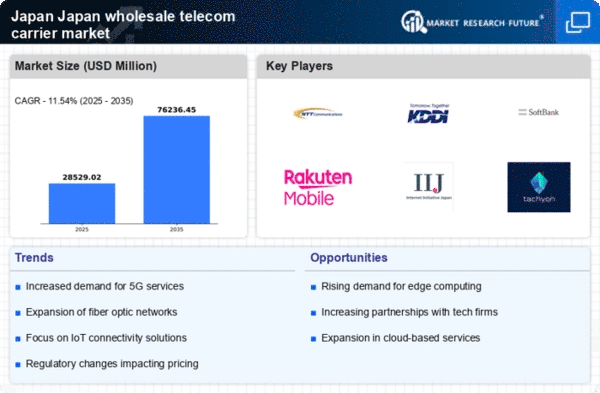
The emergence of new technologies is reshaping the Japan Wholesale Telecom Carrier Market. Innovations such as 5G, edge computing, and artificial intelligence are creating new opportunities for wholesale carriers to enhance their service offerings. The rollout of 5G technology is particularly noteworthy, as it promises to deliver faster speeds and lower latency, which are essential for applications like autonomous vehicles and smart cities. As of January 2026, Japan is one of the leading countries in 5G adoption, with a significant number of cities already equipped with the necessary infrastructure. This technological advancement is likely to drive demand for wholesale services, as businesses seek to leverage these capabilities for competitive advantage.
Regulatory Developments
Regulatory developments play a crucial role in shaping the Japan Wholesale Telecom Carrier Market. The Japanese government has implemented various policies aimed at fostering competition among telecom carriers. For instance, the Telecommunications Business Act has been revised to promote fair practices and prevent monopolistic behaviors. These regulations encourage new entrants to the market, thereby increasing competition and driving down prices for consumers. Furthermore, the government is actively working to streamline the licensing process for wholesale carriers, which could potentially lead to a more dynamic market landscape. As these regulatory changes take effect, the industry may experience a shift in market dynamics, with established players needing to adapt to a more competitive environment.
Infrastructure Investment
The Japan Wholesale Telecom Carrier Market is currently experiencing a surge in infrastructure investment, driven by the need for enhanced connectivity and advanced telecommunications services. The government has allocated substantial funds to improve fiber optic networks and 5G infrastructure, aiming to cover 99% of the population by 2025. This investment is expected to facilitate the growth of wholesale carriers, enabling them to offer more competitive services. Additionally, the increasing demand for high-speed internet and mobile data services is prompting carriers to upgrade their existing infrastructure. As a result, the market is likely to witness a significant expansion, with new players entering the field and existing ones enhancing their service offerings to meet consumer expectations.
Digital Transformation Initiatives
Digital transformation initiatives are significantly influencing the Japan Wholesale Telecom Carrier Market. As businesses increasingly adopt digital technologies, the demand for reliable and high-speed connectivity is on the rise. Wholesale carriers are responding by enhancing their service portfolios to include cloud services, IoT solutions, and cybersecurity offerings. According to recent data, the market for cloud services in Japan is projected to grow at a compound annual growth rate of 15% through 2026. This trend indicates a shift in focus for wholesale carriers, who must now align their strategies with the evolving needs of businesses. By investing in digital transformation, these carriers can position themselves as key enablers of innovation and growth in the telecommunications sector.
Increased Demand for Data Services
The Japan Wholesale Telecom Carrier Market is witnessing an increased demand for data services, driven by the proliferation of mobile devices and the growing consumption of digital content. As consumers and businesses alike rely more on data-intensive applications, wholesale carriers are under pressure to provide robust and scalable solutions. Recent statistics indicate that mobile data traffic in Japan is expected to grow by over 30% annually, highlighting the urgent need for carriers to expand their capacity. This trend presents both challenges and opportunities for the industry, as carriers must invest in their networks to meet the rising demand while also exploring innovative pricing models to attract new customers. The ability to adapt to these changing dynamics will be crucial for success in the competitive landscape.