×
Request Free Sample ×

Kindly complete the form below to receive a free sample of this Report

* Please use a valid business email

Leading companies partner with us for data-driven Insights

clients tt-cursor
Hero Background

US Structured Cabling Market

ID: MRFR/ICT/61265-HCR
200 Pages
Aarti Dhapte
February 2026

US Structured Cabling Market Size, Share and Research Report: By Wire Category (Category 5e, Category 6, Category 7), By Application (LAN & WAN), and By Product Type (Copper, Co-Axil)-Forecast to 2035

Share:
Download PDF ×

We do not share your information with anyone. However, we may send you emails based on your report interest from time to time. You may contact us at any time to opt-out.

US Structured Cabling Market Infographic
Purchase Options

US Structured Cabling Market Summary

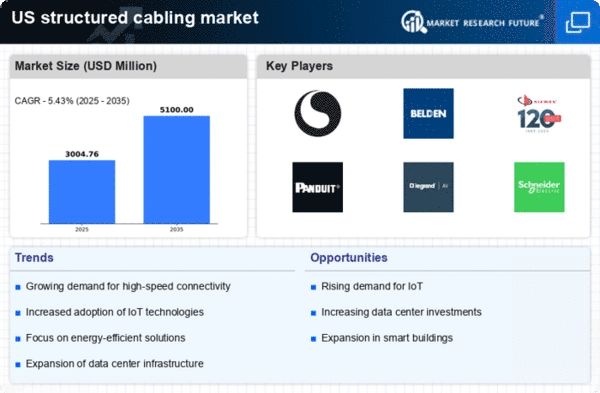
As per Market Research Future analysis, the US Structured Cabling Market size was estimated at 2850.0 USD Million in 2024. The US structured cabling market is projected to grow from 3004.76 USD Million in 2025 to 5100.0 USD Million by 2035, exhibiting a compound annual growth rate (CAGR) of 5.4% during the forecast period 2025 - 2035

Key Market Trends & Highlights

The US structured cabling market is experiencing robust growth driven by technological advancements and increasing connectivity demands.

  • The demand for high-speed connectivity is surging, particularly in the data center segment, which remains the largest in the market.
  • Integration of smart technologies is becoming prevalent, with smart buildings emerging as the fastest-growing segment.
  • Sustainability initiatives are influencing market strategies, as companies seek eco-friendly cabling solutions.
  • Key drivers include the expansion of data centers and the rise in IoT applications, which are reshaping the market landscape.

Market Size & Forecast

2024 Market Size 2850.0 (USD Million)
2035 Market Size 5100.0 (USD Million)
CAGR (2025 - 2035) 5.43%

Major Players

CommScope (US), Belden (US), Siemon (US), Panduit (US), Legrand (FR), Schneider Electric (FR), Corning (US), Nexans (FR), TE Connectivity (CH)

Our Impact
Enabled $4.3B Revenue Impact for Fortune 500 and Leading Multinationals
Partnering with 2000+ Global Organizations Each Year
30K+ Citations by Top-Tier Firms in the Industry

US Structured Cabling Market Trends

The US Structured Cabling Market is currently experiencing a dynamic evolution, driven by the increasing demand for high-speed data transmission and the proliferation of smart technologies. As organizations continue to invest in digital infrastructure, the need for efficient and reliable cabling solutions becomes paramount. This market is characterized by a shift towards advanced cabling systems that support higher bandwidths and improved performance. Additionally, the rise of IoT devices and smart buildings is further propelling the adoption of structured cabling, as these technologies require robust connectivity to function optimally. Moreover, sustainability is emerging as a key consideration within the structured cabling market. Companies are increasingly seeking eco-friendly materials and practices in their cabling solutions. This trend aligns with broader environmental goals and regulations, prompting manufacturers to innovate in ways that reduce waste and energy consumption. As the market continues to mature, it appears that the integration of sustainable practices will not only enhance the appeal of products but also meet the growing expectations of environmentally conscious consumers. Overall, the structured cabling market is poised for growth, driven by technological advancements and a commitment to sustainability.

Increased Demand for High-Speed Connectivity

The structured cabling market is witnessing a surge in demand for high-speed connectivity solutions. This trend is largely influenced by the growing reliance on cloud computing, data centers, and high-bandwidth applications. Organizations are prioritizing the installation of advanced cabling systems that can support faster data transmission rates, thereby enhancing overall network performance.

Integration of Smart Technologies

The integration of smart technologies is significantly shaping the structured cabling market. As smart buildings and IoT devices become more prevalent, the need for reliable and efficient cabling solutions is paramount. This trend indicates a shift towards systems that can accommodate the increasing number of connected devices, ensuring seamless communication and data flow.

Focus on Sustainability

Sustainability is becoming a focal point in the structured cabling market. Companies are increasingly adopting eco-friendly materials and practices in their cabling solutions. This trend reflects a broader commitment to environmental responsibility, as organizations seek to minimize their carbon footprint and comply with regulatory standards.

US Structured Cabling Market Drivers

Rise in IoT Applications

The proliferation of Internet of Things (IoT) applications is driving the structured cabling market in the US. With an increasing number of devices connected to the internet, the demand for reliable and high-speed cabling solutions is paramount. In 2025, it is estimated that there will be over 30 billion connected devices globally, with a significant portion located in the US. This growth necessitates the implementation of structured cabling systems that can handle the increased data traffic and ensure efficient communication between devices. Moreover, as industries such as healthcare, manufacturing, and smart cities adopt IoT technologies, the structured cabling market is likely to experience heightened demand for innovative cabling solutions that support these applications.

Expansion of Data Centers

The expansion of data centers in the US is a pivotal driver for the structured cabling market. As businesses increasingly rely on cloud computing and data storage solutions, the demand for robust cabling infrastructure intensifies. In 2025, the data center market is projected to reach approximately $200 billion, indicating a substantial growth trajectory. This surge necessitates advanced structured cabling systems to support high data transfer rates and ensure reliable connectivity. Furthermore, the need for efficient cooling and power management in data centers further emphasizes the importance of structured cabling solutions. As organizations seek to optimize their operations, the structured cabling market stands to benefit significantly from this trend, as it provides the backbone for the seamless functioning of data centers across various sectors.

Growth of Smart Buildings

The trend towards smart buildings is significantly influencing the structured cabling market. As more commercial and residential properties integrate smart technologies, the need for advanced cabling infrastructure becomes critical. In 2025, the smart building market is projected to reach $100 billion in the US, highlighting the increasing investment in intelligent systems. Structured cabling plays a vital role in enabling the connectivity of various smart devices, such as lighting, HVAC, and security systems. This integration not only enhances energy efficiency but also improves occupant comfort and safety. Consequently, the structured cabling market is poised for growth as building owners and developers prioritize the installation of sophisticated cabling solutions to support the demands of smart building technologies.

Increased Focus on Network Security

As cyber threats continue to evolve, the emphasis on network security is becoming a crucial driver for the structured cabling market. Organizations in the US are increasingly investing in secure cabling solutions to protect sensitive data and maintain operational integrity. In 2025, the cybersecurity market is expected to exceed $300 billion, reflecting the growing awareness of the importance of safeguarding information. Structured cabling systems are integral to establishing secure networks, as they facilitate the implementation of advanced security protocols and technologies. This heightened focus on security is likely to propel the demand for structured cabling solutions that can support robust security measures, thereby enhancing the overall resilience of organizational networks.

Regulatory Compliance and Standards

Regulatory compliance and adherence to industry standards are essential drivers for the structured cabling market. In the US, various regulations govern the installation and maintenance of cabling systems, ensuring safety and performance. As organizations strive to meet these compliance requirements, the demand for high-quality structured cabling solutions increases. In 2025, it is anticipated that the market for compliance-related services will grow significantly, as businesses prioritize investments in infrastructure that meets regulatory standards. This trend not only enhances the reliability of cabling systems but also mitigates risks associated with non-compliance. Consequently, the structured cabling market is likely to benefit from the ongoing emphasis on regulatory adherence, as organizations seek to implement compliant cabling solutions.


Market Segment Insights

By Wire Category: Category 6 (Largest) vs. Category 7 (Fastest-Growing)

The US structured cabling market is characterized by distinct segments based on wire categories, with Category 6 commanding the largest share due to its superior speed and reliability for high-bandwidth applications. In contrast, Category 5e holds a significant presence but is gradually being surpassed by Category 6, which is favored for its compatibility with emerging technologies such as IoT and smart buildings. Category 7 is also emerging strong, driven by the increasing demand for higher data rates and enhanced performance in network installations. Category 7 is positioned as the fastest-growing segment, primarily influenced by the rise in data centers and enterprise networks that require advanced capabilities. As businesses increasingly adopt cloud services and high-speed connectivity, the demand for Category 7 cabling solutions is poised to expand rapidly. The emphasis on future-proofing networks and ensuring faster data transmission is propelling the growth of this segment, further supplemented by technological advancements and increased investment in infrastructure.

Category 6 (Dominant) vs. Category 7 (Emerging)

Category 6 has established itself as the dominant wire category in the structured cabling landscape due to its ability to support higher bandwidths and better transmission speeds compared to Category 5e. It is widely utilized in commercial and residential settings for high-speed internet access, VoIP applications, and multimedia distribution. This category's reliability and performance metrics make it the preferred choice for installations aiming for long-term viability. Conversely, Category 7, while currently labeled as emerging, is gaining traction for its enhanced characteristics, including shielding to reduce interference and support for 10 Gbps Ethernet over extended distances. This suitability for advanced networking solutions places it in a favorable position for future market growth.

By Application: LAN (Largest) vs. WAN (Fastest-Growing)

In the US structured cabling market, the application segment is largely dominated by the Local Area Network (LAN), which has established itself as the primary choice for enterprises due to its cost-effectiveness and efficiency in connecting devices over shorter distances. The Wide Area Network (WAN), while trailing behind in terms of market share, has been gaining significant traction owing to the rise in remote connectivity needs and the expanding digital landscape that demands robust long-distance communication solutions. The growth trends in this segment are driven by the increasing reliance on cloud services and applications that require reliable and high-speed connectivity. LAN infrastructure continues to evolve with innovations that enhance its capabilities, supporting a growing number of devices. Meanwhile, WAN technologies are rapidly advancing, becoming the fastest-growing segment, as businesses seek adaptive solutions to manage expansive networks which accommodate remote work and global operations.

LAN (Dominant) vs. WAN (Emerging)

The LAN segment is characterized by its widespread deployment in office environments, promoting seamless communication and data sharing among local devices, while maintaining lower operational costs. Its dominance is evident through its integration with various technologies, catering to a diversity of applications such as VoIP and streaming services. On the other hand, the WAN segment is emerging as a crucial component for organizations that require consistent and efficient communications over large geographical areas. This segment is marked by increasing investments in SD-WAN technologies, which enhance performance and reduce costs, appealing particularly to enterprises expanding their operations globally. Both segments serve essential functions, yet their focus and growth trajectories are marking distinct paths within the evolving landscape.

By Product: Copper (Largest) vs. Co-Axial (Fastest-Growing)

In the US structured cabling market, Copper cables hold the largest share due to their extensive use in various applications such as data centers, commercial buildings, and residential setups. This segment's reliability and performance in transmitting data effectively have made it the preferred choice for many installers and end-users. On the other hand, Co-Axial cables are rapidly capturing market attention, especially in the realm of video and data transmission, thanks to rising consumer demand for high-speed internet and video services. The growth trends for these segments reveal an interesting dynamic. While Copper continues to dominate, the Co-Axial segment is witnessing robust growth driven by advancements in technology and increasing requirements for high-bandwidth applications. Factors such as the expansion of cable-related infrastructure and the advent of smart technologies are propelling the adoption of Co-Axial cables, positioning it as the fastest-growing segment in the market. Analysts predict this trend will continue as more industries seek efficient solutions for data transmission.

Copper (Dominant) vs. Co-Axial (Emerging)

Copper cables are characterized by their exceptional conductivity and ability to transmit data over short to medium distances efficiently. They are widely adopted in various sectors, including telecommunications and networking. Their dominant position stems from established infrastructures and user familiarity, making them the go-to choice for many organizations. In contrast, Co-Axial cables, though emerging, are increasingly recognized for their advantages in high-frequency signal transmissions. Their design minimizes interference, making them suitable for broadband communications. As industries evolve towards higher data transmission demands, Co-Axial cables are quickly becoming a viable alternative, indicating a shift in preferences that could reshape market dynamics in the coming years.

Get more detailed insights about US Structured Cabling Market

Key Players and Competitive Insights

The structured cabling market is currently characterized by a dynamic competitive landscape, driven by technological advancements and increasing demand for high-speed data transmission. Key players such as CommScope (US), Belden (US), and Corning (US) are strategically positioned to leverage innovation and expand their market presence. CommScope (US) focuses on enhancing its product portfolio through continuous research and development, while Belden (US) emphasizes strategic partnerships to bolster its supply chain capabilities. Corning (US) is actively pursuing digital transformation initiatives, which collectively shape a competitive environment that prioritizes agility and responsiveness to market needs.In terms of business tactics, companies are increasingly localizing manufacturing to mitigate supply chain disruptions and optimize operational efficiency. The market appears moderately fragmented, with several key players exerting influence over various segments. This fragmentation allows for niche players to thrive, while larger companies leverage their scale to implement cost-effective solutions and innovative technologies.

In October CommScope (US) announced a significant investment in a new manufacturing facility in Texas, aimed at increasing production capacity for its fiber optic solutions. This strategic move is likely to enhance the company's ability to meet the growing demand for high-speed connectivity, particularly in the expanding data center market. By localizing production, CommScope (US) not only reduces lead times but also strengthens its supply chain resilience.

In September Belden (US) launched a new line of environmentally sustainable cabling products, reflecting a growing trend towards sustainability in the industry. This initiative not only aligns with global environmental goals but also positions Belden (US) as a leader in eco-friendly solutions, potentially attracting a broader customer base that prioritizes sustainability in their purchasing decisions. The strategic importance of this move lies in its ability to differentiate Belden (US) in a competitive market increasingly focused on environmental responsibility.

In August Corning (US) entered into a partnership with a leading cloud service provider to develop advanced cabling solutions tailored for data centers. This collaboration is indicative of the increasing integration of technology and infrastructure, as companies seek to enhance performance and efficiency. The strategic importance of this partnership lies in its potential to drive innovation and create new revenue streams, positioning Corning (US) favorably in a rapidly evolving market.

As of November current competitive trends are heavily influenced by digitalization, sustainability, and the integration of artificial intelligence (AI) into operational processes. Strategic alliances are becoming increasingly vital, as companies recognize the need to collaborate to enhance their technological capabilities and market reach. Looking ahead, competitive differentiation is likely to evolve from traditional price-based competition to a focus on innovation, technology, and supply chain reliability. This shift underscores the importance of agility and responsiveness in meeting the demands of a rapidly changing market.

Key Companies in the US Structured Cabling Market include

Industry Developments

Panduit strengthened its position in next-generation connection in January 2024 by introducing its Net-Verse CAT8 cabling system, which is intended to handle new 40GBASE-T applications in high-performance data center and enterprise settings.

Corning's EDGETM Rapid Connect solution, a modular structured cabling system designed for hyperscale data centers and providing higher scalability and faster deployment, was introduced in December 2023. By March 2024, CommScope had launched their AIM-QUOTE software platform, which improved accuracy and productivity by simplifying the cabling design and quotation process for business and data center networks.

Amphenol Corp. most recently announced in August 2025 that it would pay $10.5 billion to acquire CommScope's Connectivity & Cable Solutions division, marking a significant consolidation in the U.S. structured cabling market with an eye toward enhancing AI and data center infrastructure capabilities.

The growth of strong, high-capacity network infrastructures across organizations and hyperscale environments is being driven by the innovative efforts of top U.S. and international players, as demonstrated by these advancements. These innovations include digital tools, new cabling technologies, and strategic M&A.

Future Outlook

US Structured Cabling Market Future Outlook

The Structured Cabling Market is projected to grow at a 5.43% CAGR from 2025 to 2035, driven by increasing demand for high-speed data transmission and smart building technologies.

New opportunities lie in:

  • Expansion into smart building integration solutions
  • Development of eco-friendly cabling materials
  • Implementation of advanced network management software

By 2035, the structured cabling market is expected to achieve robust growth and innovation.

Market Segmentation

US Structured Cabling Market Product Outlook

  • Copper
  • Co-Axial

US Structured Cabling Market Application Outlook

  • LAN
  • WAN

US Structured Cabling Market Wire Category Outlook

  • Category 5e
  • Category 6
  • Category 7

Report Scope

MARKET SIZE 2024 2850.0(USD Million)
MARKET SIZE 2025 3004.76(USD Million)
MARKET SIZE 2035 5100.0(USD Million)
COMPOUND ANNUAL GROWTH RATE (CAGR) 5.43% (2025 - 2035)
REPORT COVERAGE Revenue Forecast, Competitive Landscape, Growth Factors, and Trends
BASE YEAR 2024
Market Forecast Period 2025 - 2035
Historical Data 2019 - 2024
Market Forecast Units USD Million
Key Companies Profiled CommScope (US), Belden (US), Siemon (US), Panduit (US), Legrand (FR), Schneider Electric (FR), Corning (US), Nexans (FR), TE Connectivity (CH)
Segments Covered Wire Category, Application, Product
Key Market Opportunities Integration of smart building technologies drives demand in the structured cabling market.
Key Market Dynamics Technological advancements drive demand for structured cabling solutions, enhancing network performance and scalability in various sectors.
Countries Covered US
Leave a Comment

FAQs

What was the market size of the US Structured Cabling Market in 2024?

The US Structured Cabling Market was valued at 2.54 billion USD in 2024.

What is the projected market value of the US Structured Cabling Market by 2035?

By 2035, the market is projected to reach a value of 4.69 billion USD.

What is the expected CAGR of the US Structured Cabling Market from 2025 to 2035?

The expected CAGR for the US Structured Cabling Market from 2025 to 2035 is 5.728%.

Which wire category is projected to have the largest market size in 2035?

Category 6 is projected to have the largest market size, with an estimated value of 2.5 billion USD in 2035.

What are the expected values of Category 5e and Category 7 in 2035?

Category 5e is expected to be valued at 1.45 billion USD, while Category 7 is projected to reach 0.74 billion USD by 2035.

Who are the major players in the US Structured Cabling Market?

Key players include Belden, Legrand, Schneider Electric, and CommScope, among others.

What opportunities exist in the US Structured Cabling Market?

Opportunities in the market include advancements in technology and increasing demand for high-speed communication.

What are some challenges facing the US Structured Cabling Market?

Challenges include intense competition among key players and the rapid evolution of technology.

What impact do global scenarios have on the US Structured Cabling Market?

Current global scenarios and conflicts may influence supply chains and affect market dynamics.

What was the market value of Category 6 in 2024?

Category 6 was valued at 1.3 billion USD in 2024.

Download Free Sample

Kindly complete the form below to receive a free sample of this Report

Compare Licence

×
Features License Type
Single User Multiuser License Enterprise User
Price $4,950 $5,950 $7,250
Maximum User Access Limit 1 User Upto 10 Users Unrestricted Access Throughout the Organization
Free Customization
Direct Access to Analyst
Deliverable Format
Platform Access
Discount on Next Purchase 10% 15% 15%
Printable Versions