×
Request Free Sample ×

Kindly complete the form below to receive a free sample of this Report

* Please use a valid business email

Leading companies partner with us for data-driven Insights

clients tt-cursor
Hero Background

UK Structured Cabling Market

ID: MRFR/ICT/61193-HCR
200 Pages
Aarti Dhapte
February 2026

UK Structured Cabling Market Size, Share and Research Report: By Wire Category (Category 5e, Category 6, Category 7), By Application (LAN & WAN), and By Product Type (Copper, Co-Axil)-Forecast to 2035

Share:
Download PDF ×

We do not share your information with anyone. However, we may send you emails based on your report interest from time to time. You may contact us at any time to opt-out.

UK Structured Cabling Market Infographic
Purchase Options

UK Structured Cabling Market Summary

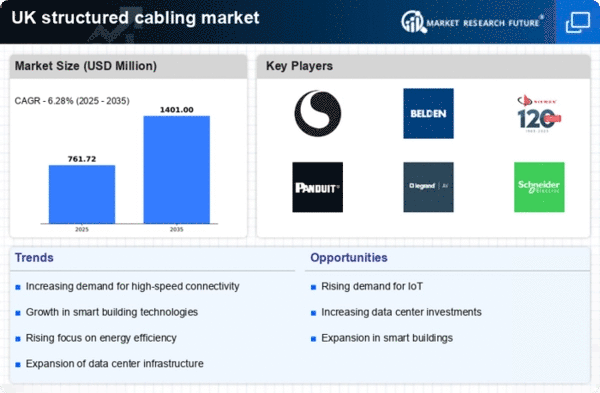
As per Market Research Future analysis, the UK Structured Cabling Market size was estimated at 716.72 USD Million in 2024. The UK structured cabling market is projected to grow from 761.72 USD Million in 2025 to 1401.0 USD Million by 2035, exhibiting a compound annual growth rate (CAGR) of 6.2% during the forecast period 2025 - 2035

Key Market Trends & Highlights

The UK structured cabling market is poised for growth driven by technological advancements and increasing connectivity demands.

  • The demand for high-speed connectivity continues to rise, reflecting a broader trend towards enhanced network performance.
  • Fiber optic technology adoption is accelerating, positioning it as a key component in modern cabling solutions.
  • Sustainability and eco-friendly solutions are becoming increasingly prioritized in cabling projects across various sectors.
  • The expansion of data centres and the rise in smart building initiatives are major drivers propelling market growth.

Market Size & Forecast

2024 Market Size 716.72 (USD Million)
2035 Market Size 1401.0 (USD Million)
CAGR (2025 - 2035) 6.28%

Major Players

CommScope (US), Belden (US), Siemon (US), Panduit (US), Legrand (FR), Schneider Electric (FR), Corning (US), Nexans (FR), TE Connectivity (CH)

Our Impact
Enabled $4.3B Revenue Impact for Fortune 500 and Leading Multinationals
Partnering with 2000+ Global Organizations Each Year
30K+ Citations by Top-Tier Firms in the Industry

UK Structured Cabling Market Trends

The UK Structured Cabling Market is currently experiencing a notable evolution, driven by the increasing demand for high-speed data transmission and the proliferation of smart technologies. As businesses and organizations seek to enhance their network infrastructure, the emphasis on reliable and efficient cabling solutions has intensified. This shift is largely influenced by the growing reliance on cloud computing, IoT devices, and the need for seamless connectivity in various sectors, including telecommunications, healthcare, and education. Furthermore, the ongoing advancements in cabling technology, such as the development of fiber optic solutions, are reshaping the landscape, offering enhanced performance and bandwidth capabilities. In addition, sustainability considerations are becoming increasingly relevant within the structured cabling market. Companies are now prioritizing eco-friendly materials and practices, reflecting a broader trend towards environmental responsibility. This focus on sustainability not only aligns with regulatory requirements but also resonates with consumers who are more conscious of their environmental impact. As a result, manufacturers are exploring innovative approaches to reduce waste and improve energy efficiency in their products. Overall, the structured cabling market appears poised for growth, driven by technological advancements and a commitment to sustainability.

Increased Demand for High-Speed Connectivity

The structured cabling market is witnessing a surge in demand for high-speed connectivity solutions. This trend is largely attributed to the growing reliance on data-intensive applications and services, which necessitate robust network infrastructures. Organizations are increasingly investing in advanced cabling systems to support their operational needs, ensuring that they can handle the increasing volume of data traffic.

Adoption of Fiber Optic Technology

There is a marked shift towards the adoption of fiber optic technology within the structured cabling market. Fiber optics offer superior performance in terms of bandwidth and transmission speed compared to traditional copper cabling. This transition is driven by the need for faster data transfer rates and improved network reliability, particularly in sectors that demand high-performance connectivity.

Focus on Sustainability and Eco-Friendly Solutions

Sustainability is becoming a central theme in the structured cabling market. Companies are increasingly prioritizing eco-friendly materials and practices in their cabling solutions. This trend reflects a growing awareness of environmental issues and aligns with regulatory pressures, as organizations seek to minimize their carbon footprint and enhance their corporate social responsibility initiatives.

UK Structured Cabling Market Drivers

Expansion of Data Centres

The rapid expansion of data centres in the UK is a primary driver for the structured cabling market. As businesses increasingly rely on data-driven operations, the demand for efficient and reliable cabling solutions has surged. In 2025, the UK data centre market is projected to reach a value of £4 billion, indicating a robust growth trajectory. This expansion necessitates advanced structured cabling systems to support high data transfer rates and connectivity. Furthermore, the need for scalability in data centres compels operators to invest in flexible cabling solutions that can adapt to evolving technological requirements. Consequently, the structured cabling market is likely to benefit from this trend, as companies seek to enhance their infrastructure to accommodate growing data needs.

Emergence of IoT Applications

The emergence of Internet of Things (IoT) applications in various sectors is driving demand for structured cabling solutions in the UK. As more devices become interconnected, the need for reliable and efficient cabling systems becomes paramount. The IoT market in the UK is projected to grow by 40% by 2026, indicating a significant shift towards connected devices in industries such as healthcare, manufacturing, and smart cities. This trend suggests that the structured cabling market will need to adapt to support the increased data traffic generated by IoT devices. Companies are likely to invest in advanced cabling solutions that can accommodate the unique requirements of IoT applications, thereby fostering growth in the structured cabling market.

Growing Need for Network Security

As cyber threats continue to evolve, the growing need for network security is becoming a significant driver for the structured cabling market. Businesses in the UK are increasingly aware of the vulnerabilities associated with outdated cabling systems, which can compromise data integrity and security. In 2025, it is estimated that the cybersecurity market in the UK will reach £8 billion, reflecting a strong emphasis on protecting sensitive information. This heightened focus on security is likely to lead organizations to invest in modern structured cabling solutions that incorporate advanced security features. Consequently, the structured cabling market may experience growth as companies seek to enhance their network security posture through improved cabling infrastructure.

Rise in Smart Building Initiatives

The increasing focus on smart building initiatives in the UK is significantly influencing the structured cabling market. Smart buildings, which integrate advanced technologies for improved energy efficiency and occupant comfort, require sophisticated cabling systems to support various applications. The UK government has set ambitious targets for energy efficiency, which may drive the adoption of smart technologies in commercial and residential buildings. As of 2025, it is estimated that the smart building market in the UK will grow by approximately 30%, creating a substantial demand for structured cabling solutions. This trend suggests that the structured cabling market will play a crucial role in facilitating the connectivity required for smart technologies, thereby enhancing overall building performance.

Increased Investment in Telecommunications Infrastructure

The UK government and private sector are making substantial investments in telecommunications infrastructure, which is a key driver for the structured cabling market. With the ongoing rollout of 5G networks, there is a heightened need for robust cabling systems that can support high-speed data transmission. The UK telecommunications market is expected to grow by 25% by 2026, driven by the demand for faster and more reliable connectivity. This investment not only enhances consumer access to high-speed internet but also stimulates the structured cabling market as businesses upgrade their infrastructure to meet new standards. The integration of advanced cabling solutions is essential for ensuring that the telecommunications infrastructure can handle increased data loads and connectivity demands.


Market Segment Insights

By Wire Category: Category 6 (Largest) vs. Category 5e (Fastest-Growing)

In the wire category segment of the UK structured cabling market, Category 6 has emerged as the largest segment, capturing a significant share among its peers. This is largely due to its robust performance in data transmission capabilities, which has made it a preferred choice for various applications in both residential and commercial settings. Meanwhile, Category 5e, while currently smaller in market share, is witnessing a surge in adoption, driven by its cost-effectiveness and adequate performance for many low to moderate bandwidth applications. The growth trends in this segment are shaped by increasing digitalization and the demand for high-speed internet connectivity. As businesses and consumers rely more on data-heavy applications, the necessity for reliable and faster cabling solutions becomes more apparent. The transition toward smart cities and IoT devices further fuels this growth, as higher data transmission speeds are required to support the sheer volume of connected devices.

Category 6 (Dominant) vs. Category 5e (Emerging)

Category 6 cabling is known for its superior data transmission capabilities, supporting frequencies up to 250 MHz and capable of handling up to 10 Gbps speed over short distances. This makes it the go-to solution for environments demanding high performance and reliability, such as data centers and enterprise networks. In contrast, Category 5e, while being an emerging segment, continues to be favored for its affordability and satisfactory performance, often serving the residential market and small businesses. As the demand for cost-effective solutions grows among less intensive users, Category 5e's position in the market is becoming increasingly important, especially for general applications that do not require the high performance of newer cabling technologies.

By Application: LAN (Largest) vs. WAN (Fastest-Growing)

In the UK structured cabling market, LAN continues to hold the largest market share among application segments. This dominance is attributed to increasing demand for high-speed internet and efficient networking solutions in both commercial and residential settings. The push for digital transformation across various industries also significantly contributes to the growth of LAN solutions, as businesses are investing heavily in setting up robust local networks to support their operations. Conversely, WAN is recognized as the fastest-growing segment due to the rapid expansion of remote work and the need for seamless connectivity over long distances. Companies are increasingly adopting cloud services and seeking reliable long-range connectivity solutions, driving the demand for advanced WAN technologies. The evolution of 5G and advancements in networking protocols are further propelling growth in this segment, making it a critical focus for providers in the market.

LAN (Dominant) vs. WAN (Emerging)

The LAN segment is characterized by its widespread implementation in both small and large enterprises, providing essential infrastructure for internal communications and data exchange. Its reliability and cost-effectiveness solidify its dominant position in the UK structured cabling market. Conversely, the WAN segment is emerging, fueled by the growing necessity for remote access and connectivity across geographically dispersed locations. Technological advancements such as software-defined WAN are enabling businesses to achieve greater flexibility and efficiency, making WAN solutions attractive to organizations looking to optimize their network performance as they scale. The contrasting market positions highlight LAN's established presence versus WAN's innovative growth trajectory.

By Product: Copper (Largest) vs. Co-Axial (Fastest-Growing)

In the UK structured cabling market, Copper remains the dominant segment, capturing significant market share. It benefits from established infrastructure and widespread applications across various sectors, including telecommunications and data centers. Co-Axial, while smaller in share, is gaining traction due to its unique advantages in specific applications, especially in broadcasting and high-frequency signals. The growth trends for Co-Axial cables are particularly promising, propelled by increasing demand for high-speed internet and advanced broadcasting technologies. This segment is rapidly evolving to accommodate newer specifications and standards, driven by innovation in technology. Meanwhile, Copper is expected to maintain its leading status, although it faces challenges from emerging alternatives that may offer higher performance and efficiency.

Copper (Dominant) vs. Co-Axial (Emerging)

Copper cabling holds a dominant position in the UK structured cabling market, primarily due to its reliability and extensive use across various applications, including networking and telecommunications. Its proven track record and compatibility with existing infrastructure make it a favored choice for many businesses. On the other hand, Co-Axial cables, while considered an emerging segment, are carving out their niche due to their ability to handle high-frequency applications and superior shielding capabilities. This allows Co-Axial to thrive in specific environments, such as broadcast and data transmission, where signal integrity is paramount. The growth of Co-Axial is further fueled by technological advancements and shifts in market demand towards specialized cabling solutions.

Get more detailed insights about UK Structured Cabling Market

Key Players and Competitive Insights

The structured cabling market in the UK is characterized by a competitive landscape that is increasingly shaped by technological advancements and evolving customer demands. Key growth drivers include the rising need for high-speed data transmission, the expansion of smart buildings, and the increasing adoption of IoT devices. Major players such as CommScope (US), Belden (US), and Schneider Electric (FR) are strategically positioned to leverage these trends. CommScope (US) focuses on innovation in fiber optic solutions, while Belden (US) emphasizes its commitment to high-performance cabling systems. Schneider Electric (FR) is actively pursuing digital transformation initiatives, enhancing its product offerings to meet the demands of a more connected world. Collectively, these strategies contribute to a dynamic competitive environment where companies are vying for market share through technological differentiation and enhanced service offerings.In terms of business tactics, companies are increasingly localizing manufacturing to reduce lead times and optimize supply chains. This approach not only enhances operational efficiency but also allows for greater responsiveness to market changes. The competitive structure of the market appears moderately fragmented, with several key players holding substantial market shares. However, the influence of these major companies is significant, as they set industry standards and drive innovation, thereby shaping the overall market dynamics.

In October CommScope (US) announced the launch of its latest fiber optic cabling solution, which is designed to support the growing demand for high-speed internet connectivity. This strategic move is likely to enhance CommScope's competitive edge by addressing the needs of data centers and enterprise networks, positioning the company as a leader in the high-performance cabling segment. The introduction of this product aligns with the broader trend of increasing bandwidth requirements in the UK market.

In September Belden (US) expanded its manufacturing capabilities in the UK by investing £5 million in a new facility. This investment is indicative of Belden's commitment to local production and supply chain optimization, which may enhance its ability to meet customer demands more effectively. By bolstering its manufacturing presence, Belden is likely to improve its competitive positioning and responsiveness to market fluctuations.

In August Schneider Electric (FR) entered into a strategic partnership with a leading technology firm to develop integrated solutions for smart buildings. This collaboration is expected to enhance Schneider's product portfolio, allowing it to offer comprehensive solutions that combine structured cabling with advanced building management systems. Such partnerships are crucial in a market that increasingly values integrated technology solutions, potentially giving Schneider a competitive advantage.

As of November the competitive trends in the structured cabling market are heavily influenced by digitalization, sustainability, and the integration of AI technologies. Companies are increasingly forming strategic alliances to enhance their technological capabilities and market reach. The shift from price-based competition to a focus on innovation and technology is evident, as firms seek to differentiate themselves through superior product offerings and reliable supply chains. Looking ahead, it appears that competitive differentiation will continue to evolve, with an emphasis on sustainability and advanced technological integration becoming paramount in shaping the future landscape of the market.

Key Companies in the UK Structured Cabling Market include

Industry Developments

With an emphasis on increased data speed and simplified deployment, CommScope expanded its footprint in the UK in April 2024 by providing major data centers in London with next-generation modular cabling systems.

Nexans UK upgraded its European plant near Manchester in November 2024, increasing production of structured cabling components to suit the growing demand for residential and business network installations.

Belden introduced a specific high-performance copper and fiber solution in March 2025 that was designed to meet the quick deployment requirements of IoT and smart infrastructure projects in the UK. In June 2025, Siemon followed suit with new pre-terminated fiber solutions designed to shorten installation times and satisfy the UK's demand for scalable and flexible network architectures.

In the meanwhile, Schneider Electric debuted its Actassi structured cabling line at a UK trade show in August 2024, emphasizing how well-suited its integrated architecture and high-density connectivity are for contemporary commercial buildings.

These advancements demonstrate how top global companies are actively advancing the structured cabling ecosystem throughout the United Kingdom, supporting the industry's drive for intelligent, scalable, and resilient network infrastructure.

Future Outlook

UK Structured Cabling Market Future Outlook

The Structured Cabling Market is projected to grow at a 6.28% CAGR from 2025 to 2035, driven by increasing demand for high-speed data transmission and smart building technologies.

New opportunities lie in:

  • Expansion into smart building integration services
  • Development of eco-friendly cabling solutions
  • Investment in advanced fiber optic technologies

By 2035, the structured cabling market is expected to achieve robust growth and innovation.

Market Segmentation

UK Structured Cabling Market Product Outlook

  • Copper
  • Co-Axial

UK Structured Cabling Market Application Outlook

  • LAN
  • WAN

UK Structured Cabling Market Wire Category Outlook

  • Category 5e
  • Category 6
  • Category 7

Report Scope

MARKET SIZE 2024 716.72(USD Million)
MARKET SIZE 2025 761.72(USD Million)
MARKET SIZE 2035 1401.0(USD Million)
COMPOUND ANNUAL GROWTH RATE (CAGR) 6.28% (2025 - 2035)
REPORT COVERAGE Revenue Forecast, Competitive Landscape, Growth Factors, and Trends
BASE YEAR 2024
Market Forecast Period 2025 - 2035
Historical Data 2019 - 2024
Market Forecast Units USD Million
Key Companies Profiled CommScope (US), Belden (US), Siemon (US), Panduit (US), Legrand (FR), Schneider Electric (FR), Corning (US), Nexans (FR), TE Connectivity (CH)
Segments Covered Wire Category, Application, Product
Key Market Opportunities Integration of smart building technologies enhances demand in the structured cabling market.
Key Market Dynamics Rising demand for high-speed connectivity drives innovation and competition in the structured cabling market.
Countries Covered UK
Leave a Comment

FAQs

What is the expected market size of the UK Structured Cabling Market in 2024?

The UK Structured Cabling Market is expected to be valued at 793.43 USD Million in 2024.

What is the projected market size of the UK Structured Cabling Market by 2035?

By 2035, the UK Structured Cabling Market is projected to reach a value of 1574.45 USD Million.

What is the expected CAGR for the UK Structured Cabling Market from 2025 to 2035?

The expected CAGR for the UK Structured Cabling Market during the forecast period is 6.428%.

Which wire category is expected to be the largest segment in the UK Structured Cabling Market by 2035?

By 2035, the Category 6 segment is expected to be the largest, valued at 600.0 USD Million.

Who are the major players in the UK Structured Cabling Market?

Key players in the UK Structured Cabling Market include Belden, Legrand, Schneider Electric, and Prysmian Group.

What will be the market value of Category 5e in 2035?

The market value of Category 5e is projected to be 500.0 USD Million in 2035.

What is the market value expected for Category 7 in 2024?

Category 7 is expected to have a market value of 243.43 USD Million in 2024.

What growth factors are driving the UK Structured Cabling Market?

Increasing demand for high-speed data transmission and network infrastructure enhancements are driving the market growth.

What challenges does the UK Structured Cabling Market face?

Challenges include technological changes and stringent regulatory environments impacting cabling standards.

How does the current global scenario affect the UK Structured Cabling Market?

The current global scenario and conflicts can lead to supply chain disruptions impacting market stability and growth.

Download Free Sample

Kindly complete the form below to receive a free sample of this Report

Compare Licence

×
Features License Type
Single User Multiuser License Enterprise User
Price $4,950 $5,950 $7,250
Maximum User Access Limit 1 User Upto 10 Users Unrestricted Access Throughout the Organization
Free Customization
Direct Access to Analyst
Deliverable Format
Platform Access
Discount on Next Purchase 10% 15% 15%
Printable Versions