×
Request Free Sample ×

Kindly complete the form below to receive a free sample of this Report

* Please use a valid business email

Leading companies partner with us for data-driven Insights

clients tt-cursor
Hero Background

Japan Structured Cabling Market

ID: MRFR/ICT/61194-HCR
200 Pages
Aarti Dhapte
February 2026

Japan Structured Cabling Market Size, Share and Research Report: By Wire Category (Category 5e, Category 6, Category 7), By Application (LAN & WAN), and By Product Type (Copper, Co-Axil)-Forecast to 2035

Share:
Download PDF ×

We do not share your information with anyone. However, we may send you emails based on your report interest from time to time. You may contact us at any time to opt-out.

Japan Structured Cabling Market Infographic
Purchase Options

Japan Structured Cabling Market Summary

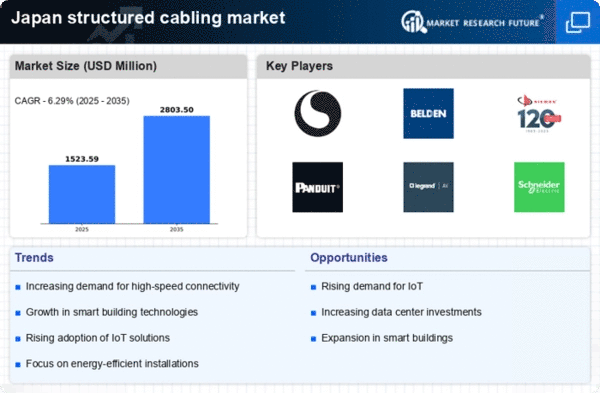
As per Market Research Future analysis, the Japan Structured Cabling Market size was estimated at 1433.43 $ Million in 2024. The Japan structured cabling market is projected to grow from 1523.59 $ Million in 2025 to 2803.5 $ Million by 2035, exhibiting a compound annual growth rate (CAGR) of 6.2% during the forecast period 2025 - 2035

Key Market Trends & Highlights

The Japan structured cabling market is poised for growth driven by technological advancements and increasing demand for connectivity.

  • Technological advancements are reshaping the structured cabling landscape, enhancing performance and efficiency.
  • The telecommunications sector remains the largest segment, while the smart building segment is the fastest-growing in Japan.
  • Regulatory support is fostering a favorable environment for market expansion, particularly in urban areas.
  • Rising demand for high-speed connectivity and the expansion of smart cities are key drivers propelling market growth.

Market Size & Forecast

2024 Market Size 1433.43 (USD Million)
2035 Market Size 2803.5 (USD Million)
CAGR (2025 - 2035) 6.29%

Major Players

CommScope (US), Belden (US), Siemon (US), Panduit (US), Legrand (FR), Schneider Electric (FR), TE Connectivity (CH), Corning (US), Nexans (FR)

Our Impact
Enabled $4.3B Revenue Impact for Fortune 500 and Leading Multinationals
Partnering with 2000+ Global Organizations Each Year
30K+ Citations by Top-Tier Firms in the Industry

Japan Structured Cabling Market Trends

The Japan Structured Cabling Market in Japan is currently experiencing a notable evolution, driven by advancements in technology and increasing demand for high-speed data transmission. As businesses and organizations continue to expand their digital infrastructure, the need for reliable and efficient cabling solutions becomes paramount. This market is characterized by a diverse range of applications, including telecommunications, data centers, and commercial buildings. The integration of smart technologies and the Internet of Things (IoT) further enhances the necessity for robust cabling systems, which are essential for seamless connectivity and data flow. Moreover, the regulatory environment in Japan appears to support the growth of the structured cabling market. Government initiatives aimed at improving digital infrastructure and promoting technological innovation are likely to foster a conducive atmosphere for market expansion. Additionally, the increasing focus on energy efficiency and sustainability may influence the development of new cabling solutions that align with these objectives. As a result, stakeholders in the structured cabling market are expected to adapt to these trends, ensuring that their offerings meet the evolving needs of consumers and businesses alike.

Technological Advancements

The structured cabling market is witnessing rapid technological advancements, particularly in fiber optic solutions. These innovations enhance data transmission speeds and reliability, catering to the growing demands of modern enterprises. As organizations seek to upgrade their infrastructure, the adoption of advanced cabling systems is likely to increase.

Regulatory Support

Government policies in Japan are increasingly favoring the development of digital infrastructure. Initiatives aimed at enhancing connectivity and promoting technological growth may provide a favorable environment for the structured cabling market. This regulatory support could lead to increased investments and innovations in cabling solutions.

Sustainability Focus

There is a growing emphasis on sustainability within the structured cabling market. Companies are exploring eco-friendly materials and energy-efficient solutions to meet environmental standards. This trend reflects a broader commitment to reducing carbon footprints and promoting sustainable practices in the telecommunications sector.

Japan Structured Cabling Market Drivers

Expansion of Smart Cities

Japan's commitment to developing smart cities is a crucial factor propelling the structured cabling market. As urban areas increasingly integrate technology to enhance infrastructure and services, the need for reliable cabling systems becomes paramount. The structured cabling market is expected to benefit from investments in smart city projects, which often require extensive cabling networks to support various applications, including traffic management, public safety, and energy efficiency. The Japanese government has allocated substantial funding for these initiatives, indicating a strong focus on modernizing urban infrastructure. This trend not only enhances the quality of life for residents but also creates a substantial opportunity for the structured cabling market to grow, as it provides the necessary backbone for smart technologies.

Emergence of Remote Work Trends

The shift towards remote work in Japan has emerged as a notable driver for the structured cabling market. As organizations adapt to flexible work arrangements, there is an increasing need for reliable home office setups that can support high-speed internet and seamless connectivity. This trend has led to a surge in demand for structured cabling solutions that facilitate efficient data transfer and communication. The structured cabling market is likely to see growth as businesses invest in infrastructure that enables remote work capabilities, ensuring employees have access to the necessary tools and resources. Furthermore, the emphasis on maintaining productivity and collaboration in a remote environment underscores the importance of robust cabling systems, thereby positively influencing the structured cabling market.

Increased Focus on Data Security

With the rise in cyber threats, the emphasis on data security has become a significant driver for the structured cabling market. Organizations in Japan are increasingly aware of the vulnerabilities associated with outdated cabling systems, which can compromise data integrity and security. As a result, there is a growing trend towards upgrading to more secure and efficient cabling solutions. The structured cabling market is likely to see a surge in demand as businesses invest in infrastructure that not only supports high-speed connectivity but also enhances security measures. This shift is particularly relevant in sectors such as finance and healthcare, where data protection is critical. Consequently, the increased focus on data security is expected to positively impact the structured cabling market.

Growth of the Telecommunications Sector

The telecommunications sector in Japan is experiencing robust growth, which serves as a vital driver for the structured cabling market. As telecom companies expand their networks to accommodate the rising demand for mobile and internet services, the need for efficient cabling solutions becomes increasingly apparent. The structured cabling market is projected to benefit from the rollout of 5G technology, which requires advanced cabling infrastructure to support higher data rates and connectivity. Investments in telecommunications infrastructure are expected to reach approximately $10 billion by 2026, further stimulating the structured cabling market. This growth not only enhances connectivity for consumers but also creates opportunities for businesses to leverage advanced technologies, thereby driving the demand for structured cabling solutions.

Rising Demand for High-Speed Connectivity

The increasing demand for high-speed internet and data transfer capabilities is a primary driver for the structured cabling market. As businesses and consumers in Japan seek faster and more reliable connectivity, the need for advanced cabling solutions becomes evident. The structured cabling market is projected to grow at a CAGR of approximately 8% from 2025 to 2030, driven by the proliferation of IoT devices and smart technologies. This trend necessitates the installation of robust cabling systems that can support high bandwidth and low latency. Furthermore, the expansion of data centers and cloud services in Japan further fuels this demand, as organizations require efficient cabling infrastructure to manage their data traffic effectively. Thus, the rising demand for high-speed connectivity significantly influences the structured cabling market.


Market Segment Insights

By Wire Category: Category 6 (Largest) vs. Category 7 (Fastest-Growing)

In the Japan structured cabling market, Category 6 has emerged as the largest segment, dominating market share due to its balance of performance and cost-effectiveness. Category 5e, while still relevant, has seen a decline in preference as users shift towards higher performance standards, while Category 7 is capturing attention with its advanced specifications and higher bandwidth capabilities. Growth trends indicate that the demand for higher data rates is propelling Category 7 as the fastest-growing segment. Factors such as the increase in smart buildings and IoT devices necessitate more robust cabling solutions, which Category 7 offers. Meanwhile, ongoing technological advancements and the push for higher speeds in network infrastructure are further contributing to the growth of this segment.

Category 6 (Dominant) vs. Category 7 (Emerging)

Category 6 cabling is characterized by its ability to support speeds up to 1 Gbps over 100 meters, making it the dominant choice for many business applications, providing a reliable and cost-effective solution for high-speed networking. In contrast, Category 7 cabling, which supports higher frequencies and data rates, is emerging rapidly in the Japan structured cabling market, particularly for applications requiring superior performance and shielding against interference. As businesses continue to adopt innovations in networking technology and engage in high-bandwidth applications, Category 7 is positioning itself as the choice for future-oriented infrastructure.

By Application: LAN (Largest) vs. WAN (Fastest-Growing)

Within the structured cabling market, LAN systems dominate the landscape, capturing a significant share due to their essential role in local networking solutions. Conversely, WAN setups are experiencing rapid adoption, reflecting a shift towards more extensive network coverage and integration, vital for modern enterprise connections. The growth trends in the application segment highlight an increasing reliance on WAN technologies, driven by the rise of remote work and cloud-based solutions. Businesses are investing in WAN to enhance connectivity and support distributed operations, indicating a notable transition. Meanwhile, LAN installations continue to thrive, supported by foundational infrastructure developments as organizations expand their local network capabilities to accommodate a burgeoning digital environment.

LAN (Dominant) vs. WAN (Emerging)

LAN systems are characterized by their ability to provide high-speed connectivity over short distances, making them indispensable for businesses looking to establish robust local networks. They serve as the backbone of daily operations, ensuring efficient data transfer and communication within offices. In contrast, WAN technologies are emerging as vital solutions for businesses seeking broader network coverage, particularly in regions with increasing remote work dynamics. The evolution of WAN services is facilitated by advancements in technology, enabling faster data transmission over longer distances and catering to the needs of expansive, distributed networks that demand reliable connectivity.

By Product: Copper (Largest) vs. Co-Axial (Fastest-Growing)

In the Japan structured cabling market, the product segment exhibits a notable distribution, with Copper cabled solutions dominating the landscape. This segment is favored due to its reliability and capacity for high-bandwidth data transmission. Co-Axial cabling, while not as predominant as Copper, has been gaining traction, particularly in specific applications such as broadcasting and video transmission, contributing to an evolving market dynamic. The growth trends within the product segment are driven by technological advancements and the increasing demand for high-speed internet and connectivity solutions. As more businesses and households favor digital transformation, the need for robust cabling infrastructure propels the growth of Co-Axial solutions, positioning them as the fastest-growing alternative. Furthermore, the ongoing developments in data centers and smart city initiatives are fueling the demand for both Copper and Co-Axial cabling, ensuring a competitive marketplace.

Copper (Dominant) vs. Co-Axial (Emerging)

Copper cabling remains the dominant choice within the product segment, renowned for its exceptional performance and longevity, making it ideal for various applications, including corporate networks and residential setups. Its ability to support high data rates and compatibility with existing network infrastructures solidifies its market position. On the other hand, Co-Axial cabling is emerging as a viable alternative, attributed to its efficiency in transmitting cable television signals and broadband internet access. This segment appeals to specific niches due to its affordability and effectiveness in video-specific applications. As technological demands evolve, both Copper and Co-Axial cables are expected to coexist, fulfilling different requirements across the structured cabling ecosystem.

Get more detailed insights about Japan Structured Cabling Market

Key Players and Competitive Insights

The structured cabling market in Japan exhibits a dynamic competitive landscape, characterized by rapid technological advancements and a growing demand for high-speed connectivity solutions. Key players such as CommScope (US), Belden (US), and Schneider Electric (FR) are strategically positioned to leverage innovation and regional expansion to enhance their market presence. CommScope (US) focuses on developing next-generation cabling solutions that cater to the increasing bandwidth requirements of data centers, while Belden (US) emphasizes its commitment to quality and reliability in its product offerings. Schneider Electric (FR) is actively pursuing digital transformation initiatives, integrating smart technologies into its structured cabling solutions, thereby enhancing operational efficiency and sustainability. Collectively, these strategies contribute to a competitive environment that prioritizes technological innovation and customer-centric solutions.In terms of business tactics, companies are increasingly localizing manufacturing and optimizing supply chains to respond swiftly to market demands. The competitive structure of the market appears moderately fragmented, with several players vying for market share. However, the influence of major companies is substantial, as they set industry standards and drive technological advancements. This competitive interplay fosters an environment where innovation is paramount, compelling smaller players to adapt or collaborate to remain relevant.

In October CommScope (US) announced the launch of its latest high-performance cabling system designed for 5G applications. This strategic move is significant as it positions the company to capitalize on the burgeoning demand for 5G infrastructure in Japan, potentially increasing its market share in a rapidly evolving sector. The introduction of this system not only enhances CommScope's product portfolio but also reinforces its commitment to innovation in response to market needs.

In September Schneider Electric (FR) unveiled a new line of eco-friendly structured cabling solutions aimed at reducing carbon footprints in data centers. This initiative aligns with global sustainability trends and reflects the company's strategic focus on environmentally responsible practices. By prioritizing sustainability, Schneider Electric (FR) not only differentiates itself from competitors but also appeals to a growing segment of environmentally conscious consumers and businesses.

In August Belden (US) entered into a strategic partnership with a leading technology firm to develop integrated cabling solutions that enhance network security. This collaboration is indicative of a broader trend where companies are seeking to combine their strengths to address emerging challenges in cybersecurity. By focusing on security, Belden (US) positions itself as a forward-thinking player in the market, likely attracting clients who prioritize secure network infrastructures.

As of November the competitive trends in the structured cabling market are increasingly defined by digitalization, sustainability, and the integration of artificial intelligence (AI) into product offerings. Strategic alliances are becoming more prevalent, as companies recognize the value of collaboration in navigating complex market dynamics. Looking ahead, competitive differentiation is expected to evolve, shifting from traditional price-based competition to a focus on innovation, technological advancements, and supply chain reliability. This transition underscores the necessity for companies to adapt and innovate continuously to maintain a competitive edge in a rapidly changing landscape.

Key Companies in the Japan Structured Cabling Market include

Industry Developments

Panduit added cutting-edge armored fiber optic cabling solutions to its Japanese product line in February 2024. These systems are made to withstand the demanding requirements of smart building networks and industrial automation. The goal of this launch was to improve safety and dependability throughout Japan's expanding industrial IoT market.

In March 2025, Furukawa Electric reported significant advancements in Tokyo's smart mobility networks, replacing outdated infrastructure with scalable structured cabling as part of Japan's "Digital Garden City Nation" project.

Major data center rollouts in Tokyo and Osaka now enable higher-density up to 40/100 Gis switches thanks to CommScope's June 2024 improvements to its SYSTIMAX structured cabling solutions. As Japan's AI-driven edge computing industry grew, Schneider Electric's structured cabling portfolio, which includes its Actassi products, became a mainstay in new data centers in April 2025.

Last but not least, in November 2024, Nexans finished expanding its factory in northern Japan, increasing its ability to manufacture cables for structured network applications in smart infrastructure and communications throughout the area.

These advancements highlight the ways in which both local and international actors are supporting Japan's shift to robust, high-performance cabling systems, which serve as the foundation for its aspirations for digital infrastructure.

Future Outlook

Japan Structured Cabling Market Future Outlook

The Structured Cabling Market in Japan is projected to grow at a 6.29% CAGR from 2025 to 2035, driven by technological advancements and increasing demand for high-speed connectivity.

New opportunities lie in:

  • Expansion of smart building infrastructure solutions
  • Development of modular cabling systems for rapid deployment
  • Integration of IoT technologies into cabling systems

By 2035, the structured cabling market is expected to achieve robust growth and enhanced technological integration.

Market Segmentation

Japan Structured Cabling Market Product Outlook

  • Copper
  • Co-Axial

Japan Structured Cabling Market Application Outlook

  • LAN
  • WAN

Japan Structured Cabling Market Wire Category Outlook

  • Category 5e
  • Category 6
  • Category 7

Report Scope

MARKET SIZE 2024 1433.43(USD Million)
MARKET SIZE 2025 1523.59(USD Million)
MARKET SIZE 2035 2803.5(USD Million)
COMPOUND ANNUAL GROWTH RATE (CAGR) 6.29% (2025 - 2035)
REPORT COVERAGE Revenue Forecast, Competitive Landscape, Growth Factors, and Trends
BASE YEAR 2024
Market Forecast Period 2025 - 2035
Historical Data 2019 - 2024
Market Forecast Units USD Million
Key Companies Profiled CommScope (US), Belden (US), Siemon (US), Panduit (US), Legrand (FR), Schneider Electric (FR), TE Connectivity (CH), Corning (US), Nexans (FR)
Segments Covered Wire Category, Application, Product
Key Market Opportunities Integration of smart building technologies drives demand in the structured cabling market.
Key Market Dynamics Rising demand for high-speed connectivity drives innovation and competition in the structured cabling market.

Countries Covered Japan
Leave a Comment

FAQs

What is the projected market size of the Japan Structured Cabling Market in 2024?

The Japan Structured Cabling Market is expected to be valued at 1.5 USD Billion in 2024.

What is the expected market value of the Japan Structured Cabling Market by 2035?

By 2035, the Japan Structured Cabling Market is projected to reach a value of 2.8 USD Billion.

What is the expected CAGR for the Japan Structured Cabling Market from 2025 to 2035?

The expected CAGR for the Japan Structured Cabling Market from 2025 to 2035 is 5.838 percent.

Which wire category holds the largest market share in Japan's Structured Cabling Market?

In 2024, the Category 6 wire category is anticipated to hold a significant market share.

How much is the market value for Category 5e in 2024?

The market value for Category 5e in 2024 is estimated at 0.6 USD Billion.

What is the projected market value for Category 6 in 2035?

In 2035, the projected market value for Category 6 is expected to be 1.3 USD Billion.

What are the key players in the Japan Structured Cabling Market?

Some of the major players in the market include Belden, Cisco, Schneider Electric, and Leviton.

What are the applications driving growth in the Japan Structured Cabling Market?

Growth in the Japan Structured Cabling Market is driven by increased demand for high-speed data transmission and network infrastructure.

What challenges might the Japan Structured Cabling Market face in the upcoming years?

Challenges may include the rapid pace of technological advancements and the need for continuous updates in cabling standards.

How does the current global economic scenario affect the Japan Structured Cabling Market?

The current global economic scenario may impact supply chains and investment trends within the Japan Structured Cabling Market.

Download Free Sample

Kindly complete the form below to receive a free sample of this Report

Compare Licence

×
Features License Type
Single User Multiuser License Enterprise User
Price $4,950 $5,950 $7,250
Maximum User Access Limit 1 User Upto 10 Users Unrestricted Access Throughout the Organization
Free Customization
Direct Access to Analyst
Deliverable Format
Platform Access
Discount on Next Purchase 10% 15% 15%
Printable Versions