×
Request Free Sample ×

Kindly complete the form below to receive a free sample of this Report

* Please use a valid business email

Leading companies partner with us for data-driven Insights

clients tt-cursor
Hero Background

US Behavioral Health Market

ID: MRFR/HC/13157-HCR
128 Pages
Rahul Gotadki
February 2026

US Behavioral Health Market Research Report: Size, Share, Trend Analysis By Disorder (Bipolar Disorder, Anxiety Disorder, Depression, Post-Traumatic Stress Disorder, Eating Disorder, Substance Abuse Disorder, Others), By Service (Home-Based Treatment Services, Outpatient Counselling, Emergency mental health services, Inpatient hospital treatment, Intensive care management) - Growth & Industry Forecast 2025 To 2035

Share:
Download PDF ×

We do not share your information with anyone. However, we may send you emails based on your report interest from time to time. You may contact us at any time to opt-out.

US Behavioral Health Market Infographic
Purchase Options

US Behavioral Health Market Summary

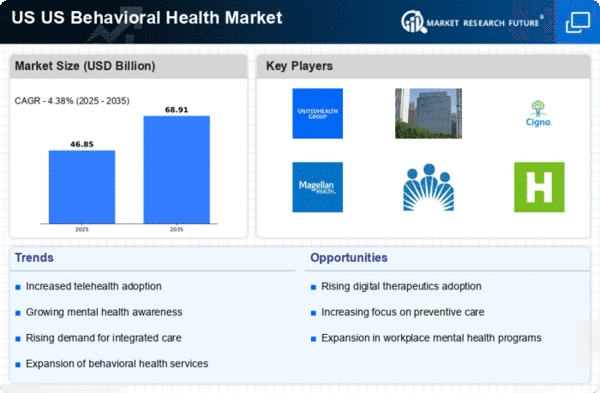
As per analysis, the US Behavioral Health Market is projected to grow from USD 46.85 Billion in 2025 to USD 68.91 Billion by 2035, exhibiting a compound annual growth rate (CAGR) of 3.97% during the forecast period (2025 - 2035).

Key Market Trends & Highlights

The US Behavioral Health Market is experiencing a transformative shift towards integrated care and telehealth solutions.

  • Psychotherapy remains the largest segment, driven by a growing demand for mental health services.
  • Teletherapy is the fastest-growing segment, reflecting increased accessibility and convenience for patients.
  • Anxiety disorders constitute the largest category of behavioral health issues, highlighting the urgent need for effective treatment options.
  • Rising prevalence of mental health disorders and increased funding are key drivers propelling market growth.

Market Size & Forecast

2024 Market Size 44.88 (USD Billion)
2035 Market Size 68.91 (USD Billion)
CAGR (2025 - 2035) 3.97%

Major Players

UnitedHealth Group (US), Anthem (US), Cigna (US), Magellan Health (US), Centene Corporation (US), Kaiser Permanente (US), Horizon Blue Cross Blue Shield (US), WellCare Health Plans (US), Aetna (US)

Our Impact
Enabled $4.3B Revenue Impact for Fortune 500 and Leading Multinationals
Partnering with 2000+ Global Organizations Each Year
30K+ Citations by Top-Tier Firms in the Industry

US Behavioral Health Market Trends

The US Behavioral Health Market is currently experiencing a transformative phase, characterized by an increasing recognition of mental health as a critical component of overall well-being. This shift is largely driven by heightened awareness among the public and policymakers regarding the prevalence of mental health disorders. As a result, there is a growing demand for accessible and effective treatment options. Various stakeholders, including healthcare providers, insurers, and community organizations, are collaborating to enhance service delivery and improve patient outcomes. Furthermore, the integration of technology into behavioral health services is becoming more pronounced, with telehealth solutions gaining traction. This trend appears to facilitate greater access to care, particularly for underserved populations, thereby addressing longstanding disparities in mental health services. In addition, the US government is actively investing in initiatives aimed at expanding mental health resources. Legislative measures are being introduced to ensure that mental health services are adequately funded and integrated into primary care settings. This approach not only promotes holistic treatment but also encourages early intervention, which is crucial for effective management of mental health conditions. As the landscape evolves, it seems likely that the US Behavioral Health Market will continue to adapt, embracing innovative practices and policies that prioritize mental health as a fundamental aspect of public health.

Increased Telehealth Adoption

The US Behavioral Health Market is witnessing a notable rise in telehealth services, which offer remote access to mental health care. This trend is particularly beneficial for individuals in rural or underserved areas, where traditional services may be limited. Telehealth not only enhances convenience but also reduces barriers to seeking help, thereby encouraging more individuals to engage with mental health professionals.

Focus on Integrated Care Models

There is a growing emphasis on integrated care models within the US Behavioral Health Market. These models aim to combine mental health services with primary healthcare, fostering a more comprehensive approach to patient treatment. By addressing both physical and mental health needs simultaneously, this strategy may lead to improved health outcomes and greater patient satisfaction.

Legislative Support for Mental Health

Recent legislative efforts in the US are increasingly focused on bolstering mental health resources. Policymakers are advocating for enhanced funding and support for mental health initiatives, which could lead to expanded access to care. This trend indicates a commitment to prioritizing mental health as a vital component of public health policy.

US Behavioral Health Market Drivers

Growing Awareness and Advocacy

There is a growing awareness and advocacy for mental health issues within the US Behavioral Health Market, which appears to be a crucial driver of change. Public campaigns and initiatives aimed at reducing stigma surrounding mental health have gained momentum, encouraging individuals to seek help without fear of judgment. Organizations such as the National Alliance on Mental Illness are actively promoting mental health education and resources, which is likely to lead to increased demand for services. This heightened awareness is also influencing policy changes, as lawmakers recognize the importance of mental health in overall public health. As advocacy efforts continue to evolve, they may contribute to a more supportive environment for individuals seeking behavioral health care, ultimately benefiting the US Behavioral Health Market.

Increased Funding and Investment

The US Behavioral Health Market is witnessing a surge in funding and investment, driven by both public and private sectors. Legislative measures, such as the Mental Health Parity and Addiction Equity Act, have mandated that mental health services be covered by insurance plans, thereby increasing financial support for behavioral health initiatives. Additionally, venture capital investments in mental health startups have seen a significant rise, with funding reaching billions of dollars in recent years. This influx of capital is facilitating the development of innovative treatment solutions and expanding access to care. Furthermore, government initiatives aimed at addressing the mental health crisis are likely to bolster funding for community-based programs, enhancing the overall infrastructure of the US Behavioral Health Market. This financial support is crucial for improving service delivery and ensuring that individuals receive the care they need.

Technological Advancements in Treatment

Technological advancements are playing a pivotal role in shaping the US Behavioral Health Market. Innovations such as mobile health applications, teletherapy platforms, and artificial intelligence-driven diagnostic tools are enhancing the accessibility and effectiveness of mental health care. The integration of technology into treatment modalities allows for real-time monitoring of patients, which can lead to improved outcomes. For instance, the use of telehealth services has surged, with a report indicating that telehealth visits for mental health increased by over 50% in recent years. This trend suggests that technology is not only facilitating access to care but also transforming traditional treatment paradigms. As these technologies continue to evolve, they are likely to attract further investment and interest within the US Behavioral Health Market, ultimately benefiting patients and providers alike.

Rising Prevalence of Mental Health Disorders

The US Behavioral Health Market is experiencing a notable increase in the prevalence of mental health disorders, which appears to be a significant driver of market growth. According to the National Institute of Mental Health, approximately 20% of adults in the US experience mental illness each year. This rising incidence necessitates enhanced access to behavioral health services, thereby propelling demand for treatment options. The growing awareness surrounding mental health issues has led to a cultural shift, encouraging individuals to seek help. Consequently, healthcare providers are expanding their services to accommodate this demand, which is likely to result in increased investments in the US Behavioral Health Market. Furthermore, the integration of mental health services into primary care settings is becoming more common, indicating a shift towards a more holistic approach to health care.

Integration of Behavioral Health into Primary Care

The integration of behavioral health into primary care settings is emerging as a significant trend within the US Behavioral Health Market. This model promotes a holistic approach to health care, addressing both physical and mental health needs simultaneously. Research indicates that integrated care can lead to improved patient outcomes and reduced healthcare costs. By incorporating mental health professionals into primary care teams, patients are more likely to receive timely and appropriate care. This trend is further supported by policy initiatives aimed at promoting integrated care models, which are likely to enhance access to behavioral health services. As healthcare systems continue to adopt this approach, the US Behavioral Health Market is expected to experience growth, driven by the demand for comprehensive care solutions.


Market Segment Insights

By Treatment Type: Psychotherapy (Largest) vs. Teletherapy (Fastest-Growing)

In the US Behavioral Health Market, psychotherapy holds the largest share among treatment types, reflecting a longstanding preference for face-to-face interactions in mental health care. This traditional approach is valued for its effectiveness in addressing various mental health conditions, leading to a steady demand. Next in line are medication and counseling, which, although important, do not have the same level of market dominance as psychotherapy. Emerging trends point to a rising interest in teletherapy, indicating a shift in consumer behavior due to technology and accessibility issues.

Psychotherapy (Dominant) vs. Teletherapy (Emerging)

Psychotherapy, as the dominant treatment type in the US Behavioral Health Market, offers structured therapeutic strategies supported by research and clinical efficacy. It caters to a wide range of mental health issues, including depression and anxiety, and is often favored for its personalized approach. In contrast, teletherapy is rapidly emerging due to its convenience and accessibility, allowing patients to receive care from home. This trend is particularly appealing to younger demographics and those living in remote areas, leading to its recognition as a viable alternative to traditional therapy. The integration of technology in mental health care is transforming how services are offered and perceived.

By Disorder Type: Anxiety Disorders (Largest) vs. Substance Use Disorders (Fastest-Growing)

In the US Behavioral Health Market, Anxiety Disorders hold the largest market share, reflecting the widespread prevalence and recognition of these conditions. Mood Disorders and Personality Disorders follow, contributing significantly to the overall market. Psychotic Disorders and Substance Use Disorders also play vital roles, with the latter rapidly gaining attention as one of the fastest-growing areas due to increasing societal acceptance and focus on treatment solutions.

Anxiety Disorders (Dominant) vs. Substance Use Disorders (Emerging)

Anxiety Disorders are characterized by excessive fear or anxiety, impacting millions across the United States, and are considered the dominant segment in the behavioral health market. These disorders encompass various forms such as Generalized Anxiety Disorder and Panic Disorder, leading to significant demand for therapeutic solutions. In contrast, Substance Use Disorders represent an emerging segment, driven by a growing understanding of addiction as a chronic disease. This shift has propelled new treatment modalities and interventions, making it one of the fastest-growing areas in the behavioral health landscape, focusing on recovery and rehabilitation.

By Patient Demographics: Adults (Largest) vs. Children (Fastest-Growing)

In the US Behavioral Health Market, the patient demographic segments reveal a diverse distribution in terms of market share. Adults represent the largest segment, encompassing a broad age range and various mental health conditions. Following adults, the child demographic exhibits significant growth, fueled by increasing awareness of mental health issues and the importance of early intervention. Both segments highlight the need for tailored treatment options to meet their respective challenges and requirements. The growth trends within these demographics are propelled by evolving societal perceptions of mental health, increased advocacy for children's mental health, and the integration of mental health services within educational settings for children. The adult segment continues to be driven by the rising prevalence of stress-related disorders and challenges posed by modern lifestyles. Meanwhile, the children's segment is witnessing innovation in therapeutic approaches designed for younger populations, positioning it as a transformative area in the market.

Adults (Dominant) vs. Children (Emerging)

The adult demographic in the US Behavioral Health Market holds a dominant position due to the prevalence of various mental health challenges, including anxiety, depression, and substance abuse disorders. This segment's characteristics include a growing number of treatment options tailored for adults, often involving psychotherapy, medication management, and holistic approaches. In contrast, the children segment is emerging rapidly as awareness about mental health issues in youth surges. With parents and schools increasingly prioritizing mental health, the demand for specialized interventions designed for children is on the rise. Services often incorporate family-based therapy and school counseling, marking a shift towards holistic care that encompasses both emotional and developmental needs.

By Service Delivery Model: Outpatient Services (Largest) vs. Telehealth Services (Fastest-Growing)

In the US Behavioral Health Market, the service delivery model is characterized by a diverse range of offerings including inpatient services, outpatient services, residential treatment, community-based services, and telehealth services. Outpatient services hold the largest market share, catering to individuals seeking accessible and flexible treatment options without the need for hospitalization. Telehealth services are rapidly gaining traction, as they provide a convenient platform for behavioral health services, enabling patients to connect with providers remotely.

Outpatient Services (Dominant) vs. Telehealth Services (Emerging)

Outpatient services are a cornerstone of the US Behavioral Health Market, providing essential treatment options for a broad spectrum of mental health conditions. This model emphasizes accessibility and flexibility, allowing patients to receive care during scheduled visits rather than during hospital stays. In contrast, telehealth services are emerging as a significant trend, driven by technological advancements and the increasing demand for remote healthcare solutions, particularly post-pandemic. This model offers patients the convenience of receiving care from their own homes, thus expanding the reach of behavioral health services and attracting a diverse range of clients.

By Provider Type: Psychiatrists (Largest) vs. Psychologists (Fastest-Growing)

In the US Behavioral Health Market, market share distribution among provider types shows a clear leader in psychiatrists, who hold a significant share due to their key role in medication management and treatment of severe mental illnesses. Following them, psychologists contribute substantially, recognized for their emphasis on psychotherapy and psychological testing, and they have been progressively increasing their market presence over recent years. Growth trends in this segment are influenced by a rise in mental health awareness and the stigma reduction surrounding mental health care. While psychiatrists remain dominant, psychologists are emerging as the fastest-growing group owing to increased demand for therapy services. The proliferation of digital health solutions and the integration of mental health services into primary care are additional drivers for the sector's growth.

Psychiatrists (Dominant) vs. Counselors (Emerging)

Psychiatrists are established as the dominant player in the US Behavioral Health Market, primarily due to their medical training allowing them to prescribe medications and treat complex mental health conditions. They often collaborate with other professionals for comprehensive treatment. Counselors, on the other hand, represent an emerging segment known for their focus on behavioral and emotional issues through various therapeutic modalities. The growth of counseling services is significantly driven by increased access to mental health resources and a growing preference for community-based care models. This evolution reflects broader trends in the mental health landscape, where preventive and holistic approaches are gaining traction alongside traditional psychiatric interventions.

Get more detailed insights about US Behavioral Health Market

Key Players and Competitive Insights

The Behavioral Health Market in the US is characterized by a dynamic competitive landscape, driven by increasing demand for mental health services and a growing recognition of the importance of behavioral health in overall wellness. Key players such as UnitedHealth Group (US), Anthem (US), and Cigna (US) are actively shaping the market through strategic initiatives that emphasize innovation, digital transformation, and partnerships. These companies are not only expanding their service offerings but are also investing in technology to enhance patient engagement and streamline care delivery, thereby collectively fostering a more integrated and responsive healthcare environment.
The market structure appears moderately fragmented, with a mix of large insurers and specialized providers. Key players are employing various business tactics, such as optimizing supply chains and localizing services to better meet regional needs. This competitive structure allows for a diverse range of services, although the influence of major companies remains substantial, often setting benchmarks for quality and accessibility in behavioral health services.
In December 2025, UnitedHealth Group (US) announced a partnership with a leading telehealth provider to enhance access to mental health services across rural areas. This strategic move is likely to address the growing demand for remote care options, particularly in underserved regions, thereby positioning UnitedHealth as a leader in expanding access to behavioral health resources. The partnership underscores the importance of leveraging technology to improve service delivery and patient outcomes.
In November 2025, Anthem (US) launched a new initiative aimed at integrating behavioral health services into primary care settings. This initiative is significant as it reflects a broader trend towards holistic care models, which are increasingly recognized for their effectiveness in treating mental health issues. By embedding behavioral health professionals within primary care teams, Anthem is likely to enhance early intervention and improve overall patient care.
In October 2025, Cigna (US) expanded its mental health support services by introducing a comprehensive digital platform that offers personalized care plans and resources. This development is indicative of the growing trend towards digitalization in healthcare, as Cigna seeks to empower patients with tools that facilitate self-management and proactive engagement in their mental health journeys. The platform's launch may enhance Cigna's competitive edge by providing tailored solutions that resonate with the evolving needs of consumers.
As of January 2026, the Behavioral Health Market is witnessing trends such as increased digitalization, the integration of artificial intelligence (AI) in care delivery, and a heightened focus on sustainability. Strategic alliances among key players are shaping the competitive landscape, fostering innovation and enhancing service offerings. Moving forward, competitive differentiation is likely to evolve from traditional price-based strategies to a focus on technological advancements, innovative care models, and reliable supply chains, reflecting a shift towards a more patient-centered approach in behavioral health.

Key Companies in the US Behavioral Health Market include

Industry Developments

October 2022: Spring Health, a mental health solution provider in the global market, partnered with Moda Health. Moda's innovative Behavioral Health 360 platform is projected to deliver measure-based behavioral health care to the nominated employer groups through its platform. Additionally, Spring Health increases its product offering by entering the payer and health plan market.

September 2022: Accanto Health launched the “Gather Behavioral Health” program, its first virtual and outpatient mental health treatment program. The program provided mental health care for those suffering from anxiety, depression, trauma, and PTSD. This program is launched in Wisconsin and Minnesota. A virtual outpatient visit is also an option, in addition to in-person visits.

Future Outlook

US Behavioral Health Market Future Outlook

The US Behavioral Health Market is projected to grow at a 3.97% CAGR from 2025 to 2035, driven by increasing mental health awareness, technological advancements, and policy reforms.

New opportunities lie in:

  • Expansion of telehealth services for remote therapy access Development of AI-driven mental health assessment tools Integration of behavioral health into primary care settings

By 2035, the market is expected to be robust, reflecting enhanced service delivery and accessibility.

Market Segmentation

US Behavioral Health Market Disorder Type Outlook

  • Anxiety Disorders
  • Mood Disorders
  • Personality Disorders
  • Psychotic Disorders
  • Substance Use Disorders

US Behavioral Health Market Provider Type Outlook

  • Psychiatrists
  • Psychologists
  • Social Workers
  • Counselors
  • Nurse Practitioners

US Behavioral Health Market Treatment Type Outlook

  • Psychotherapy
  • Medication
  • Counseling
  • Support Groups
  • Teletherapy

US Behavioral Health Market Patient Demographics Outlook

  • Children
  • Adolescents
  • Adults
  • Elderly
  • Veterans

US Behavioral Health Market Service Delivery Model Outlook

  • Inpatient Services
  • Outpatient Services
  • Residential Treatment
  • Community-Based Services
  • Telehealth Services

Report Scope

MARKET SIZE 2024 44.88(USD Billion)
MARKET SIZE 2025 46.85(USD Billion)
MARKET SIZE 2035 68.91(USD Billion)
COMPOUND ANNUAL GROWTH RATE (CAGR) 3.97% (2024 - 2035)
REPORT COVERAGE Revenue Forecast, Competitive Landscape, Growth Factors, and Trends
BASE YEAR 2024
Market Forecast Period 2025 - 2035
Historical Data 2019 - 2024
Market Forecast Units USD Billion
Key Companies Profiled UnitedHealth Group (US), Anthem (US), Cigna (US), Magellan Health (US), Centene Corporation (US), Kaiser Permanente (US), Horizon Blue Cross Blue Shield (US), WellCare Health Plans (US), Aetna (US)
Segments Covered Treatment Type, Disorder Type, Patient Demographics, Service Delivery Model, Provider Type
Key Market Opportunities Integration of telehealth services enhances access to care in the US Behavioral Health Market.
Key Market Dynamics Growing demand for telehealth services reshapes access and delivery in the US Behavioral Health Market.
Countries Covered US

Market Highlights

Author
Rahul Gotadki
Assistant Manager

He holds an experience of about 7+ years in Market Research and Business Consulting, working under the spectrum of Life Sciences and Healthcare domains. Rahul conceptualizes and implements a scalable business strategy and provides strategic leadership to the clients. His expertise lies in market estimation, competitive intelligence, pipeline analysis, customer assessment, etc. In addition to the above, his other responsibility includes strategic tracking of high growth markets & advising clients on the potential areas of focus they could direct their business initiatives

Leave a Comment

FAQs

What is the current valuation of the US Behavioral Health Market?

The US Behavioral Health Market was valued at 44.88 USD Billion in 2024.

What is the projected market size for the US Behavioral Health Market by 2035?

The market is projected to reach 68.91 USD Billion by 2035.

What is the expected CAGR for the US Behavioral Health Market during the forecast period?

The expected CAGR for the US Behavioral Health Market from 2025 to 2035 is 3.97%.

Which treatment type segment shows the highest projected growth?

The Substance Use Disorders segment is expected to grow from 15.88 USD Billion to 24.91 USD Billion by 2035.

How does the market for teletherapy compare to other treatment types?

Teletherapy is projected to increase from 8.88 USD Billion in 2024 to 14.91 USD Billion by 2035.

Download Free Sample

Kindly complete the form below to receive a free sample of this Report

Compare Licence

×
Features License Type
Single User Multiuser License Enterprise User
Price $4,950 $5,950 $7,250
Maximum User Access Limit 1 User Upto 10 Users Unrestricted Access Throughout the Organization
Free Customization
Direct Access to Analyst
Deliverable Format
Platform Access
Discount on Next Purchase 10% 15% 15%
Printable Versions