×
Request Free Sample ×

Kindly complete the form below to receive a free sample of this Report

* Please use a valid business email

Leading companies partner with us for data-driven Insights

clients tt-cursor
Hero Background

US Aerostat Systems Market

ID: MRFR/AD/14699-HCR
100 Pages
Garvit Vyas
February 2026

US Aerostat Systems Market

Share:
Download PDF ×

We do not share your information with anyone. However, we may send you emails based on your report interest from time to time. You may contact us at any time to opt-out.

US Aerostat Systems Market Infographic
Purchase Options

US Aerostat Systems Market Summary

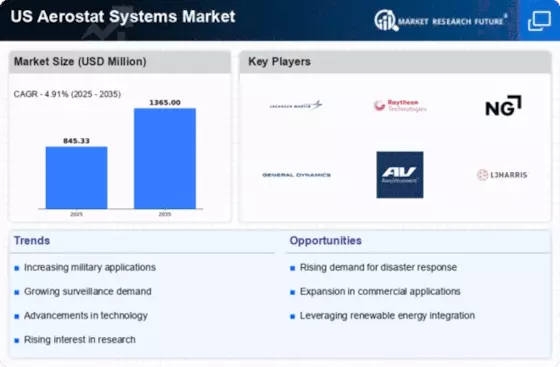
As per analysis, the US Aerostat Systems Market is projected to grow from USD 805.77 Million in 2024 to USD 1365.0 Million by 2035, exhibiting a compound annual growth rate (CAGR) of 4.91% during the forecast period (2025 - 2035).

Key Market Trends & Highlights

The US Aerostat Systems Market is poised for growth driven by technological advancements and increasing demand for surveillance applications.

  • The Surveillance segment remains the largest contributor to the US Aerostat Systems Market, reflecting a robust demand for monitoring capabilities.
  • Military Operations are identified as the fastest-growing segment, indicating a rising interest in advanced aerial surveillance technologies.
  • The Defense sector continues to dominate the market, while the Commercial segment is experiencing rapid growth due to emerging applications.
  • Technological advancements and regulatory developments are key drivers propelling the market forward, particularly in surveillance and military operations.

Market Size & Forecast

2024 Market Size 805.77 (USD Million)
2035 Market Size 1365.0 (USD Million)
CAGR (2025 - 2035) 4.91%

Major Players

Lockheed Martin (US), Raytheon Technologies (US), Northrop Grumman (US), General Dynamics (US), AeroVironment (US), L3Harris Technologies (US), Textron (US), Boeing (US), Airship Management Services (US)

Our Impact
Enabled $4.3B Revenue Impact for Fortune 500 and Leading Multinationals
Partnering with 2000+ Global Organizations Each Year
30K+ Citations by Top-Tier Firms in the Industry

US Aerostat Systems Market Trends

The US Aerostat Systems Market is currently experiencing a notable evolution, driven by advancements in technology and increasing demand for surveillance and reconnaissance capabilities. Aerostats, which are lighter-than-air systems, are being utilized for various applications, including border security, disaster management, and military operations. The integration of sophisticated sensors and communication systems into these platforms enhances their operational effectiveness, allowing for real-time data collection and analysis. As the need for persistent surveillance grows, the market appears poised for further expansion, with both government and commercial sectors showing heightened interest in these systems. Moreover, the regulatory environment in the United States is evolving to accommodate the deployment of aerostat systems. Agencies such as the Federal Aviation Administration (FAA) are working to establish guidelines that facilitate the safe integration of these platforms into national airspace. This regulatory support, combined with technological advancements, suggests a favorable outlook for the US Aerostat Systems Market. Stakeholders are likely to invest in research and development to enhance the capabilities of aerostats, potentially leading to innovative applications in various sectors, including environmental monitoring and public safety.

Technological Advancements

The US Aerostat Systems Market is witnessing rapid technological advancements, particularly in sensor integration and data processing capabilities. Enhanced imaging systems and communication technologies are being incorporated into aerostats, allowing for improved surveillance and reconnaissance operations. This trend indicates a shift towards more sophisticated applications, potentially expanding the market's reach across various sectors.

Regulatory Developments

Regulatory frameworks in the United States are adapting to the growing presence of aerostat systems. The FAA is actively working on guidelines that facilitate the safe operation of these platforms within national airspace. Such developments may encourage investment and innovation in the market, as stakeholders seek to align with emerging regulations.

Increased Demand for Surveillance

There is a rising demand for surveillance solutions within the US Aerostat Systems Market, driven by security concerns and the need for effective monitoring. Aerostats are being increasingly deployed for border security, disaster response, and military applications. This trend suggests a robust market potential as organizations seek reliable and cost-effective surveillance options.

US Aerostat Systems Market Drivers

Growing Interest in Civilian Applications

The US Aerostat Systems Market is not limited to military applications; there is a growing interest in civilian uses as well. Aerostats are increasingly being utilized for disaster management, environmental monitoring, and telecommunications. Their ability to provide aerial surveillance and communication capabilities in remote or disaster-stricken areas makes them an attractive option for government agencies and private organizations. The market for civilian aerostat applications is projected to grow, with estimates indicating a potential increase of 4% annually over the next five years. This diversification of applications is likely to enhance the overall market landscape, as more stakeholders recognize the versatility of aerostat systems.

Strategic Partnerships and Collaborations

The US Aerostat Systems Market is benefiting from strategic partnerships and collaborations among key stakeholders. Companies are increasingly joining forces with government agencies, research institutions, and technology providers to enhance the development and deployment of aerostat systems. These collaborations facilitate knowledge sharing and resource pooling, leading to innovative solutions that address specific market needs. For instance, partnerships focused on developing advanced sensor technologies or improving aerostat design are likely to yield products that meet the evolving demands of both military and civilian sectors. Such strategic alliances are expected to drive market growth, as they enable faster product development cycles and more effective market penetration.

Technological Advancements in Aerostat Systems

The US Aerostat Systems Market is experiencing a surge in technological advancements that enhance the capabilities of aerostats. Innovations in materials, such as lighter and more durable fabrics, contribute to improved performance and operational efficiency. Additionally, advancements in sensor technology enable aerostats to carry sophisticated surveillance and communication equipment, making them invaluable for military and civilian applications. The integration of artificial intelligence and machine learning into aerostat systems allows for real-time data analysis and decision-making, further solidifying their role in modern surveillance operations. As a result, the market is projected to grow significantly, with estimates suggesting a compound annual growth rate of over 5% in the coming years.

Increased Demand for Surveillance and Reconnaissance

The US Aerostat Systems Market is witnessing an increased demand for surveillance and reconnaissance capabilities, driven by evolving security threats. Aerostats provide a cost-effective solution for persistent surveillance, offering a stable platform for high-resolution imaging and data collection. This demand is particularly pronounced in military applications, where aerostats are deployed for border security and intelligence gathering. According to recent estimates, the military segment accounts for approximately 60% of the total market share, highlighting the critical role of aerostats in national defense strategies. As security concerns continue to rise, the market is expected to expand, with more agencies seeking to integrate aerostat systems into their operational frameworks.

Regulatory Developments Supporting Aerostat Operations

The US Aerostat Systems Market is influenced by regulatory developments that facilitate the deployment and operation of aerostats. The Federal Aviation Administration (FAA) has established guidelines that streamline the approval process for aerostat operations, particularly in urban areas. These regulations aim to ensure safety while promoting the use of aerostats for various applications, including border security and disaster response. Furthermore, the US government has shown a commitment to investing in aerostat technology, as evidenced by funding initiatives aimed at enhancing national security. Such regulatory support is likely to bolster market growth, as it encourages both public and private sector investments in aerostat systems.


Market Segment Insights

By Application: Surveillance (Largest) vs. Military Operations (Fastest-Growing)

In the US Aerostat Systems Market, the application segment is notably diverse, with surveillance leading the charge. Surveillance systems account for a significant share of the market, facilitated by the growing demand for enhanced security and monitoring capabilities. On the other hand, military operations are rapidly gaining traction, reflecting a shift towards more advanced aerial surveillance solutions that Align with national defense strategies. The weather monitoring, disaster management, and communication applications, while crucial, hold comparatively smaller shares amidst this competitive environment.

Surveillance (Dominant) vs. Military Operations (Emerging)

Surveillance is recognized as the dominant application within the US Aerostat Systems Market, driven by governmental and commercial investments in security infrastructure. Its capacity to provide real-time data and aerial surveillance capabilities makes it invaluable for law enforcement and border control efforts. Conversely, military operations represent an emerging application, thanks to their increasing incorporation of aerostat systems for reconnaissance and intelligence-gathering. This growth is propelled by military modernization initiatives and the need for improved situational awareness in complex operational environments. As both segments evolve, they showcase the market's dynamic nature and adaptability to changing demands.

By End Use: Defense (Largest) vs. Commercial (Fastest-Growing)

In the US Aerostat Systems Market, the end use segment is diverse and dynamic, comprising defense, commercial, research, public safety, and environmental monitoring applications. The defense sector accounts for the largest share, driven by the increasing demand for surveillance and reconnaissance capabilities in military operations. Meanwhile, the commercial sector is rapidly gaining traction as businesses recognize the operational advantages of aerostat systems for monitoring infrastructure and providing communication services.

Public Safety (Dominant) vs. Environmental Monitoring (Emerging)

In the context of end-use applications, the public safety segment is dominant due to the heightened focus on security and emergency response capabilities, utilizing aerostat systems for surveillance and law enforcement needs. On the other hand, environmental monitoring is emerging as a critical application, leveraging aerostat systems for data collection on atmospheric conditions and wildlife tracking. Both sectors benefit from technological advancements, with public safety relying on robust surveillance capabilities and environmental monitoring utilizing real-time data analytics for enhanced decision-making.

By Platform Type: Tethered Aerostat (Largest) vs. Free-Flying Aerostat (Fastest-Growing)

In the US Aerostat Systems Market, the platform type segment is primarily dominated by tethered aerostat systems, which hold the largest market share. These systems provide prolonged surveillance capabilities and are favored by military and commercial sectors alike. Free-flying aerostats, although currently smaller in market share compared to tethered options, are gaining traction in various applications. As the technology evolves, there's a noticeable shift toward more versatile free-flying models.

Tethered Aerostat (Dominant) vs. Free-Flying Aerostat (Emerging)

Tethered aerostats are recognized for their stability and extended operational duration, making them ideal for continuous surveillance and situational awareness, particularly in military and homeland security applications. They are anchored to the ground, allowing for substantial control and reduced operational risk. In contrast, free-flying aerostats are emerging as a dynamic solution for a range of applications, including environmental monitoring and disaster management. Their lightweight design and mobility allow them to cover larger areas and adapt to various operational needs quickly. This flexibility positions free-flying aerostats as a significant growth prospect within the market.

By Payload Type: Cameras (Largest) vs. Sensors (Fastest-Growing)

In the US Aerostat Systems Market, the payload type segment shows a diverse distribution among its key values, particularly highlighting Cameras and Sensors. Cameras hold the largest share within this segment, widely used for surveillance, reconnaissance, and monitoring applications. Meanwhile, Sensors, although comparatively smaller, exhibit rapid growth driven by their increasing adoption in various domains, including environmental monitoring, defense, and infrastructure inspection. As the market evolves, the demand for advanced sensing technologies is propelling the growth of the Sensor segment. Key drivers include the rise in unmanned aerial systems for surveillance, enhanced data collection needs, and the integration of AI and IoT technologies, which necessitate efficient sensing capabilities. This trend indicates a robust potential for Sensors as they meet emerging requirements for precision and real-time data processing.

Cameras (Dominant) vs. Sensors (Emerging)

Cameras are the dominant payload within the US Aerostat Systems Market due to their essential role in various applications like surveillance and reconnaissance. They provide high-resolution imaging and have become a staple in security and monitoring operations. The demand for Cameras is fueled by advancements in imaging technology, enabling clearer and more detailed visuals. On the other hand, Sensors represent the emerging side of this segment. They are increasingly integrated into aerostat systems to facilitate data collection and environmental monitoring. With innovations leading to miniaturization and higher accuracy, Sensors are gaining traction, especially in defense and smart city applications. As the focus shifts towards automation and data-driven approaches, the prominence of Sensors in the market is expected to grow significantly.

By Technology: Electromechanical Systems (Largest) vs. Control Systems (Fastest-Growing)

The US Aerostat Systems Market showcases a significant market share distribution among its technology segment values. Electromechanical Systems holds the largest share due to its widespread application in aerostat platforms for various operational needs. Meanwhile, Control Systems have emerged as a key player in the market, reflecting increasing demand driven by advancements in automation and control technologies for drone and aerostat operations. In terms of growth trends, Control Systems are noted for their rapid expansion as they integrate advanced technologies such as AI and machine learning, enhancing operational efficiency and data accuracy. The shifting focus towards unmanned aerial vehicles (UAVs) and rising government initiatives for surveillance and communication are propelling this segment forward. Electromechanical Systems remain dominant, ensuring reliability and robustness in aerostat functionalities, but must adapt to evolving technological standards to sustain their market position.

Technology: Electromechanical Systems (Dominant) vs. Control Systems (Emerging)

Electromechanical Systems are the backbone of the US Aerostat Systems Market, delivering critical functionalities that ensure the operational reliability of aerostat platforms. Characterized by their mechanical and electronic components, these systems provide robust performance, making them indispensable for a variety of applications, including surveillance and data collection. On the other hand, Control Systems represent an emerging segment that is gaining traction due to exponential technological advancements. These systems are increasingly being designed to facilitate more precise and efficient operations, leveraging cutting-edge innovations in software and hardware. As the demand for precision and enhanced capabilities in aerostat operations increases, Control Systems are rapidly evolving, making strategic partnerships and advanced research and development essential for their future growth.

Get more detailed insights about US Aerostat Systems Market

Key Players and Competitive Insights

The Aerostat Systems Market is characterized by a dynamic competitive landscape, driven by advancements in surveillance, reconnaissance, and communication technologies. Key players such as Lockheed Martin (US), Raytheon Technologies (US), and Northrop Grumman (US) are at the forefront, each adopting distinct strategies to enhance their market positioning. Lockheed Martin (US) emphasizes innovation through the development of next-generation aerostat systems, while Raytheon Technologies (US) focuses on integrating artificial intelligence into its surveillance solutions. Northrop Grumman (US) appears to be leveraging strategic partnerships to expand its operational capabilities, collectively shaping a competitive environment that is increasingly reliant on technological advancements and collaborative efforts.

In terms of business tactics, companies are localizing manufacturing and optimizing supply chains to enhance efficiency and responsiveness to market demands. The competitive structure of the Aerostat Systems Market is moderately fragmented, with several key players exerting influence over various segments. This fragmentation allows for a diverse range of offerings, yet the collective impact of major companies drives innovation and sets industry standards.

In December 2025, Lockheed Martin (US) announced a partnership with a leading technology firm to develop advanced sensor technologies for its aerostat systems. This collaboration is expected to enhance the capabilities of their surveillance platforms, positioning Lockheed Martin (US) as a leader in high-tech aerostat solutions. The strategic importance of this partnership lies in its potential to integrate cutting-edge technology, thereby improving operational effectiveness and expanding market reach.

In November 2025, Raytheon Technologies (US) unveiled a new AI-driven analytics platform designed to optimize the performance of its aerostat systems. This initiative reflects a broader trend towards digital transformation within the industry, as companies seek to harness data analytics for improved decision-making. The introduction of this platform is likely to enhance Raytheon’s competitive edge by providing clients with actionable insights and real-time data.

In October 2025, Northrop Grumman (US) secured a contract with the U.S. Department of Defense to supply aerostat systems for border surveillance. This contract not only underscores Northrop Grumman’s (US) commitment to national security but also highlights the growing demand for persistent surveillance solutions. The strategic significance of this contract lies in its potential to solidify Northrop Grumman’s (US) position as a key supplier in the defense sector, further enhancing its market presence.

As of January 2026, current trends in the Aerostat Systems Market indicate a strong focus on digitalization, sustainability, and the integration of AI technologies. Strategic alliances are increasingly shaping the competitive landscape, enabling companies to pool resources and expertise. Looking ahead, it is anticipated that competitive differentiation will evolve, with a shift from price-based competition to a focus on innovation, technological advancements, and supply chain reliability. This evolution suggests that companies that prioritize these aspects are likely to thrive in an increasingly complex market.

Key Companies in the US Aerostat Systems Market include

Future Outlook

US Aerostat Systems Market Future Outlook

The US Aerostat Systems Market is projected to grow at a 4.91% CAGR from 2025 to 2035, driven by advancements in surveillance technology and increasing defense budgets.

New opportunities lie in:

  • Development of hybrid aerostat systems for enhanced operational flexibility.
  • Integration of AI for real-time data analytics in surveillance applications.
  • Expansion into commercial sectors such as telecommunications and disaster management.

By 2035, the market is expected to solidify its position as a critical component of aerial surveillance and communication.

Market Segmentation

US Aerostat Systems Market End Use Outlook

  • Defense
  • Commercial
  • Research
  • Public Safety
  • Environmental Monitoring

US Aerostat Systems Market Technology Outlook

  • Electromechanical Systems
  • Control Systems
  • Data Processing Systems

US Aerostat Systems Market Application Outlook

  • Surveillance
  • Communication
  • Weather Monitoring
  • Military Operations
  • Disaster Management

US Aerostat Systems Market Payload Type Outlook

  • Cameras
  • Sensors
  • Communication Equipment
  • Radars

US Aerostat Systems Market Platform Type Outlook

  • Tethered Aerostat
  • Free-Flying Aerostat
  • Hybrid Aerostat

Report Scope

MARKET SIZE 2024805.77(USD Million)
MARKET SIZE 2025849.45(USD Million)
MARKET SIZE 20351365.0(USD Million)
COMPOUND ANNUAL GROWTH RATE (CAGR)4.91% (2024 - 2035)
REPORT COVERAGERevenue Forecast, Competitive Landscape, Growth Factors, and Trends
BASE YEAR2024
Market Forecast Period2025 - 2035
Historical Data2019 - 2024
Market Forecast UnitsUSD Million
Key Companies ProfiledLockheed Martin (US), Raytheon Technologies (US), Northrop Grumman (US), General Dynamics (US), AeroVironment (US), L3Harris Technologies (US), Textron (US), Boeing (US), Airship Management Services (US)
Segments CoveredApplication, End Use, Platform Type, Payload Type, Technology
Key Market OpportunitiesGrowing demand for surveillance and communication solutions enhances opportunities in the US Aerostat Systems Market.
Key Market DynamicsGrowing demand for surveillance and reconnaissance capabilities drives innovation in the US Aerostat Systems Market.
Countries CoveredUS
Leave a Comment

FAQs

What is the projected market valuation of the US Aerostat Systems Market by 2035?

The projected market valuation of the US Aerostat Systems Market is expected to reach 1365.0 USD Million by 2035.

What was the overall market valuation of the US Aerostat Systems Market in 2024?

The overall market valuation of the US Aerostat Systems Market was 805.77 USD Million in 2024.

What is the expected CAGR for the US Aerostat Systems Market during the forecast period 2025 - 2035?

The expected CAGR for the US Aerostat Systems Market during the forecast period 2025 - 2035 is 4.91%.

Which companies are considered key players in the US Aerostat Systems Market?

Key players in the US Aerostat Systems Market include Lockheed Martin, Raytheon Technologies, Northrop Grumman, and General Dynamics.

What are the primary applications of aerostat systems in the US market?

The primary applications of aerostat systems in the US market include Surveillance, Communication, Weather Monitoring, Military Operations, and Disaster Management.

How does the defense sector contribute to the US Aerostat Systems Market?

The defense sector contributes significantly, with a valuation ranging from 300.0 to 500.0 USD Million.

What is the market size for tethered aerostats in the US?

The market size for tethered aerostats in the US is projected to be between 300.0 and 500.0 USD Million.

What types of payloads are commonly used in US aerostat systems?

Common payloads in US aerostat systems include Cameras, Sensors, Communication Equipment, and Radars.

What technological components are essential for US aerostat systems?

Essential technological components for US aerostat systems include Electromechanical Systems, Control Systems, and Data Processing Systems.

What is the expected market trend for commercial applications of aerostat systems?

The commercial applications of aerostat systems are expected to grow, with a market size projected between 150.0 and 250.0 USD Million.

Download Free Sample

Kindly complete the form below to receive a free sample of this Report

Compare Licence

×
Features License Type
Single User Multiuser License Enterprise User
Price $4,950 $5,950 $7,250
Maximum User Access Limit 1 User Upto 10 Users Unrestricted Access Throughout the Organization
Free Customization
Direct Access to Analyst
Deliverable Format
Platform Access
Discount on Next Purchase 10% 15% 15%
Printable Versions