Expansion of Application Areas
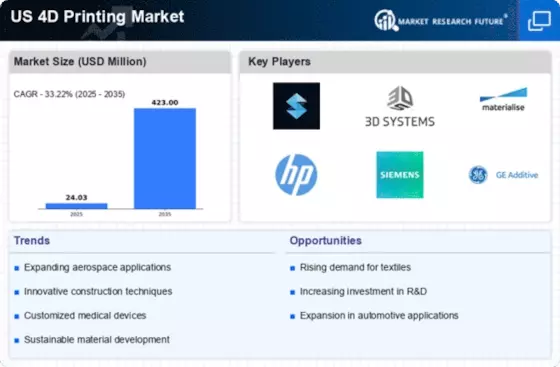
The US 4D Printing Market is characterized by the expansion of application areas across diverse sectors. Industries such as aerospace, automotive, healthcare, and construction are increasingly exploring the potential of 4D printing to enhance their operations. For example, in aerospace, 4D printing is being utilized to create components that can self-repair or adapt to changing conditions, improving safety and efficiency. In healthcare, the technology is being applied to develop personalized medical devices and implants that can respond to the body's needs. Market forecasts indicate that the application of 4D printing in these sectors could lead to a market growth rate of over 18% in the next few years, highlighting the transformative potential of this technology in the US.
Government Support and Funding
The US 4D Printing Market benefits from substantial government support and funding aimed at fostering innovation in advanced manufacturing technologies. Federal initiatives, such as the National Institute of Standards and Technology (NIST) and the Advanced Manufacturing Office (AMO), are actively promoting research and development in 4D printing. These programs provide grants and resources to companies and research institutions, facilitating collaboration and knowledge sharing. In 2025, the federal budget allocated over $1 billion to advanced manufacturing initiatives, which includes 4D printing technologies. This financial backing is likely to accelerate the adoption of 4D printing solutions across various industries, positioning the US as a leader in this emerging field.
Growing Demand for Customization
The US 4D Printing Market is witnessing a growing demand for customization in manufacturing processes. As consumers increasingly seek personalized products, 4D printing offers the flexibility to create tailored solutions that meet specific needs. This trend is particularly evident in sectors such as fashion, consumer goods, and healthcare, where bespoke designs and individualized products are becoming more prevalent. Market analysis indicates that the customization segment within the 4D printing industry is expected to grow at a CAGR of approximately 15% over the next five years. This shift towards customization not only enhances customer satisfaction but also drives innovation in design and production methodologies, further solidifying the role of 4D printing in the US market.
Sustainability and Environmental Concerns
The US 4D Printing Market is increasingly influenced by sustainability and environmental concerns. As industries strive to reduce their carbon footprint and minimize waste, 4D printing presents a viable solution by enabling more efficient use of materials and energy. The ability to create products that can adapt and change over time reduces the need for multiple components, thereby decreasing material consumption. Recent studies suggest that 4D printing can potentially reduce waste by up to 30% compared to traditional manufacturing methods. This focus on sustainability aligns with broader national goals to promote green technologies and practices, making 4D printing an attractive option for environmentally conscious businesses in the US.
Technological Advancements in 4D Printing
The US 4D Printing Market is experiencing rapid technological advancements that enhance the capabilities of 4D printing. Innovations in materials science, particularly the development of smart materials that can change shape or function in response to environmental stimuli, are driving this market forward. For instance, the integration of shape-memory polymers and hydrogels is enabling the creation of complex structures that can self-assemble or adapt over time. According to recent data, the market for smart materials is projected to grow significantly, with a compound annual growth rate (CAGR) of over 20% in the coming years. This technological evolution not only improves the efficiency of production processes but also expands the potential applications of 4D printing across various sectors, including aerospace, automotive, and healthcare.