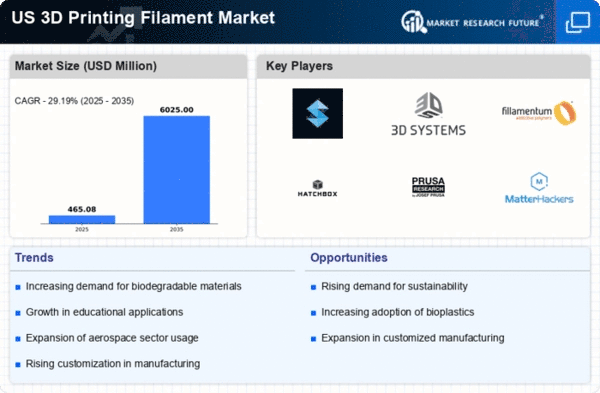
The 3D printing-filament market exhibits a dynamic competitive landscape characterized by rapid technological advancements and increasing demand across various sectors. Key players such as Stratasys (US), 3D Systems (US), and MatterHackers (US) are strategically positioned to leverage innovation and expand their market presence. Stratasys (US) focuses on enhancing its product offerings through continuous research and development, while 3D Systems (US) emphasizes partnerships to broaden its technological capabilities. MatterHackers (US) appears to be concentrating on customer engagement and community building, which collectively shapes a competitive environment that is increasingly reliant on innovation and customer-centric strategies.The market structure is moderately fragmented, with numerous players vying for market share. Key business tactics include localizing manufacturing to reduce lead times and optimize supply chains. This approach not only enhances operational efficiency but also allows companies to respond swiftly to market demands. The collective influence of major players fosters a competitive atmosphere where agility and responsiveness are paramount, driving the need for continuous improvement in product offerings and customer service.
In October Stratasys (US) announced a strategic partnership with a leading aerospace manufacturer to develop specialized filaments tailored for high-performance applications. This collaboration is expected to enhance Stratasys's position in the aerospace sector, where the demand for lightweight and durable materials is surging. The strategic importance of this partnership lies in its potential to open new revenue streams and solidify Stratasys's reputation as a leader in advanced materials technology.
In September 3D Systems (US) launched a new line of eco-friendly filaments made from recycled materials, aligning with the growing trend towards sustainability in manufacturing. This initiative not only addresses environmental concerns but also positions 3D Systems as a forward-thinking company committed to reducing its carbon footprint. The introduction of these products is likely to attract environmentally conscious consumers and businesses, thereby expanding its market reach.
In August MatterHackers (US) expanded its distribution network by partnering with several local retailers across the US. This move aims to enhance accessibility to its products and improve customer service. By localizing its distribution, MatterHackers can better cater to regional demands and foster stronger relationships with customers, which is crucial in a market where personalized service is increasingly valued.
As of November current competitive trends in the 3D printing-filament market are heavily influenced by digitalization, sustainability, and the integration of AI technologies. Strategic alliances are becoming more prevalent, as companies recognize the value of collaboration in driving innovation and enhancing product offerings. Looking ahead, competitive differentiation is likely to evolve from traditional price-based competition to a focus on innovation, technological advancements, and supply chain reliability. This shift underscores the importance of adaptability and forward-thinking strategies in maintaining a competitive edge in a rapidly changing market.