×
Request Free Sample ×

Kindly complete the form below to receive a free sample of this Report

* Please use a valid business email

Leading companies partner with us for data-driven Insights

clients tt-cursor
Hero Background

US 3D Food Printing Market

ID: MRFR/Equip/19713-HCR
100 Pages
Garvit Vyas
February 2026

US 3D Food Printing Market Research Report By End Use Outlook ( Restaurants, Catering Services, Households ), Material Outlook ( Proteins, Carbohydrates, Fats, Sugars ), Technology Outlook ( Fused Deposition Modeling – FDM, Selective Laser Sintering – SLS, Binder Jetting, Material Extrusion ), and Application Outlook ( Personal Consumption, Commercial Food Production, Food Decoration, Nutritional Customization ) forecast by 2035

Share:
Download PDF ×

We do not share your information with anyone. However, we may send you emails based on your report interest from time to time. You may contact us at any time to opt-out.

US 3D Food Printing Market Infographic
Purchase Options

US 3D Food Printing Market Summary

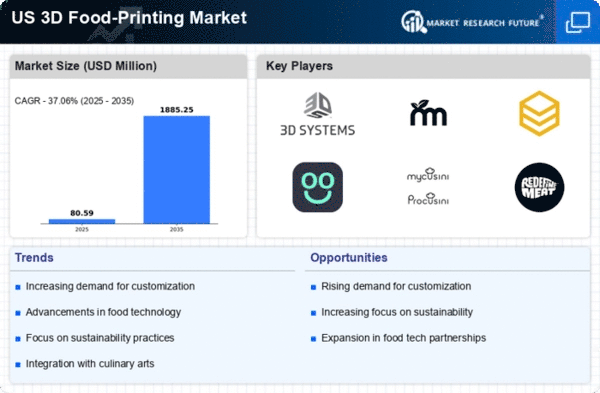
As per Market Research Future analysis, the US 3D Food Printing Market size was estimated at 58.8 USD Million in 2024. The United States 3D Food-printing market is projected to grow from 80.59 USD Million in 2025 to 1885.25 USD Million by 2035, exhibiting a compound annual growth rate (CAGR) of 37.0% during the forecast period 2025 - 2035

Key Market Trends & Highlights

The US 3D Food-Printing Market is poised for growth driven by customization and sustainability trends.

  • Customization and personalization are becoming increasingly prevalent in the 3D food-printing market, catering to diverse consumer preferences.
  • Sustainability and waste reduction initiatives are gaining traction, reflecting a broader societal shift towards eco-friendly practices.
  • The largest segment in the market is the food service industry, while the fastest-growing segment appears to be home-based food printing.
  • Technological advancements in food printing and rising demand for healthy food options are key drivers propelling market expansion.

Market Size & Forecast

2024 Market Size 58.8 (USD Million)
2035 Market Size 1885.25 (USD Million)
CAGR (2025 - 2035) 37.06%

Major Players

3D Systems (US), Natural Machines (ES), BeeHex (US), Foodini (US), Print2Taste (DE), Redefine Meat (IL), SavorEat (IL), TNO (NL)

Our Impact
Enabled $4.3B Revenue Impact for Fortune 500 and Leading Multinationals
Partnering with 2000+ Global Organizations Each Year
30K+ Citations by Top-Tier Firms in the Industry

US 3D Food Printing Market Trends

The US 3D Food Printing Market is currently experiencing a notable evolution, driven by advancements in technology and changing consumer preferences. As individuals increasingly seek personalized and sustainable food options, the demand for innovative food production methods appears to be on the rise. This market is characterized by a growing interest in the customization of food items, allowing consumers to tailor their meals according to dietary needs and preferences. Furthermore, the integration of 3d printing technology in food production may enhance efficiency and reduce waste, aligning with broader sustainability goals. In addition, the regulatory landscape surrounding food safety and production is evolving, which could impact the adoption of 3d food-printing technologies. As the industry matures, it seems likely that more stringent guidelines will emerge, ensuring that products meet safety standards while fostering innovation. The intersection of technology, consumer demand, and regulatory frameworks suggests a dynamic environment for the 3d food-printing market, with potential for significant growth and transformation in the coming years.

Customization and Personalization

The trend towards customization in the 3d food-printing market reflects a growing consumer desire for tailored food experiences. Individuals are increasingly interested in creating meals that cater to their specific dietary requirements, preferences, and aesthetic desires. This shift is likely to drive innovation in food design and production, as companies explore ways to leverage 3d printing technology to meet these demands.

Sustainability and Waste Reduction

Sustainability is becoming a central theme in the 3d food-printing market, as consumers and producers alike seek to minimize food waste and environmental impact. The ability to produce food on demand using 3d printing technology may lead to more efficient resource utilization, potentially reducing excess production and waste. This trend aligns with broader societal goals of promoting sustainable practices in food production.

Regulatory Developments

As the 3d food-printing market evolves, regulatory frameworks are likely to adapt to ensure food safety and quality. The emergence of new technologies may prompt the establishment of guidelines that govern the use of 3d printing in food production. These regulations could play a crucial role in shaping industry standards and consumer trust, influencing the pace of adoption and innovation.

US 3D Food Printing Market Drivers

Increased Focus on Food Aesthetics

The visual appeal of food has become increasingly important in the culinary world, influencing the 3d food-printing market. As social media platforms continue to promote food photography, consumers are seeking visually stunning dishes that are not only delicious but also Instagram-worthy. 3d food printing technology allows chefs and food manufacturers to create intricate designs and shapes that enhance the presentation of food. This focus on aesthetics is likely to drive demand for 3d printed food products, particularly in the restaurant and catering sectors. The market for food presentation tools is projected to grow by 15% annually, suggesting that the 3d food-printing market could benefit from this trend as businesses strive to meet consumer expectations for visually appealing meals.

Expansion of Food Delivery Services

The rise of food delivery services is having a notable impact on the 3d food-printing market. As consumers increasingly seek convenience and variety in their dining options, food delivery platforms are expanding their offerings to include unique and customized meals. 3d food printing technology can facilitate the production of personalized meals that cater to individual preferences, making it an attractive option for food delivery services. This trend is likely to drive demand for 3d printed food products, as companies look to differentiate themselves in a competitive market. The food delivery market is projected to reach $200 billion by 2025, suggesting a substantial opportunity for the 3d food-printing market to align with this growing sector.

Rising Demand for Healthy Food Options

Consumer preferences are shifting towards healthier food options, which is significantly impacting the 3d food-printing market. As awareness of nutrition and health issues increases, there is a growing demand for food products that are not only tasty but also nutritious. 3d food printing technology allows for the precise control of ingredients, enabling the creation of customized meals that cater to specific dietary needs, such as gluten-free or low-calorie options. This trend is particularly appealing to health-conscious consumers and is expected to drive market growth. In fact, the market for healthy food alternatives is anticipated to reach $200 billion by 2026, indicating a substantial opportunity for the 3d food-printing market to capitalize on this demand.

Growing Interest in Culinary Innovation

The 3d food-printing market is benefiting from a burgeoning interest in culinary innovation among chefs and food enthusiasts. As the culinary landscape evolves, there is a strong desire for novel cooking techniques and unique food experiences. 3d food printing offers an avenue for chefs to experiment with flavors, textures, and presentations that were previously unattainable. This trend is particularly evident in high-end restaurants and culinary schools, where the technology is being embraced as a tool for creativity. The market for culinary innovation is expected to expand, with an estimated growth rate of 18% over the next few years, indicating that the 3d food-printing market is well-positioned to capitalize on this enthusiasm for new culinary experiences.

Technological Advancements in Food Printing

The 3d food-printing market is experiencing rapid technological advancements that enhance the efficiency and quality of food production. Innovations in printing materials, such as edible inks and bio-inks, are expanding the range of food products that can be created. For instance, the introduction of multi-material printers allows for the combination of various textures and flavors in a single dish. This evolution is likely to attract both consumers and businesses, as it offers unique culinary experiences. Furthermore, the market is projected to grow at a CAGR of approximately 20% over the next five years, driven by these technological improvements. As a result, the 3d food-printing market is becoming increasingly competitive, with new entrants and established companies investing heavily in research and development to stay ahead.


Market Segment Insights

By Technology: Fused Deposition Modeling (Largest) vs. Selective Laser Sintering (Fastest-Growing)

In the US 3d food-printing market, Fused Deposition Modeling (FDM) has emerged as the largest segment due to its simplicity, cost-effectiveness, and widespread adoption in various applications. It holds a significant market share, driven by its user-friendly technology that allows for mass production of personalized food items. On the other hand, Selective Laser Sintering (SLS) is gaining momentum and is recognized as the fastest-growing technology, appealing to niche markets and innovative culinary creations. The growth in the US 3d food-printing market is influenced by the increasing demand for customization in food products and the evolving landscape of food technology. SLS's rapid development can be attributed to advancements in laser technology and material science, enabling the production of complex food structures that were previously unattainable. This trend indicates a shift towards more sophisticated applications, drawing attention from food manufacturers and culinary innovators alike.

Technology: Fused Deposition Modeling (Dominant) vs. Selective Laser Sintering (Emerging)

Fused Deposition Modeling (FDM) stands out as the dominant technology in the market, leveraging its capability to easily create a variety of food shapes with readily available materials. This technique is favored for its affordability and accessibility, making it suitable for both small-scale and large-scale production. Conversely, Selective Laser Sintering (SLS) is an emerging technology that holds significant promise for the future, primarily due to its ability to utilize a wider range of materials and create intricate designs. The growing interest in gourmet food applications and avant-garde culinary techniques is likely to raise SLS’s profile in the market, making it a vital player that could adapt to changing consumer preferences.

By Application: Personal Consumption (Largest) vs. Commercial Food Production (Fastest-Growing)

In the US 3d food-printing market, Personal Consumption dominates with a significant share, reflecting the increasing trend of consumers seeking personalized and unique food experiences. This segment leverages the technology to cater to individual tastes and preferences, resulting in a strong market presence. On the other hand, Commercial Food Production is recognized as the fastest-growing segment, driven by the demand for automation and efficiency in food manufacturing processes. This segment is capitalizing on trends such as mass customization and reducing waste, making it increasingly popular among food producers aiming to enhance their operational capabilities.

Personal Consumption: Dominant vs. Commercial Food Production: Emerging

Personal Consumption is characterized by its focus on individual preferences, offering unique culinary experiences through 3d food printing technology. This segment is marked by innovation in flavor, design, and nutritional options, appealing to consumers who desire customization in their meals. In contrast, Commercial Food Production is emerging as a vital force in the market, blending technology with production efficiency. This segment utilizes 3d printing to streamline food preparation, reduce product waste, and meet the growing demand for customized food solutions in restaurants and catering services, signifying a notable shift in how food is created and distributed.

By Material: Proteins (Largest) vs. Carbohydrates (Fastest-Growing)

The US 3d food-printing market sees a significant distribution in the Material segment, primarily between Proteins, Carbohydrates, Fats, and Sugars. Proteins hold the largest share due to their essential role in human nutrition and the growing demand for high-protein diets. Carbohydrates also represent a substantial portion, driven by their foundational role in food products, while Fats and Sugars capture smaller market shares but are essential for flavor and texture enhancement. Growth trends in this segment indicate a rising demand for plant-based Proteins driven by health consciousness and sustainability concerns. Carbohydrates are experiencing rapid growth as innovations in 3D printing techniques enhance their application in creating intricate food designs. Additionally, changing consumer preferences towards customized food solutions are propelling the development and acceptance of Fats and Sugars, further expanding the possibilities within the US 3d food-printing market.

Proteins: Dominant vs. Carbohydrates: Emerging

In the Material segment of the US 3d food-printing market, Proteins are recognized as the dominant force due to their crucial nutritional benefits and versatility in food applications. They are favored for high-performance food products that cater to health-conscious consumers. On the other hand, Carbohydrates are emerging as a valuable segment, propelled by innovations in technology that enable unique food structures and designs. This evolution reflects changing consumer preferences for more customized and visually appealing food options. Fats and Sugars, while smaller segments, still play vital roles by enhancing taste and mouthfeel. The interplay between these materials underscores a dynamic market adapting to both health trends and artistic culinary expressions.

By End Use: Restaurants (Largest) vs. Households (Fastest-Growing)

In the US 3d food-printing market, the segment distribution reveals that restaurants hold the largest share, leveraging the technology for innovative menu offerings and efficiency in food preparation. Catering services also play a significant role, serving large gatherings and events, while households are emerging as a fast-growing segment, driven by increasing consumer interest in home-cooked meals and customization. The growth trends indicate a rising demand for 3d food printing in households due to the convenience it offers in creating personalized and healthy food options. Additionally, advancements in technology are making it more accessible and affordable for personal use, thus fueling its adoption. Restaurants, while still dominant, continue to innovate using this technology to enhance customer experience, blending creativity with culinary art.

Catering Services: Dominant vs. Households: Emerging

Catering services represent a dominant segment in the US 3d food-printing market, utilizing advanced printing techniques to create custom meals for large events, banquets, and corporate functions. This segment thrives on the ability to produce intricate food designs that cater to diverse dietary preferences, ensuring both aesthetic appeal and taste. In contrast, the households segment is emerging rapidly, driven by consumer desires for creative meal preparation and personalized dining experiences at home. This shift is marked by increased investment in user-friendly 3d food printers, making the technology accessible to non-professionals. Both segments highlight a trend towards customization, albeit in different contexts, with catering services focusing on professional applications and households emphasizing personal creativity.

Get more detailed insights about US 3D Food Printing Market

Key Players and Competitive Insights

The 3D food-printing market is currently characterized by a dynamic competitive landscape, driven by innovation, sustainability, and the increasing demand for personalized nutrition. Key players such as 3D Systems (US), BeeHex (US), and Redefine Meat (IL) are at the forefront, each adopting distinct strategies to enhance their market positioning. 3D Systems (US) focuses on technological advancements in food printing, emphasizing the development of high-quality, customizable food products. Meanwhile, BeeHex (US) has carved a niche in the automated food preparation sector, leveraging robotics to streamline food production processes. Redefine Meat (IL) is pioneering the plant-based meat alternative segment, utilizing 3D printing technology to create realistic meat substitutes, thereby appealing to the growing vegan and flexitarian consumer base. Collectively, these strategies contribute to a competitive environment that is increasingly centered on innovation and consumer-centric solutions. In terms of business tactics, companies are increasingly localizing manufacturing to reduce supply chain complexities and enhance responsiveness to market demands. The competitive structure of the market appears moderately fragmented, with several players vying for market share while also collaborating on technological advancements. This fragmentation allows for diverse offerings, yet the influence of key players remains substantial, as they set benchmarks for quality and innovation. In October 2025, 3D Systems (US) announced a partnership with a leading culinary institute to develop a new line of gourmet 3D-printed foods. This collaboration is strategically significant as it not only enhances 3D Systems' product offerings but also positions the company as a leader in culinary innovation, potentially attracting high-end restaurants and food enthusiasts. The partnership underscores the importance of aligning technological capabilities with culinary expertise to create unique dining experiences. In September 2025, BeeHex (US) launched a new automated pizza-making system that utilizes 3D printing technology to produce customized pizzas in real-time. This move is crucial as it addresses the growing consumer demand for personalized food experiences while also streamlining the food service process. By integrating automation with 3D printing, BeeHex is likely to enhance operational efficiency and reduce labor costs, thereby improving profitability. In August 2025, Redefine Meat (IL) secured a $30M investment to expand its production capabilities and enhance its R&D efforts. This funding is pivotal as it allows the company to scale its operations and accelerate the development of its 3D-printed meat alternatives. The investment reflects a broader trend in the market where companies are increasingly focusing on sustainability and health-conscious products, aligning with consumer preferences for plant-based diets. As of November 2025, the competitive trends in the 3D food-printing market are heavily influenced by digitalization, sustainability, and the integration of AI technologies. Strategic alliances are becoming more prevalent, as companies recognize the value of collaboration in driving innovation and enhancing product offerings. Looking ahead, it is anticipated that competitive differentiation will increasingly pivot from price-based strategies to those centered on technological innovation, product quality, and supply chain reliability. This shift suggests a future where companies that prioritize R&D and consumer engagement will likely emerge as leaders in the evolving landscape.

Key Companies in the US 3D Food Printing Market include

Future Outlook

US 3D Food Printing Market Future Outlook

The 3D Food Printing Market is projected to grow at a 37.06% CAGR from 2025 to 2035, driven by technological advancements, increasing consumer demand for customization, and sustainability initiatives.

New opportunities lie in:

  • Development of personalized nutrition solutions for health-conscious consumers. Integration of 3D food printers in commercial kitchens for efficiency. Partnerships with food delivery services to offer customized meal options.

By 2035, the market is expected to be a pivotal player in the food industry.

Market Segmentation

US 3D Food Printing Market End Use Outlook

  • Restaurants
  • Catering Services
  • Households

US 3D Food Printing Market Material Outlook

  • Proteins
  • Carbohydrates
  • Fats
  • Sugars

US 3D Food Printing Market Technology Outlook

  • Fused Deposition Modeling (FDM)
  • Selective Laser Sintering (SLS)
  • Binder Jetting
  • Material Extrusion

US 3D Food Printing Market Application Outlook

  • Personal Consumption
  • Commercial Food Production
  • Food Decoration
  • Nutritional Customization

Report Scope

MARKET SIZE 2024 58.8(USD Million)
MARKET SIZE 2025 80.59(USD Million)
MARKET SIZE 2035 1885.25(USD Million)
COMPOUND ANNUAL GROWTH RATE (CAGR) 37.06% (2025 - 2035)
REPORT COVERAGE Revenue Forecast, Competitive Landscape, Growth Factors, and Trends
BASE YEAR 2024
Market Forecast Period 2025 - 2035
Historical Data 2019 - 2024
Market Forecast Units USD Million
Key Companies Profiled 3D Systems (US), Natural Machines (ES), BeeHex (US), Foodini (US), Print2Taste (DE), Redefine Meat (IL), SavorEat (IL), TNO (NL)
Segments Covered Technology, Application, Material, End Use
Key Market Opportunities Integration of personalized nutrition and sustainable practices in the 3d food-printing market.
Key Market Dynamics Technological advancements drive innovation and competition in the evolving 3D food-printing market.
Countries Covered US
Leave a Comment
Download Free Sample

Kindly complete the form below to receive a free sample of this Report

Compare Licence

×
Features License Type
Single User Multiuser License Enterprise User
Price $4,950 $5,950 $7,250
Maximum User Access Limit 1 User Upto 10 Users Unrestricted Access Throughout the Organization
Free Customization
Direct Access to Analyst
Deliverable Format
Platform Access
Discount on Next Purchase 10% 15% 15%
Printable Versions