×
Request Free Sample ×

Kindly complete the form below to receive a free sample of this Report

* Please use a valid business email

Leading companies partner with us for data-driven Insights

clients tt-cursor
Hero Background

UK Smart Toys Market

ID: MRFR/ICT/60969-HCR
200 Pages
Aarti Dhapte
February 2026

UK Smart Toys Market Research Report By Type (Robots, Interactive Games, Educational Robots), By Technology (Wi-Fi, Bluetooth, RFID or NFC), By Distribution Channel (Online/Ecommerce Stores, Specialty Stores, Toy Shops) and By End-user (Toddlers, Pre-schoolers, School-going, Stripling)- Forecast to 2035

Share:
Download PDF ×

We do not share your information with anyone. However, we may send you emails based on your report interest from time to time. You may contact us at any time to opt-out.

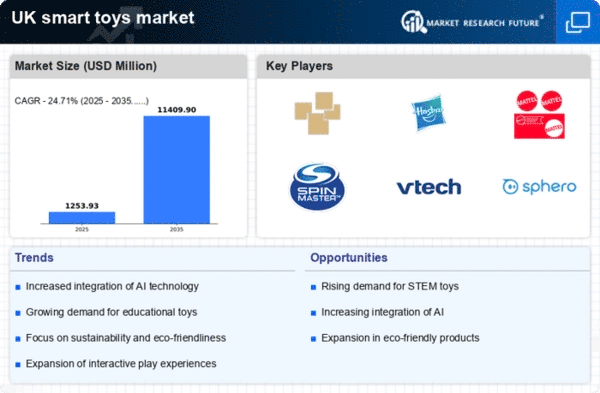
UK Smart Toys Market Infographic
Purchase Options

UK Smart Toys Market Summary

As per Market Research Future analysis, the UK smart toys market Size was estimated at 1005.48 USD Million in 2024. The UK smart toys market is projected to grow from 1253.93 USD Million in 2025 to 11409.9 USD Million by 2035, exhibiting a compound annual growth rate (CAGR) of 24.7% during the forecast period 2025 - 2035

Key Market Trends & Highlights

The UK smart toys market is experiencing robust growth driven by technological integration and educational focus.

  • The largest segment in the UK smart toys market is educational toys, which are increasingly favored by parents.
  • The fastest-growing segment is interactive toys, reflecting a rising demand for engaging play experiences.
  • Sustainability initiatives are becoming a focal point, as consumers show preference for eco-friendly products.
  • Key market drivers include the rising demand for interactive play and increased parental awareness of educational benefits.

Market Size & Forecast

2024 Market Size 1005.48 (USD Million)
2035 Market Size 11409.9 (USD Million)
CAGR (2025 - 2035) 24.71%

Major Players

LEGO Group (DK), Hasbro Inc (US), Mattel Inc (US), Spin Master Corp (CA), VTech Holdings Ltd (HK), Sphero Inc (US), Fisher-Price (US), Nerf (US)

Our Impact
Enabled $4.3B Revenue Impact for Fortune 500 and Leading Multinationals
Partnering with 2000+ Global Organizations Each Year
30K+ Citations by Top-Tier Firms in the Industry

UK Smart Toys Market Trends

The smart toys market is currently experiencing a dynamic evolution, driven by advancements in technology and changing consumer preferences. As children increasingly engage with digital devices, the demand for interactive and educational toys has surged. This shift reflects a broader trend towards integrating play with learning, where toys not only entertain but also foster cognitive development. Manufacturers are responding by creating products that incorporate artificial intelligence, augmented reality, and connectivity features, enhancing the play experience. Furthermore, parents are becoming more discerning, seeking toys that promote creativity, problem-solving, and social skills. This has led to a proliferation of innovative offerings that cater to diverse age groups and interests. In addition, sustainability is emerging as a key consideration within the smart toys market. Consumers are increasingly aware of environmental issues, prompting manufacturers to adopt eco-friendly materials and production processes. This trend aligns with a growing preference for products that are not only fun but also responsible. As the market continues to evolve, it appears poised for further growth, with potential for new entrants and innovations that could reshape the landscape. The interplay between technology, education, and sustainability will likely define the future trajectory of this sector, making it an exciting area for stakeholders to monitor closely.

Integration of Technology

The incorporation of advanced technologies such as artificial intelligence and augmented reality is transforming the smart toys market. These innovations enhance interactivity, allowing children to engage in immersive play experiences that promote learning and creativity.

Focus on Educational Value

There is a noticeable shift towards toys that provide educational benefits. Parents are increasingly prioritizing products that support cognitive development, problem-solving skills, and creativity, leading to a rise in demand for educational smart toys.

Sustainability Initiatives

Sustainability is becoming a critical factor in purchasing decisions. Manufacturers are responding by utilizing eco-friendly materials and sustainable practices, appealing to environmentally conscious consumers who seek responsible products.

UK Smart Toys Market Drivers

Expansion of E-commerce Platforms

The expansion of e-commerce platforms is reshaping the smart toys market in the UK. Online shopping has become increasingly popular, providing consumers with greater access to a diverse range of smart toys. This shift is evidenced by a reported 40% increase in online toy sales in 2025, as more parents opt for the convenience of purchasing toys online. E-commerce platforms also enable manufacturers to reach a broader audience, facilitating the introduction of innovative products to the market. As online shopping continues to grow, it is likely that the smart toys market will benefit from enhanced visibility and accessibility, further driving its expansion.

Rising Demand for Interactive Play

The smart toys market in the UK is experiencing a notable increase in demand for interactive play experiences. Parents are increasingly seeking toys that engage children in meaningful ways, promoting cognitive development and social skills. This trend is reflected in market data, which indicates that interactive toys accounted for approximately 35% of total toy sales in the UK in 2025. The appeal of smart toys lies in their ability to adapt to a child's learning pace, providing personalized experiences that traditional toys cannot offer. As a result, manufacturers are investing in advanced technologies to enhance interactivity, thereby driving growth in the smart toys market.

Technological Advancements in Toy Design

Technological advancements are significantly influencing the smart toys market in the UK. Innovations such as artificial intelligence, augmented reality, and machine learning are being integrated into toy designs, enhancing user experience and engagement. For instance, toys that can respond to voice commands or adapt to a child's preferences are becoming more prevalent. This trend is supported by market data indicating that the segment of smart toys utilizing advanced technology is projected to grow by 25% annually through 2027. As these technologies become more accessible, manufacturers are likely to continue developing cutting-edge products that appeal to tech-savvy consumers, thereby driving the smart toys market.

Growing Focus on Safety and Quality Standards

Safety and quality standards are becoming increasingly critical in the smart toys market. In the UK, regulatory bodies are enforcing stringent safety regulations to ensure that toys are safe for children. This focus on safety is influencing consumer purchasing decisions, with parents prioritizing products that meet high-quality standards. Market analysis indicates that toys meeting these safety certifications are likely to capture a larger market share, as approximately 70% of parents express concerns about toy safety. Consequently, manufacturers are investing in quality assurance processes and materials, which not only enhances product safety but also boosts consumer confidence in the smart toys market.

Increased Parental Awareness of Educational Benefits

There is a growing awareness among parents in the UK regarding the educational benefits of smart toys. These toys are designed to foster learning through play, which aligns with modern educational philosophies that emphasize experiential learning. Market Research Future suggests that around 60% of parents consider educational value as a key factor when purchasing toys. This shift in consumer behavior is propelling the smart toys market forward, as manufacturers are increasingly highlighting the developmental advantages of their products. The emphasis on STEM (Science, Technology, Engineering, and Mathematics) learning through smart toys is particularly resonating with parents, further solidifying the market's growth trajectory.


Market Segment Insights

By Type: Robots (Largest) vs. Interactive Games (Fastest-Growing)

In the UK smart toys market, the distribution of market share reveals that Robots hold a significant portion, positioning them as the largest segment. Interactive Games are rapidly gaining traction, appealing to a tech-savvy generation and contributing to their swift growth. Educational Robots also represent an important niche, driven by increasing demand for learning through play, yet they currently hold a smaller market share compared to the other segments. The growth trends reflecting the UK smart toys market highlight a pronounced consumer shift towards tech-driven products. Innovations in robotics and interactivity are giving rise to greater engagement, resulting in sustained interest among parents seeking educational and entertaining products. The integration of AI technologies and personalized learning experiences fuels the growth of Interactive Games, while the focus on STEM education bolsters the relevance of Educational Robots, enhancing their market presence.

Robots (Dominant) vs. Interactive Games (Emerging)

Robots are the dominant segment in the UK smart toys market, characterized by their multifaceted functionalities that blend play with learning. They engage children through advanced interactiveness and adaptability, often powered by AI technologies. This segment encompasses a range of products, from simple remote-controlled models to complex programmable robots that encourage creativity and problem-solving skills. In contrast, Interactive Games, while emerging, have shown remarkable growth potential, driven by immersive technology and interactive play experiences. Their appeal lies in engaging storylines and the ability to adapt to a child's learning pace. Both segments showcase the importance of innovation in creating intelligent toys that enhance children's development and entertainment.

By Technology: Bluetooth (Largest) vs. Wi-Fi (Fastest-Growing)

In the UK smart toys market, Bluetooth technology currently holds the largest share, driven by its widespread adoption in various toy categories. This popularity can be attributed to the technology's reliability and ease of use, making it a preferred choice among consumers. Wi-Fi also garners significant interest, particularly in more interactive and connected toy solutions. While it is not as dominant as Bluetooth, it plays an essential role in the market landscape. Growth trends in the smart toys segment highlight Bluetooth as a dominant force while Wi-Fi is rapidly emerging as a preferred choice due to the increasing demand for connectivity and interactivity in play. RFID or NFC technologies are also gaining attention as they enhance engagement through resource sharing and data exchange. This dynamism in technology adoption reflects changing consumer preferences towards more intelligent and responsive play experiences.

Technology: Bluetooth (Dominant) vs. Wi-Fi (Emerging)

Bluetooth technology remains the dominant force within the UK smart toys market due to its long-range connectivity and compatibility with various devices. It facilitates seamless interactions between toys and smartphones, making it a favorite choice for parents investing in smart play experiences. Emerging rapidly, Wi-Fi technology offers the advantage of online connectivity, allowing toys to access a broader content range and enabling real-time updates and interactions. This positions Wi-Fi as a valuable player in the evolving landscape, particularly among tech-savvy consumers looking for enhanced functionality in their smart toys. The combination of Bluetooth's established presence and Wi-Fi's growing appeal will shape the competitive dynamics in the coming years.

By Distribution Channel: Online/E-commerce Stores (Largest) vs. Toy Shops (Fastest-Growing)

In the UK smart toys market, Online/E-commerce Stores currently hold the largest share of market distribution, driven by the increasing consumer preference for online shopping. Specialty Stores and Toy Shops follow, with Toy Shops gaining traction due to their unique offerings and personalized customer service. The convenience and broad selection available through e-commerce channels continue to attract a significant portion of toy buyers. Growth trends indicate that the overall distribution channel is shifting towards online platforms, largely influenced by the rise of digital technology and changing consumer behaviors. The COVID-19 pandemic accelerated this trend, resulting in an increased emphasis on online sales. Simultaneously, Toy Shops are emerging as preferred destinations for hands-on experience and engagement, making them a key focus for continuing growth in the market.

Online/E-commerce Stores (Dominant) vs. Toy Shops (Emerging)

Online/E-commerce Stores dominate the distribution channel for smart toys, providing unparalleled convenience and access to an extensive range of products. Their success is attributed to a well-established online presence and effective marketing strategies that resonate with tech-savvy consumers. On the other hand, Toy Shops are emerging as significant players, capitalizing on the consumer desire for tactile experiences and personalized shopping. While they represent a smaller share of the market, their growth reflects a shift towards experiential retail, where customers seek to interact with products before purchasing. This duality between dominant online stores and the emerging presence of specialized shops illustrates the evolving landscape of the UK smart toys market.

By End-user: Toddlers (Largest) vs. Preschoolers (Fastest-Growing)

In the UK smart toys market, the end-user segment is diversified, featuring notable categories such as Toddlers, Preschoolers, School-going children, and Stripling. Among these, Toddlers hold the largest share, as their smart toys incorporate engaging learning experiences that cater to physical and cognitive development. Preschoolers, closely following, emerge as a significant segment characterized by toys promoting early education and interactive play, which resonates with both parents and children. The growth trends in the UK smart toys market are driven by innovation and evolving consumer preferences. The demand for educational play experiences is robust, particularly among Preschoolers, making them the fastest-growing segment. Factors like technological advancements, parental investment in developmental toys, and the increasing focus on STEM education for children are propelling the growth of this segment, ultimately shaping market offerings towards more interactive and educational products.

Toddlers: Dominant vs. Preschoolers: Emerging

Toddlers represent the dominant segment in the UK smart toys market due to their engagement with products designed for developmental learning. These toys often focus on sensory skills, language acquisition, and motor skills, making them essential for early childhood growth. In contrast, Preschoolers, as an emerging group, are increasingly drawn to toys that foster creativity, critical thinking, and collaborative play. This segment is crucial for market growth as they require more sophisticated educational tools that support cognitive development. While Toddlers cement their position with foundational learning aids, Preschoolers push the boundaries of interactive play, driving a shift towards smart toys that enhance both learning and fun.

Get more detailed insights about UK Smart Toys Market

Key Players and Competitive Insights

The smart toys market is currently characterized by a dynamic competitive landscape, driven by innovation, technological advancements, and evolving consumer preferences. Key players such as LEGO Group (DK), Hasbro Inc (US), and Spin Master Corp (CA) are at the forefront, each adopting distinct strategies to enhance their market positioning. LEGO Group (DK) emphasizes innovation through its integration of augmented reality (AR) into its product lines, aiming to create immersive play experiences. Meanwhile, Hasbro Inc (US) focuses on expanding its digital offerings, leveraging partnerships with tech companies to enhance its smart toy portfolio. Spin Master Corp (CA) appears to be concentrating on sustainability, integrating eco-friendly materials into its products, which resonates with the growing consumer demand for environmentally responsible toys. Collectively, these strategies contribute to a competitive environment that is increasingly centered around technological integration and consumer engagement.In terms of business tactics, companies are localizing manufacturing and optimizing supply chains to enhance efficiency and responsiveness to market demands. The competitive structure of the smart toys market is moderately fragmented, with several key players exerting influence over various segments. This fragmentation allows for niche players to emerge, while larger companies leverage their scale to dominate market share. The collective influence of these key players shapes the market dynamics, fostering an environment where innovation and consumer-centric strategies are paramount.

In October LEGO Group (DK) launched a new line of smart building sets that incorporate AR technology, allowing children to interact with their creations in a virtual environment. This strategic move not only enhances the play experience but also positions LEGO as a leader in the integration of technology within traditional play. The introduction of AR aligns with current trends towards digitalization, potentially attracting tech-savvy consumers and reinforcing brand loyalty.

In September Hasbro Inc (US) announced a partnership with a leading AI firm to develop interactive smart toys that adapt to children's learning styles. This collaboration signifies a strategic pivot towards personalized play experiences, which could enhance educational outcomes and engagement. By leveraging AI, Hasbro aims to differentiate its offerings in a crowded market, appealing to parents seeking educational value in toys.

In August Spin Master Corp (CA) unveiled its commitment to sustainability by launching a range of eco-friendly smart toys made from recycled materials. This initiative not only addresses consumer concerns regarding environmental impact but also positions Spin Master as a forward-thinking player in the market. The strategic importance of this move lies in its potential to attract environmentally conscious consumers, thereby expanding the company's market reach.

As of November the smart toys market is witnessing trends that emphasize digitalization, sustainability, and AI integration. Strategic alliances are increasingly shaping the competitive landscape, enabling companies to pool resources and expertise to innovate more effectively. Looking ahead, competitive differentiation is likely to evolve from traditional price-based competition to a focus on innovation, technology integration, and supply chain reliability. Companies that can successfully navigate these trends will likely secure a competitive edge in the rapidly changing market.

Key Companies in the UK Smart Toys Market include

Industry Developments

The UK Smart Toys Market has seen notable advancements, with companies such as Sphero and VTech leading innovation.. In September 2023, LEGO announced a strategic partnership with educators to develop a curriculum that incorporates their smart playsets, enhancing engagement in physical and digital realms. The market valuations of key players like Hasbro has surged as demand for tech-driven toys rises. Moreover, the surge in digital learning solutions has made companies rethink their product strategies, responding to the growing consumer interest in educational smart toys. 

In terms of mergers and acquisitions, Hasbro's interest in acquiring rival companies for expanding their digital toy division has been a topic of discussion, although no final agreements were reached recently. Regulatory dynamics around data privacy for children's products continue to shape the market landscape, impacting design and features of smart toys. Over the past two to three years, awareness and investment in safe, interactive play experiences have driven growth, with significant traction gained since early 2022 as families increasingly seek technological solutions for learning through play.

Future Outlook

UK Smart Toys Market Future Outlook

The Smart Toys Market is projected to grow at a 24.71% CAGR from 2025 to 2035, driven by technological advancements, increased consumer demand, and educational benefits.

New opportunities lie in:

  • Development of AI-driven interactive learning platforms
  • Expansion into subscription-based toy rental services
  • Integration of augmented reality features in traditional toys

By 2035, the smart toys market is expected to achieve substantial growth and innovation.

Market Segmentation

UK Smart Toys Market Type Outlook

  • Robots
  • Interactive Games
  • Educational Robots

UK Smart Toys Market End-user Outlook

  • Toddlers
  • Preschoolers
  • School-going
  • Stripling

UK Smart Toys Market Technology Outlook

  • Wi-Fi
  • Bluetooth
  • RFID or NFC

UK Smart Toys Market Distribution Channel Outlook

  • Online/E-commerce Stores
  • Specialty Stores
  • Toy Shops

Report Scope

MARKET SIZE 2024 1005.48(USD Million)
MARKET SIZE 2025 1253.93(USD Million)
MARKET SIZE 2035 11409.9(USD Million)
COMPOUND ANNUAL GROWTH RATE (CAGR) 24.71% (2025 - 2035)
REPORT COVERAGE Revenue Forecast, Competitive Landscape, Growth Factors, and Trends
BASE YEAR 2024
Market Forecast Period 2025 - 2035
Historical Data 2019 - 2024
Market Forecast Units USD Million
Key Companies Profiled LEGO Group (DK), Hasbro Inc (US), Mattel Inc (US), Spin Master Corp (CA), VTech Holdings Ltd (HK), Sphero Inc (US), Fisher-Price (US), Nerf (US)
Segments Covered Type, Technology, Distribution Channel, End-user
Key Market Opportunities Integration of artificial intelligence enhances personalized learning experiences in the smart toys market.
Key Market Dynamics Growing consumer demand for interactive features drives innovation in the smart toys market.
Countries Covered UK
Leave a Comment

FAQs

What is the expected market size of the UK Smart Toys Market in 2024?

The UK Smart Toys Market is anticipated to be valued at 976.18 million USD in 2024.

What will be the market value of the UK Smart Toys Market by 2035?

By 2035, the market is projected to reach a value of 3102.42 million USD.

What is the expected compound annual growth rate (CAGR) for the UK Smart Toys Market from 2025 to 2035?

The UK Smart Toys Market is estimated to grow at a CAGR of 11.084% from 2025 to 2035.

Which segment is expected to dominate the UK Smart Toys Market?

The Robots segment is expected to dominate the market, projected at 400.0 million USD in 2024 and 1275.0 million USD by 2035.

What is the market size for Interactive Games in the UK Smart Toys Market in 2024?

The Interactive Games segment is valued at 350.0 million USD in 2024.

How much is the Educational Robots segment expected to be valued by 2035?

The Educational Robots segment is projected to reach a value of 727.42 million USD by 2035.

Who are the major competitors in the UK Smart Toys Market?

Key players in the UK Smart Toys Market include Sphero, VTech, LEGO, and Hasbro among others.

What are the growth drivers for the UK Smart Toys Market?

Growing technology adoption among children and increasing demand for interactive learning tools are key growth drivers.

What are the emerging trends in the UK Smart Toys Market?

Trends like increased personalization in smart toys and integration of artificial intelligence are emerging in the market.

How do global conflicts impact the UK Smart Toys Market?

Current global conflicts may create supply chain challenges, potentially affecting market growth and pricing.

Download Free Sample

Kindly complete the form below to receive a free sample of this Report

Compare Licence

×
Features License Type
Single User Multiuser License Enterprise User
Price $4,950 $5,950 $7,250
Maximum User Access Limit 1 User Upto 10 Users Unrestricted Access Throughout the Organization
Free Customization
Direct Access to Analyst
Deliverable Format
Platform Access
Discount on Next Purchase 10% 15% 15%
Printable Versions