×
Request Free Sample ×

Kindly complete the form below to receive a free sample of this Report

* Please use a valid business email

Leading companies partner with us for data-driven Insights

clients tt-cursor
Hero Background

Germany Smart Toys Market

ID: MRFR/ICT/60971-HCR
200 Pages
Aarti Dhapte
February 2026

Germany Smart Toys Market Research Report By Type (Robots, Interactive Games, Educational Robots), By Technology (Wi-Fi, Bluetooth, RFID or NFC), By Distribution Channel (Online/Ecommerce Stores, Specialty Stores, Toy Shops) and By End-user (Toddlers, Pre-schoolers, School-going, Stripling)-Forecast to 2035

Share:
Download PDF ×

We do not share your information with anyone. However, we may send you emails based on your report interest from time to time. You may contact us at any time to opt-out.

Germany Smart Toys Market Infographic
Purchase Options

Germany Smart Toys Market Summary

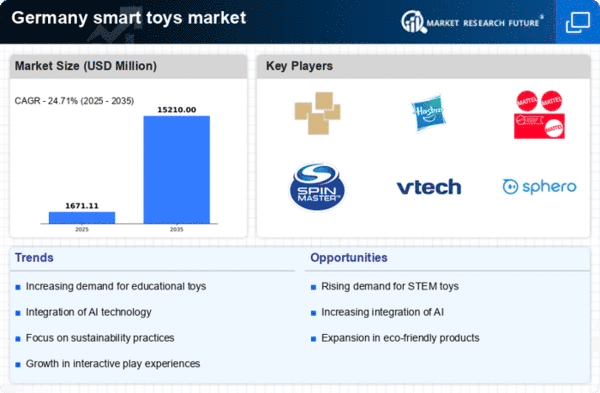
As per Market Research Future analysis, the Germany Smart Toys Market size was estimated at 1340.0 USD Million in 2024. The Smart Toys market is projected to grow from 1671.11 USD Million in 2025 to 15210.0 USD Million by 2035, exhibiting a compound annual growth rate (CAGR) of 24.7% during the forecast period 2025 - 2035

Key Market Trends & Highlights

The Germany smart toys market is experiencing robust growth driven by technological advancements and evolving consumer preferences.

  • The integration of AI and interactivity in smart toys is reshaping play experiences for children.
  • Sustainability is becoming a focal point, with manufacturers increasingly prioritizing eco-friendly materials.
  • E-commerce is witnessing significant growth, facilitating easier access to smart toys for consumers.
  • Technological advancements in smart toys and growing parental awareness of educational benefits are key drivers of market expansion.

Market Size & Forecast

2024 Market Size 1340.0 (USD Million)
2035 Market Size 15210.0 (USD Million)
CAGR (2025 - 2035) 24.71%

Major Players

LEGO Group (DK), Hasbro Inc (US), Mattel Inc (US), Spin Master Corp (CA), VTech Holdings Ltd (HK), Sphero Inc (US), Fisher-Price (US), Nerf (US), WowWee Group Ltd (CA)

Our Impact
Enabled $4.3B Revenue Impact for Fortune 500 and Leading Multinationals
Partnering with 2000+ Global Organizations Each Year
30K+ Citations by Top-Tier Firms in the Industry

Germany Smart Toys Market Trends

The Germany Smart Toys Market is currently experiencing a dynamic evolution, driven by technological advancements and changing consumer preferences. In Germany, the integration of artificial intelligence and interactive features into toys has become increasingly prevalent. This shift not only enhances the play experience for children but also fosters educational development. Parents are increasingly seeking products that combine entertainment with learning, leading to a surge in demand for toys that promote cognitive skills and creativity. Furthermore, sustainability has emerged as a key consideration, with manufacturers focusing on eco-friendly materials and production processes. This trend aligns with the growing awareness of environmental issues among consumers, particularly in Germany, where eco-consciousness is a significant factor in purchasing decisions. In addition, the rise of digital platforms and online retailing has transformed how consumers access and purchase smart toys. E-commerce has become a vital channel, allowing for greater convenience and variety. As a result, traditional retail outlets are adapting to this shift by enhancing their online presence and offering exclusive products. The interplay between technology, sustainability, and changing shopping habits indicates a promising future for the smart toys market, as it continues to evolve in response to consumer demands and societal trends.

Integration of AI and Interactivity

The incorporation of artificial intelligence and interactive elements into toys is reshaping the smart toys market. This trend enhances engagement and educational value, appealing to both children and parents.

Sustainability Focus

There is a growing emphasis on eco-friendly materials and sustainable production methods within the smart toys market. This reflects a broader consumer shift towards environmentally responsible purchasing.

E-commerce Growth

The expansion of online retailing is significantly impacting the smart toys market. Consumers increasingly prefer the convenience of digital shopping, prompting traditional retailers to adapt their strategies.

Germany Smart Toys Market Drivers

Rise of Digital Play Experiences

The smart toys market in Germany is witnessing a rise in digital play experiences. The integration of digital elements into traditional toys is creating a hybrid play environment that captivates young audiences. In 2025, the market for digital play experiences is estimated to account for over 30% of the overall smart toys market. This shift is driven by children's growing familiarity with technology and their desire for interactive play. As a result, manufacturers are focusing on creating toys that blend physical and digital play, thereby enhancing engagement and learning outcomes. This trend indicates a promising future for the smart toys market.

Technological Advancements in Smart Toys

The smart toys market in Germany is surging due to rapid technological advancements. Innovations in artificial intelligence, augmented reality, and Internet of Things (IoT) are enhancing the interactivity and educational value of toys. For instance, toys that adapt to a child's learning pace are becoming increasingly popular. In 2025, the market is projected to grow by approximately 15% due to these technological enhancements. Parents are increasingly seeking toys that not only entertain but also educate, leading to a shift in purchasing behavior. This trend indicates a strong demand for smart toys that incorporate advanced technologies.

Increased Investment in Research and Development

Investment in research and development (R&D) within the smart toys market is on the rise in Germany. Companies are allocating substantial resources to innovate and create new products that meet the evolving demands of consumers. This focus on R&D is crucial, as it allows manufacturers to stay competitive and introduce cutting-edge features that appeal to tech-savvy children and their parents. In 2025, it is projected that R&D expenditures in the smart toys market will increase by 20%, reflecting the industry's commitment to innovation. This trend suggests that continuous investment in R&D will play a pivotal role in shaping the future landscape of the smart toys market.

Growing Parental Awareness of Educational Benefits

In Germany, there is a notable increase in parental awareness regarding the educational benefits of smart toys. Parents are actively seeking toys that promote cognitive development, problem-solving skills, and creativity. This shift in consumer behavior is likely to drive the smart toys market, as parents prioritize educational value over traditional play. Research indicates that 70% of parents are willing to invest more in toys that offer learning opportunities. Consequently, manufacturers are responding by developing products that align with educational standards, further stimulating market growth. This trend suggests that the smart toys market will continue to expand as educational awareness among parents increases.

Expansion of Retail Channels and Distribution Networks

The smart toys market in Germany benefits from expanding retail channels and distribution networks. With the rise of e-commerce and the diversification of retail formats, consumers have greater access to a variety of smart toys. This expansion is likely to enhance market visibility and availability, making it easier for consumers to discover and purchase innovative products. In 2025, it is anticipated that online sales will represent over 40% of total smart toy sales, driven by the convenience and variety offered by digital platforms. This trend indicates that the smart toys market will continue to thrive as retail channels evolve and adapt to consumer preferences.


Market Segment Insights

By Type: Robots (Largest) vs. Interactive Games (Fastest-Growing)

In the Germany smart toys market, the segment distribution shows that Robots dominate with the highest market share, capturing significant attention from consumers seeking innovative play options. This segment has gained traction due to the increasing interest in robotics and automation among children, translating into robust sales and a loyal customer base. In contrast, Interactive Games are rapidly growing, appealing to tech-savvy families looking for engaging and educational play experiences. The growth trends in this segment are attributed to the rising adoption of technology-enhanced learning and the increasing reliance on interactive toys that promote skill development. The surge in interest for STEM education further propels the demand for Educational Robots, while Interactive Games leverage captivating features and digital integration to attract younger audiences. This dynamic shift indicates a promising trajectory for manufacturers targeting these innovative play categories.

Robots: Dominant vs. Interactive Games: Emerging

Robots in the Germany smart toys market represent a dominant force due to their ability to provide interactive and educational experiences that resonate well with children. These toys emphasize hands-on learning, often incorporating coding and problem-solving elements that enrich a child's playtime. In contrast, Interactive Games are emerging as a vital force, capturing the attention of children and parents alike through engaging gameplay that combines entertainment with educational value. While Robots offer a unique learning experience, Interactive Games are evolving to include augmented reality and multiplayer features, fostering social interaction and collaboration among players. As both segments evolve, they cater to the shifting preferences of modern families, making them pivotal in shaping the future of the smart toys landscape.

By Technology: Bluetooth (Largest) vs. Wi-Fi (Fastest-Growing)

In the Germany smart toys market, the distribution of market shares among technology segments indicates that Bluetooth plays a significant role, capturing the largest share due to its widespread adoption and compatibility with numerous devices. Wi-Fi technology, while not as widely utilized, is gaining traction due to its ability to connect toys to the internet, enabling interactive and online features that enhance user experiences. Growth trends in this segment showcase an increasing preference for smart toys that utilize Wi-Fi technology. The trends are driven by a rise in internet connectivity and children's growing interest in interactive play. The demand for Bluetooth-enabled toys remains robust, thanks to established habits and preferences among consumers. Emerging technologies like RFID and NFC continue to carve out niche markets, offering innovative functionalities that support educational and interactive play experiences.

Technology: Bluetooth (Dominant) vs. Wi-Fi (Emerging)

Bluetooth technology dominates the Germany smart toys market, primarily due to its established presence and compatibility with a wide range of devices, allowing for easy pairing and enhanced user engagement. The ease of use and accessibility of Bluetooth-enabled toys resonate with parents looking for hassle-free educational play. On the other hand, Wi-Fi technology is emerging and gaining popularity, driven by the increased demand for toys that offer connectivity features, such as access to online games and educational content. Although still carving its niche, Wi-Fi is positioned for rapid growth as consumers increasingly seek interactive experiences for their children, making smart toys more versatile and enriching.

By Distribution Channel: Online/E-commerce Stores (Largest) vs. Specialty Stores (Fastest-Growing)

In the Germany smart toys market, Online/E-commerce Stores hold the largest share of the distribution channel segment, driven by the increasing trend of online shopping among consumers. Specialty Stores and Toy Shops, while present, tend to capture a smaller portion of the market share, as consumers shift towards the convenience of digital purchasing. This dynamic indicates a clear preference for online platforms in the distribution of smart toys. The growth trends in this segment highlight the rapid expansion of Online/E-commerce Stores, facilitated by advancements in digital technology and targeted marketing strategies. Meanwhile, Specialty Stores are recognized as the fastest-growing segment, capitalizing on niche markets and personalized customer experiences. The overall increase in sales of smart toys continues to be propelled by rising consumer interest and technological innovation, promoting a diverse approach to distribution channels.

Online/E-commerce Stores (Dominant) vs. Specialty Stores (Emerging)

Online/E-commerce Stores are the dominant force in the distribution of smart toys, offering unparalleled convenience and a wide variety of products to consumers. The accessibility of online shopping platforms enables customers to explore extensive catalogs and compare prices effortlessly. In contrast, Specialty Stores are emerging as a vital segment, attracting consumers seeking unique and high-quality smart toys. These stores often focus on curated selections and personalized service, which creates a loyal customer base. The interplay between these two segments illustrates the evolving landscape of retail in the smart toy industry, where both convenience and specialized offerings play significant roles.

By End-user: Preschoolers (Largest) vs. Toddlers (Fastest-Growing)

In the Germany smart toys market, the end-user segment displays a clear distribution, with preschoolers representing the largest share, capturing the attention of not only parents but also educators looking for interactive and educational toys. Following closely are toddlers, who are quickly growing in popularity, driven by the increasing demand for toys that promote early learning and development. The school-going segment also holds a considerable position, reflecting a competitive landscape among various age groups. The growth trends within this segment indicate a remarkable shift towards the integration of technology in toys, especially for toddlers and preschoolers. Factors such as the rise in digital learning tools and the emphasis on STEM education are propelling the development of innovative toys. The emergence of eco-friendly materials and sustainable practices is another driver, appealing to the environmentally conscious consumers in Germany looking for products that align with their values.

Preschoolers: Dominant vs. Toddlers: Emerging

Preschoolers hold a dominant position in the Germany smart toys market, as their toys often emphasize educational value and developmental milestones. These toys are designed to enhance cognitive and motor skills, making them appealing to parents and caregivers. Meanwhile, toddlers represent an emerging segment, with a growing focus on engaging, multisensory play experiences. Toys targeting this age group are increasingly incorporating technology, allowing for interactive learning and play. As the demand for smart toys grows, brands are innovating and expanding their product ranges to cater to both preschoolers and toddlers, setting the stage for competitive dynamics in the market.

Get more detailed insights about Germany Smart Toys Market

Key Players and Competitive Insights

The smart toys market in Germany is characterized by a dynamic competitive landscape, driven by innovation and technological advancements. Key players such as LEGO Group (DK), Hasbro Inc (US), and VTech Holdings Ltd (HK) are at the forefront, each adopting distinct strategies to enhance their market presence. LEGO Group (DK) focuses on integrating digital experiences with traditional play, thereby appealing to a tech-savvy generation. Meanwhile, Hasbro Inc (US) emphasizes partnerships with popular franchises, leveraging brand recognition to attract consumers. VTech Holdings Ltd (HK) is committed to educational toys, aligning its offerings with the growing demand for learning through play. Collectively, these strategies contribute to a competitive environment that prioritizes innovation and consumer engagement.In terms of business tactics, companies are increasingly localizing manufacturing to reduce lead times and enhance supply chain efficiency. The market structure appears moderately fragmented, with several players vying for market share. However, the influence of major companies is substantial, as they set trends and standards that smaller firms often follow. This competitive structure fosters a landscape where innovation and adaptability are crucial for success.

In October LEGO Group (DK) announced the launch of a new augmented reality (AR) platform that enhances its physical building sets, allowing children to interact with their creations in a digital space. This strategic move not only reinforces LEGO's commitment to innovation but also positions the company to capture the interest of a generation increasingly drawn to digital experiences. The integration of AR technology is likely to enhance user engagement and drive sales, reflecting a broader trend towards immersive play.

In September Hasbro Inc (US) expanded its collaboration with Disney, introducing a new line of smart toys based on popular characters from recent animated films. This partnership underscores Hasbro's strategy of leveraging established franchises to boost product appeal. By aligning with Disney's strong brand equity, Hasbro is poised to attract a wider audience, particularly among families seeking quality entertainment options for their children.

In August VTech Holdings Ltd (HK) launched a new series of interactive learning toys that incorporate artificial intelligence (AI) to personalize educational content for children. This initiative reflects VTech's focus on educational value, catering to parents' increasing demand for toys that promote learning. The use of AI not only enhances the user experience but also positions VTech as a leader in the educational toy segment, potentially increasing its market share.

As of November current trends in the smart toys market include a strong emphasis on digitalization, sustainability, and AI integration. Companies are increasingly forming strategic alliances to enhance their technological capabilities and market reach. The competitive landscape is shifting from price-based competition to a focus on innovation and reliability in supply chains. This evolution suggests that future differentiation will hinge on the ability to deliver unique, technology-driven experiences that resonate with consumers, thereby redefining the parameters of competition in the smart toys market.

Key Companies in the Germany Smart Toys Market include

Industry Developments

The Germany Smart Toys Market has experienced significant activity in recent months, with companies like LEGO Group and Ravensburger expanding their product lines to incorporate advanced technologies, such as Artificial Intelligence and Augmented Reality. In July 2023, VTech announced the acquisition of a smaller tech-focused toy firm to enhance its innovation capabilities in smart educational toys.

Recent developments show an upward trend in market valuation as innovations in interactive learning tools and robotics captivate both children and parents. Companies like Sphero and Tech Will Save Us have reported robust sales growth, driven by engaging and educational smart toys.

These advancements align with Germany's focus on integrating digitalization in education and play, further propelling the market's growth trajectory amid increasing demand for high-tech toys. Efforts to promote STEM education through smart toys are being supported by initiatives from governmental organizations, emphasizing the importance of playful learning in creating future-ready skills.

Future Outlook

Germany Smart Toys Market Future Outlook

The Smart Toys Market is projected to grow at a 24.71% CAGR from 2025 to 2035, driven by technological advancements, increased consumer demand, and educational benefits.

New opportunities lie in:

  • Development of AI-driven interactive learning platforms
  • Expansion into subscription-based toy rental services
  • Integration of augmented reality features in traditional toys

By 2035, the smart toys market is expected to achieve substantial growth and innovation.

Market Segmentation

Germany Smart Toys Market Type Outlook

  • Robots
  • Interactive Games
  • Educational Robots

Germany Smart Toys Market End-user Outlook

  • Toddlers
  • Preschoolers
  • School-going
  • Stripling

Germany Smart Toys Market Technology Outlook

  • Wi-Fi
  • Bluetooth
  • RFID or NFC

Germany Smart Toys Market Distribution Channel Outlook

  • Online/E-commerce Stores
  • Specialty Stores
  • Toy Shops

Report Scope

MARKET SIZE 2024 1340.0(USD Million)
MARKET SIZE 2025 1671.11(USD Million)
MARKET SIZE 2035 15210.0(USD Million)
COMPOUND ANNUAL GROWTH RATE (CAGR) 24.71% (2025 - 2035)
REPORT COVERAGE Revenue Forecast, Competitive Landscape, Growth Factors, and Trends
BASE YEAR 2024
Market Forecast Period 2025 - 2035
Historical Data 2019 - 2024
Market Forecast Units USD Million
Key Companies Profiled LEGO Group (DK), Hasbro Inc (US), Mattel Inc (US), Spin Master Corp (CA), VTech Holdings Ltd (HK), Sphero Inc (US), Fisher-Price (US), Nerf (US), WowWee Group Ltd (CA)
Segments Covered Type, Technology, Distribution Channel, End-user
Key Market Opportunities Integration of artificial intelligence in smart toys enhances educational engagement and personalized play experiences.
Key Market Dynamics Growing consumer demand for interactive features drives innovation in the smart toys market.
Countries Covered Germany
Leave a Comment

FAQs

What is the projected market size of the Germany Smart Toys Market in 2024?

The Germany Smart Toys Market is expected to be valued at 1.3 billion USD in 2024.

What will be the market size of the Germany Smart Toys Market in 2035?

By 2035, the Germany Smart Toys Market is anticipated to reach a value of 7.14 billion USD.

What is the expected CAGR for the Germany Smart Toys Market from 2025 to 2035?

The expected CAGR for the Germany Smart Toys Market from 2025 to 2035 is 16.741%.

Which segment within the Germany Smart Toys Market is projected to dominate in 2035?

The Robots segment is projected to dominate, with a market value of 2.8 billion USD in 2035.

What are the expected market sizes for Interactive Games and Educational Robots by 2035?

Interactive Games are expected to reach 2.2 billion USD, and Educational Robots are projected to be valued at 2.14 billion USD by 2035.

Who are the key players in the Germany Smart Toys Market?

Some major players in the market include Sphero, Ravensburger, LEGO Group, and Mattel.

How has the market for Robots evolved between 2024 and 2035?

The market for Robots within the Germany Smart Toys Market is expected to grow from 0.5 billion USD in 2024 to 2.8 billion USD by 2035.

What opportunities are driving growth in the Germany Smart Toys Market?

The increasing demand for educational and interactive toys is driving growth in the Germany Smart Toys Market.

What challenges are currently facing the Germany Smart Toys Market?

Challenges include market saturation and the need for constant innovation in smart toy technology.

How does the Germany Smart Toys Market's growth compare regionally?

The Germany Smart Toys Market is growing steadily and is among the leading markets in Europe for smart toys.

Download Free Sample

Kindly complete the form below to receive a free sample of this Report

Compare Licence

×
Features License Type
Single User Multiuser License Enterprise User
Price $4,950 $5,950 $7,250
Maximum User Access Limit 1 User Upto 10 Users Unrestricted Access Throughout the Organization
Free Customization
Direct Access to Analyst
Deliverable Format
Platform Access
Discount on Next Purchase 10% 15% 15%
Printable Versions